No two states count tenancy disputes the same way, and none of the reports reviewed shows how they end. Bond data is fuller: in NSW, 61.6% of bonds refunded in 2025 went back to the tenant in full.
In the year to June 2025 the capital cities grew 1.76% and the rest of the states 1.08%, taking 77% of national growth. The capitals grow through overseas migration while Sydney and Melbourne lose residents internally.
NSW has 1,825 items on its State Heritage Register and 36,724 in its councils’ plans; Victoria has 2,428 on its register and 25,048 mapped heritage overlay areas; the Commonwealth lists 126 places of national significance. The registers count different things,...
By June 2025 Australia’s population was 369,000 below the 2017-based medium projection and 207,000 above the 2022-based one. How two editions of ABS projections compare with what happened.
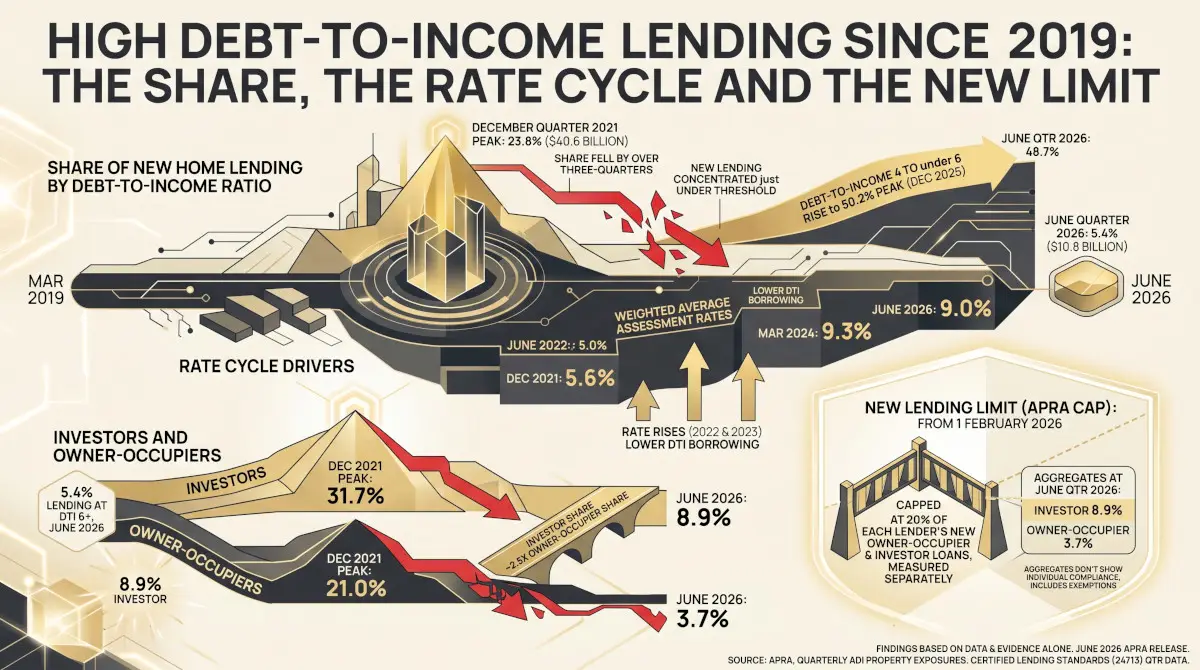
In the June quarter 2026, 5.4% of new home lending was written at six times the borrower’s income or more, against 23.8% at the December 2021 peak. Investors sat at 8.9% and owner-occupiers at 3.7% in the first full quarter...
Planning, building, strata, renting, sale of land, duty and land tax: which law governs each, in the capital city council area of every state and territory.
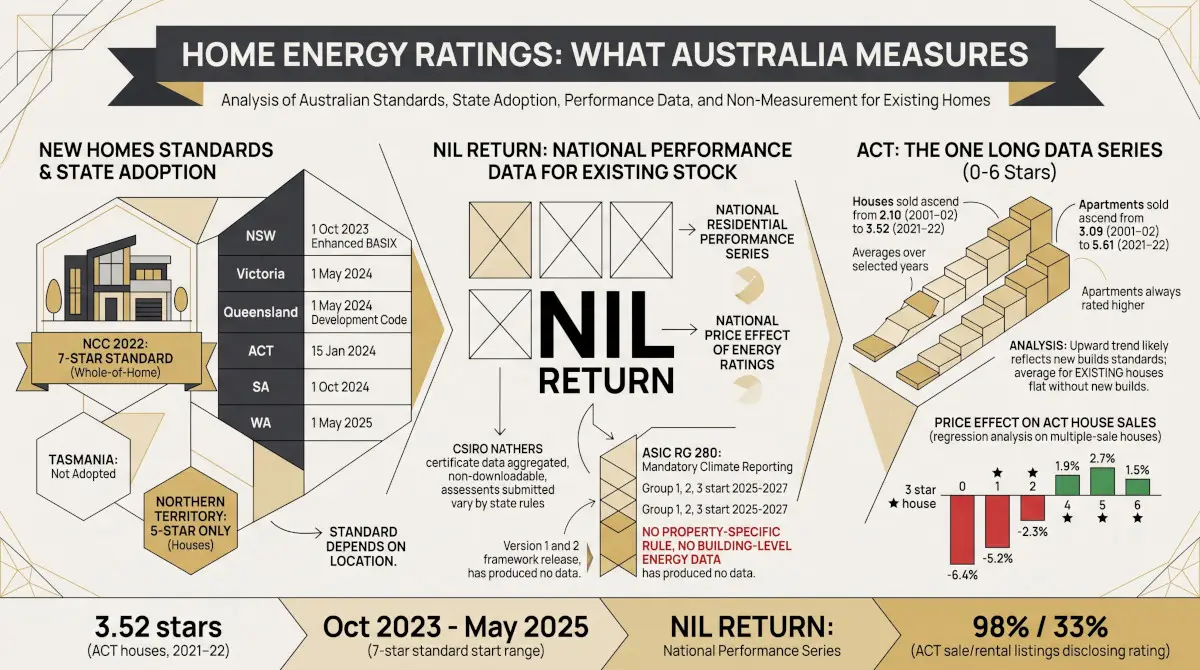
The 7-star standard started state by state between October 2023 and May 2025. The only long series for homes sold is the ACT's, where a considerable part of the rise in ratings likely came from new builds.
Western Australia grew fastest in the year to March 2026 and Tasmania slowest. Overseas migration was the largest source of growth in every state, while New South Wales lost 20,818 people interstate and Queensland gained 14,718.
In 2023–24, 1,276,669 Australians reported a net loss on rental property, 54.8% of those with a rental result, up from a low of 41.9% in 2021–22. About seven in ten rental holders under 40 report a loss, against 13.7% of...
Australia’s average household fell from 2.6 people to 2.5 between the 2016 and 2021 Censuses. One-person households rose to 25.6% of the total, and the ABS projections disagree on whether that continues.
In the June quarter 2026, first home buyers took 2.88% of new investor loans, the lowest share since the ABS began counting in 2019 and less than half the 6.31% peak of March 2021. Their loans fell while investor lending...
Private dwelling investment reached $38.1 billion in the June quarter of 2026 in volume terms, the highest in the series, and added about 0.31 points to GDP growth over the year. Alterations and additions are at their highest; new dwelling...
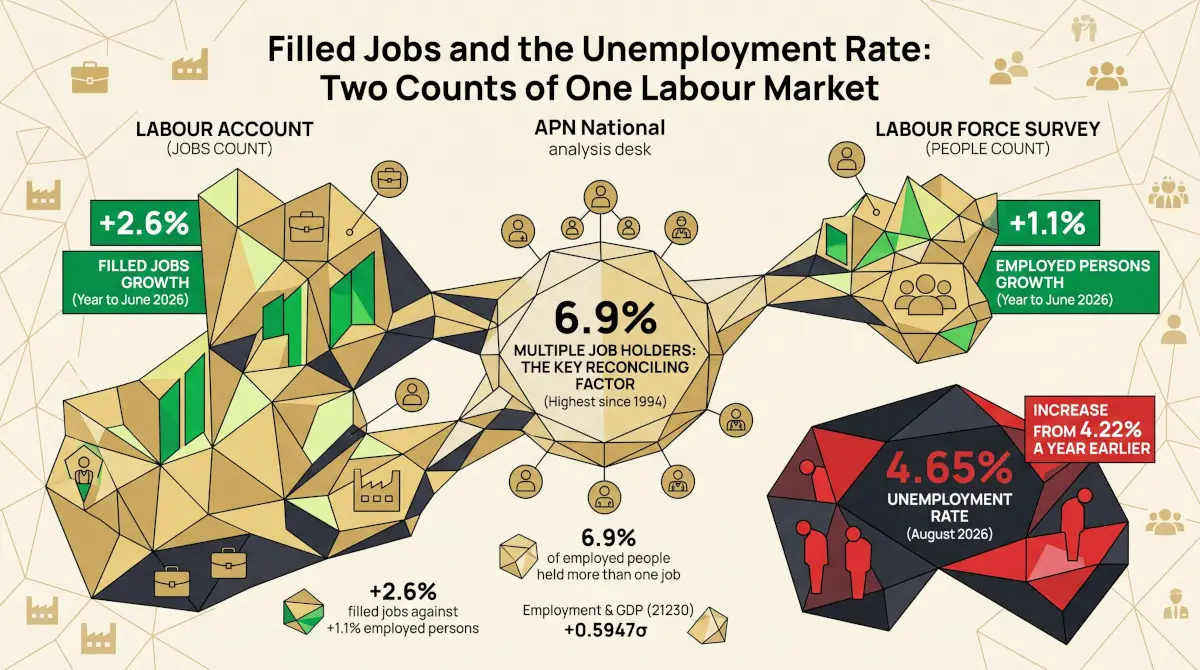
Over the year to June 2026 filled jobs rose 2.6% while the number of people employed rose 1.1%, and unemployment rose to 4.65% in August, from 4.22% a year earlier. The difference is largely second jobs: 6.9% of employed people...
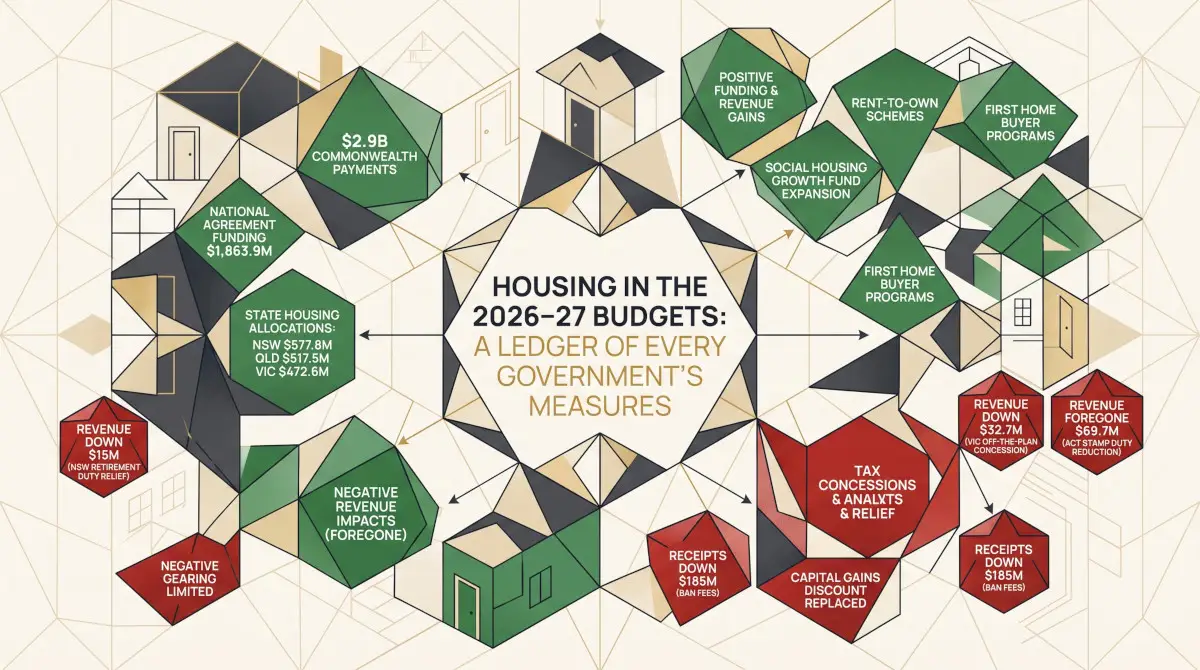
The Commonwealth will pay the states $2.9 billion for housing in 2026–27 and is changing how rental property is taxed. Every state and territory budget carries its own housing measures, counted its own way. This ledger sets out what each...
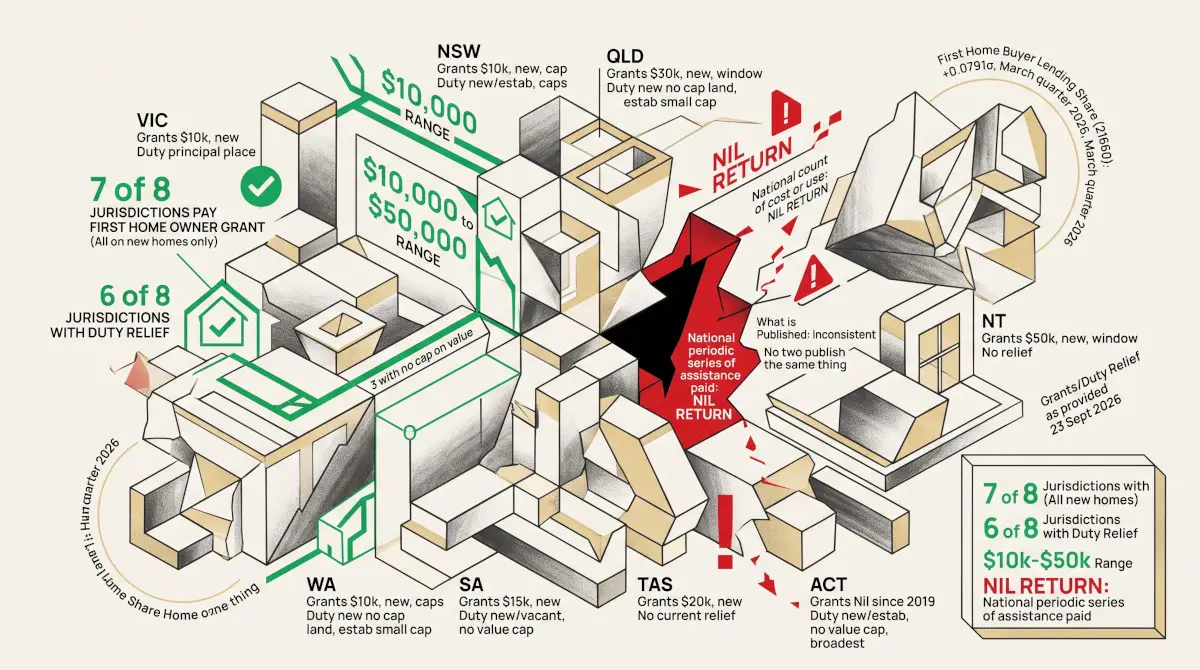
Seven states and territories pay a first home owner grant, from $10,000 to $50,000, and every one pays it only on a new home. Six relieve transfer duty for first home buyers, three with no cap on the value of...
Between 2011 and 2026 the number of Australians aged 75 to 79 rose 86% while children under five rose 3.2%. The median age went from 37.2 to 38.5 and the most common single age from 39 to 31.
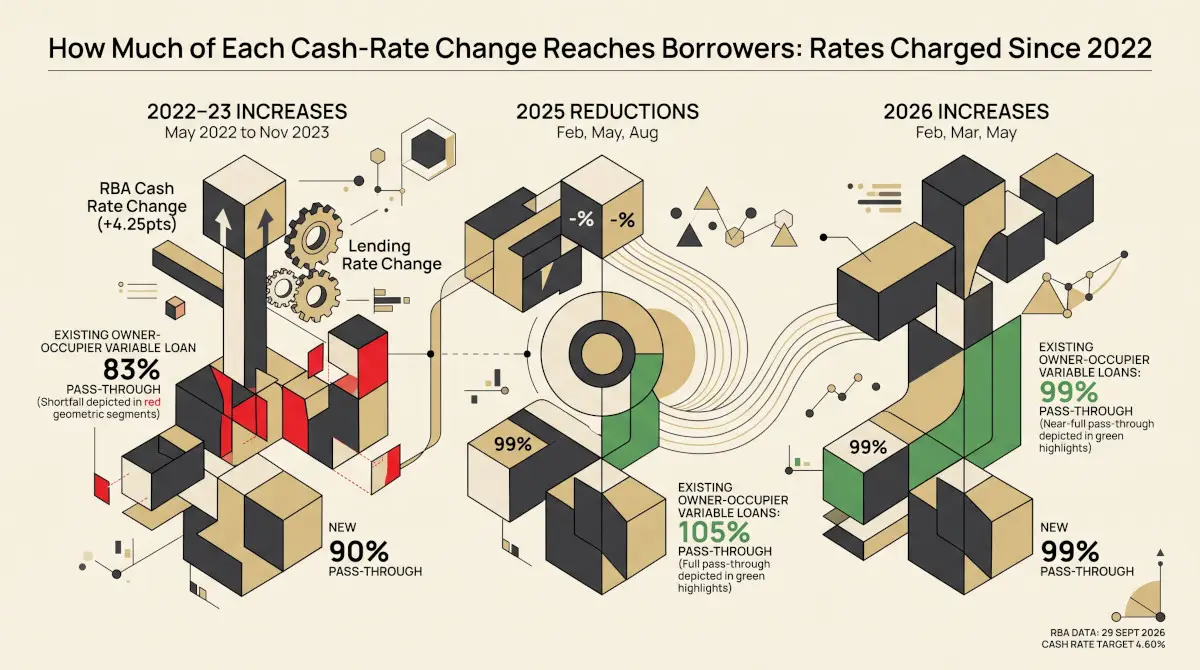
The RBA raised the cash rate to 4.60% on 29 September 2026. Across 2022 and 2023, about 83% of the increases reached existing owner-occupier variable rates; the changes of 2025 and 2026 reached them in full.
APRA has accepted 37 enforceable undertakings since 2005, none in seven of the 21 years, and every one since 2014 from an institution. What the register and ASIC's six-monthly counts show, and what small numbers cannot.
Self-funded retiree households have had the smallest rise in living costs of the four household types the ABS tracks: 115.3% since 1998. Insurance and financial services, which include interest charges, are only 7.0% of their costs, against 18.4% for employee...
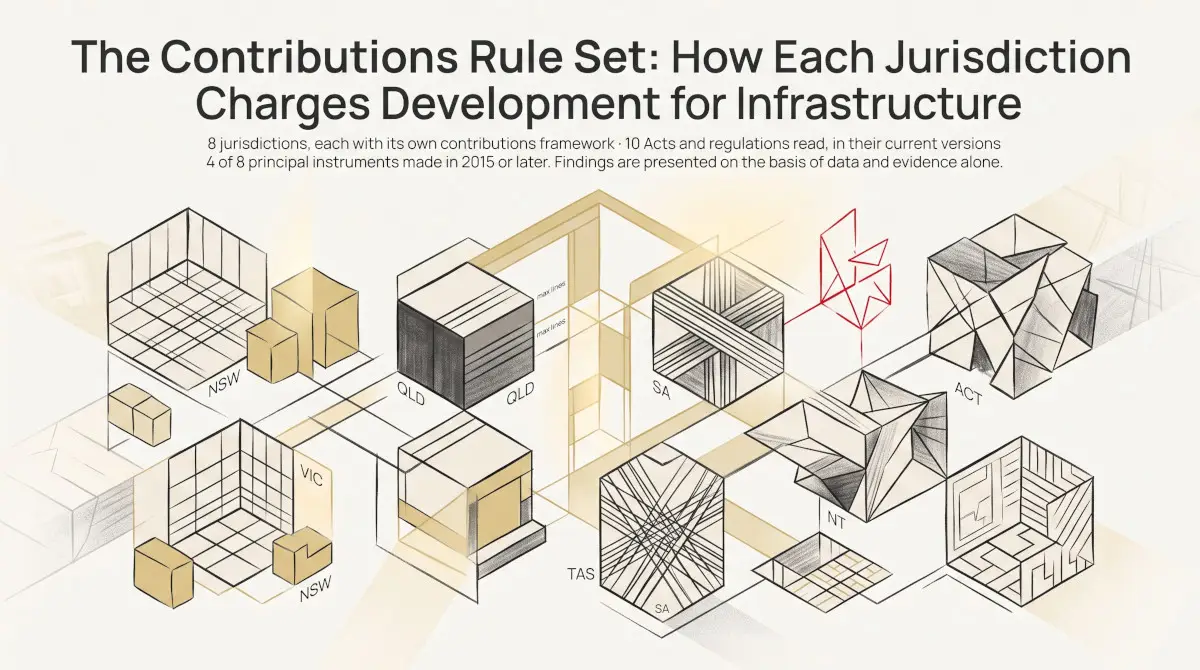
Every Australian jurisdiction lets development be charged for infrastructure, but through different instruments: contributions plans, a capped charge, statutory schemes, agreements or a lease variation charge. What each framework provides, and what it requires to be published.
NSW councils held $5.4 billion in contributions collected from developers at 30 June 2025, up $2.2 billion in four years. About half sat with fourteen councils, and ten of those spent less than a fifth of their opening balance in...
There were 27.2 Australians aged 65 and over for every 100 aged 15 to 64 in March 2026, up from 20.5 in 2011. The ratio rose fastest when the borders closed and barely moved while migration was at its highest.
Every state and territory writes its own tenancy law. Read side by side, the eight residential tenancies Acts largely agree on three basic rules: seven cap a bond at four weeks' rent and seven allow one rent increase in 12...
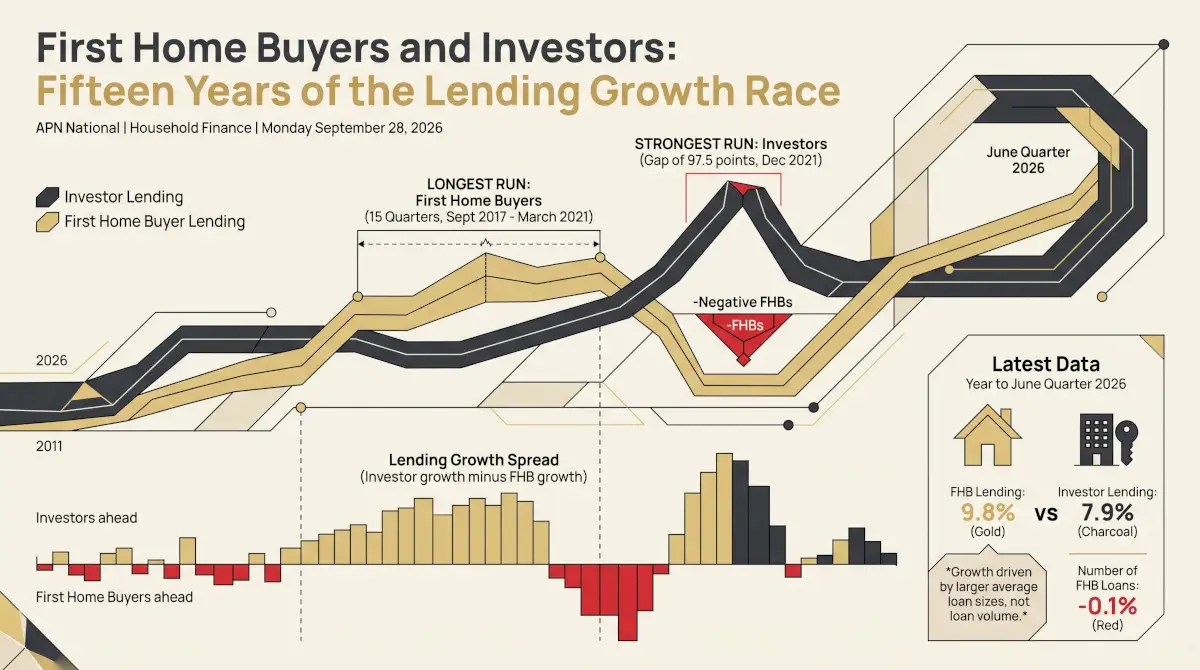
Since 2011 first home buyer lending has grown faster than investor lending in 31 of 62 quarters, and the lead has changed hands nine times. In the June quarter of 2026 first home buyers moved ahead again, on larger loans...
NCC 2025 was released on 1 May 2026, and the states have split on when it applies: three from May 2026, four from May 2027, and one has not adopted it. Residential changes to the code are paused until mid-2029.
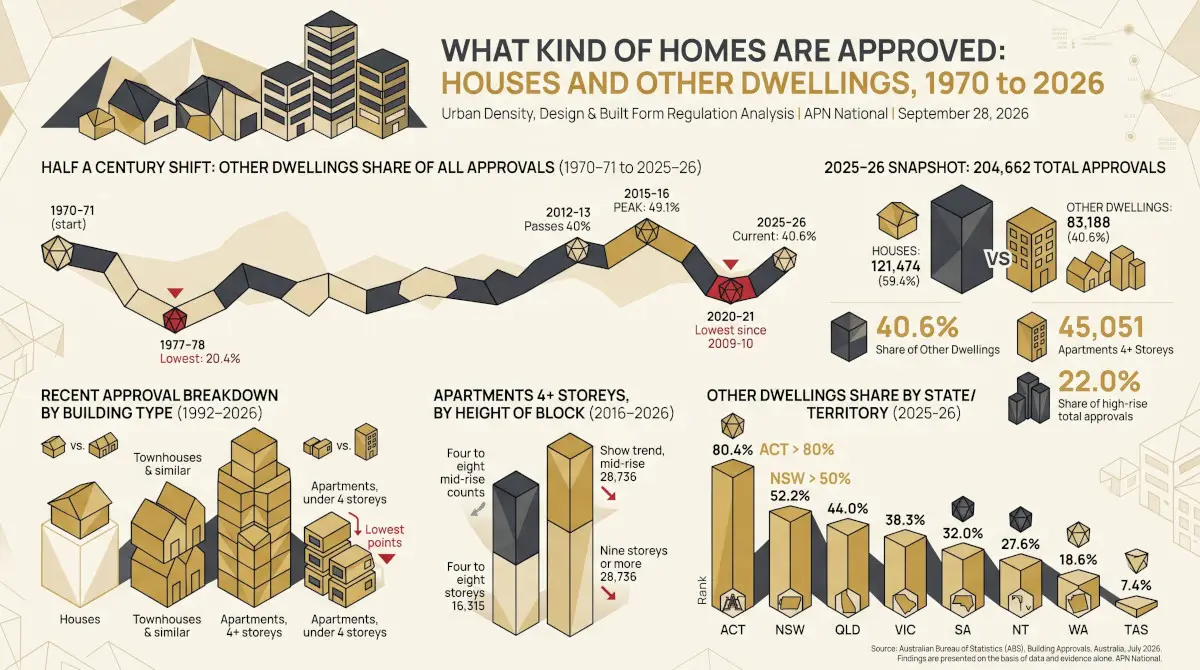
In 2025–26, 40.6% of the new homes approved in Australia were not houses. The share peaked at 49.1% in 2015–16, and it ranges from 80.4% in the Australian Capital Territory to 7.4% in Tasmania.
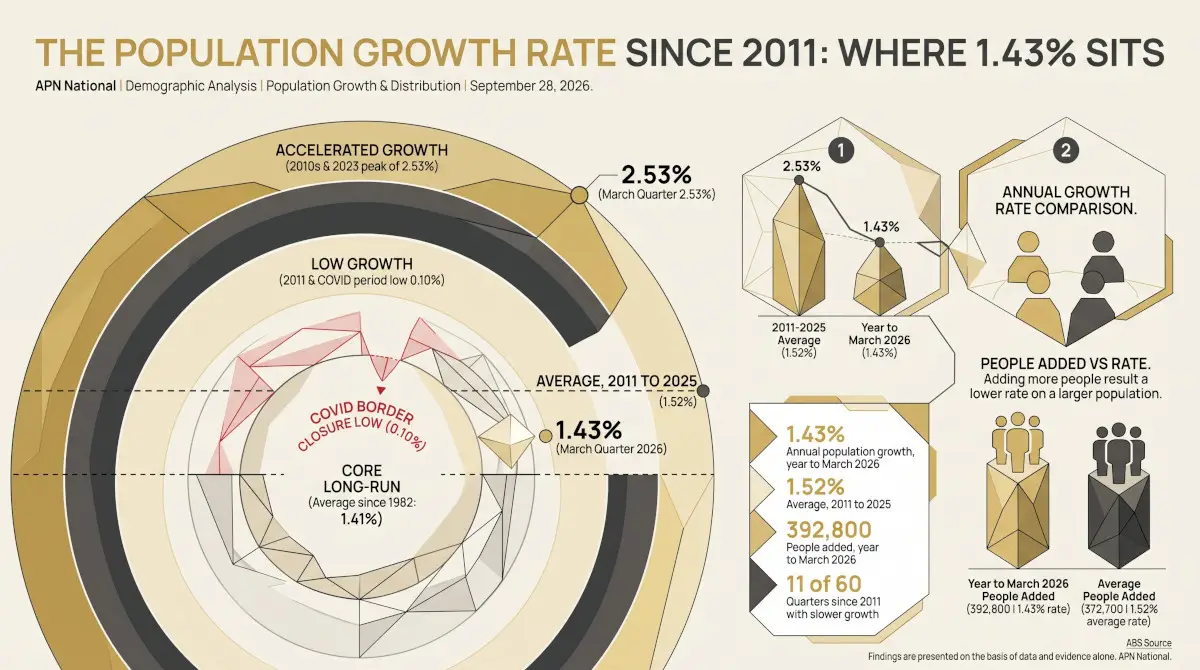
Australia’s population grew 1.43% in the year to March 2026: below its 2011–2025 average of 1.52%, slower than in all but 11 of those 60 quarters, and close to its average since 1982.
Five states and territories charge foreign or absent owners an extra rate of land tax each year, from 0.75% in the ACT to 5% in New South Wales. How each surcharge was built since 2016, who it applies to, and...
Zones are written three ways in Australia: one instrument for the jurisdiction, a state scheme with local schedules, or a scheme for each council on a state framework. And the instruments are amended continually.
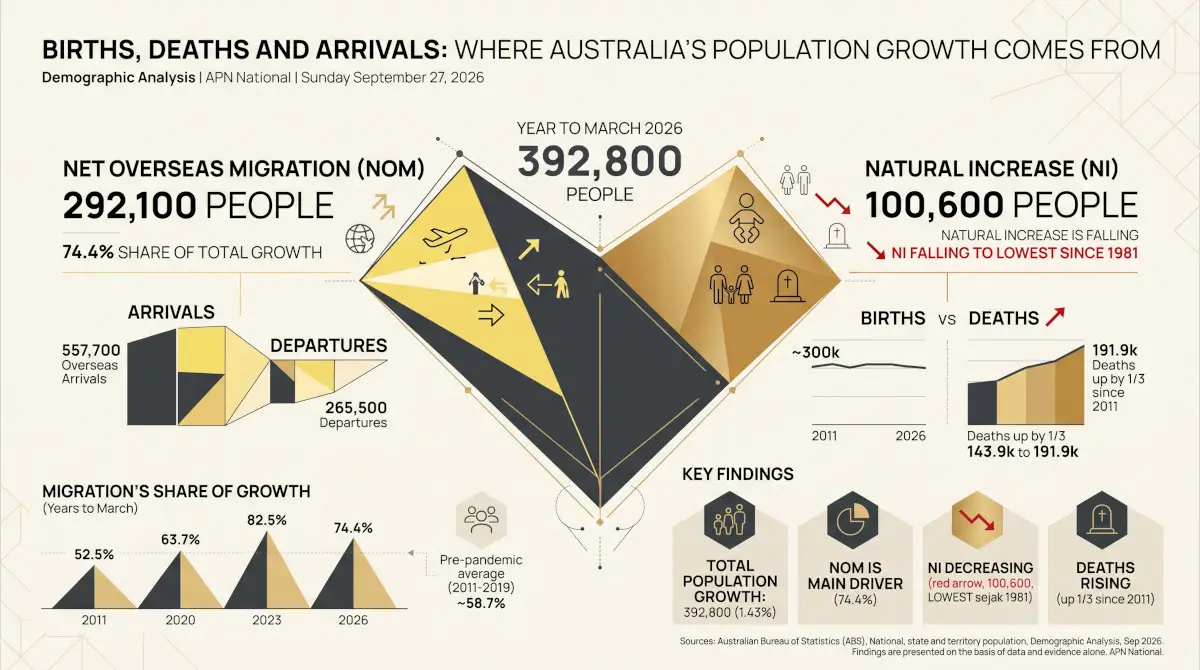
Three in every four of the 392,800 people added to Australia’s population in the year to March 2026 came from net overseas migration. Births have held near 300,000 a year while deaths have risen by a third, so natural increase...
Before December 2015 a foreign buyer of a new home paid the Commonwealth nothing. Today the fee at $1 million is $15,600 for a new home and $46,800 for an established one, and established homes are closed to foreign buyers,...
Public engineering work on roads, water, sewerage and power has moved in the same direction as dwelling commencements in only 73 of 152 quarters since 1988. Between the years to March 2022 and 2026 it almost doubled while commencements fell.
Asked by National Cabinet how many homes their land could hold, seven jurisdictions gave a greenfield figure and three an infill figure, with no definitions. A national figure for the housing capacity of zoned land cannot be built from what...
Unemployment, jobs growth and new lending to first home buyers and investors all sit close to their 2011–2025 averages. Migration is the exception: easing from its 2023 peak, but still above any year from 2011 to 2020.
Six jurisdictions levy transfer duty under a Duties Act made between 1997 and 2008; South Australia and the Northern Territory keep stamp duty Acts of 1923 and 1978. Every jurisdiction except the Northern Territory levies land tax, and New South...
A foreign person buying a new $1 million home pays between 1.51% and 10.51% of the price more than an Australian resident, depending on the state or territory. How the state duty surcharges and the Commonwealth application fee built that...
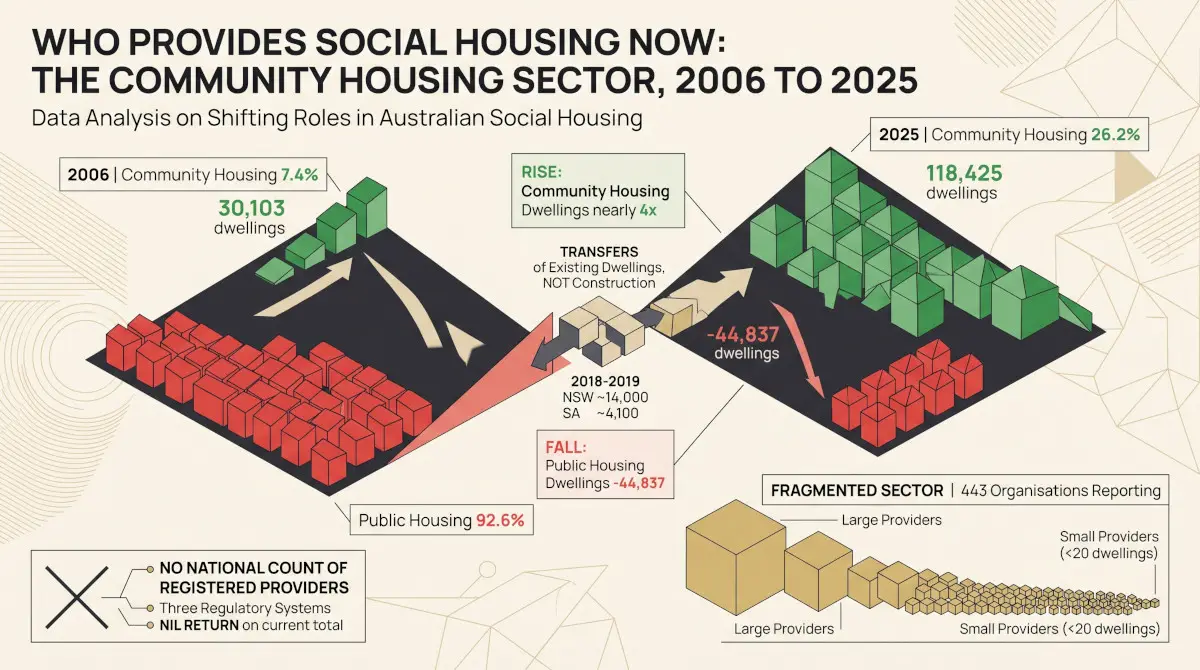
Community housing held 30,103 dwellings in 2006 and 118,425 in 2025, taking its share of social housing from 7.4% to 26.2% while public housing fell by 44,837. Part of the shift was transfer of existing dwellings, not new building. The...
No Australian jurisdiction requires every new housing development to include affordable housing. South Australia expects 15% in developments of 20 or more dwellings within its overlay, the City of Sydney levies 3% of residential floor area, and New South Wales...
Affordable housing is defined three different ways in Australian state law: by household income in New South Wales and Victoria, by rent in Queensland's priority development areas, and by sale price in South Australia, where the limit for a dwelling...
In 2024–25, specialist homelessness services identified a need for long-term housing for 113,368 people and provided it to 4,407. They recorded 128,915 requests they could not assist, most often because no accommodation was available. What the service records measure, and...
On Census night 2021, 122,494 people in Australia were counted as homeless, 48.2 per 10,000. In 2024–25, 288,970 people received help from specialist homelessness services. The two counts measure different things, and the largest group in the Census count is...
At 30 June 2025, 205,977 households were on the AIHW's consolidated social housing waitlist. Each state assembles its list under its own rules, and the share classed in greatest need runs from 16.8% in New South Wales to 99.6% in...
Social housing made up 4.69% of Australia's residential dwellings in June 2012 and 3.98% in June 2025, and the share fell in each of the thirteen years that followed. The stock grew by 25,311 dwellings while about 2.26 million were...
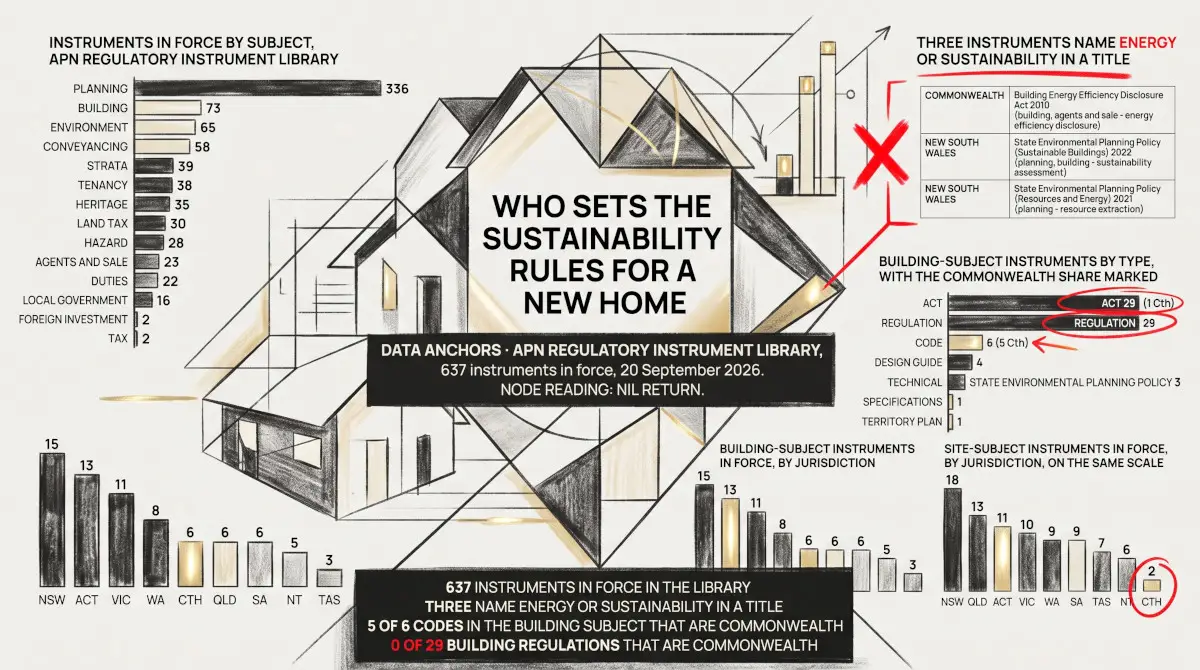
Of the 637 instruments in force in the APN Regulatory Instrument Library, three name energy or sustainability in their title, and the library has no subject for it at all. The requirements that decide how a new home performs are...
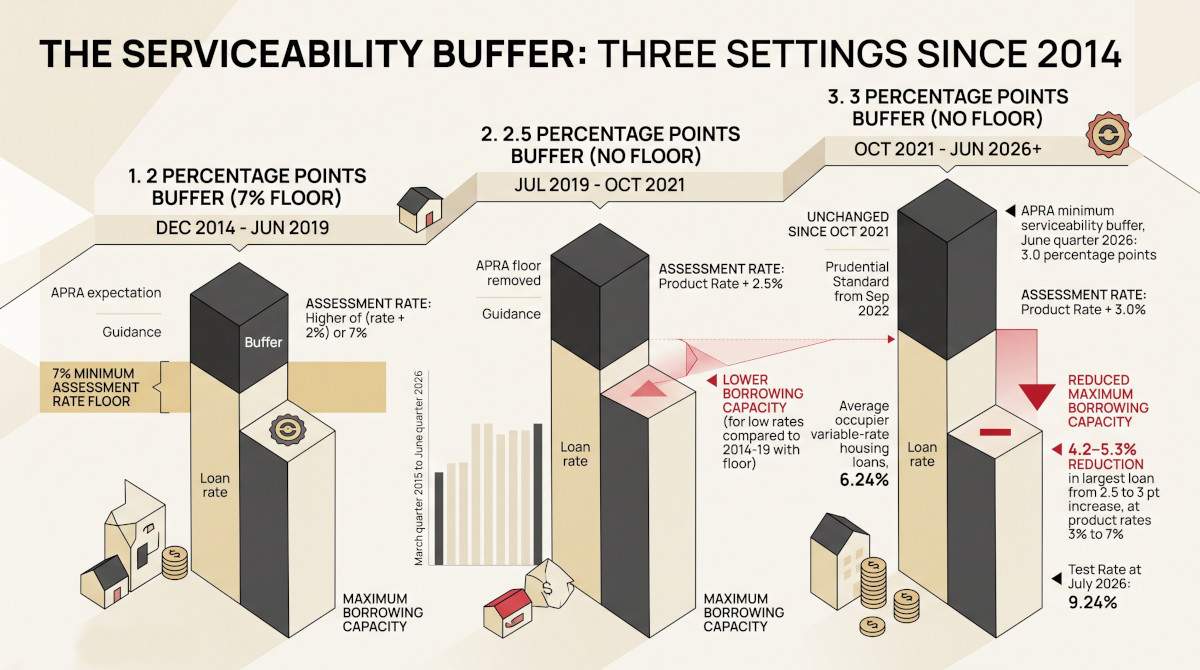
APRA's minimum serviceability buffer has had three settings since 2014: 2 percentage points with a 7% floor, 2.5 points from July 2019 and 3 points from October 2021. What each setting does to the rate at which loans are tested,...
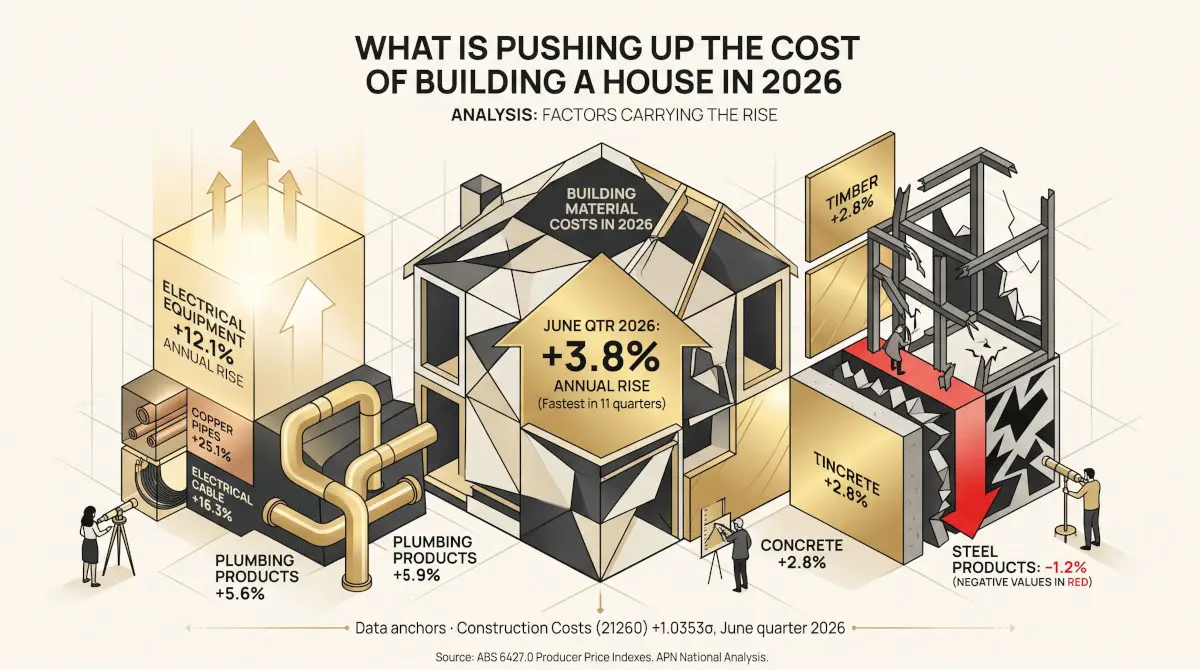
The materials that go into a new house cost 3.8% more in the June quarter 2026 than a year earlier, the fastest annual rise in eleven quarters; in the two years to the December quarter 2025 the figure never went...
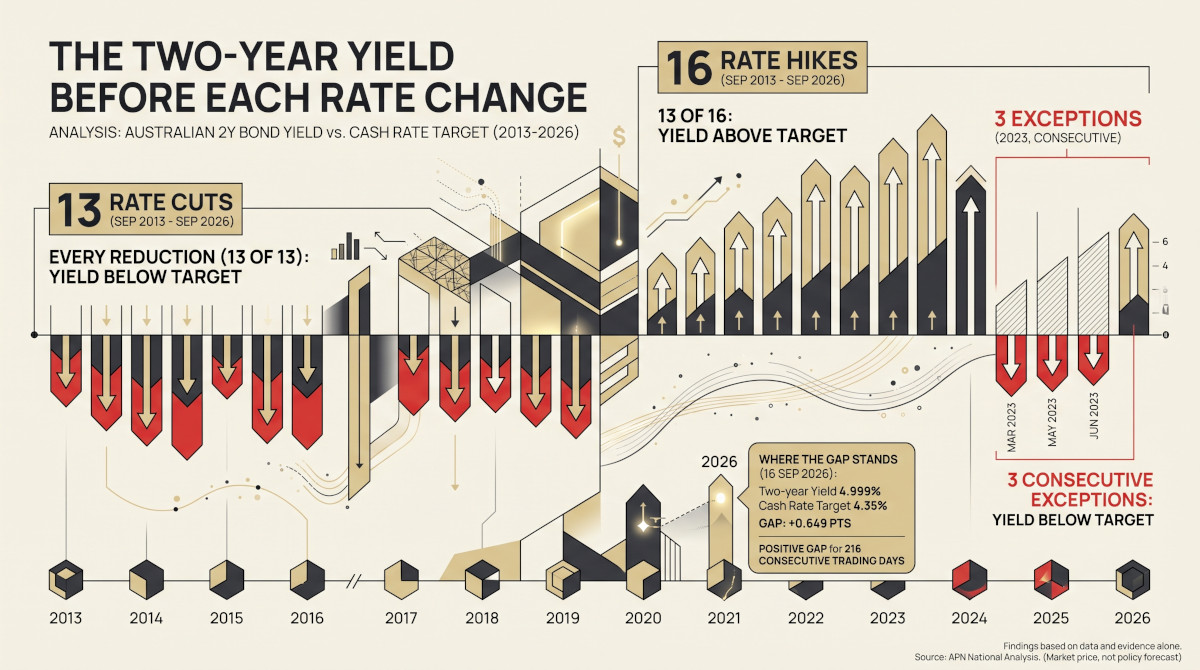
Across the 29 changes to the cash rate target since September 2013, the two-year Australian Government bond yield, read at the last close before each decision was announced, sat below the target before 12 of the 13 reductions and above...
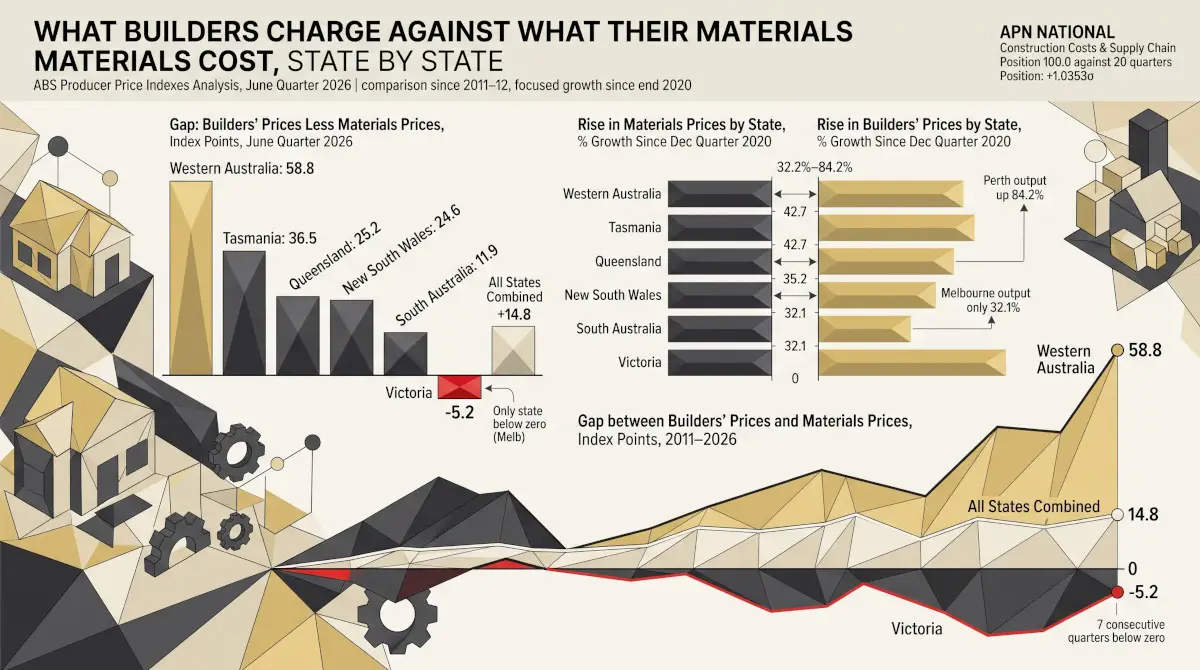
Since the end of 2020 the materials that go into a new house have risen in price by between 35.2% and 42.7% in every state capital. What builders charge for the finished house has not moved together: 32.1% in Melbourne,...
The advertised standard variable home-loan rate has sat 4.42 percentage points above the cash rate in 67 of the 69 months since November 2020, moving point for point with it. The rates borrowers are actually charged have not: new owner-occupier...
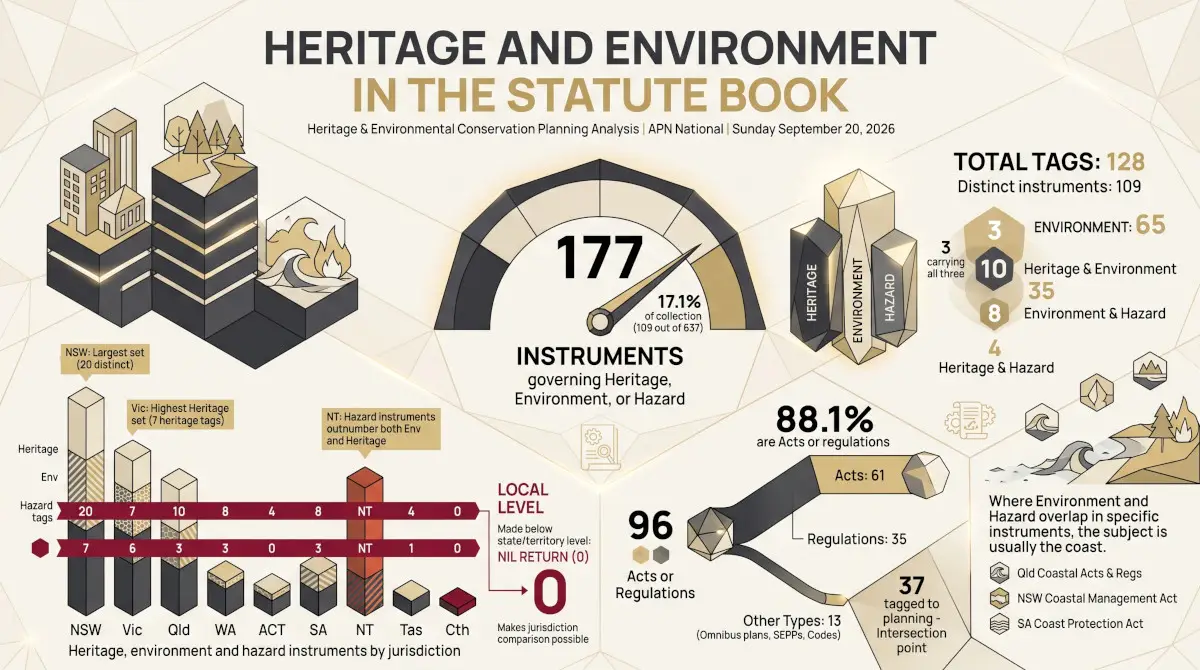
One hundred and nine of the 637 instruments in the APN Regulatory Instrument Library govern heritage, the environment or natural hazards. Every one is made by a state, a territory or the Commonwealth, and 96 of them are Acts or...