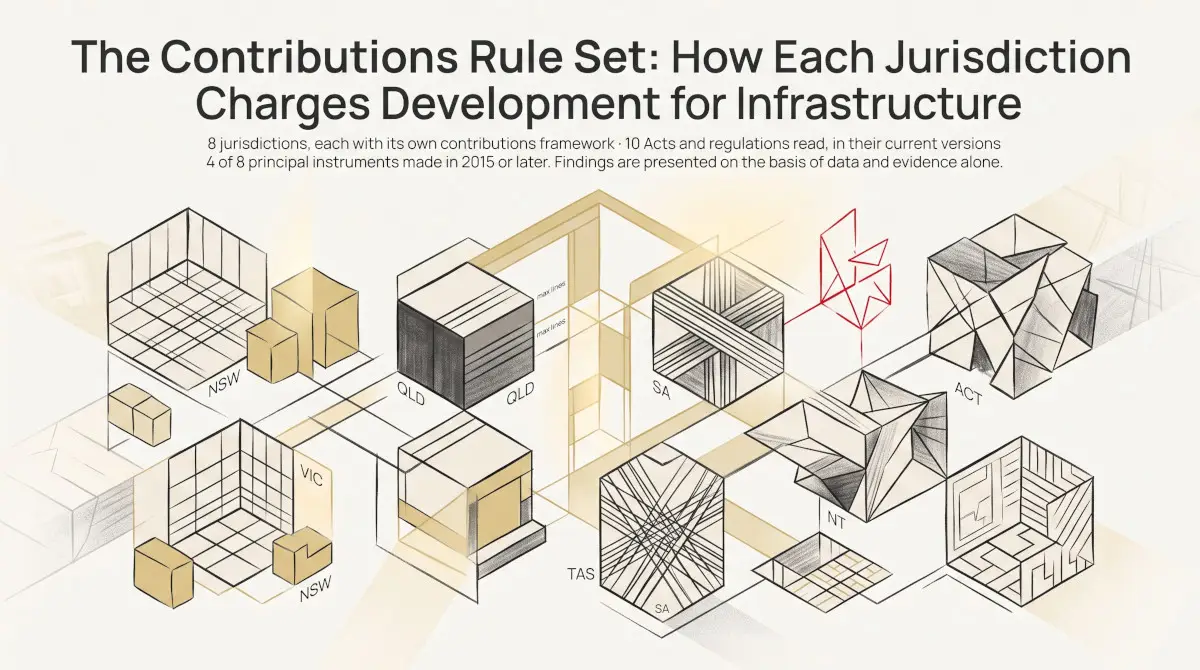

Every Australian jurisdiction allows new development to be asked to pay towards the infrastructure it needs, but the rules sit in different instruments and work in different ways. New South Wales, Victoria, Western Australia and the Northern Territory work through contributions plans. Queensland caps a charge that councils adopt by resolution. South Australia runs statutory schemes, Tasmania relies on agreements, and the Australian Capital Territory charges when a lease is varied. New South Wales and Victoria also levy a standing state contribution in defined regions.
Node reading for Planning Regulations & Zoning Policy (21320): NIL RETURN. This article rests on the source data alone.
The shared idea
Infrastructure contributions rest on one proposition: development that creates a need for roads, drainage, open space or community facilities should pay a share of providing them. Most frameworks tie the payment to that need. A plan identifies an area, the works it will need and a method of dividing their cost among the land or development that creates the demand. A consent or approval then carries a requirement to pay.
What differs is where the rules are written, who sets the amount, when it is paid and what must be reported. This article sets out each jurisdiction’s framework from its own legislation. It describes the mechanisms, not the amounts charged under them. The instruments sit within the wider body of planning law mapped in What Governs Housing: The Statute Book, Mapped; contributions for affordable housing, which some states levy alongside those for infrastructure, are covered in When Development Must Include Affordable Housing, State by State.
Eight frameworks at a glance
| Jurisdiction | Where the rules sit | Local or plan-based contributions | State or regional contributions | How a contribution is imposed |
|---|---|---|---|---|
| New South Wales | Environmental Planning and Assessment Act 1979, Part 7 | Section 7.11 contributions of land or money for public amenities and services; section 7.12 levies set as a percentage of development cost; planning agreements | Housing and productivity contribution for regional infrastructure, required by Ministerial planning order and paid into the Housing and Productivity Fund | Condition of development consent or of a complying development certificate |
| Victoria | Planning and Environment Act 1987, Parts 3AB, 3B and 9B | Infrastructure contributions plans and development contributions plans, each incorporated in a planning scheme | Growth areas infrastructure contribution, imposed once on land in a contribution area | Plans: through the planning scheme and permit. Growth areas contribution: on the first of a defined set of events, such as subdivision, a building permit application or a dutiable transfer |
| Queensland | Planning Act 2016, chapter 4; Planning Regulation 2017 | Adopted charges for trunk infrastructure, set by council resolution up to a maximum prescribed by regulation, where the planning scheme includes a local government infrastructure plan | State infrastructure providers may impose conditions about infrastructure; infrastructure agreements | Infrastructure charges notice given with the development approval; the charge attaches to the premises |
| Western Australia | Planning and Development (Local Planning Schemes) Regulations 2015, Part 7 | Development contribution plans for development contribution areas shown on the scheme map | Not provided in this instrument | No contribution may be levied for an area without a plan in place |
| South Australia | Planning, Development and Infrastructure Act 2016, Parts 13 and 15; Fees, Charges and Contributions Regulations 2019 | Open space contribution on land division; contribution for multi-unit buildings; off-set schemes | Infrastructure delivery schemes: a charge over land imposed by the Minister, or contributions by councils recovered as a charge on rateable land | Scheme terms, and requirements attached to land division or planning consent |
| Tasmania | Land Use Planning and Approvals Act 1993, section 73A | Payments or other contributions for infrastructure written into an agreement under Part 5 | Not provided in this instrument | Agreement, which may be required as a condition of a permit or by the planning scheme |
| Northern Territory | Planning Act 1999, Part 6 | Contribution plans made by a council or a service authority for a policy area, for infrastructure or public car parking | Not provided in this instrument | Owners carrying out development of a type the plan specifies are required to contribute |
| Australian Capital Territory | Planning Act 2023, division 10.7.3 | Not provided in this instrument | Lease variation charge on a chargeable variation of a nominal rent lease | Paid, or deferred by arrangement, before the variation is executed |
Mechanisms as set out in the instruments named, in the versions current at 23 September 2026 (Western Australia: the consolidation as at 3 November 2024, the current version). “Not provided in this instrument” means the instrument read contains no such mechanism; it does not rule one out elsewhere in that jurisdiction’s law.
Plan-based contributions: New South Wales, Victoria, Western Australia and the Northern Territory
New South Wales. Part 7 of the Environmental Planning and Assessment Act 1979 gives councils two alternatives. Under section 7.11, a consent authority satisfied that development will increase the demand for public amenities and services may require land, money or both, but only a reasonable dedication or contribution. Under section 7.12, it may instead levy a percentage of the development’s cost, at the rate a contributions plan authorises. The two cannot be combined on one consent. Councils prepare and approve the contributions plans, alone or jointly. A planning agreement, negotiated with a planning authority, is a third route.
Victoria. The Planning and Environment Act 1987 provides two kinds of plan, both incorporated in a planning scheme. A development contributions plan can impose a development infrastructure levy, a community infrastructure levy or both; the Act caps the community infrastructure levy. An infrastructure contributions plan funds works, services and facilities and the land needed for public purposes. A 2026 amendment allowed these plans to fund works outside the plan area where the works are essential to its development, relate to significant infrastructure serving it, or cannot reasonably be provided within it.
Western Australia. Part 7 of the Local Planning Schemes Regulations 2015 lets a local government declare a development contribution area, shown on the scheme map as a special control area, where development would need infrastructure or facilities. Each area must have a development contribution plan setting out who contributes and how, and a council may not levy a contribution for an area without one. Areas and plans are introduced as part of a local planning scheme or as a complex amendment to one.
Northern Territory. Part 6 of the Planning Act 1999 allows a council or a service authority to make a contribution plan for a policy area, after exhibiting it for at least 28 days. The plan describes the infrastructure or public car parking required, the order of works, the capital cost and a formula for each owner’s contribution.
A capped charge: Queensland
Queensland’s Planning Act 2016 applies its charging regime only to councils whose planning scheme includes a local government infrastructure plan. Such a council adopts charges for trunk infrastructure by resolution. The charge cannot exceed a maximum prescribed by regulation, which is indexed each year by a three-year moving average of the Producer Price Index. The resolution does not itself levy anything: the charge is levied by an infrastructure charges notice given with the development approval, and it attaches to the premises. State infrastructure providers may separately impose conditions about infrastructure, and the Act provides for infrastructure agreements. The schedule of maximum amounts in the Planning Regulation 2017 has been replaced in most years since 2017, most recently by amending legislation that commenced on 1 July 2026.
Schemes and agreements: South Australia and Tasmania
South Australia. The Planning, Development and Infrastructure Act 2016 builds infrastructure funding around schemes. An infrastructure delivery scheme can provide basic infrastructure, such as roads and stormwater management, or primary infrastructure, which adds open space, recreation facilities and community buildings, in a designated growth area or declared project area. Its funding can include a charge the Minister imposes over land in the area, with or without the owner’s agreement, or contributions by the councils concerned, which recover them through a charge on rateable land. Separately, land division creating allotments of less than a hectare can attract an open space contribution of land or money, and a multi-unit building a contribution paid into the Planning and Development Fund. Off-set schemes can require a contribution to a fund, or works in kind, to address a matter the scheme identifies.
Tasmania. The Land Use Planning and Approvals Act 1993 has no contributions plan. Since 1995, section 73A has allowed an agreement between a planning authority and a landowner to include a payment or other contribution for infrastructure, to be paid in stages or delivered as works. Such an agreement can be required as a condition of a permit or by a planning scheme, and it can also deal with the subdivision matters covered by section 86 of the Local Government (Building and Miscellaneous Provisions) Act 1993.
Charges at the state or territory level
New South Wales and Victoria each levy a standing state contribution in defined regions, on top of local arrangements. In New South Wales, the housing and productivity contribution was introduced by a 2023 amending Act. It is required by Ministerial planning order for development in the regions the order identifies, imposed as a condition of consent, and paid into the Housing and Productivity Fund, administered by the Treasury Secretary. It funds regional infrastructure, which the Act defines to include affordable and public housing, transport, regional and State roads, and measures to conserve the natural environment.
In Victoria, the growth areas infrastructure contribution, inserted in 2010, applies to land in a declared contribution area. It is imposed once only for any parcel, on the first of a defined set of events, which include the issue of a statement of compliance for a subdivision, an application for a building permit and a dutiable transaction in the land.
The Australian Capital Territory works differently again. Under division 10.7.3 of the Planning Act 2023, a lease variation charge is payable when a nominal rent lease is varied in a way the Act treats as chargeable, and the variation cannot be executed until the charge is paid or a deferral arrangement is in place.
When the frameworks were made
Principal instruments and later contribution mechanisms, by jurisdiction
Squares: the year in the title of the principal Act or regulation holding each framework. Circles: the year of an amending Act that inserted a further mechanism, as recorded in the instrument’s own history notes: the New South Wales housing and productivity contribution (2023), Victoria’s development contributions plans (1995), growth areas contribution (2010) and infrastructure contributions plans (2015), and Tasmania’s section 73A (1995). Years of Acts, not dates of effect. Sources: the instruments named in the first table, current versions at 23 September 2026.
Four of the eight principal instruments were made in 2015 or later: Western Australia’s regulations in 2015, Queensland’s and South Australia’s Acts in 2016, and the Australian Capital Territory’s Act in 2023. New South Wales, Victoria, Tasmania and the Northern Territory work within older Acts that have been added to. Victoria’s is the most layered: development contributions plans were inserted in 1995, the growth areas contribution in 2010 and infrastructure contributions plans in 2015.
The provisions keep changing. Victoria recast its infrastructure contributions plan provisions in 2018 and extended them in 2026. The Northern Territory substituted its contribution-plan section in 2020, Tasmania amended section 73A in 2015, and Queensland re-prescribes its schedule of maximum charges in most years, most recently from 1 July 2026, having applied more detailed register requirements to charges levied from 1 January 2020.
What must be published
The frameworks differ as much in what they require to be reported as in how they charge. Among the instruments read, Queensland’s register requirement is the most specific about the individual charge; New South Wales councils are also required to publish contributions registers, under rules outside the Act read here. New South Wales and Victoria require a report to Parliament, on a state fund and on contributions paid respectively. No instrument read provides for a national figure.
| Jurisdiction | What the instrument requires to be published or reported |
|---|---|
| New South Wales | Planning agreements publicly notified and open to inspection for at least 28 days before they are entered into, amended or revoked; an annual report by the Treasurer to Parliament on payments into and out of the Housing and Productivity Fund, within six months of each financial year |
| Victoria | A report by the Minister to Parliament at least every 12 months on contributions and levies paid; collecting and development agencies report to the Minister on levies received and their use |
| Queensland | Councils with an infrastructure plan publish a searchable, downloadable register of charges levied, updated at least monthly, with charges information added before 1 December each year; councils whose estimated charges or forecast spending on trunk infrastructure for a year is $20 million or more add quarterly information on the infrastructure provided |
| Western Australia | Each development contribution plan states the infrastructure to be funded, the method of working out each owner’s contribution, the priority and timing of works, and whether costs are reviewed annually |
| South Australia | A report on each off-set scheme, given to Parliament’s Environment, Resources and Development Committee and published on the SA planning portal; the Planning and Development Fund audited by the Auditor-General at least once a year |
| Tasmania | No publication requirement in section 73A |
| Northern Territory | Proposed plans exhibited for at least 28 days; plans made or proposed available for public inspection and purchase |
| Australian Capital Territory | No aggregate publication requirement in division 10.7.3 |
From the same instruments. Other laws, including local government financial reporting rules, may require more.
What this does not show
This is a reading of the principal instruments, not a complete account of contributions law in each jurisdiction. Local planning schemes, contributions plans, ministerial directions, practice notes and local government financial rules add detail that is not covered here, and water and sewerage headworks charges set by utilities are outside it. The article does not compare the amounts charged, which depend on the plan, the location and the type of development, nor how much each framework raises. Where an instrument records only the year of an amending Act, that year is shown, not the date the change took effect.
Findings are presented on the basis of data and evidence alone.