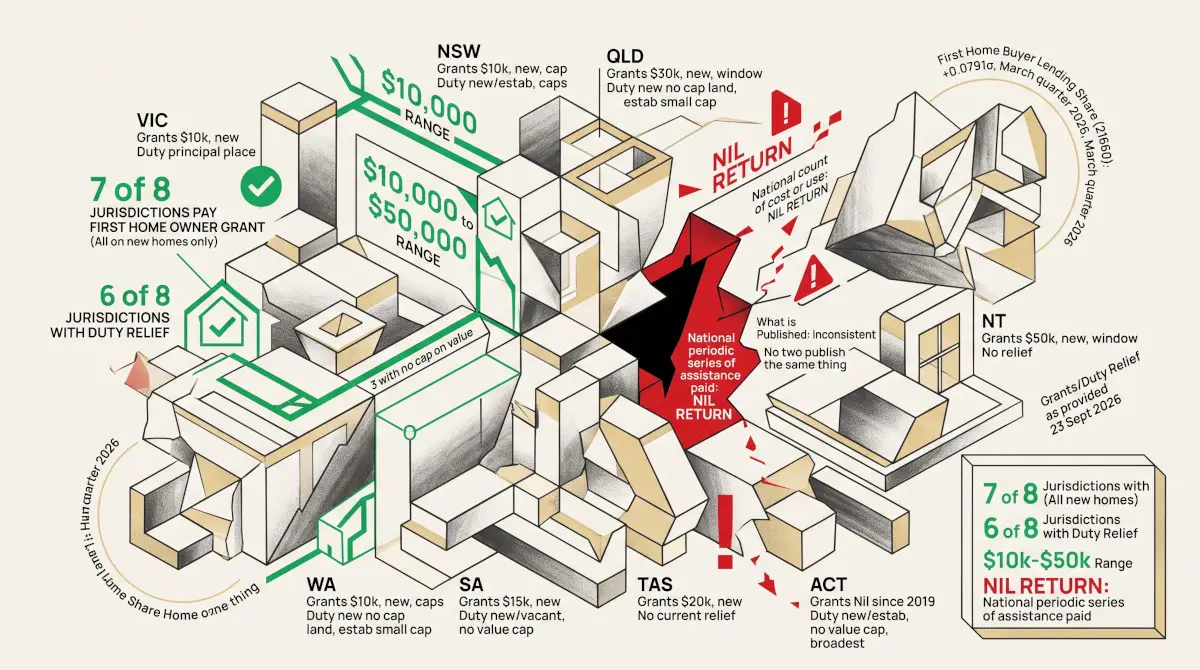

First home buyer assistance in Australia is eight separate systems, and they differ on almost every point. Seven states and territories pay a first home owner grant, from $10,000 in New South Wales, Victoria and Western Australia to $50,000 in the Northern Territory, and every one pays it only on a new home. Six relieve transfer duty for first home buyers, three of them with no cap on the value of the home. What none publishes is a national count of what this assistance costs or how many people use it.
Grants and duty relief as provided on 23 September 2026. The node reading measures first home buyers’ share of new lending; it averages three measures, one of which begins in the September quarter 2019, leaving 26 quarters in its 2011 to 2025 baseline, below the platform’s minimum-observation standard.
Two kinds of help, set by each state
State and territory help for a first home buyer comes in two forms. A first home owner grant is a cash payment, made under each jurisdiction’s own grant Act. Duty relief reduces or removes the transfer duty, often called stamp duty, that a buyer pays on the purchase, under the jurisdiction’s duties Act. The two are separate: a buyer can qualify for one, both or neither, and the rules on which homes qualify differ between them.
Above both sits a Commonwealth layer that works through the loan rather than the price. Under the Australian Government 5% Deposit Scheme, a first home buyer can borrow with a 5% deposit without paying lenders mortgage insurance; since 1 October 2025 the scheme has had no income caps and no waitlists. The Help to Buy scheme and the First Home Super Saver Scheme sit alongside it. These Commonwealth schemes do not change what a state charges or pays.
The grant: new homes only, everywhere it is paid
Seven jurisdictions pay a grant today, and every one restricts it to a new home (in most, including a substantially renovated one). The amounts range from $10,000 to $50,000. The Australian Capital Territory still has a grant Act, but the amount has been set at nil since 1 July 2019; the Territory relies on duty relief instead.
First home owner grant for a contract signed now, by jurisdiction
Grant amount in thousands of dollars for a contract or building start in September 2026. Source: each jurisdiction’s grant Act, current version; Queensland Revenue Office.
Two of the amounts are set for a fixed window. The Northern Territory’s $50,000 applies to contracts to 30 September 2027 and falls to $10,000 after that. Tasmania’s grant is $20,000 for transactions from 1 July 2026 to 30 June 2027, down from $30,000 in the year before. Several jurisdictions also cap the value of an eligible home. New South Wales, for example, sets $600,000 to buy and $750,000 to build; Western Australia’s cap for transactions from 7 May 2026 is $800,000 south of the 26th parallel, which includes all of Perth, and $1,000,000 north of it.
| Jurisdiction | Grant for a contract signed now | Homes covered | Where it is set |
|---|---|---|---|
| New South Wales | $10,000 | New homes only; total value no more than $600,000 to buy or $750,000 to build | First Home Owner Grant and Shared Equity Act 2000, ss 13, 13A, 18 |
| Victoria | $10,000 | New homes only, since 1 July 2013 | First Home Owner Grant and Home Buyer Schemes Act 2000, s 18 |
| Queensland | $30,000 | New homes only; $30,000 for contracts signed from 20 November 2023 | First Home Owner Grant and Other Home Owner Grants Act 2000, s 20 |
| Western Australia | $10,000 | New or substantially renovated homes only | First Home Owner Grant Act 2000, s 19 |
| South Australia | $15,000 | New homes only; the grant for other homes ended in 2014 | First Home and Housing Construction Grants Act 2000, s 18 |
| Tasmania | $20,000 | New homes only; $20,000 for transactions from 1 July 2026 to 30 June 2027, down from $30,000 | First Home Owner Grant Act 2000, s 18M |
| Northern Territory | $50,000 | New homes only from 1 October 2025; $50,000 to 30 September 2027, then $10,000 | First Home Owner Grant Act 2000, ss 13, 18 |
| Australian Capital Territory | Nil | Nil for transactions from 1 July 2019 | First Home Owner Grant Act 2000, s 18; nil amount determination 2019 |
Amounts for a contract or building start in September 2026. The grant is the lesser of the amount shown and the price paid.
Duty relief: where the differences are largest
Duty relief is where the systems diverge most, in what homes qualify and how far the relief reaches. Five jurisdictions extend it to established homes as well as new ones: New South Wales, Victoria, Queensland, Western Australia and the Australian Capital Territory. South Australia relieves duty only on a new home or on land for building one, but with no value cap. Queensland removes duty on a new first home whatever its value, and gives a smaller, capped concession on an established one.
Tasmania and the Northern Territory currently offer no duty relief limited to first home buyers. Tasmania’s exemption for established homes up to $750,000 applied to transfers settling to 30 June 2026 and was not continued. The Northern Territory’s first home owner concession and discount apply only to earlier dates; the duty measures it retains, a house and land package exemption and a Territory home owner discount, are open to buyers who have owned a home before.
The Australian Capital Territory’s scheme is the broadest. From 1 July 2026 an eligible buyer pays no duty on any residential property, new or established, with no value cap and no income test. It is not limited to first home buyers: the test is that the buyer has not held property in the previous five years.
| Jurisdiction | Homes covered | What a first home buyer pays | Where it is set |
|---|---|---|---|
| New South Wales | New and established homes, and vacant land | No duty on a home up to $800,000, and a concession below $1,000,000; for vacant land, no duty up to $350,000 and a concession below $450,000 | Duties Act 1997, ss 74, 78A |
| Victoria | A home bought as the principal place of residence | Exemption up to $600,000; concession from $600,000 to $750,000 | Duties Act 2000, s 57JA |
| Queensland | New homes, established homes and vacant land, each under its own provision | New home: a concession that removes the duty on the residential land, with no value cap. Established home: a concession of up to $17,350 below $710,000, tapering to nil at $800,000 | Duties Act 2001, ss 92, 92A, 92B, sch 4A |
| Western Australia | New and established homes, and vacant land | Home in Perth or Peel: nil to $500,000, a concessional rate to $700,000. Home elsewhere: nil to $500,000, concessional to $750,000. Vacant land: nil to $350,000, concessional to $450,000 | Duties Act 2008, s 143, sch 2 |
| South Australia | New homes, and vacant land for building one | No duty for contracts from 6 June 2024, with no value cap. No relief for established homes | Stamp Duties Act 1923, s 71DD |
| Tasmania | No current relief | The exemption for established homes up to $750,000 applied to transfers settling from 18 February 2024 to 30 June 2026 and is not available after that | Duties Act 2001, s 57G; State Revenue Office |
| Northern Territory | No relief limited to first home buyers | The Act’s first home owner concession and discount apply only to earlier dates. A house and land package exemption, to 30 June 2027, and a Territory home owner discount of up to $18,601 are open to other buyers too | Stamp Duty Act 1978, ss 89, 89AA, 89AAB, 90D |
| Australian Capital Territory | New and established homes, and vacant land | No duty from 1 July 2026 for an eligible buyer, with no value cap and no income test; buyers must not have held property in the previous five years | Home buyer concession scheme, determined under the Taxation Administration Act, s 139 |
Values are the dutiable value of the property. Each scheme has further conditions, such as residence, age and prior ownership, which are not shown.
What is published about use
Six of the eight governments publish something about how their assistance is used, but no two publish the same thing. New South Wales has a monthly dashboard of duty exemptions and concessions. Western Australia and South Australia publish grant data by month. Victoria and Tasmania publish annual counts, Tasmania by number and value of grants paid. Queensland’s grant data appears once a year on its open data portal, most recently for 2023–24. For the Northern Territory and the Australian Capital Territory, no statistics page was found.
Tasmania’s tables cite a “National FHOG Online database” as their source. No national figure is published from it. Duty forgone through concessions is reported, where at all, state by state and on different bases. A national, periodic series of what first home buyer assistance costs, or how many buyers receive it, does not exist: NIL RETURN.
| Jurisdiction | What is published about use |
|---|---|
| New South Wales | Revenue NSW: a first home buyer assistance dashboard of duty exemptions and concessions, updated monthly |
| Victoria | State Revenue Office: first home buyer duty concessions by year; concessions by postcode and first home owner grant statistics, each to 2024–25 |
| Queensland | Open data portal: first home owner grants by statistical area, one dataset a year, the latest 2023–24 |
| Western Australia | RevenueWA: first home owner grant data, published by the 15th of each month |
| South Australia | RevenueSA: first home owner grant applications by month and financial year, and grants paid in the top 20 postcodes |
| Tasmania | State Revenue Office: number and value of grants paid each year, and payments by municipality |
| Northern Territory | NIL RETURN: no statistics page found on the government’s revenue or home owner assistance pages |
| Australian Capital Territory | NIL RETURN: no statistics page found for the home buyer concession scheme on the Revenue Office site |
Revenue office statistics pages as at 23 September 2026.
What can be measured nationally is the outcome in lending rather than the assistance. First home buyers took 35.9% of owner-occupier new lending in the June quarter of 2026; the full history is in Twenty-Four Years of First Home Buyer Lending. That measure moves with interest rates, prices and incomes as well as with assistance, and it cannot say how much of any movement a grant or concession caused.
What this does not show
This is a reading of the grant and duty provisions, not a guide to eligibility. Every scheme carries conditions on age, citizenship or residency, prior ownership and living in the home, and several set further limits by regulation or notice. Amounts and thresholds are those in force on 23 September 2026 and change often. Local council and utility charges, Commonwealth tax settings and shared-equity schemes run by the states are outside this comparison. The article describes what the instruments provide; it does not assess whether any scheme is warranted and is not advice to a buyer, who should rely on the current legislation and the revenue office in their jurisdiction.
Findings are presented on the basis of data and evidence alone.