The National Construction Code sets the minimum technical standards every new home in Australia must meet, but each state and territory decides when a new edition takes legal effect. The 2025 edition, released on 1 May 2026, has split them. Victoria, Western Australia and the Australian Capital Territory gave it effect from that date, the last two with a 12-month transition. New South Wales, Queensland, South Australia and Tasmania have set 1 May 2027 for the building code. The Northern Territory has not adopted it. Building Ministers have also agreed that, apart from essential quality and safety measures, there will be no further residential changes to the code until mid-2029.
Node reading for Planning Regulations & Zoning Policy (21320): NIL RETURN. This article rests on the source data alone.
What the code is, and who decides when it applies
The National Construction Code is published by the Australian Building Codes Board in collaboration with the Australian, state and territory governments. It sets minimum requirements for health, safety, amenity, accessibility and sustainability in the design and construction of new buildings. Volumes One and Two are the Building Code of Australia, covering apartments and other large buildings, and houses respectively; Volume Three is the Plumbing Code of Australia. The code has no legal force of its own. Each state and territory gives an edition effect through its own building legislation, on a date it chooses, and may add its own variations.
The code is set in the same place for every jurisdiction, but it applies on different dates. That is the subject of this article: which edition a new home is built to, and when that changes. The zoning and design rules that decide what may be built on a site are separate instruments, described in Who Writes the Zones: Australia’s Zoning Instruments, State by State.
NCC 2025: what is in it, and what was left out
Building Ministers settled the content of the 2025 edition at their meeting on 22 October 2025. They agreed to include water management and carpark fire safety for commercial and apartment buildings, commercial energy efficiency reforms including mandatory on-site solar photovoltaic systems, and condensation mitigation. They also agreed that there would be no further residential changes in NCC 2025 outside essential safety and quality changes. Changes to residential energy efficiency and electric vehicle charging provisions were not introduced, and embodied carbon provisions were to be published as voluntary guidance. The residential standards adopted in NCC 2022, including 7-star energy efficiency, remain in place.
| In NCC 2025 | Not in NCC 2025 |
|---|---|
| Water management in commercial and apartment buildings, to prevent water ingress | Changes to residential energy efficiency |
| Carpark fire safety provisions for commercial and apartment buildings | Electric vehicle charging provisions |
| Commercial energy efficiency, including mandatory on-site solar photovoltaic systems | Embodied carbon provisions, published instead as voluntary guidance |
| Condensation mitigation | — |
Source: Building Ministers’ Meeting communiqué, 22 October 2025.
The Australian Building Codes Board released the full edition of NCC 2025 on 1 May 2026, after a preview published in February, stating that the most substantial technical changes apply to commercial buildings. Because residential changes were limited to essential safety and quality measures, the 2025 edition changes less for a new detached house than for an apartment building, to which the water management and carpark fire safety provisions apply.
Adoption, jurisdiction by jurisdiction
Which edition of the National Construction Code applies, by jurisdiction, 2026 to 2029
Building code (Volumes One and Two). Transition periods differ: in the Australian Capital Territory either edition may be used; in Tasmania the transition follows a temporary adoption of NCC 2025 from 1 May to 4 June 2026. South Australia adopted the NCC 2025 plumbing code from 1 May 2026. Dates after September 2026 are as currently set and may change. Source: Australian Building Codes Board, NCC 2025 state and territory adoption information, read 23 September 2026; Building Ministers’ Meeting communiqué, 22 October 2025.
| Jurisdiction | NCC 2025 takes effect | Transition period | Edition applying to a new home, 23 September 2026 |
|---|---|---|---|
| Victoria | 1 May 2026 | No transition | NCC 2025 |
| Western Australia | 1 May 2026 | 12 months | NCC 2022 or NCC 2025 during a 12-month transition to 1 May 2027 |
| Australian Capital Territory | 1 May 2026 | 12 months | Either NCC 2022 or NCC 2025, at the builder’s choice |
| Tasmania | 1 May 2027; temporarily adopted 1 May to 4 June 2026 | 5 June 2026 to 1 May 2027 | NCC 2022, with transition arrangements for the temporary adoption |
| New South Wales | 1 May 2027 | No transition | NCC 2022 |
| Queensland | 1 May 2027 | No transition | NCC 2022 |
| South Australia | Building code 1 May 2027; plumbing code 1 May 2026 | No transition | NCC 2022 for building; NCC 2025 for plumbing |
| Northern Territory | Not adopted | No transition | NCC 2022 |
Sources: Australian Building Codes Board, NCC 2025 state and territory adoption information; NSW Government, 25 March 2026; ACT Planning; Australian Building Codes Board, Queensland introduction to NCC 2025. Read 23 September 2026.
Three jurisdictions gave NCC 2025 effect from 1 May 2026. In Victoria it applies without a transition. In the Australian Capital Territory it commenced on 1 May 2026 but is not mandatory until 1 May 2027: in between, a building approved may comply with either NCC 2022 or NCC 2025, and a project whose development application was lodged before 1 November 2026 may use either edition until that application expires. Western Australia also adopted it from 1 May 2026, with a 12-month transition.
Four jurisdictions set 1 May 2027 for the building code. New South Wales announced on 25 March 2026 that it would defer commencement by 12 months, which it describes as a transition period, to give its building industry more time to adjust. Queensland states that NCC 2025 is adopted and has legal effect on 1 May 2027, with NCC 2022 remaining in force until then. South Australia adopted the plumbing code on 1 May 2026 and set 1 May 2027 for the building code. Tasmania adopted NCC 2025 temporarily, from 1 May to 4 June 2026, before its adoption was deferred to 1 May 2027, with transition arrangements in between.
The Northern Territory has not adopted NCC 2025, and the Australian Building Codes Board lists no date for it. NCC 2022 continues to apply there.
The pause to mid-2029
On 24 August 2025 the Commonwealth announced that no further residential changes would be made to the code, except for essential quality and safety measures, until mid-2029, after NCC 2025 was finalised. Building Ministers agreed to that pause on 22 October 2025. The pause means the next residential changes, other than essential measures, will come no earlier than mid-2029.
The communiqué also records that the adoption of NCC 2025 is a matter for each jurisdiction, and the adoption dates show how much that matters. Between 1 May 2026 and 1 May 2027 a new apartment building in Melbourne and one in Sydney may be built to different editions of the national code.
What this does not show
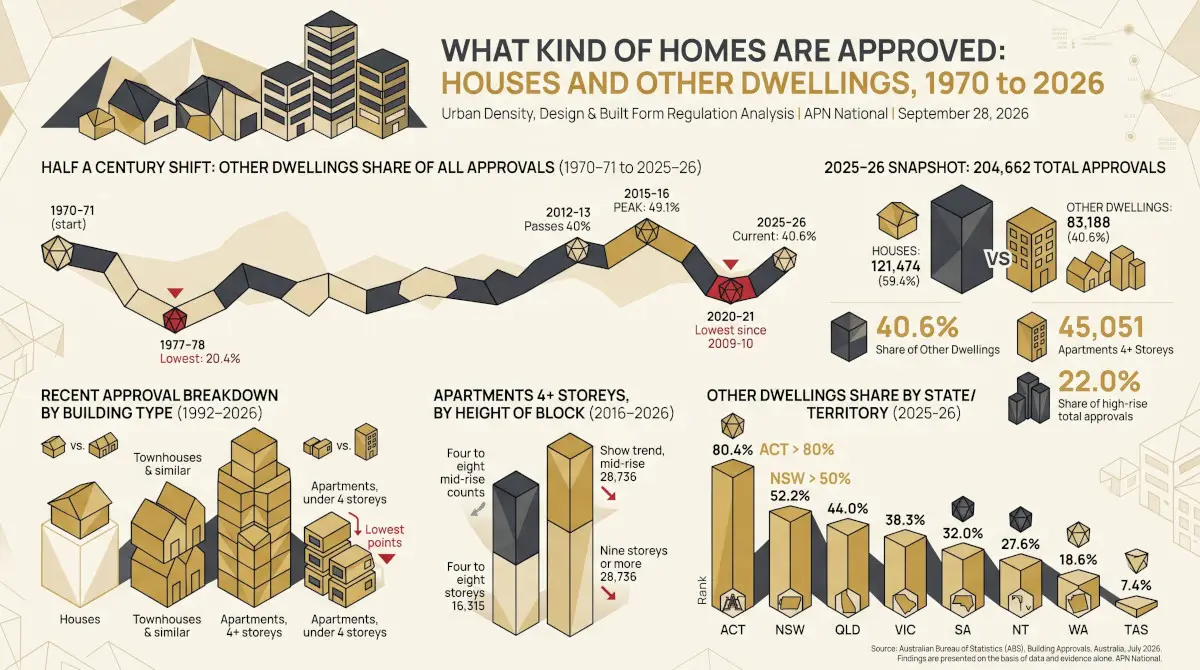
This article sets out which edition applies and when; it does not assess the cost or effect of any provision. Adoption dates after September 2026 are as currently set and can change, as Tasmania’s did. Each jurisdiction also applies its own variations to the code, including to the livable housing provisions, and those variations are not compared here. How the form of new housing has changed, from houses to townhouses and apartments, is set out in What Kind of Homes Are Approved: Houses and Other Dwellings, 1970 to 2026.
Findings are presented on the basis of data and evidence alone.