
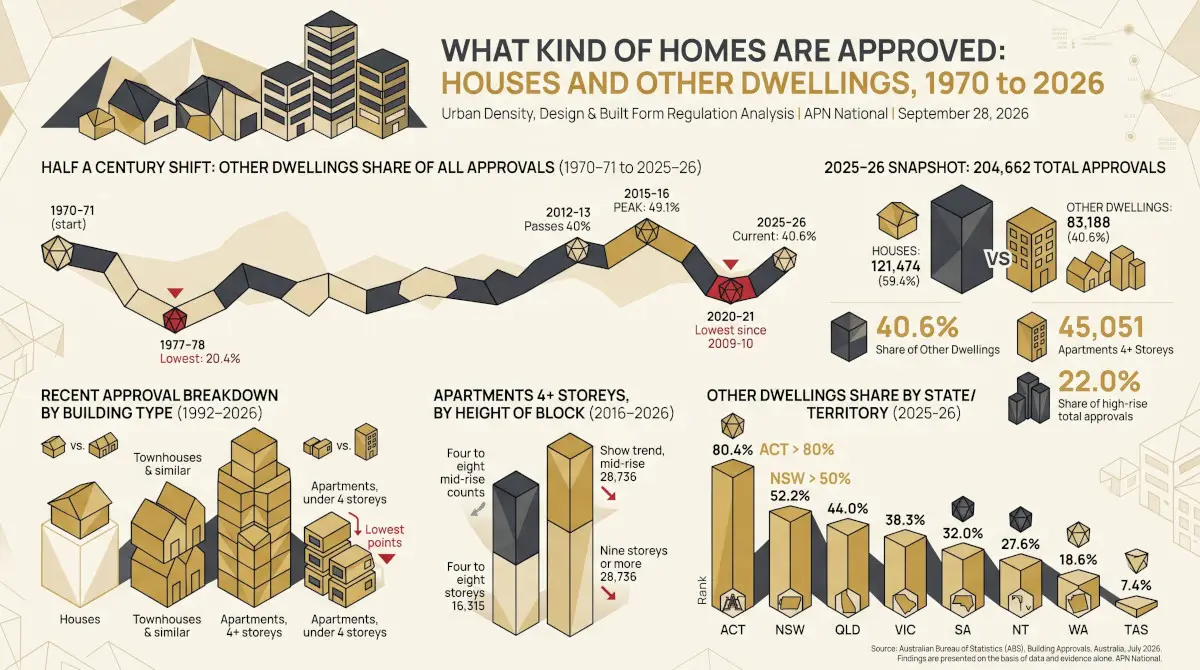

Of the 204,662 new homes approved across Australia in 2025–26, 121,474 were houses and 83,188, or 40.6%, were something else: townhouses, terraces, semi-detached homes and apartments. For most of the past half-century that share sat between a fifth and a third. It rose above 40% in 2012–13, peaked at 49.1% in 2015–16, and since 2018–19 it has ranged between 33.3% and 40.6%. Where those other dwellings go up is concentrated: in 2025–26 they were 80.4% of approvals in the Australian Capital Territory and 52.2% in New South Wales, against 18.6% in Western Australia and 7.4% in Tasmania.
Node reading for Planning Regulations & Zoning Policy (21320): NIL RETURN. This article rests on the source data alone.
What is counted
New dwellings approved for construction are recorded by the Australian Bureau of Statistics by the type of building they are in. A house is a detached dwelling. Everything else is “other residential”: semi-detached, row and terrace houses and townhouses, and apartments, which the ABS further divides by the height of the block they sit in. The mix of what is approved is the nearest regular measure of the form new housing takes. It records what was approved, not the planning rules that shaped it, and approval is not completion: some approved dwellings are never built.
Half a century of the house and the rest
Dwellings other than houses, share of all new dwellings approved, Australia
Per cent, financial years ending June, 1970–71 to 2025–26. New residential buildings, original. Source: ABS, Building Approvals, Australia, July 2026, table 20.
From 1970–71 to 2009–10 the share of new dwellings that were not houses never rose above 33.4%, and it fell as low as 20.4% in 1977–78. It broke that range in 2010–11 and passed 40% in 2012–13, reaching 49.1% in 2015–16, when 115,993 of the 236,024 dwellings approved were not houses. It then fell back to 33.3% in 2020–21, the lowest since 2009–10, in the year that 147,349 houses were approved, the most in any financial year since the series began in 1956–57. In 2025–26 it stood at 40.6%.
Which other dwellings
Since July 1991 the ABS has split other residential building into townhouses and apartments, and apartments by storeys. The detail shows two movements behind the headline share.
New dwellings approved by type of building, Australia
Thousands of dwellings, financial years ending June, 1991–92 to 2025–26. Townhouses and similar are semi-detached, row or terrace houses and townhouses. Apartments under four storeys include apartments attached to a house. Source: ABS, Building Approvals, Australia, July 2026, table 20.
The first is the rise of the apartment block of four storeys or more. In 1991–92 such apartments were 0.8% of dwellings approved. By 2015–16 they were 30.6%, or 72,258 dwellings, more than the townhouses, terraces and low-rise apartments approved that year put together. In 2025–26 they numbered 45,051, 22.0% of the total.
The second is the decline of the low-rise apartment. Apartments in blocks under four storeys numbered 11,260 in 1991–92 and 1,808 in 2023–24, the fewest in the series; there were 3,777 in 2025–26. Townhouses, terraces and semi-detached homes have held steadier, at 34,360 in 2025–26 against a high of 36,607 in 2017–18.
How tall the blocks are
Apartments approved in blocks of four storeys or more, by height of block, Australia
Thousands of dwellings, financial years. The split between four to eight storeys and nine or more is published from July 2016. Source: ABS, Building Approvals, Australia, July 2026, table 20.
Since the ABS began separating them in 2016–17, apartments in blocks of nine storeys or more have outnumbered those in blocks of four to eight storeys in every year. In 2025–26 the counts were 28,736 and 16,315. The mid-rise count has fallen further in proportion: from 29,228 in 2017–18 to 9,249 in 2023–24, down 68%, against a fall of 49% for the taller blocks over the same years. It recovered to 16,315 in 2025–26.
State by state
Dwellings other than houses, share of new dwellings approved, by state and territory, 2025–26
Per cent, financial year 2025–26. Source: ABS, Building Approvals, Australia, July 2026, tables 22 to 29.
| State or territory | Houses | Townhouses and similar | Apartments, four storeys or more | All other dwellings | Other dwellings, share |
|---|---|---|---|---|---|
| Australian Capital Territory | 807 | 627 | 2,516 | 3,320 | 80.4% |
| New South Wales | 24,876 | 11,124 | 15,298 | 27,141 | 52.2% |
| Queensland | 27,205 | 6,468 | 13,512 | 21,380 | 44.0% |
| Victoria | 34,372 | 10,376 | 10,284 | 21,329 | 38.3% |
| South Australia | 10,280 | 3,612 | 909 | 4,830 | 32.0% |
| Northern Territory | 610 | 206 | 0 | 233 | 27.6% |
| Western Australia | 20,839 | 1,883 | 2,484 | 4,757 | 18.6% |
| Tasmania | 2,485 | 64 | 48 | 198 | 7.4% |
| Australia | 121,474 | 34,360 | 45,051 | 83,188 | 40.6% |
Dwelling units approved in new residential buildings, 2025–26, original. Townhouses and similar are semi-detached, row or terrace houses and townhouses. The state figures sum to the Australian totals. Source: ABS, Building Approvals, Australia, July 2026, tables 20 and 22 to 29.
New South Wales is the only state where more dwellings other than houses were approved than houses, 27,141 against 24,876; the Australian Capital Territory, largely one city, is the only other jurisdiction where that is so. Queensland follows at 44.0% and Victoria at 38.3%. New South Wales, Victoria and Queensland together account for 86.8% of the apartments approved in blocks of four storeys or more. In Western Australia houses were 81% of new dwellings approved, and in Tasmania 93%.
What this does not show
The mix of approvals records outcomes, not the rules behind them. Height limits, floor-space controls, apartment design standards and building code changes all bear on what is proposed, but so do interest rates, construction costs, pre-sales and development finance, which move apartment approvals in particular. This data cannot separate those influences, and no attempt is made here to attribute any change to a rule. Approvals are not completions; how many approved dwellings go on to start construction is covered in From Approval to Start: The Conversion Gap. The instruments that set the zones these dwellings sit in are described in Who Writes the Zones: Australia’s Zoning Instruments, State by State.
Findings are presented on the basis of data and evidence alone.


