Affordable housing has no single meaning in Australia. New South Wales and Victoria define it by who lives in it: households whose income falls within set bands. Queensland defines it, for its priority development areas, by what it costs: rent of no more than 74.9% of market rent, or no more than 30% of household income. South Australia defines it largely by what it sells for, to buyers below an income limit: $522,000 for a dwelling in Greater Adelaide. The Australian Capital Territory and the Commonwealth define it only for tax purposes, and no statutory definition could be located for Tasmania, Western Australia or the Northern Territory. Because the definitions rest on different bases, they cannot be added together, and no national count of affordable housing can be built from them.
Node reading for Housing Policy (Affordable, Social) (21330): NIL RETURN. This article rests on the source data alone.
Why the definition matters
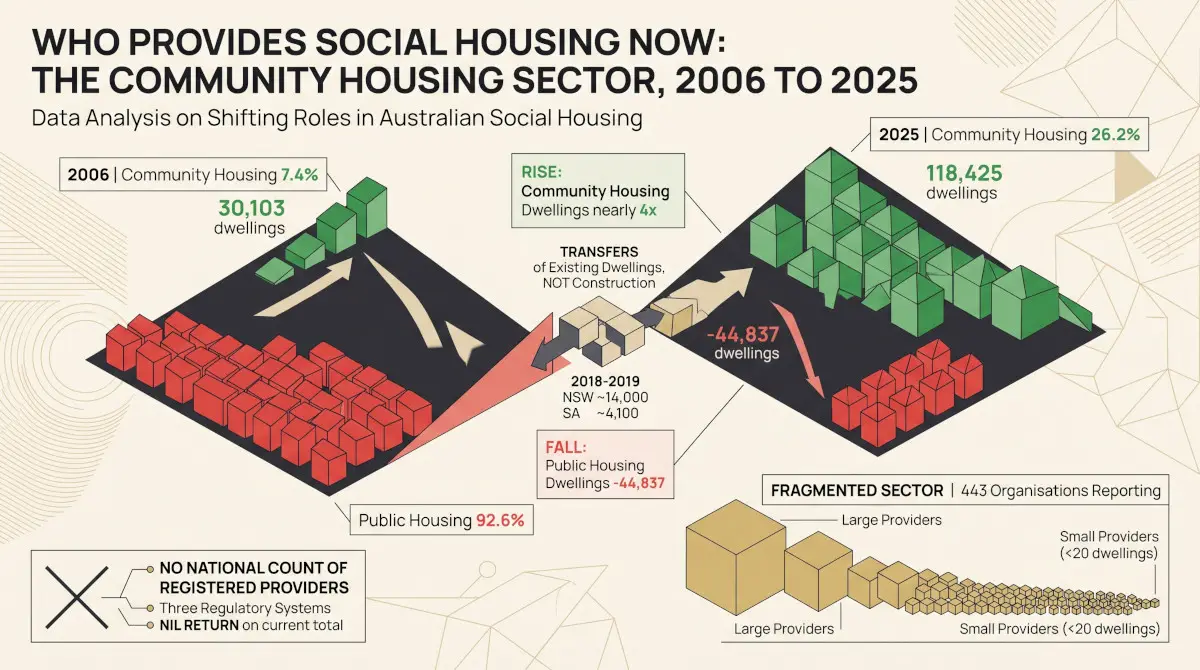
Affordable housing is housing let or sold below the market to households on very low to moderate incomes. It is distinct from social housing, which is let to eligible households by governments and not-for-profit providers at rents tied to income, and whose stock is set out in Social Housing as a Share of All Dwellings, 2012 to 2025. Where affordable housing is defined in law, the definition decides who may occupy a dwelling, what a developer must deliver to meet a planning requirement or earn a bonus, and what a government can count. Each jurisdiction that defines it writes its own.
The definitions rest on three different bases.
| Basis | What makes housing affordable | Where it is used |
|---|---|---|
| Household income band | Who lives in it: households whose income falls within set bands | New South Wales, Victoria |
| Rent relative to market or income | What it costs to rent: a share of market rent, or of the household’s income | Queensland; the Australian Capital Territory, for land tax; New South Wales and one Victorian scheme as a rent rule |
| Sale price | What it sells for: a price ceiling, for buyers below an income limit | South Australia; Queensland as an alternative test |
The definitions, jurisdiction by jurisdiction
| Jurisdiction | Basis | Thresholds | Rent or price test | Source |
|---|---|---|---|---|
| New South Wales | Household income band | Very low below 50%, low 50% to 80%, moderate 80% to 120% of median income; limits reissued each year | Rent at least 20% below market rent | Environmental Planning and Assessment Act 1979; State Environmental Planning Policy (Housing) 2021; Affordable Housing Ministerial Guidelines |
| Victoria | Household income band | Very low, low and moderate ranges set by Order in Council, by household type and region | No rent test in the definition; one Homes Victoria scheme sets rent at the lower of 30% of income and 74.99% of market rent | Planning and Environment Act 1987, s 3AB Order; Housing Act 1983, ss 142JA and 142JB |
| Queensland | Rent or price, for households by income | Very low income 50% or less of median household income; low to moderate more than 50% and less than 120% | Rent not more than 74.9% of market rent, or an affordable rent of not more than 30% of gross income; a purchase price test | Economic Development Regulation 2023, as amended by SL 2024-0208 |
| South Australia | Sale price, or rental through an eligible provider | Buyers below an income limit ($120,000 single, $155,000 couple or family, Greater Adelaide) | Sale at or below $522,000 for a dwelling in Greater Adelaide, $401,000 elsewhere | South Australian Housing Trust Regulations 2025 and Gazette notice |
| Tasmania | No statutory definition | Homes Tasmania Act 2022 refers to low or moderate incomes without defining them | NIL RETURN | Homes Tasmania Act 2022, s 5 |
| Western Australia | NIL RETURN | NIL RETURN | NIL RETURN | No statutory definition located |
| Australian Capital Territory | Rent below market, for a land tax exemption | Affordable by people on low or moderate incomes | Community housing rented at less than current market rent | Land Tax Act 2004, s 13A |
| Northern Territory | NIL RETURN | NIL RETURN | NIL RETURN | No statutory definition located |
| Commonwealth | Managed dwelling, for tax concessions | NIL RETURN | Tenancy managed exclusively by an eligible community housing provider, which certifies the dwelling | Income Tax Assessment Act 1997, Division 980 |
As at 22 September 2026. NIL RETURN: no statutory definition was located. Sources as listed; see the methodology note for editions and dates.
New South Wales: income bands and a rent discount
New South Wales defines affordable housing by household income, in bands set against the median: very low income below 50% of the median, low from 50% to 80%, and moderate from 80% to 120%, as defined in the State Environmental Planning Policy (Housing) 2021. The limits are reissued each year and set separately for Sydney and the rest of the state. For 2026–27 a single adult in Sydney is eligible on a moderate income of up to $90,700; each additional adult adds $45,400 to that limit and each child $27,200. A tenant already housed remains eligible on an income up to 25% above the limit, $113,375 for a single adult in Sydney.
The rent follows from the Affordable Housing Ministerial Guidelines: affordable housing is to be let at a discount of at least 20% to market rent, and very low and low income households should in general pay no more than 25% to 30% of their gross income in rent.
Moderate income limit for affordable housing, Sydney, by household, 2026–27
Thousands of dollars, gross annual household income. Source: NSW Government, Household income eligibility limits for affordable housing 2026/27, table 3.
| Household, Sydney | Very low | Low | Moderate |
|---|---|---|---|
| Single | $37,800 | $60,400 | $90,700 |
| Single + 1 | $49,100 | $78,500 | $117,900 |
| Couple | $56,700 | $90,600 | $136,100 |
| Couple + 2 | $79,300 | $126,800 | $190,500 |
| Single, rest of New South Wales | $34,100 | $54,600 | $81,900 |
Gross annual household income limits, 2026–27. Source: NSW Government, Household income eligibility limits for affordable housing 2026/27, tables 3 and 4.
Victoria: income ranges set by Order
Victoria also defines affordable housing by income. Under section 3AB of the Planning and Environment Act 1987 the Governor in Council specifies, by Order in the Government Gazette, a very low, a low and a moderate income range for affordable housing that is not social housing. The Order in operation from 1 July 2026 sets separate ranges for Greater Melbourne and the rest of the state, derived from 2021 Census area median incomes indexed by the housing group of the Consumer Price Index. A single adult in Greater Melbourne falls within the moderate range on an income of up to $77,390.
The Victorian definition carries no rent test of its own. Rent rules appear instead in individual programs: the Homes Victoria Affordable Housing Rental Scheme Two, declared by an Order published on 4 June 2026, sets rent at the lower of 30% of the household’s income and 74.99% of market rent.
Upper limit of the moderate income range, Victoria, by household, from 1 July 2026
Thousands of dollars, annual household income. Source: Victoria Government Gazette S 338, 23 June 2026, Order in Council specifying income ranges for affordable housing.
| Household | Very low income | Low income | Moderate income |
|---|---|---|---|
| Single adult, Greater Melbourne | Up to $32,250 | $32,251 to $51,590 | $51,591 to $77,390 |
| Couple, no dependant, Greater Melbourne | Up to $48,360 | $48,361 to $77,390 | $77,391 to $116,080 |
| Family with dependent children, Greater Melbourne | Up to $67,710 | $67,711 to $108,350 | $108,351 to $162,510 |
| Single adult, rest of Victoria | Up to $23,500 | $23,501 to $37,620 | $37,621 to $56,420 |
| Couple, no dependant, rest of Victoria | Up to $35,260 | $35,261 to $56,420 | $56,421 to $84,640 |
| Family with dependent children, rest of Victoria | Up to $49,360 | $49,361 to $78,990 | $78,991 to $118,500 |
Annual household income, from 1 July 2026. Source: Victoria Government Gazette S 338, 23 June 2026, tables 1 and 2.
Queensland: rent and price tests, for its priority development areas
Queensland’s definition is made for the Economic Development Act 2012, which governs its priority development areas. Housing is affordable to low to moderate income households — those on more than 50% and less than 120% of the median household income — if, among other criteria, it is let at no more than 74.9% of market rent, or sold at no more than an affordable purchase price. An affordable rent is one of no more than 30% of the household’s gross income, and an affordable purchase price is one at which servicing a loan for 90% of the price costs no more than 30% of gross income.
South Australia: a sale price
In South Australia the criteria are set under the South Australian Housing Trust Regulations 2025 and a notice in the Government Gazette. Housing is affordable where a developer or landowner is legally obliged to provide it as affordable housing, and it is either sold to an eligible buyer at or below the affordable sale price, or let through an eligible rental provider such as a community housing provider. The affordable sale price for a dwelling in Greater Adelaide is $522,000, and $401,000 in the rest of the state; prices are reviewed every six months. Developers may apply for variances of up to 15% for energy efficiency, proximity to high-frequency public transport or specialised finance, and a higher cap applies to homes sold with a shared equity loan.
Buyers must also qualify. In Greater Adelaide a single buyer’s income must be below $120,000 a year and a couple’s or family’s below $155,000; in regional South Australia the limits are $95,000 and $120,000. Assets must be valued below $579,500 for a single buyer and $739,500 for a couple or family.
Affordable sale prices for a dwelling, Greater Adelaide, April 2026
Thousands of dollars, including GST. Variances are granted on application. Source: Government of South Australia, Affordable Housing Developer Toolkit, April 2026, table 1.
Definitions for tax, and where there is none
Two jurisdictions define affordable housing only for a tax concession. The Australian Capital Territory exempts from land tax land made available to a registered community housing provider for affordable community housing, which its Land Tax Act 2004 defines as community housing rented at less than the current market rent and affordable by people on low or moderate incomes. The Commonwealth’s Income Tax Assessment Act 1997, in Division 980, treats a dwelling as providing affordable housing, for capital gains tax and managed investment trust purposes, where its tenancy is managed exclusively by an eligible community housing provider that certifies it; its test rests on who manages the dwelling rather than on income, rent or price.
The Homes Tasmania Act 2022 refers to people on low or moderate incomes but defines neither, and defines neither affordable nor social housing. No statutory definition of affordable housing was located for Western Australia or the Northern Territory, where the term is used in policy and program documents.
Why there is no national total
A national count would need one test applied to every dwelling. The definitions do not provide one. A dwelling in Adelaide sold below the price point, a dwelling in Sydney let at 20% below market to a household within the income bands, and a dwelling in a Queensland priority development area let at 74.9% of market rent are each affordable housing under their own state’s law, and none would necessarily qualify under another’s. The Commonwealth’s tax definition is a single national test, but it covers only dwellings managed by certified community housing providers. No national statistical collection counts affordable rental dwellings separately from social housing; the Australian Capital Territory is the one jurisdiction found to publish its own count. No national count of affordable housing can be built from the state definitions, and none is published: NIL RETURN.
What this does not show
A definition is not a measure of supply. The thresholds show who may be housed, not how many dwellings meet the test or how many households on these incomes are housed in them. Income limits and price points are reset each year or half-year, so the figures here date quickly; each is given with its edition. Where a jurisdiction has no statutory definition, affordable housing may still be defined for a particular program or agreement, and those program definitions are not collected here.
Findings are presented on the basis of data and evidence alone.