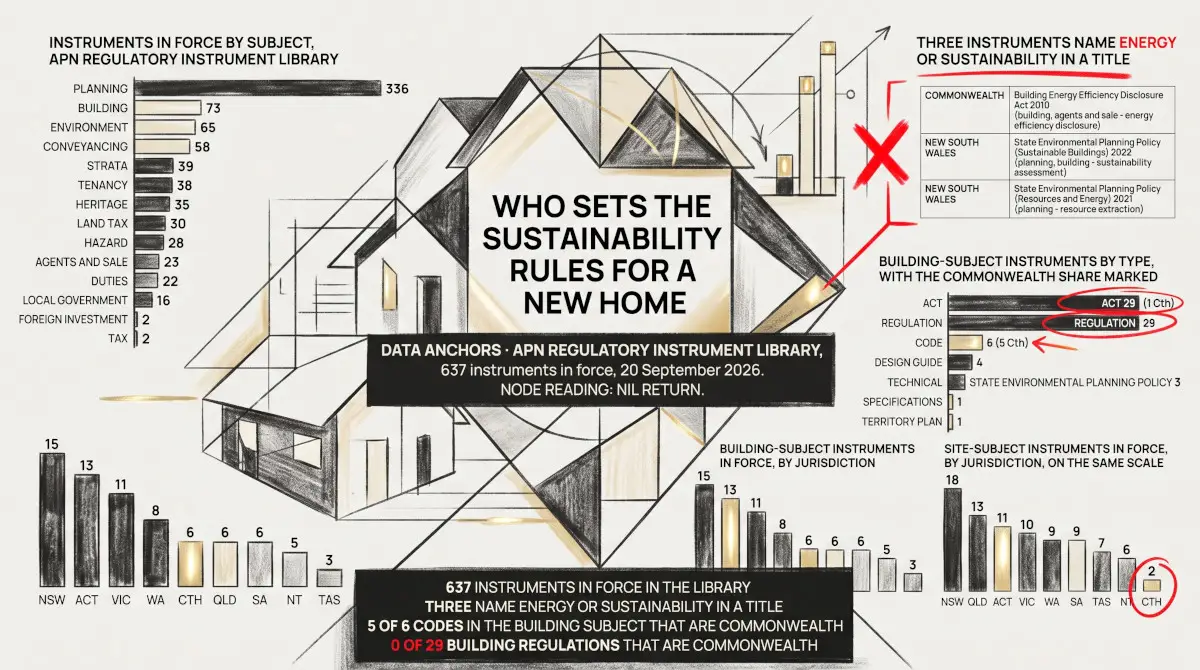

Of the 637 instruments recorded in force in the APN Regulatory Instrument Library, three name energy or sustainability in their title, and only two of those concern how a building performs. The library sorts its instruments into fourteen subjects and sustainability is not one of them. That is not an omission so much as a description: the requirements that decide how much energy a new home uses are not written as environmental law, and they do not come from where most property regulation comes from. Of the six codes in the library’s building subject, five are Commonwealth. Of the 29 Acts, one is. Of the 29 regulations, none.
This article is anchored on the library’s own counts rather than on an APN node reading. Node reading for Sustainability & Environmental Policies (21360): NIL RETURN.
What the library is, and what a subject means in it
The APN Regulatory Instrument Library is a corpus of the legislation, regulations, planning instruments and codes that govern property in Australia. As at 20 September 2026 it holds 637 instruments recorded in force, across the Commonwealth and all eight states and territories. Each is filed under one or more subjects, and an instrument may carry several.
The subjects are the library’s own, derived from what the instruments do. They are worth listing in full, because the list is the first part of the finding.
Instruments in force by subject, APN Regulatory Instrument Library
Source: APN Regulatory Instrument Library, 20 September 2026. An instrument may carry more than one subject, so the bars do not sum to 637.
Planning dominates at 336, which is unsurprising: it is the subject that reaches every parcel of land and is written at every level of government down to the council. Building follows at 73, then environment at 65, conveyancing at 58, strata, tenancy, heritage, land tax, hazard. There is no subject for sustainability, none for energy, none for emissions.
Three instruments name it
Searching the titles rather than the subjects returns three instruments in the whole corpus, and one of those turns out to be about energy as a resource to be extracted rather than a quantity a building consumes.
| Jurisdiction | Instrument | Subjects it is filed under | What it concerns |
|---|---|---|---|
| Commonwealth | Building Energy Efficiency Disclosure Act 2010 | building, agents and sale | Energy efficiency disclosure for buildings. |
| New South Wales | State Environmental Planning Policy (Sustainable Buildings) 2022 | planning, building | Sustainability assessment and building performance data. |
| New South Wales | State Environmental Planning Policy (Resources and Energy) 2021 | planning | Energy and resource extraction, not building performance. |
So the entire visible footprint of sustainability in this corpus, measured by what instruments call themselves, is a Commonwealth disclosure Act and a New South Wales planning policy. Set against 637 instruments, that is under half of one per cent.
The conclusion to resist is that the requirements therefore do not exist. They do. They are simply not filed under that name, and finding them means looking at how the statute book divides the problem.
The land and the building are governed differently
Two layers of this corpus bind a new dwelling. One governs the site: what may be done to a piece of land, what is protected on it, what hazard it is exposed to. That is the environment and hazard subjects together, 65 and 28 tags across 85 distinct instruments, since eight carry both. The other governs the building: how the thing placed on the land must be put together and how it must perform. That is the building subject, 73 instruments. Eleven instruments sit in both.
Both layers reach all nine jurisdictions. There the resemblance ends. Of the 85 site instruments, 83 are made at state or territory level and two are Commonwealth. The building layer holds six Commonwealth instruments, three times as many in a smaller set.
Building-subject instruments in force, by jurisdiction
Source: APN Regulatory Instrument Library, 20 September 2026.
Site-subject instruments in force, by jurisdiction, on the same scale
Source: APN Regulatory Instrument Library, 20 September 2026. The site layer is the environment and hazard subjects combined and de-duplicated. The scale matches the chart above so the two layers can be read against each other.
| Jurisdiction | Building | Site | All subjects, state level or above |
|---|---|---|---|
| New South Wales | 15 | 18 | 75 |
| Australian Capital Territory | 13 | 11 | 61 |
| Victoria | 11 | 10 | 60 |
| Queensland | 6 | 13 | 53 |
| Western Australia | 8 | 9 | 48 |
| South Australia | 6 | 9 | 41 |
| Northern Territory | 5 | 6 | 34 |
| Tasmania | 3 | 7 | 25 |
| Commonwealth | 6 | 2 | 14 |
| Total | 73 | 85 | 411 |
One property of the library has to be dealt with before those columns can be read across jurisdictions. Its coverage below state level is uneven, from 7 instruments in one jurisdiction to 58 in another, which would make a raw total per jurisdiction a measure of the corpus rather than of the statute book. It does not affect what is compared here: all 226 of the library’s local instruments carry the planning subject, exactly one of them also carries building, and none carries a site subject. The building and site layers sit at state level or above almost entirely, so the final column above is drawn on the same basis.
The states write the Acts; the code is written nationally
The headline count understates the difference, because it treats a licensing Act and a construction code as one instrument each. Splitting the building subject by instrument type separates them.
Building-subject instruments by type, with the Commonwealth share marked
Source: APN Regulatory Instrument Library, 20 September 2026. The note on each bar gives the number of that type made by the Commonwealth.
| Instrument type | In force | Commonwealth | State or territory |
|---|---|---|---|
| Act | 29 | 1 | 28 |
| Regulation | 29 | 0 | 29 |
| Code | 6 | 5 | 1 |
| Design Guide | 4 | 0 | 4 |
| State Environmental Planning Policy | 3 | 0 | 3 |
| Technical Specifications | 1 | 0 | 1 |
| Territory Plan | 1 | 0 | 1 |
| All building instruments | 73 | 6 | 67 |
The division is almost complete. Of the 29 Acts in the building subject, one is Commonwealth. Of the 29 regulations, none is. Of the six codes, five are. The states and territories write the statutes and the regulations that create permits, certifiers, licences, warranties and enforcement; the technical content those instruments point at is written once, nationally, by the Australian Building Codes Board on behalf of the Commonwealth and the states and territories together. The library files those codes at Commonwealth level.
Those five Commonwealth codes, and the one Commonwealth Act beside them, are the whole of the Commonwealth’s presence in this subject.
| Instrument | Type | What the library says it covers |
|---|---|---|
| National Construction Code 2025 Volume One | Code | Contains part of the Building Code of Australia, published by the Australian Building Codes Board. |
| National Construction Code 2025 Volume Two | Code | Contains part of the Building Code of Australia, published by the Australian Building Codes Board. |
| National Construction Code 2025 Volume Three | Code | Contains the Plumbing Code of Australia, published by the Australian Building Codes Board. |
| ABCB Housing Provisions Standard 2025 | Code | Sets construction requirements for housing under the National Construction Code, covering structural provisions, earthworks, drainage, termite risk management, and footings and slabs. |
| Livable Housing Design Standard 2025 | Code | Sets livable housing design requirements for dwellings, covering access, entrances, internal doors and corridors, sanitary compartments and showers. |
| Building Energy Efficiency Disclosure Act 2010 | Act | Promotes the disclosure of energy efficiency information about buildings, with the aim of contributing to Australia’s greenhouse gas emissions reduction targets, and provides for accredited assessors, auditors and an auditing authority. |
That is six of the 14 Commonwealth instruments the library holds across every subject. Building is the largest single block of instruments the library records at Commonwealth level, at double the next: planning and conveyancing carry three Commonwealth instruments each, and no other subject carries more than two.
How each jurisdiction carries it
Six of the eight states and territories carry building control in a dedicated Building Act with its own regulations. New South Wales and South Australia do not: both route it through their planning statutes instead.
| Jurisdiction | Principal Act | Principal subordinate instrument |
|---|---|---|
| Australian Capital Territory | Building Act 2004 | Building (General) Regulation 2008 |
| Northern Territory | Building Act 1993 | Building Regulations 1993 |
| Queensland | Building Act 1975 | Building Regulation 2021 |
| Tasmania | Building Act 2016 | Building Regulations 2016 |
| Victoria | Building Act 1993 | Building Regulations 2018 |
| Western Australia | Building Act 2011 | Building Regulations 2012 |
| New South Wales | Environmental Planning and Assessment Act 1979 | Environmental Planning and Assessment (Development Certification and Fire Safety) Regulation 2021 |
| South Australia | Planning, Development and Infrastructure Act 2016 | Planning, Development and Infrastructure (General) Regulations 2017 |
Where the library carries a summary of what these instruments do, the relationship to the national code is explicit in the wording. The Northern Territory’s regulations are described as “adopting the Building Code of Australia as the building standard”, and its Act as “supporting national uniform standards and product accreditation”. Tasmania’s Act carries the object “that such work meets or exceeds national construction standards”. Western Australia’s regulations include “modifications to the Building Code, including for bush fire prone areas” — which is the other half of the arrangement, since adopting a national code does not mean adopting it unchanged.
That wording is illustrative and not a count. The library’s summaries are incomplete: it names the code for seven of the 67 building instruments outside the Commonwealth, and eleven Victorian building instruments carry no summary at all. A count built on them would measure the summaries rather than the statute book, so none is offered here.
The one state instrument of its kind
State Environmental Planning Policy (Sustainable Buildings) 2022 is the single standalone sustainability instrument at state or territory level anywhere in the corpus. The library describes it as promoting the design and delivery of sustainable buildings through consistent sustainability assessment and the recording of building performance data, targeting lower energy and mains water use, reduced greenhouse gas emissions, monitoring of embodied emissions in construction materials, and thermal performance.
Every other jurisdiction reaches the same ground, so far as this corpus shows it, through the national code and its own adoption of it. Queensland, Tasmania and the Northern Territory are partial exceptions in wording: the library’s summaries of their Building Acts name sustainable buildings, efficiency in the use of energy and water, and environmentally efficient buildings respectively, but each does so inside a general building statute rather than in an instrument of its own.
What this does not settle
The library is a corpus, not the statute book entire. Its coverage below state level is uneven between jurisdictions, which is why every comparison here is drawn at state level or above; that the local layer is entirely planning material is what makes the building and site layers safe to compare. Counts in this article are of what the library holds, and a jurisdiction holding fewer instruments in a subject is not the same as that jurisdiction regulating it less.
The subjects are the library’s classification, not a legal taxonomy. That sustainability has no subject tag is a fact about how this corpus divides the material, and it is offered as evidence of how the instruments are written rather than as a claim about what the law requires.
Nothing here measures stringency. A count of instruments is not a measure of how demanding they are, and the fact that energy performance is set nationally says nothing about the level at which it is set. Nor does this article date anything: the library’s version dates mark when the currently published consolidation took effect, not when an instrument was made or when its requirements last changed, so no date is quoted and no change is inferred.
The companion piece on heritage and environment in the statute book covers the site layer in its own right, including the heritage instruments left aside here.
Findings are presented on the basis of data and evidence alone.