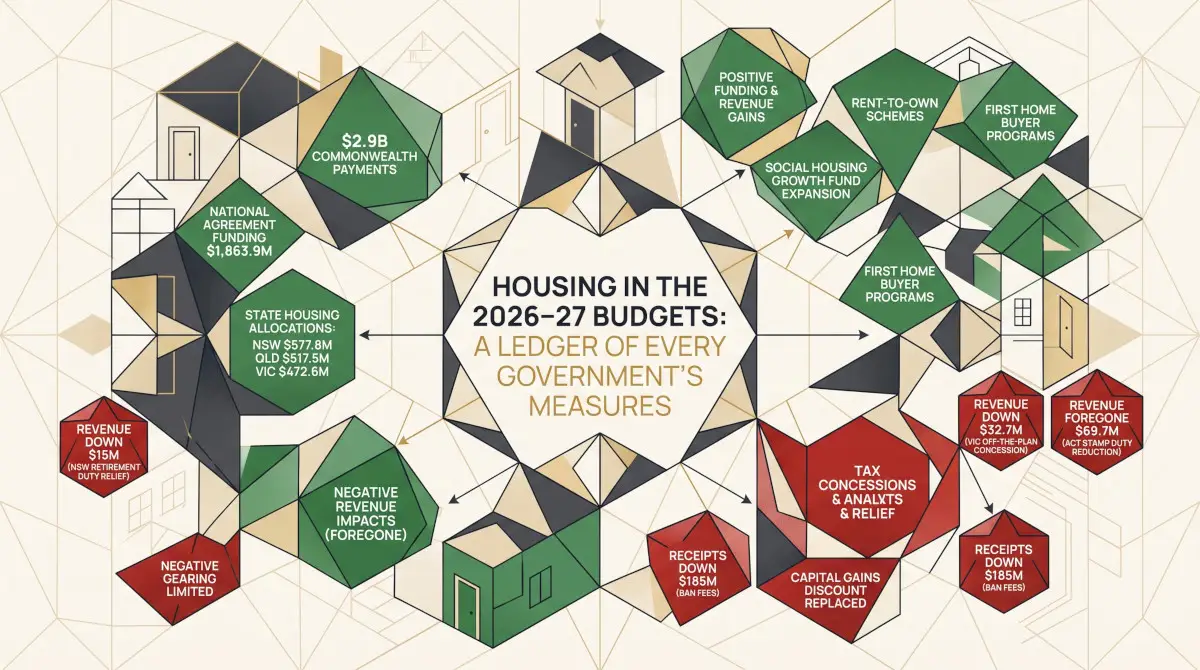

The Commonwealth will pay the states and territories $2.9 billion for housing in 2026–27, rising to $3.7 billion in 2029–30, and its budget changes how rental property is taxed: from 1 July 2027, losses on established homes bought after budget night can no longer be offset against other income, and the capital gains discount is replaced. Every state and territory budget also carries new housing measures, but each counts and presents them differently. This ledger sets out what each government committed, in its own papers and its own terms.
Node reading for Housing Policy (Affordable, Social) (21330): −1.2971σ at 30 June 2025, with social housing 3.98% of all residential dwellings. Position 9.7: indicative position, empirical ranking begins at 20 observations (currently 14). The ledger’s figures are taken from the budget papers alone.
What this ledger counts
A budget measure is a decision announced in a budget: new spending, a change to a tax, or a new program. This ledger lists the housing measures in the 2026–27 budgets of the Commonwealth and all eight states and territories, as each government’s own budget papers state them. A measure is included where the paper describes housing, homes, homelessness, tenancy or buying a home as its purpose, or where it changes a property duty or tax. Where a measure also serves another purpose, the table says so.
Three cautions apply throughout. These are commitments, not outcomes: an amount in a budget is what a government plans to spend or forgo, not what is built. The states do not count alike: some list each measure with a yearly profile, some group measures into packages, and some give no amount at all, so the state tables below are not added up or ranked against each other. And money moves between governments: several state measures are paid for in part by the Commonwealth payments in the first section.
The Commonwealth: payments to the states
The Commonwealth pays the states for housing in two ways. The National Agreement on Social Housing and Homelessness is ongoing funding for social housing and homelessness services, $1,863.9 million in 2026–27. National Partnership payments fund particular programs, $1,065.2 million in 2026–27. Together they come to $2,929.1 million.
Commonwealth housing payments to each state and territory, 2026–27 ($ million)
National Agreement and National Partnership housing payments with a state split set in the budget. A further $271.4 million is not yet allocated between states. Source: Australian Government, Budget 2026–27, Budget Paper No. 3, Table 2.7 and the tables that follow it.
New South Wales receives the most, $577.8 million, almost all of it through the National Agreement. The Northern Territory’s $438.2 million is larger than the payments to Western Australia or South Australia, because $353.6 million of it comes through two programs paid only to the Territory, for remote housing and for homelands. The payments are not shares of a fixed pool: each program has its own purpose and its own basis for dividing the money.
| State or territory | Allocated housing payments, 2026–27 | Of which, National Agreement |
|---|---|---|
| New South Wales | $577.8 million | $565.3 million |
| Queensland | $517.5 million | $372.3 million |
| Victoria | $472.6 million | $472.5 million |
| Northern Territory | $438.2 million | $58.2 million |
| Western Australia | $303.9 million | $199.5 million |
| South Australia | $263.4 million | $125.4 million |
| Tasmania | $53.0 million | $39.2 million |
| Australian Capital Territory | $31.6 million | $31.6 million |
Payments whose state split is set in Budget Paper No. 3. A further $271.4 million in 2026–27 is not yet allocated between states. Columns may not add to the national total because of rounding.
Commonwealth housing payments by program, 2026–27 ($ million)
Source: Australian Government, Budget 2026–27, Budget Paper No. 3, Table 2.7.
After the National Agreement, the largest payments in 2026–27 are the grant component of the 100,000 Homes for First Home Buyers program, $326.1 million, which funds homes reserved for sale to first home buyers and the infrastructure they need, and Northern Territory remote housing, $265.6 million. The new Local Infrastructure Fund starts at $250.0 million and rises to $650.0 million in 2029–30, $2.0 billion in all; it is open only to states that commit to further productivity reforms.
Commonwealth housing payments to the states, 2025–26 to 2029–30 ($ million)
Source: Australian Government, Budget 2026–27, Budget Paper No. 3, Table 2.7.
The total rises most in 2029–30, when $714.2 million is budgeted for the New Homes Bonus. That is an incentive payment to states that build more than their share of the National Housing Accord target. The amount is the Commonwealth’s estimate from forecast completions, and it has committed to pay up to $3.0 billion if more homes are built.
The Commonwealth: new measures
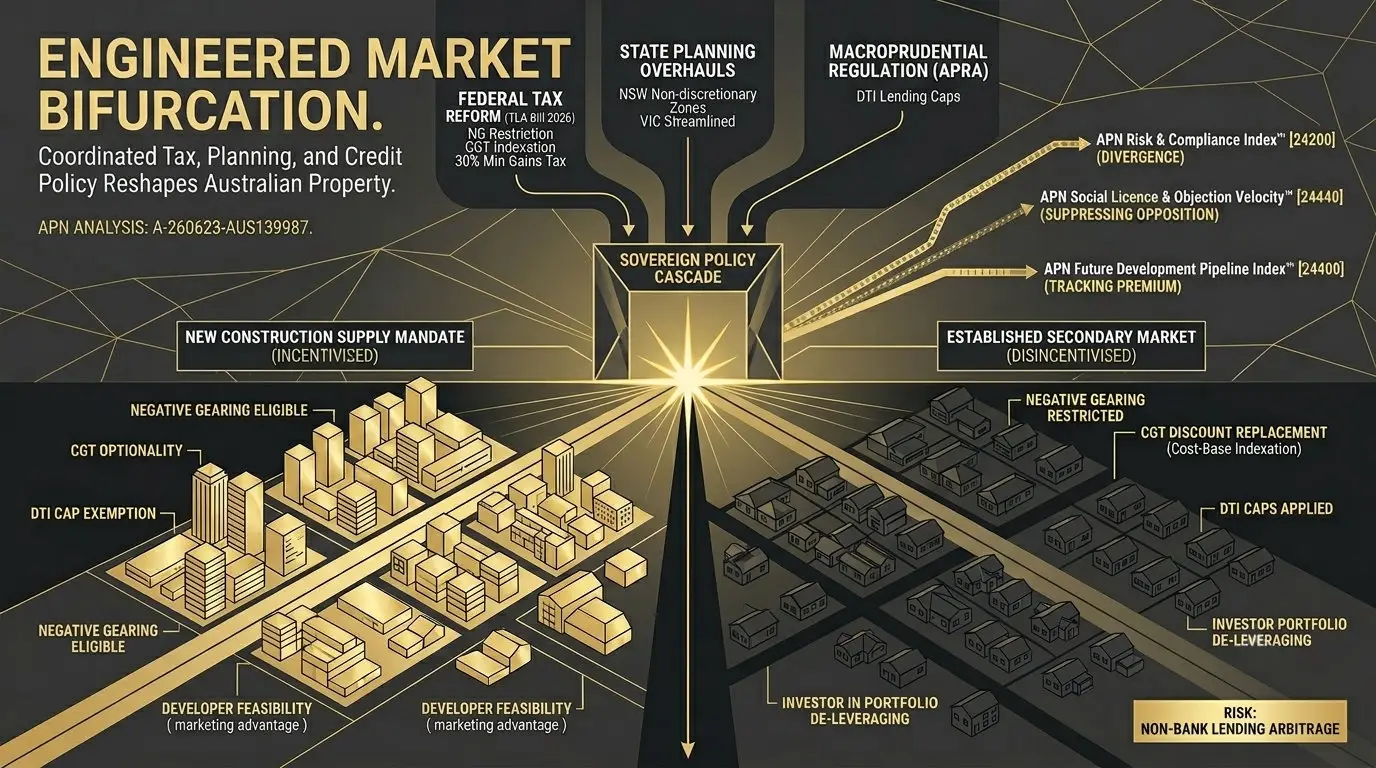
The Commonwealth budget contains two kinds of housing measure: spending, and changes to tax. The largest is a tax change. From 1 July 2027, losses on established residential property acquired from 7.30 pm AEST on 12 May 2026 can be deducted only against rental income or capital gains from residential property, with any excess carried forward; eligible new builds keep the existing treatment. At the same time the 50 per cent capital gains tax discount is replaced by indexation of the cost base, with a 30 per cent minimum tax on net gains, for all assets; investors in new residential property may keep the discount. The budget estimates the two changes together raise $3.6 billion over five years, with receipts beginning in 2028–29.
| Measure | Amount, as the paper states it | Note |
|---|---|---|
| Negative gearing limited to new builds, and the 50 per cent capital gains tax discount replaced by indexation with a 30 per cent minimum tax, both from 1 July 2027 | Receipts up $3.6 billion over five years from 2025–26 ($1,350.0 million in 2028–29, $2,280.0 million in 2029–30) | The capital gains change applies to all assets, not only housing; the estimate covers both changes |
| Housing Support Program, Local Infrastructure Fund | $2.0 billion over four years from 2026–27 | Paid through the states to local governments and utility providers; contingent on state productivity reforms |
| Treasury oversight of the Homes for Australia programs and a public information campaign on the tax changes | $56.4 million over four years from 2025–26 | |
| Australian Housing and Urban Research Institute | $2.1 million in 2026–27 | |
| Ban on foreign purchases of established dwellings extended to 30 June 2029 | Receipts down $185.0 million over five years from 2025–26 | Foregone foreign investment application fees |
| Supporting youth into community housing | $59.4 million over four years from 2026–27 | Rental income supplement for community housing providers housing over 4,000 young people |
| National First Nations housing peak body | $6.3 million over three years from 2026–27 |
Source: Australian Government, Budget 2026–27, Budget Paper No. 2, Budget Measures.
New South Wales
The NSW Budget Statement lists its housing measures in its overview chapter. Several are policy changes with no amount stated. The largest amount, for social housing energy upgrades, is Commonwealth money.
| Measure | Amount, as the paper states it | Note |
|---|---|---|
| Development Coordination Authority, a single point to coordinate agency inputs on development applications and planning proposals, from 1 July 2026 | No amount stated | |
| Pre-Sale Finance Guarantee extended to not-for-profit community housing providers and smaller developments | No amount stated | Expands an existing $1 billion program |
| Surcharge purchaser duty relief for retirement village developers and operators | Revenue down $15 million over four years to 2029–30 | |
| Surcharge purchaser duty relief for operational build-to-rent properties | Revenue effect shown as nil | |
| NSW Digital Planning System | $14.0 million | |
| Building Commission: new building approvals system, modern methods of construction framework, dispute resolution pilot | $32.3 million | |
| Expression of interest for a modern methods of construction manufacturing facility | No amount stated | |
| Social Housing Energy Performance Initiative extension | $145.3 million | Commonwealth funding under a Federation Funding Agreement |
| First Nations housing and tenancy support services | $9.9 million in 2026–27 | |
| Air conditioning and energy upgrades for Aboriginal Housing Office properties | $6.9 million over two years | Over 600 tenants |
| Planning for housing and infrastructure in discrete Aboriginal communities | $5.0 million over two years |
Source: NSW Budget 2026–27, Budget Paper No. 1, Budget Statement (Chapters 1 and 4, and the Aboriginal outcomes statement). The Measures Statement in Appendix B lists these measures without amounts.
Victoria
Victoria lists each measure with a yearly amount. Its largest housing measure is an $859.7 million transfer into the Social Housing Growth Fund, whose investment returns fund social housing built by community housing providers. Victoria also extends its off-the-plan duty concession for six months.
| Measure | Amount, as the paper states it | Note |
|---|---|---|
| Social Housing Growth Fund and Affordable Housing Investment Partnerships expansion | $859.7 million, 2025–26 to 2029–30 | Invested in the Fund; returns fund more than 7,000 social housing homes over ten years |
| Continuing supportive housing for rough sleepers using a Housing First model | $15.1 million, 2026–27 to 2027–28 | Five supportive housing sites |
| Making homelessness rare and non-recurring | $25.8 million, 2026–27 to 2029–30 | Assertive outreach and emergency accommodation |
| Support for renters to maintain tenancies | $6.1 million, 2026–27 to 2027–28 | Tenancy Plus expansion for social housing renters |
| Continuing investment in a thriving North Richmond | $2.0 million, 2026–27 to 2027–28 | North Richmond public housing estate |
| Rent-To-Buy for First Peoples | $16.0 million, 2026–27 to 2029–30 | Up to 30 newly built dwellings |
| Energy efficiency in community housing | $10.0 million, 2025–26 | |
| Faster, fit for purpose environmental assessments and approvals for renewable energy and affordable housing | $2.1 million, 2026–27 | Shared with renewable energy projects |
| Building policy and reform | $80.8 million, 2026–27 to 2029–30 | Housing and building reform and consumer protection |
| Development Facilitation Program | $9.9 million, 2026–27 to 2028–29 | Fast-tracking significant housing and economic development |
| Implementing the 10-year plan for Melbourne’s greenfields | $15.6 million, 2026–27 to 2029–30 | Land supply for new homes |
| Plan for Victoria implementation | $1.5 million, 2025–26 to 2026–27 | Partly funds the Geelong Authority to support housing delivery |
| Off-the-plan land transfer duty concession extended by six months, to contracts signed before 21 April 2027 | Revenue down $32.7 million, 2026–27 to 2029–30 |
Source: Victorian Budget 2026/27, Budget Paper No. 3, Service Delivery, Chapter 1. Amounts are the sum of the yearly figures in the output initiative tables.
Queensland
Queensland’s Budget Measures paper states each measure’s total in its own words. The largest are continued funding for its social and community housing program and for homelessness services. Two revenue measures change who gets duty and surcharge relief.
| Measure | Amount, as the paper states it | Note |
|---|---|---|
| Continued delivery of 53,500 social and community homes by 2044 | $487.3 million over five years (expense) and $537.1 million over five years (capital) | Part of a stated $5.725 billion over four years in social and community housing |
| Specialist homelessness services and peak bodies, funding continuity | $450.1 million over four years | Then $27.4 million a year to 2036–37 |
| Private rental market tenancy support programs | $83.4 million over three years | |
| Residential Tenancies Authority operations | $18.5 million over four years | Then $4.9 million a year |
| Regulation of community housing providers, retirement villages and residential services | $6.4 million over four years | Then $1.6 million a year |
| Palm Island rent-to-buy home ownership scheme | $731,000 over four years | $2 million over ten years |
| Boost to Buy shared equity scheme | $163 million (capital) and $2 million (expense) in 2026–27 | Part of a stated $330 million package for up to 2,000 first home buyers |
| Infrastructure Activation Fund, enabling works to unlock new homes | $20 million in 2026–27 | A $200 million fund; the balance is met from within existing budgets |
| Woolloongabba entertainment and housing precinct, early works and market process | $45.6 million over two years | Shared with an arena |
| Skills demand for housing, construction and health | $44.2 million in 2026–27 | Shared with health and the 2032 Games |
| Home, first home and vacant land transfer duty concessions closed to temporary residents from 1 August 2026 | Revenue foregone down $28.9 million over four years | |
| Transfer duty and land tax surcharge relief for entities building housing: qualifying threshold cut from 50 dwellings to 20 | Revenue foregone of $66.2 million over five years |
Source: Queensland Budget 2026–27, Budget Paper No. 4, Budget Measures.
Western Australia
Western Australia presents its housing measures as one package, which it puts at $4.7 billion in new initiatives, and groups them as shown here. The package includes Commonwealth co-investment: $212 million in grants and $849 million in interest-free loans under the 100,000 Homes for First Home Buyers program.
| Measure | Amount, as the paper states it | Note |
|---|---|---|
| Land supply and enabling infrastructure | $1.3 billion | Includes $570 million for new residential developments and station precincts, and the Housing Enabling Infrastructure Fund raised to $665 million |
| Social and affordable housing | $1.5 billion | Includes $1 billion for 1,426 dwellings with the Housing Australia Future Fund, $218 million for 165 new and 215 refurbished dwellings, and $234 million for maintenance |
| Housing Taxation Package | $297 million | First home buyer duty exemption to $600,000 for established homes; off-the-plan concession extended to 30 June 2028 and widened; First Home Owner Grant cap raised to $800,000 |
| 500 affordable homes for first home buyers, with Keystart shared equity loans | $375 million | |
| Presales Finance Guarantee and First Home Buyer Commercial Financing Facility | $250 million each | |
| Housing and Infrastructure Advanced Manufacturing Facilities, Neerabup and Kwinana | $48 million | |
| Housing for regional government workers | $419 million | Includes $170 million from resources companies |
| Broome North and South Hedland residential developments; Regional Housing Support Fund | $116 million; $50 million | 232 additional lots |
| Housing support and homelessness | $105 million | Includes $13.5 million for rent relief grants and $45 million for homelessness accommodation |
| Construction workforce: training places, visa subsidies and fee-free courses | $19.6 million, $13.1 million and $18.7 million |
Source: Western Australia 2026–27 Budget, Budget Paper No. 3, Economic and Fiscal Outlook, Housing Investment feature box and Chapter 4 revenue measures. The state groups its measures this way.
South Australia
South Australia’s Budget Measures Statement sets out each measure. Several run through government businesses; Renewal SA expects to recover its spending over time from selling land and homes. Two of the funds are a guarantee and a land purchase fund rather than grants.
| Measure | Amount, as the paper states it | Note |
|---|---|---|
| Rent to Own: 2,000 affordable homes leased at 75% of market rent with an option to buy | Over $1.3 billion over eight years | Includes a $133.6 million Commonwealth contribution |
| Housing Fast-Track Fund: strategic land bought and sold for housing development | $500 million from 2026–27 | |
| Apartment Fast-Track Fund: government guarantee of up to half the dwellings in eligible off-the-plan developments | $500 million fund | A guarantee; no expense is shown in the forward estimates |
| 200 additional supported accommodation places | $110 million over four years | |
| Playford Alive: enabling infrastructure for 400 homes for first home buyers | $50 million in 2026–27 | Assisted by a Commonwealth interest-free loan |
| Social Housing Energy Performance initiative expansion, 3,500 homes | $36.1 million over three years | Fully Commonwealth funded |
| 300 vacant public housing homes upgraded | $30 million over five years from 2025–26 | |
| Housing skills: 1,000 pathways into the construction workforce | $29.5 million over eight years | A workforce measure |
| Remote Aboriginal housing property and tenancy management | $12.2 million in 2026–27 | Continues services after Commonwealth funding ceased |
| Homelessness support services in the Adelaide CBD | $6.0 million over four years | |
| Portable Rental Bonds Scheme | $5.7 million over three years | Then $1.2 million a year, recovered through a $35 transfer fee |
| Residential parks compliance and dispute resolution | $567,000 a year and $168,000 capital | |
| Housing pattern book of pre-approved designs | $500,000 over two years | |
| HomeStart Finance online service for first home buyers | $500,000 over two years | With wider loan eligibility |
| Downsizing stamp duty concession for buyers aged 60 and over purchasing a new home or land to build one | Revenue down $77 million, 2025–26 to 2029–30 | Relief of up to $103,830 |
Source: South Australia 2026–27 Budget, Budget Measures Statement.
Tasmania
Tasmania’s housing measures in its Policy and Parameter Statement are small in dollar terms; the largest are $10.9 million to extend the First Home Owner Grant boost and $10.0 million over four years for youth housing. The budget papers also note that the first home buyer duty exemption was due to expire on 30 June 2026; none of the revenue policy decisions in the statement extends it.
| Measure | Amount, as the paper states it | Note |
|---|---|---|
| Youth housing | $10.0 million, 2026–27 to 2029–30 | |
| First Home Owner Grant Boost extension | $10.9 million, 2026–27 to 2027–28 | |
| Homes Tasmania: rising property holding costs | $6.7 million, 2025–26 to 2026–27 | |
| Homes Tasmania: Social Housing Maintenance Fund | $1.5 million, 2025–26 to 2026–27 | |
| Homes Tasmania: McCombe House | $0.8 million, 2026–27 to 2029–30 | |
| Homes Tasmania: Jireh House | $0.4 million, 2026–27 to 2029–30 | |
| Remote Indigenous housing, Cape Barren and Flinders Island | $0.5 million, 2026–27 |
Source: Tasmanian Budget 2026–27, Budget Paper No. 1, Chapter 5, Table 5.5 Policy and Parameter Statement. Amounts are the sum of the yearly figures shown.
Australian Capital Territory
The ACT reports each decision as a net cost or net capital figure over four years. It describes $770 million in funding for housing access and supply, including 450 new public homes and support for more than 1,000 affordable homes. It also abolishes conveyance duty for all first home buyers.
| Measure | Amount, as the paper states it | Note |
|---|---|---|
| 30,000 homes by 2030: public housing pipeline | $302.0 million over four years | Capital |
| Public housing repairs and maintenance | $214.5 million over four years | Net cost; the initiative also carries net capital of −$31.1 million over the same years |
| Supporting community housing | $38.2 million over four years | |
| Progressing public housing repairs and maintenance insourcing | $18.8 million over four years | Net cost; plus net capital of $2.6 million in 2026–27 |
| Investing in housing and homelessness services | $16.9 million over four years | |
| Reducing stamp duty for owner-occupiers | Revenue forgone $69.7 million over four years; net cost $4.2 million after an offset from general rates | |
| Cost of living – Housing Crisis Support Fund | $3.2 million over two years, 2026–27 to 2027–28 | |
| Missing middle lease variation charge remission and review | $2.0 million over four years |
Source: ACT Budget 2026–27, Budget Outlook, new policy decisions ($’000, 2026–27 to 2029–30). Amounts are the net figures the territory reports, after any offsets.
Northern Territory
Among the key expenditure commitments the Northern Territory lists as approved in its 2026–27 Budget, one is for housing: $22.8 million to support applications for new social and affordable housing in round 3 of the Housing Australia Future Fund. The list also includes $2 million a year in 2026–27 and 2027–28 to support land release in Alice Springs, Katherine and Tennant Creek. Two earlier commitments, $11 million to extend the HomeGrown and FreshStart home grants and $40 million for local government, housing and community development, appear in the 2025–26 mid-year report and are not counted here. The Territory also receives $438.2 million in Commonwealth housing payments in 2026–27, shown above.
What this ledger does not show
A budget amount is a plan. It does not show how many homes are built, when, or at what cost, and some amounts are guarantees or loans that may never be drawn. The state tables are not comparable with each other: they come from different documents, cover different years, mix spending with capital and revenue, and in some cases include Commonwealth money that also appears in the first section. Measures that affect housing indirectly, such as transport, water and general planning reform, are included only where the paper names housing as a purpose; how public spending on the roads, water and power behind new housing has moved is covered in Roads, Water and Power: The Public Groundwork Behind New Housing. The ledger sets out what was announced in the 2026–27 budgets; later updates may change any amount.
Findings are presented on the basis of data and evidence alone.