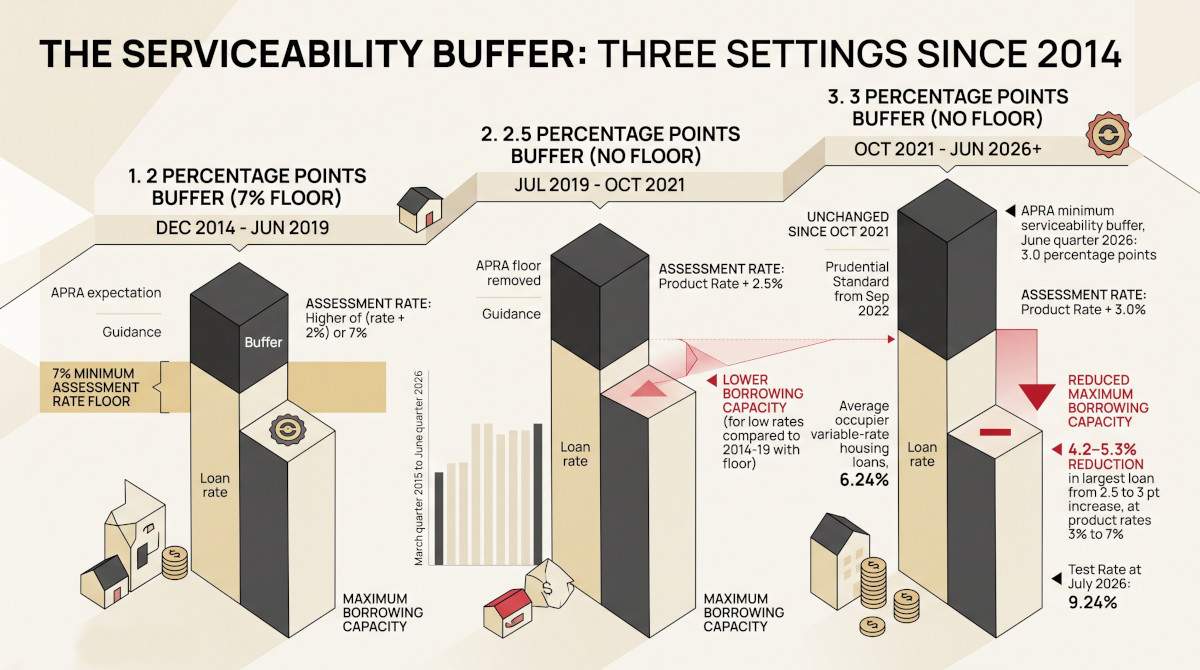

When a bank decides how much it will lend for a home, it does not test repayments at the rate the borrower will pay. It tests them at a higher rate, set by adding a buffer that the prudential regulator, APRA, requires every lender it supervises to apply. That buffer has had three settings since the end of 2014: 2 percentage points alongside a 7% minimum assessment rate, 2.5 points from July 2019, and 3 points from October 2021. It has stood at 3 points for 19 consecutive quarters to June 2026. In July 2026 the average new owner-occupier variable loan was priced at 6.24%, so it was tested at no less than 9.24%.
The buffer is a regulatory setting, not a market measure. It changes only when APRA changes it, so it is presented as a history of three settings rather than as a reading against a long-run average.
What the buffer is
A serviceability assessment asks whether a borrower could keep meeting repayments if circumstances changed. Lenders take the borrower’s income, subtract living expenses and other debts, and check that what is left covers the loan’s repayments. The buffer decides the interest rate used in that check. A loan offered at 6% with a 3-point buffer is assessed as if it cost 9%.
APRA explained the purpose when it first set the expectation, in a letter to all authorised deposit-taking institutions on 9 December 2014: the buffer accommodates not only future changes in interest rates but also unexpected changes in a borrower’s income and expenses. It applies when a loan is assessed, so a change reaches new borrowers rather than existing loans.
From guidance to a prudential standard
For almost eight years the buffer was an expectation in APRA’s guidance, and lenders that ignored it faced supervisory attention rather than a breach. That changed on 1 September 2022, when Attachment C to Prudential Standard APS 220 Credit Risk Management took effect. That attachment, made under section 11AF of the Banking Act 1959, requires that a bank apply a buffer over a loan’s interest rate and that the level “must be at least 3.0 per cent, unless determined otherwise by APRA”. The buffer is applied to the rate the borrower will actually pay, setting aside any discounted introductory rate offered for a limited period at origination.
The same attachment sets the range within which the requirement can move: APRA may vary the minimum between 2.0 and 5.0 per cent. A change within that range needs no new standard and no legislation.
Three settings since 2014
The first expectation combined two tests. Lenders were to assess loans at a rate at least 2 percentage points above the product rate, and at no less than 7%. Whichever was higher applied. In July 2019 APRA removed the 7% floor, saying that in the prevailing environment a floor of more than 7% was higher than necessary for sound lending standards, and raised the buffer to at least 2.5 points. APRA noted that common industry practice had been a floor of 7.25%, and that the spread of different prices for different types of loan had weakened the case for a single floor across all products. Lenders were left to set their own floors.
In October 2021 APRA raised the buffer to at least 3 percentage points. The cash rate target was then 0.1%. APRA pointed to a rising share of heavily indebted borrowers, noting that more than one in five new loans approved in the June quarter of 2021 were at more than six times the borrower’s income. The level has not moved since. It was confirmed most recently on 28 May 2026, when APRA left its macroprudential settings unchanged.
APRA minimum serviceability buffer, percentage points above the loan product rate, March quarter 2015 to June quarter 2026
Source: APRA letter to authorised deposit-taking institutions, 9 December 2014; APRA media releases of 5 July 2019 and 6 October 2021; APRA macroprudential update, 28 May 2026. Each bar shows the setting that applied in the quarter. The 2.0 setting also carried a 7% minimum assessment rate, which the bars do not show.
| Set | APRA document | Buffer | Floor rate | Instrument | In force |
|---|---|---|---|---|---|
| December 2014 | Letter to all authorised deposit-taking institutions, 9 December 2014 | At least 2 per cent above the loan product rate | Minimum assessment rate of 7 per cent; common industry practice 7.25 per cent | Guidance | January 2015 to June 2019 |
| July 2019 | Media release and letter, 5 July 2019; amended APG 223 | At least 2.5 per cent over the loan’s interest rate | APRA floor removed; each lender sets its own | Guidance | July 2019 to October 2021 |
| October 2021 | Media release and letter, 6 October 2021 | At least 3.0 percentage points above the loan product rate | No APRA floor | Guidance, then a requirement of APS 220 from 1 September 2022 | From the end of October 2021; most recently confirmed 28 May 2026 |
Source: APRA letters and media releases as listed; Prudential Standard APS 220 Credit Risk Management, Attachment C.
Why the 2015 and 2019 settings cannot be compared on the number alone
A buffer of 2.5 points looks tighter than a buffer of 2 points. For a loan priced below 4.5%, it was not. Under the first setting the 7% floor, not the buffer, set the assessment rate for any loan priced below 5%. Replacing the floor with a 2.5-point buffer therefore lowered the assessment rate for loans priced below 4.5% and raised it for loans priced above 4.5%. Against the 7.25% floor that lenders commonly used, the dividing line was 4.75%. At the headline standard variable rate, which ran between 5.15% and 5.93% from January 2015 to June 2019, the buffer set the test; it was loans priced below 5%, under that headline rate, that met the floor first.
Which side of that line lending sat on can be measured from July 2019, the month the change took effect and the month the RBA’s series of rates actually charged begins. New owner-occupier variable loans funded that month were priced at 3.50% on average. Under the old rule they would have been assessed at 7.00%, the floor; under the new one, at 6.00%. The buffer rose and the test fell by a full percentage point, which for a given repayment capacity is worth about 11.0% more borrowing.
Assessment rate by loan product rate under each APRA setting, %
APN calculation. The assessment rate is the product rate plus the buffer, and for the 2015 to 2019 setting no less than 7%. The lines show APRA’s minimum expectations; a lender could assess at a higher rate, and after July 2019 could set its own floor.
What was actually applied, 2019 to 2026
The buffer is added to whatever the product rate is, so the rate at which new loans are tested moves with the market even when the setting does not. The chart below takes the average rate on new owner-occupier variable loans each month and adds the buffer in force. On that basis the test was at its lowest in October 2021, at 5.13%, the last month before the buffer rose; under the 3-point setting its low was 5.41% in April 2022. In July 2026 it stood at 9.24%. The dashed line shows what the 2015 rule would have produced over the same period.
The gap between the two lines is the arithmetic effect of removing the floor, not a measure of what lenders did next: from July 2019 each set its own floor, and where those sat is outside this data. In 43 of the 85 months since July 2019, or 51% of them, the average new loan was priced below 5%, which is the point below which the old floor would have bound. Through that stretch the floor, not the buffer, would have set the test, and the assessment rate would have been fixed at 7% no matter how far the cash rate fell.
Average rate on new owner-occupier variable loans, the assessment rate applied, and the 2015 rule, July 2019 to July 2026
Sources: RBA Statistical Table F6, housing lending rates, new loans funded in the month, owner-occupied, variable-rate, all institutions; APRA buffer settings. The assessment rate applied adds the buffer in force that month; the dashed line adds a 2.0-point buffer with a 7% floor. Rates are averages across lenders, and an individual loan may be priced above or below them.
What a buffer does to a borrowing limit
The buffer works through the repayment on a loan. If a borrower can put a fixed amount each month towards repayments, the largest loan they qualify for is the loan whose repayment, at the assessment rate, equals that amount. A higher assessment rate means a larger repayment per dollar borrowed, and so a smaller loan.
The illustration below assumes $1,000 a month of repayment capacity, a 30-year principal-and-interest loan and APRA’s minimum settings, applied to the average new-loan rate in two months: July 2019, at 3.50%, and July 2026, at 6.24%. At the 2019 rate the three settings produce $150.3k, $166.8k and $158.2k: the floor is the tightest of the three, and even the 3-point buffer leaves the test half a point below it. At the 2026 rate the order reverses, because the product rate plus the buffer is well above the 7% floor, so only the buffer applies: $133.2k, $127.2k and $121.7k, a difference of 8.7% between the first setting and the current one.
Across product rates between 3% and 7%, raising the buffer from 2.5 to 3 points reduces the largest loan by between 4.2% and 5.3%, a little less at higher rates. That is consistent with APRA’s own estimate in October 2021 that the increase would reduce maximum borrowing capacity for the typical borrower by around 5%. In the month it took effect the average new loan was priced at 2.63%, so the test moved from 5.13% to 5.63%.
Largest loan per $1,000 of monthly repayment capacity, at the average new-loan rate in two months, $ thousand
APN illustration, not advice. The rate in brackets is the assessment rate. Assumes a 30-year principal-and-interest loan with monthly repayments, APRA’s minimum buffer and floor settings, and the same repayment capacity in every case. Lenders apply their own assessment rates, expense measures and income policies, and actual limits differ.
The rate moves; the setting does not
Since April 2022 the average rate on new owner-occupier variable loans has risen 3.83 percentage points, from 2.41% to 6.24%. With the buffer unchanged, the assessment rate rose with it, from 5.41% to 9.24%, and the largest loan for a given repayment capacity is about 32% smaller than it was at that low. The 2021 buffer increase moved the test by half a point; the market moved it by 3.83.
The regulatory setting and the test a borrower faces are therefore separate things. The setting has not changed since 2021. The rate at which new loans are tested has changed with every movement in lending rates. Nor does that movement have to come from the Reserve Bank: fixed rates are priced off longer-term funding costs, so a borrower taking a fixed rate can be tested at a different rate this month than last with no change in the cash rate at all. The rate borrowers pay is also not the rate banks advertise: the indicator standard variable rate was 8.77% in July 2026, 2.53 percentage points above the average rate on loans actually funded that month.
What the measure does and does not show
The buffer is a step series. It holds one value for years and changes only when APRA changes it, so it records a regulatory choice, not a condition that fluctuates. Three settings in more than eleven years do not form a distribution from which a normal level could be estimated, and APN does not present the buffer as above or below an average.
The figures are APRA’s minimum requirements, and four things sit outside them. Banks may lend outside their own serviceability policy where those exceptions are monitored and reported; APRA told the Senate Select Committee on Productivity in April 2026 that such exceptions account for less than 5% of new housing lending, and that a bank may consider a refinancing borrower’s past repayment behaviour among other indicators of capacity. The buffer binds banks and other authorised deposit-taking institutions, not the non-bank lenders that answer to ASIC’s responsible lending obligations; APRA names a migration of lending to those lenders as a potential indicator that its settings are too restrictive, and puts their share of housing lending at less than 5%. The buffer is one part of an assessment that also covers expenses and income, where APRA’s guidance says a prudent lender would discount less certain income, such as bonuses and overtime, by at least 20%. And it works alongside a separate limit, in force since 1 February 2026, allowing banks to write no more than 20% of new lending at six times income or more, applied separately to their owner-occupier and investor lending.
APN reads the buffer as an input to Prudential Policy Settings (24722), a component of Policy & Regulatory Conditions (24720).
Findings are presented on the basis of data and evidence alone.