Buy, build, rent or strata-title a home in any Australian capital and the same few kinds of law apply, but under different names in each state and territory. The owners of a strata flat in Melbourne deal with the Owners Corporations Act 2006; in Brisbane, with the Body Corporate and Community Management Act 1997. This guide sets out, for the capital city council area in each state and territory, which instrument governs each subject, from the planning rules for what can be built to the tax paid each year on the land.
The library is a curated set of the laws governing housing and property, not a census of all Australian law.
Three layers, one address
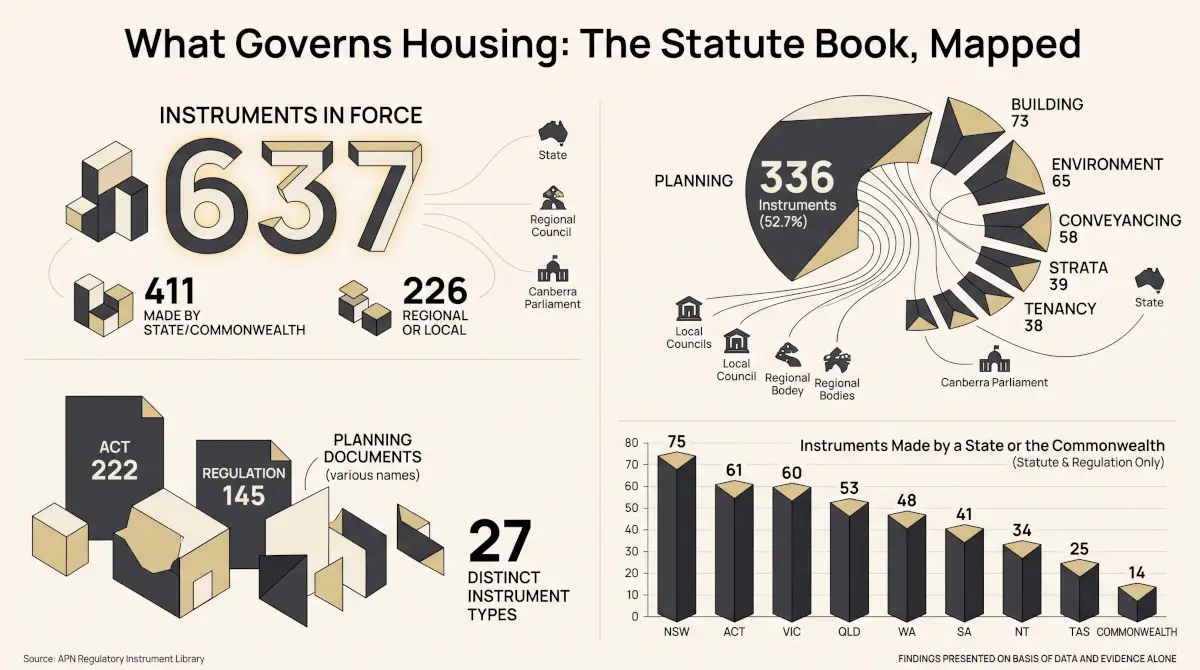
Any home in Australia is covered by three layers of law. A national layer, including the three volumes of the National Construction Code, is the same in every state and territory. The state or territory layer covers most of what a buyer, owner or tenant deals with: planning, building, strata, renting, sale of land and property taxes. A council-level layer adds the planning rules for a particular area. The APN Regulatory Instrument Library records which instruments apply where; this guide uses it to answer a practical question for one area in each state and territory, the capital city council area.
What can be built: the planning layers
Planning law is where the capitals differ most in structure. In Sydney, Melbourne and Brisbane the council area has its own plan made under the state’s planning Act: the Sydney Local Environmental Plan 2012, the Melbourne Planning Scheme and Brisbane City Plan 2014. In Adelaide there is no council plan at all; South Australia’s single Planning and Design Code applies in every area, with a regional plan for Greater Adelaide above it. Hobart has a Local Provisions Schedule that forms part of the one Tasmanian Planning Scheme. Darwin sits under the territory-wide Northern Territory Planning Scheme 2020, with six area plans for particular parts of the city. Canberra has no councils; the Territory Plan applies throughout, with district strategies and technical specifications, and the Commonwealth’s National Capital Plan applies across the Territory, with detailed control in its Designated Areas.
Some capitals carry rules of their own. Sydney, Melbourne, Brisbane and Perth each have an Act of Parliament specific to the capital city council, as does Adelaide (the City of Adelaide Act 1998, not held in the library), and two New South Wales precinct policies reach parts of the City of Sydney.
| Capital council area | Principal planning Act | State-wide planning instrument | Council-level planning instrument | Place-specific or regional instruments |
|---|---|---|---|---|
| City of Sydney | Environmental Planning and Assessment Act 1979 | State environmental planning policies, such as the State Environmental Planning Policy (Housing) 2021 | Sydney Local Environmental Plan 2012, with five older or site-specific plans, such as the Sydney Local Environmental Plan (Harold Park) 2011 | Two precinct policies, and the City of Sydney Act 1988 |
| City of Melbourne | Planning and Environment Act 1987 | NIL RETURN in the library | Melbourne Planning Scheme | The City of Melbourne Act 2001 |
| City of Brisbane | Planning Act 2016 | The Planning Regulation 2017 | Brisbane City Plan 2014 | The City of Brisbane Act 2010 and its regulation |
| City of Perth | Planning and Development Act 2005 | The Planning and Development (Local Planning Schemes) Regulations 2015 | NIL RETURN: the City of Perth’s local planning scheme is not yet held | The City of Perth Act 2016 |
| City of Adelaide | Planning, Development and Infrastructure Act 2016 | The Planning and Design Code and State Planning Policies | No council plan: the state-wide Code applies | The Greater Adelaide Regional Plan |
| City of Hobart | Land Use Planning and Approvals Act 1993 | The State Planning Provisions of the Tasmanian Planning Scheme | The Hobart Local Provisions Schedule to the Tasmanian Planning Scheme | The Southern Tasmania Regional Land Use Strategy 2026 |
| Canberra (ACT) | Planning Act 2023 | The Territory Plan 2023 | No councils: district strategies and technical specifications, such as the Planning (Inner North and City) District Strategy 2023 | The Commonwealth’s National Capital Plan |
| City of Darwin | Planning Act 1999 | The Northern Territory Planning Scheme 2020 | Six area plans, such as the Central Darwin Area Plan | The Darwin Regional Land Use Plan |
Instruments held in the APN Regulatory Instrument Library, as at 17 September 2026. NIL RETURN marks an instrument the library does not yet hold.
Owning, renting and selling: the state laws
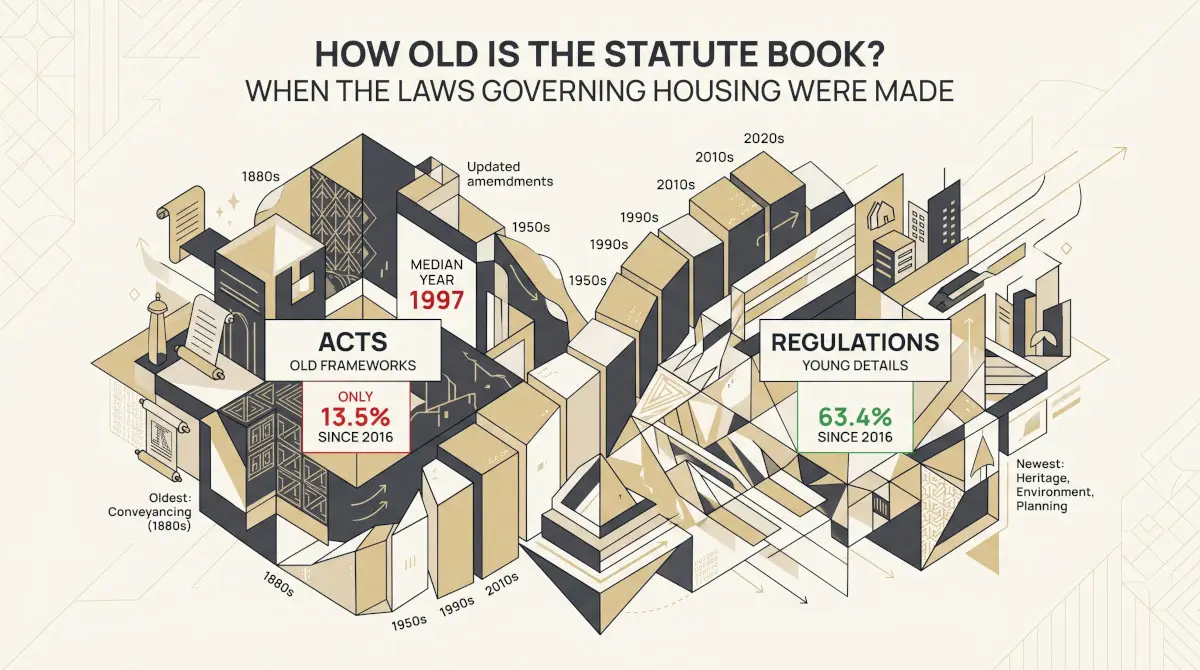
Beyond planning, the laws that govern a home are state and territory Acts that apply throughout each jurisdiction, so they are the same in the capital as in the rest of the state. Each state and territory has its own Act for each subject, except that the Northern Territory levies no land tax, and they differ in name and age: the oldest principal Act in the table is Tasmania’s Conveyancing and Law of Property Act 1884, and the newest Queensland’s Property Law Act 2023.
| Subject | City of Sydney | City of Melbourne | City of Brisbane | City of Perth | City of Adelaide | City of Hobart | Canberra (ACT) | City of Darwin |
|---|---|---|---|---|---|---|---|---|
| Building | Home Building Act 1989 | Building Act 1993 | Building Act 1975 | Building Act 2011 | Planning, Development and Infrastructure Act 2016 | Building Act 2016 | Building Act 2004 | Building Act 1993 |
| Strata and community title | Strata Schemes Management Act 2015 | Owners Corporations Act 2006 | Body Corporate and Community Management Act 1997 | Strata Titles Act 1985 | Strata Titles Act 1988 | Strata Titles Act 1998 | Unit Titles (Management) Act 2011 | Unit Title Schemes Act 2009 |
| Renting | Residential Tenancies Act 2010 | Residential Tenancies Act 1997 | Residential Tenancies and Rooming Accommodation Act 2008 | Residential Tenancies Act 1987 | Residential Tenancies Act 1995 | Residential Tenancy Act 1997 | Residential Tenancies Act 1997 | Residential Tenancies Act 1999 |
| Buying and selling | Conveyancing Act 1919 | Sale of Land Act 1962 | Property Law Act 2023 | Sale of Land Act 1970 | Land and Business (Sale and Conveyancing) Act 1994 | Conveyancing and Law of Property Act 1884 | Civil Law (Sale of Residential Property) Act 2003 | Law of Property Act 2000 |
| Transfer (stamp) duty | Duties Act 1997 | Duties Act 2000 | Duties Act 2001 | Duties Act 2008 | Stamp Duties Act 1923 | Duties Act 2001 | Duties Act 1999 | Stamp Duty Act 1978 |
| Land tax | Land Tax Act 1956 | Land Tax Act 2005 | Land Tax Act 2010 | Land Tax Act 2002 | Land Tax Act 1936 | Land Tax Act 2000 | Land Tax Act 2004 | No land tax |
The principal Act for each subject in the state or territory that contains each capital; each applies throughout that jurisdiction. Regulations, codes and related Acts sit alongside most of these. Source: APN Regulatory Instrument Library, as at 17 September 2026.
Which Acts levy land tax and duty in each state is covered in more detail in Land Tax and Duty in the Statute Book, and how the tenancy Acts compare on bonds, rent increases and notice in Tenancy Law Across the States.
What this does not show
The guide names the principal instrument for each subject; each works alongside regulations, codes and related Acts not listed. The library holds the version of each instrument currently in force, not its amendment history, and does not yet hold every council’s planning instrument; the City of Perth’s local planning scheme is one it does not hold. Council development control plans and local laws are not included. Nothing here is legal advice; anyone buying, building or renting should check the current instruments and seek advice.
Findings are presented on the basis of data and evidence alone.