On Census night 2021, 5.1% of the labour force were unemployed. Suburb by suburb the rate ranged far wider, and 392 localities, home to 1.0 million people, had rates of 10% or more.
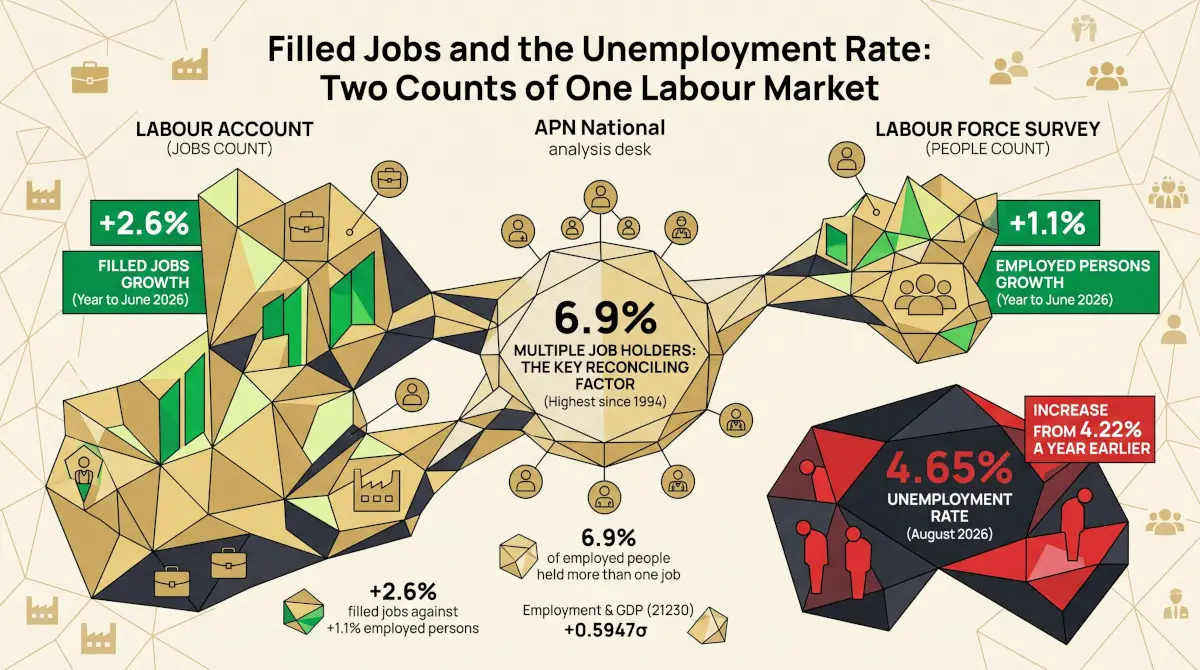
Over the year to June 2026 filled jobs rose 2.6% while the number of people employed rose 1.1%, and unemployment rose to 4.65% in August, from 4.22% a year earlier. The difference is largely second jobs: 6.9% of employed people...
APN 22000 Series Claim Test: five of six Final Budget Outcome claims hold, including the slowest public demand growth in 11 years and the lowest average unemployment since 1978; the productivity claim does not hold on either GDP per hour...
Unemployment, jobs growth and new lending to first home buyers and investors all sit close to their 2011–2025 averages. Migration is the exception: easing from its 2023 peak, but still above any year from 2011 to 2020.
An APN 23000 Series attributed perspective: Clime founder John Abernethy responds to the Reserve Bank Governor's remark that unemployment of 4.5 to 5 per cent would ease inflation, arguing that wages have not matched inflation since COVID and that three...
APN 22000 Series Claim Test: real wages are 4.4% below their December 2019 level after two years of recovery reversed as inflation re-accelerated, and unemployment, at 4.6% in August, is already inside the 4.5 to 5 per cent range the...
Unemployment averaged 4.43% in the June quarter of 2026, 0.26 points higher than a year earlier, and 75 of 87 regions rose. Hobart rose 1.47 points, the Northern Territory outback 1.19, and the gap between the highest and lowest regions...
Australias unemployment rate has risen 0.38 points off its January 2026 floor, with a 4.4-point spread across regions -- and a two-quarter pullback in investor lending concentration arriving in the same window.