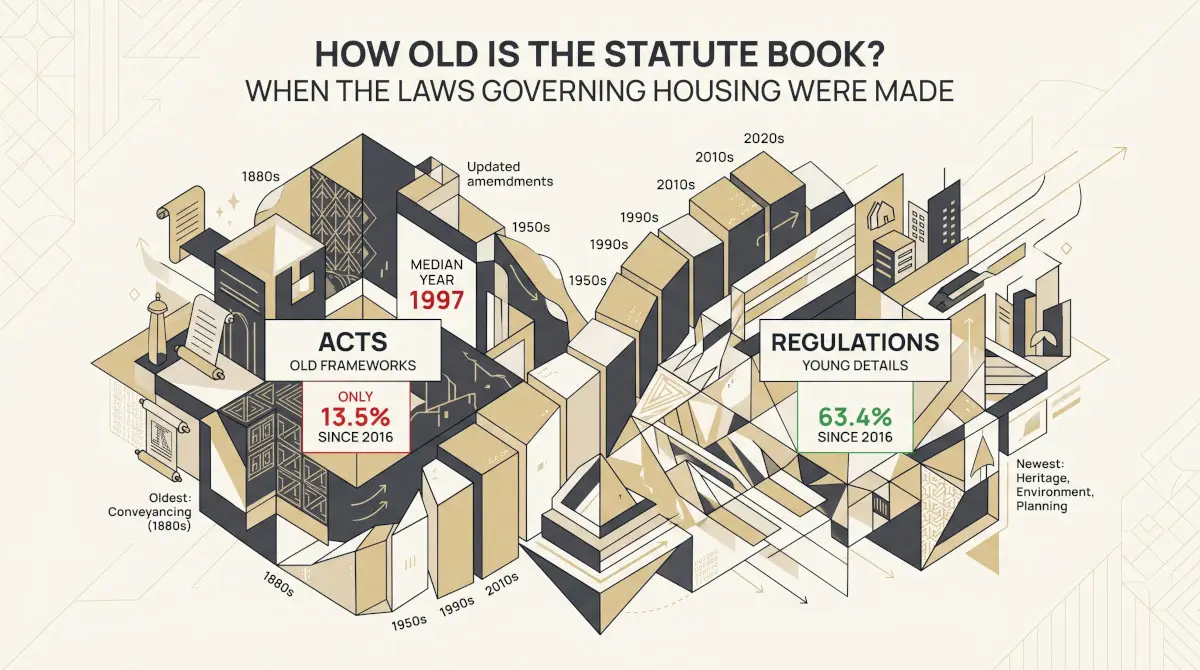

Half the Acts and regulations governing Australian housing were made in 2006 or later, but the two kinds of statute age very differently. The Acts are old: half were made in 1997 or earlier, and only 13.5% since 2016. The regulations under them are young: half date from 2018 or later. Conveyancing law holds the oldest statutes still in force, from the 1880s; heritage, environment, planning and building law are the newest.
Year made is the year in each statute’s title. The library does not hold amendment history, so a statute’s year says when it was made, not when its rules last changed.
How the age of a statute is measured
Every Act and regulation carries the year it was made in its title: the Conveyancing Act 1919, the Residential Tenancies Regulations 2025. The APN Regulatory Instrument Library holds 367 Acts and regulations in force that govern housing and property, 222 Acts and 145 regulations, across the Commonwealth, the states and the territories. This piece dates each by the year in its title.
That year is when the statute was made, not when its rules were last changed. Most Acts have been amended many times; the library holds the version in force today but not the history of amendments behind it. An old year therefore means an old framework, not an unchanged rule. The dates the library holds for its current versions are publication dates for the latest consolidation, mostly from 2025 and 2026, and are not used here.
Acts are old, regulations are young
The Acts have a median year of 1997: half were made in that year or earlier, and only 30 of 222, or 13.5%, were made in 2016 or later. Regulations have a median year of 2018, and 92 of 145, or 63.4%, were made in 2016 or later. All 16 statutes in the library made in 2025 or 2026 are regulations. The pattern is consistent with regulations, which carry the detail, being remade more often than the Acts they sit under.
Acts and regulations in force, by decade made
By the year in each statute’s title; the 10 made before 1950 are not shown. The 2020s are incomplete. Source: APN Regulatory Instrument Library, as at 17 September 2026.
More statutes date from the 2010s than any other decade, 93, and 83% were made in 1990 or later. For Acts alone, the 1990s are the largest decade.
Oldest and newest subjects
Conveyancing and land title law holds the oldest statutes in the library. The six oldest statutes in force are all property, title or valuation Acts, led by Tasmania’s Conveyancing and Law of Property Act 1884 and South Australia’s Real Property Act 1886. The newest subjects are heritage (median year 2015), environment, building and planning. Hazard law has the oldest median, 1997.5, followed by conveyancing at 1998.5: its oldest statutes are very old, but most of its regulations are recent.
| Subject | Statutes | Median year made | Oldest | Newest |
|---|---|---|---|---|
| Hazard | 20 | 1997.5 | 1954 | 2022 |
| Conveyancing and title | 58 | 1998.5 | 1884 | 2026 |
| Duties | 22 | 2001 | 1923 | 2023 |
| Land tax | 30 | 2002.5 | 1916 | 2025 |
| Agents and sales | 23 | 2003 | 1978 | 2025 |
| Tenancy | 38 | 2006.5 | 1983 | 2026 |
| Local government | 16 | 2009.5 | 1988 | 2021 |
| Strata and community title | 39 | 2011 | 1975 | 2026 |
| Planning | 72 | 2012 | 1958 | 2026 |
| Building | 58 | 2012 | 1958 | 2026 |
| Environment | 57 | 2013 | 1972 | 2026 |
| Heritage | 31 | 2015 | 1977 | 2026 |
Acts and regulations tagged to each subject, ordered by median year; a statute can carry more than one subject. Source: APN Regulatory Instrument Library, as at 17 September 2026.
| Statute | Jurisdiction | Subject |
|---|---|---|
| Conveyancing and Law of Property Act 1884 | Tasmania | Conveyancing and title |
| Real Property Act 1886 | South Australia | Conveyancing and title |
| Transfer of Land Act 1893 | Western Australia | Conveyancing and title |
| Real Property Act 1900 | New South Wales | Conveyancing and title |
| Valuation of Land Act 1916 | New South Wales | Land tax |
| Conveyancing Act 1919 | New South Wales | Conveyancing and title |
The six oldest statutes in force in the library, by the year in their title. Each has been amended since. Source: APN Regulatory Instrument Library, as at 17 September 2026.
By state and territory
Among Acts, the ACT’s are the youngest, with a median year of 2004, and Victoria’s the oldest, at 1990. The library holds between 16 and 40 Acts per jurisdiction, so the medians rest on modest numbers and reflect which Acts the library holds as much as the age of each statute book.
| Jurisdiction | Acts in the library | Median year made |
|---|---|---|
| Victoria | 40 | 1990 |
| South Australia | 25 | 1994 |
| Tasmania | 18 | 1995 |
| New South Wales | 33 | 1997 |
| Queensland | 28 | 1999.5 |
| Northern Territory | 16 | 1999.5 |
| Western Australia | 30 | 2000 |
| Australian Capital Territory | 25 | 2004 |
Acts only. Source: APN Regulatory Instrument Library, as at 17 September 2026.
What this does not show
The year a statute was made says nothing about how much it has changed since, or about how many of its rules are recent. The library is a curated set of the statutes governing housing and property, not every Australian law, and planning schemes, codes and policies are not included in this count. What applies in each capital is set out in What Applies Where, and the land tax and duty Acts in Land Tax and Duty in the Statute Book. Nothing here is legal advice.
Findings are presented on the basis of data and evidence alone.