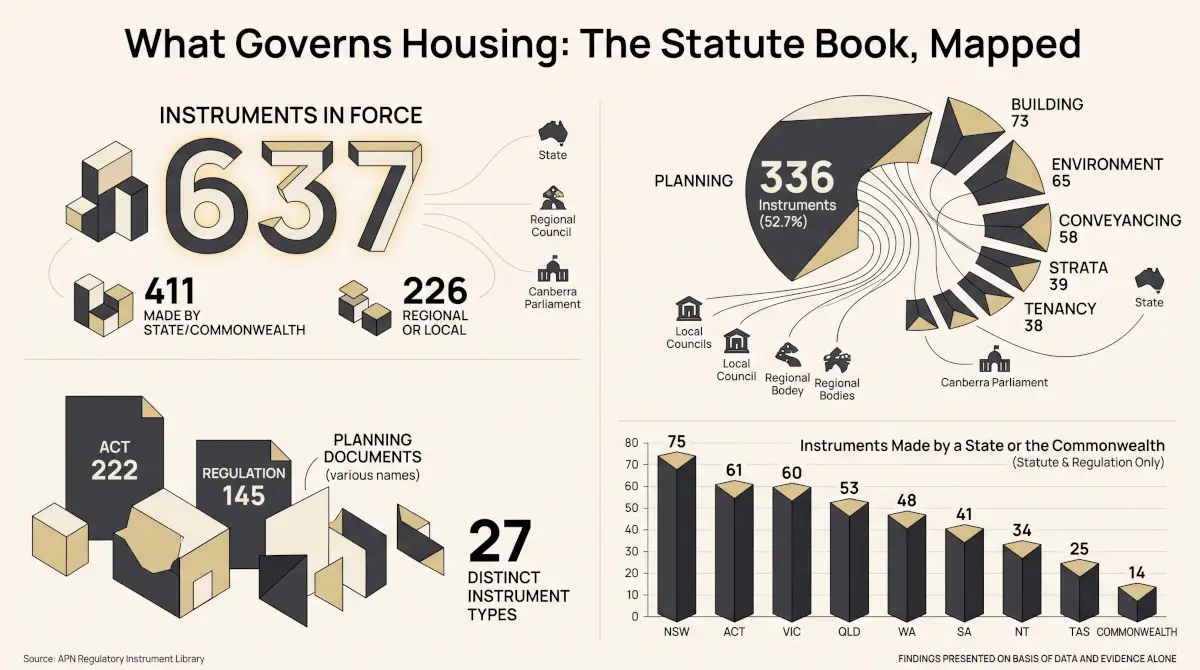

Australian housing is governed by 637 separate legal instruments, on the count APN maintains: acts, regulations, planning schemes, environmental plans and codes, spread across nine jurisdictions and made at four different levels of government. Just over half of them — 336 — deal with planning. And planning is the only subject in the whole collection where the rules are written below the state level. Every one of the 226 instruments made by a council or a regional body is a planning instrument; building, tenancy, strata, conveyancing and every other subject is made entirely by state parliaments and the Commonwealth.
APN’s Legislation & Policy Analysis (21300) carries no certified reading, so no node reading is cited here and the figures are the library’s own counts. The library is a curated collection of the instruments that bear on housing and property, not a census of Australian law, and it is still being extended — the counts below describe its coverage on the date given.
What an instrument is, and what this counts
An instrument is one document that carries legal force: an act of parliament, a regulation made under one, a planning scheme adopted by a council, a code adopted by reference. Each is counted once, whatever its length. A one-page regulation and a thousand-page planning scheme both count as one.
That is the first thing to hold onto, because it means a count measures surface area — how many separate documents a person has to know about — and not weight, complexity or cost. Nothing here says that a jurisdiction with more instruments regulates more heavily. It may simply divide the same subject matter into more documents.
The second thing is that this is a curated collection, not a census. APN’s library holds the instruments that bear on housing and property, and it is still being extended. At the date of this count 637 instruments are in force in it, with one more made but not yet commenced. They come from 102 issuing bodies and fall into 27 distinct instrument types.
Four levels, and most of the volume is not at the top
The instruments sit at four levels. The Commonwealth accounts for 14 — a small number, but they include the ones with the widest reach: the three volumes of the National Construction Code, the Environment Protection and Biodiversity Conservation Act 1999, the Foreign Acquisitions and Takeovers Act 1975 and the Native Title Act 1993.
States and territories account for 397 more. Below them sit 36 regional instruments and 190 local ones — together 226, or rather more than a third of everything in the collection. The statute book that governs housing is not mostly made in Canberra, and it is not mostly made in state parliaments either.
Comparing jurisdictions, carefully
The chart below compares jurisdictions on their statute and regulation only — the level at which all nine are represented in the library. New South Wales carries the most at 75, the Australian Capital Territory 61, Victoria 60, and Tasmania the fewest of the states at 25.
It deliberately excludes the local layer, and the reason matters. Local coverage in the library is uneven by construction: New South Wales has 58 local instruments recorded and Western Australia 11, while South Australia and the Australian Capital Territory have none yet. Ranking jurisdictions on their totals would describe the order in which the library was built, not the law. The full picture is in the table, where the local column should be read as coverage rather than as a count of what exists.
Instruments made by a state or the Commonwealth, by jurisdiction
Source: APN Regulatory Instrument Library, in force at 19 September 2026. Statute and regulation only — the level at which every jurisdiction is represented. Regional and local instruments are excluded here and shown separately in the table below.
| Jurisdiction | Statute and regulation | Regional | Local | Total |
|---|---|---|---|---|
| New South Wales | 75 | — | 58 | 133 |
| Victoria | 60 | — | 33 | 93 |
| Northern Territory | 34 | 6 | 45 | 85 |
| Australian Capital Territory | 61 | 20 | — | 81 |
| Queensland | 53 | — | 14 | 67 |
| Western Australia | 48 | — | 11 | 59 |
| Tasmania | 25 | 3 | 29 | 57 |
| South Australia | 41 | 7 | — | 48 |
| Commonwealth | 14 | — | — | 14 |
| All | 411 | 36 | 190 | 637 |
Source: APN Regulatory Instrument Library, in force at 19 September 2026. The regional and local columns record what the library currently holds, which is not uniform across jurisdictions and is not a count of every such instrument in existence.
Planning is the outlier, and not only by size
Sorted by subject, the collection is lopsided. Planning accounts for 336 instruments, 52.7% of everything in force. The next largest subject is building at 73, then environment at 65 and conveyancing at 58. Tenancy, which governs residential tenancies in every state and territory, accounts for 38.
The more useful division is not size but where the rules are made. Of the 336 planning instruments, 226 are regional or local. That accounts for every single instrument in the collection made below state level. Put the other way round: building, environment, conveyancing, strata, tenancy, heritage, land tax, hazard, agents and sales, duties and the rest are, in this collection, entirely the work of state parliaments and the Commonwealth. The one apparent exception is an Australian Capital Territory design guide that carries a building tag alongside its planning one, which is why the building row below shows a single regional instrument.
That is the structural fact worth carrying away. A person dealing with tenancy law, or stamp duty, or strata title, deals with one set of rules per state. A person dealing with planning deals with a state framework and whatever the relevant council has adopted underneath it — which is why planning is the subject where the answer to a question most often depends on exactly where the land is.
Instruments by subject
Source: APN Regulatory Instrument Library, in force at 19 September 2026. An instrument may carry more than one subject tag, so the bars sum to more than the number of instruments. Where each subject’s rules are made — state or Commonwealth against regional or local — is in the table below.
| Subject | Instruments | State or Commonwealth | Regional or local |
|---|---|---|---|
| Planning | 336 | 110 | 226 |
| Building | 73 | 72 | 1 |
| Environment | 65 | 65 | — |
| Conveyancing | 58 | 58 | — |
| Strata and community title | 39 | 39 | — |
| Tenancy | 38 | 38 | — |
| Heritage | 35 | 35 | — |
| Land tax | 30 | 30 | — |
| Hazard | 28 | 28 | — |
| Agents and sales | 23 | 23 | — |
| Duties | 22 | 22 | — |
| Local government | 16 | 16 | — |
| Foreign investment | 2 | 2 | — |
| Tax | 2 | 2 | — |
Source: APN Regulatory Instrument Library, in force at 19 September 2026. Subject tags are the library’s own classification. 540 instruments carry a single subject and 97 carry more than one, so the 767 tags here describe 637 instruments. The single regional instrument in the building row is also counted in the planning row.
Two document types carry most of the law
Acts and regulations together account for 367 instruments, 57.6% of the collection. Everything else is spread thinly across 25 further types, most of them planning documents under various names: local environmental plans in New South Wales, planning schemes in Victoria and Queensland, local provisions schedules in Tasmania — schedules to a single state-wide scheme rather than separate council ones — area plans in the Northern Territory, and local planning schemes in Western Australia.
The naming is not cosmetic. The same function — setting what may be built where, in one council area — carries a different label and a different legal character in each jurisdiction, which is part of why the planning layer resists national comparison in a way that tenancy or duties law does not.
The ten largest instrument types
Source: APN Regulatory Instrument Library, in force at 19 September 2026. 27 types are recorded in total; the remaining seventeen account for fewer than ten instruments each.
What this measure does not show
It does not measure regulatory burden. A count treats a minor amending regulation and a principal act as equals, and says nothing about how long, how strict, how well drafted or how costly to comply with any of them is. No conclusion about which jurisdiction regulates housing most heavily can be drawn from these numbers, and none is drawn here.
It does not claim completeness. The library is curated: instruments are added because they bear on housing and property, and the collection grows. The local layer in particular is partial, and two jurisdictions have none of it recorded yet. Counts are reported as at a date for that reason.
And it is a snapshot of what is in force, not of what has changed. 541 of the 647 instrument versions carry a commencement date, which is enough to ask when the rules now in force actually came into effect — but amendment history is not captured, so an old commencement date does not mean an unchanged rule. Applicability to particular council areas is mapped for 222 local government areas across 768 recorded links, also partial. Both are questions for their own piece rather than caveats to this one.
Findings are presented on the basis of data and evidence alone.