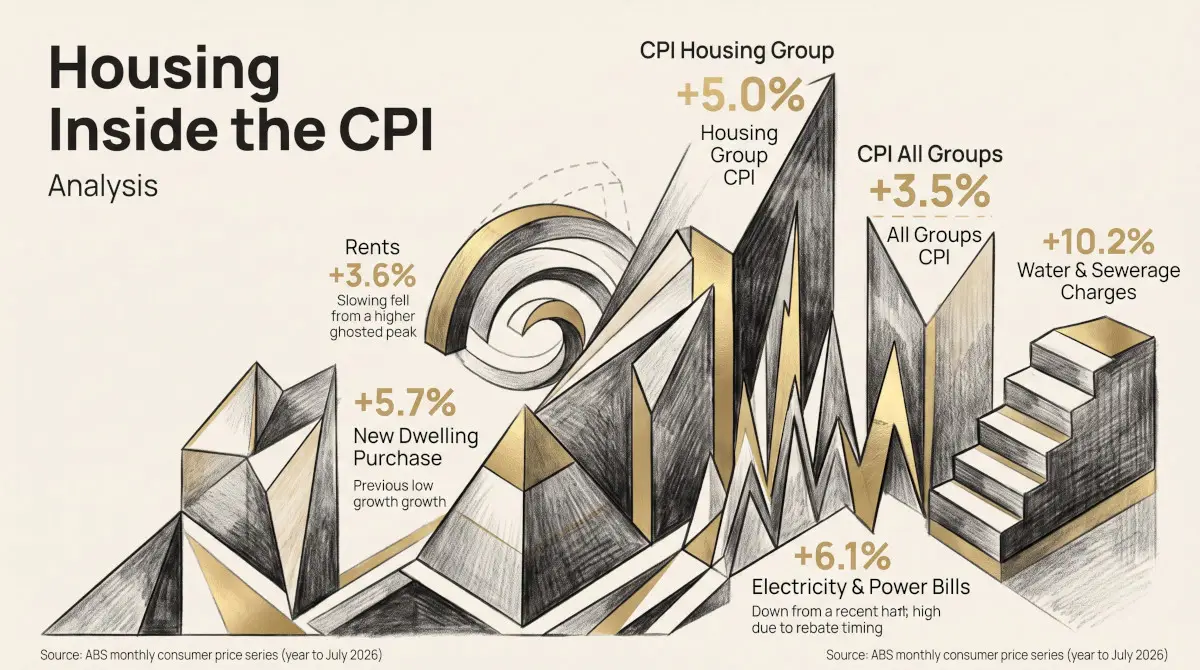

Housing costs are rising faster than the rest of what households buy. In the year to July 2026, the housing group of the Consumer Price Index rose 5.0%, against 3.5% for the CPI as a whole, and it has run ahead of the all-groups figure in every month since July 2025. Underneath that total the parts are moving in opposite directions: rent increases have slowed to 3.6% from a peak of 7.8% in 2023, the cost of building or buying a new home has picked up to 5.7% from 0.5% a year earlier, electricity bills have swung with the arrival and expiry of government rebates, and water charges have stepped up at their annual resets.
The σ figure is APN’s certified reading for inflation conditions: how far they sit from their 2011–2025 average, measured in standard deviations. The monthly figures in this article are published ABS data and are not the node reading.
What sits inside the CPI housing group
The CPI housing group covers what households pay to occupy a home: rents; the cost of buying a newly built dwelling, which stands in for the construction cost an owner-occupier faces; property rates and charges; water and sewerage; electricity and gas; and maintenance and repairs. It does not include mortgage interest, which the CPI excludes altogether, or the price of established houses and the land under them. A rise in the housing group is therefore about the cost of building, servicing and renting homes, not about property values.
The figures here come from the ABS monthly consumer price series. The components begin at different dates: electricity and gas from October 2021, rents from July 2022, and the housing group total from April 2024, so some comparisons run over shorter windows than others.
Housing above the basket
In the year to July 2026 the housing group rose 5.0% and the CPI as a whole 3.5%, a gap of about one and a half percentage points. A year earlier the same pair read 3.7% and 3.0%. Housing has been the faster of the two in every month since July 2025, although the gap narrowed in July: the housing group’s annual rate fell to 5.0% from 6.8% in June and a high of 7.2% in February, as the comparison moved past a jump in electricity prices in July 2025 that reflected the timing of rebate payments.
Annual change in the CPI housing group and in the CPI as a whole, %, 2025–2026
Source: ABS monthly consumer price series, housing group and all groups, original. The housing group series begins in April 2024, so annual changes start in April 2025.
Rents have slowed; new homes have not
Rent increases peaked at 7.8% in the year to August 2023 and have slowed in most months since, to 3.6% in the year to July 2026. That is a slower rate of increase, not a fall: measured rents are 23.8% higher than in July 2022, when the monthly rent series begins.
The cost of buying a newly built dwelling has moved the other way. It rose 5.7% over the past year, against 0.5% a year earlier, when it had almost stopped rising. The longer run puts that in context: this component rose 28.8% in the two years to July 2023, during the period of material and labour cost increases, and is 46.8% above its level of July 2020.
Annual change in new dwelling purchase and rents, %, 2018–2026
Source: ABS monthly consumer price series, new dwelling purchase by owner-occupiers and rents, original. The rent series begins in July 2022, so its annual changes start in July 2023. New dwelling purchase measures the cost of buying a newly built home, excluding land.
Power and water: rebates in, rebates out
Electricity is the most volatile series in the group. Government energy rebates reduce the amount households actually pay, and the ABS measures the price after those rebates, so a rebate lowers the index and the end of one raises it. The electricity index fell to 65.5 in October 2024, its lowest since the series began in October 2021, as rebates applied, and has since risen to 113.7, 33.6% above its level of June 2022. Over the past year it rose 6.1%, down from 22.4% in the year to June 2026 and against 13.6% a year earlier. The ABS attributes the fall in the annual rate mainly to the timing of rebate payments in 2025; these figures say more about rebate timing than about the underlying cost of supply.
Gas and other household fuels rose 3.7% over the year. Water and sewerage, which is measured in steps as utilities reset their charges, rose 10.2%, the fastest annual rise of the housing components in the year to July 2026. Property rates and charges, also an annual step, rose 6.2% at their most recent reset and are 32.3% higher than in 2017.
Electricity and gas price indexes, September 2025 = 100, 2021–2026
Source: ABS monthly consumer price series, electricity and gas and other household fuels, original. Prices are measured after government rebates, so the dips and steps reflect rebates being applied and used up as well as changes in underlying prices.
The components at the latest reading
Ranked by annual change, the housing components divide into three groups: water and electricity at the top, where rebate timing and scheduled resets dominate; construction costs in the middle, rising again after a flat year; and rents at the bottom, now increasing at about the same pace as the CPI as a whole.
Annual change by housing component and the CPI, %, year to July 2026
Source: ABS monthly consumer price series, original. Utilities covers electricity, gas and water and sewerage combined. All groups CPI is shown for comparison.
Reading the housing group
The housing group is rising faster than the basket as a whole, but its make-up has changed. In the year to July 2023, rents rose 7.6%, the cost of new dwellings 5.9% and electricity 15.6%: rents, construction costs and energy were all rising quickly. Now rent increases have eased to 3.6%, close to their slowest since the monthly rent series began, and utilities and the cost of new homes carry more of the increase. For anyone weighing the cost of building against the cost of renting, those two components are moving apart.
The July 2026 release as a whole, including underlying inflation, is covered in APN’s analysis of the July 2026 CPI; how closely the price of a new home tracks builders’ own prices is examined in Builders’ Prices and Buyers’ Prices. Where the economy as a whole sits against its long-run averages is set out in APN’s comparison against fifteen-year averages.
Findings are presented on the basis of data and evidence alone.