

Electron Valuation Confirmed: Industrial Property Undergoes Structural Adjustment into a Two-Speed Market
APN ANALYSIS: A-251208-AUS131760
Executive Summary
The Australian industrial property market has undergone a structural adjustment. A material increase in demand from AI-native data centres, coinciding with a physically and regulatorily constrained electricity grid, has fundamentally changed the asset class’s valuation metric from dollars per square metre to dollars per megawatt of secured power. This has created a two-tier market where ‘Power Shells’—sites with confirmed high-voltage grid access—command premiums of over 100%, while traditional logistics sites, regardless of their prime location, are being effectively devalued in relative terms.
For property professionals, this is not a cyclical trend but a permanent recalibration of industrial asset value. Investment strategies must pivot from ‘strategic land acquisition’ to ‘power banking’. The highest and best use for industrial land is now dictated by substation proximity and connection agreements, rendering sites without high-voltage access as stranded assets, regardless of their zoning or transport connectivity.
Background & Strategic Context
This market’s structural adjustment validates and calibrates APN’s core macro-theses, demonstrating how state-level intervention and infrastructure limitations create new valuation paradigms. The collision of hyperscale demand and grid constraints is a textbook example of how physical and regulatory boundaries, not just market sentiment, define asset value and create deep, structural moats for incumbent owners.
APN Sovereign Policy Composite Index™ (SPCI, 24800) in Action: The actions of state actors like the Australian Energy Market Operator (AEMO), Transgrid, and the NSW Environment Protection Authority (EPA) are the primary force shaping this new market. The AEMO connection queue and the EPA’s emissions firewall are not market bugs; they are features of state intervention that create a regulatory moat around incumbent assets, directly manufacturing scarcity and value.
The New Infrastructure Uplift (APN Infrastructure Uplift Multiplier™ (24420)): The APN Infrastructure Uplift Multiplier™ (APN IUM™) must now be recalibrated. While transport links remain relevant for logistics, the new prime multiplier is high-voltage transmission infrastructure. A secured connection to a substation delivers a valuation uplift that dwarfs the impact of a new motorway interchange for this asset class.
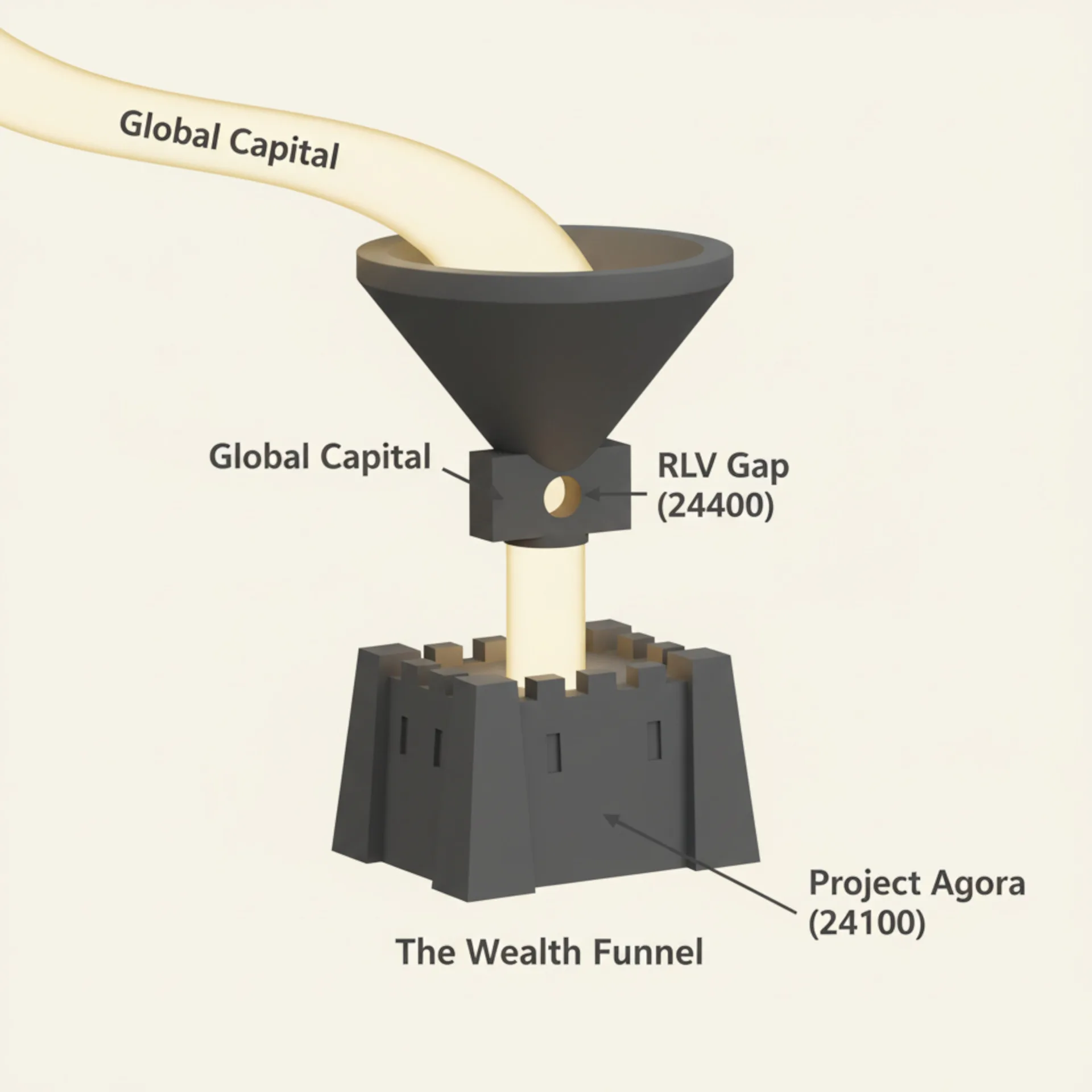
The Viability Gap Widens (APN Residual Land Value (RLV) Gap™ (24410)): The APN Residual Land Value (RLV) Gap™ is now elevated between the two tiers. A logistics developer’s RLV is capped by rent and construction costs. A data centre developer’s RLV is determined by the fundamental requirement for power, making the land cost a minor component and allowing them to pay premiums that structurally exclude all other industrial users.
The Brown Discount Emerges (APN Regional Brown Discount™ (24520)): The failure of the ‘off-grid’ gas bypass strategy triggers the APN Regional Brown Discount™. Sites proposing fossil fuel generation face significant regulatory and ESG risk, creating a valuation discount compared to sites with access to the increasingly renewable grid, which command a ‘Green Premium’.
Deconstruction of the Source Event
This deconstruction is based on an internal APN intelligence briefing, which stress-tested the ‘Electron Valuation’ hypothesis against late-2025 market data. The key facts are:
- Valuation Metric Shift: Transactional evidence confirms industrial land valuation is decoupling from surface area ($/sqm) to secured grid capacity ($/MW).
- The Two-Tier Market: A bifurcation in valuation has created a premium of 40-100%+ for ‘Tier 1’ power-ready sites over ‘Tier 2’ traditional logistics land in key precincts like Western Sydney and Melbourne’s west.
- Material Demand Increase: AI-driven demand has caused a fortyfold expansion in data centre capacity over two decades, with two-thirds of this growth occurring in the last five years, materially exceeding supply.
- Grid Constraint: The national electricity grid is the primary bottleneck. Connection inquiries materially exceed capacity, with over 18 GW in Victoria and 10 GW in NSW creating a multi-year waiting list and a regulatory moat around approved sites.
- Corporate Pivot: Major players like Goodman Group are pivoting their strategy from ‘strategic land acquisition’ to ‘power banking’, with data centres now comprising 57% of their development work in progress, validating the shift in value.
- Regulatory Firewall: The ‘off-grid’ gas generation bypass is not a scalable solution due to strict NSW EPA emissions limits and Net Zero mandates tied to major project approvals, making it a niche, high-risk strategy.
Critical Analysis & Balanced View
The ‘Megawatt Bifurcation’ represents more than just a premium for a new tenant class; it is a fundamental re-ordering of the factors of production for industrial real estate. The land itself has become secondary to the legal and physical right to draw power. This creates a paradox: vast tracts of zoned industrial land are becoming economically sterile for their highest and best use, while smaller, well-connected sites accrue material value. The risk for investors is misinterpreting this as a simple supply/demand issue.
The primary barrier to entry is not the availability of capital or land, but the physics and politics of the electricity grid. The ‘Power Shell’ is not just a building; it is a capitalised entitlement to a scarce public utility. This also introduces a new systemic risk: as data centres become a dominant baseload power consumer, their development becomes intertwined with national energy policy, exposing property investors to a new vector of political and regulatory volatility.
Strategic Implications for Property Professionals
- For Developers & Strategic Land Acquirers: Your primary due diligence metric must shift from zoning and transport to electrical infrastructure. A site’s value is now defined by its proximity to transmission substations and its position in the AEMO connection queue. Acquiring unpowered land on speculation is now a high-risk proposition based on navigating a multi-year regulatory process.
- For Valuers & Financiers: The ‘highest and best use’ analysis for industrial land is now bifurcated. A dual valuation approach is required: one based on a traditional logistics $/sqm model and a second, parallel valuation based on a $/MW model if power access is confirmed. Failure to account for the ‘Power Shell’ potential will lead to significant undervaluation of capable sites and overvaluation of stranded ones.
- For Agents & Buyers’ Agents: You are no longer just trading land; you are trading power rights. Your advisory must now include specialist electrical engineering and regulatory insights. The ability to identify and verify a site’s MVA capacity and connection status is the new source of competitive advantage in the industrial market.
- For Asset & Fund Managers: Portfolio-level risk assessment must now include a ‘grid-dependency’ audit. Assets should be re-classified based on their power capacity. Portfolios heavily weighted towards ‘Tier 3’ (unpowered, poor access) sites face a long-term devaluation risk. The strategic priority is to identify and acquire sites with latent power capacity or execute strategies to upgrade existing assets.
APN Index Management
The APN Codex 24000 Series is a proprietary set of indices that translates complex market forces into measurable metrics. This section outlines how the preceding analysis is validated against, and informs the calibration of, these frameworks.
- Validation: This analysis provides validation for the core theses of the APN Sovereign Policy Composite Index™ (SPCI, 24800) (state intervention as a primary value driver) and the APN Future Development Pipeline Index™ (24400). The grid constraint acts as a state-enforced filter, creating ‘Paper Rezonings’ out of unpowered industrial land.
- Index Calibration: The APN Infrastructure Uplift Multiplier™ (APN IUM™) (24420) will be recalibrated to include a new variable for ‘Secured Megawatt Capacity’. The weighting of this variable will exceed that of transport infrastructure for assets within designated data centre precincts.
- Index Calibration: The APN Regional Brown Discount™ (24520) is now activated for industrial assets reliant on proposed off-grid fossil fuel generation, reflecting the high regulatory risk identified by the APN Risk & Compliance Index™ (24200).
- Data Capture: This triggers a new data capture mandate for the APN Symbiotic Intelligence Network™ (24310) to track transaction premiums based on $/MW, AEMO queue positions, and substation capacity data, feeding this intelligence directly into the APN Future Development Pipeline Index™ (24400).
Disclaimer
The analysis and information contained in this deconstruction are for general informational and strategic purposes only and do not constitute financial, investment, legal, or any other form of professional advice. The Australian Property Network (APN) is a strategic intelligence organisation and is not a licensed financial advisor.
This analysis is based on data and information from third-party sources believed to be reliable; however, APN provides no warranty as to its accuracy, currency, or completeness. Images used in this analysis are for illustrative and conceptual purposes only and may not represent real persons, properties, or events.
All frameworks (Codex 24100-24800) are proprietary to APN.
Property values and market conditions can go up or down. Before making any property or investment decisions, you must conduct your own thorough research and seek independent professional advice tailored to your specific circumstances.