

The Valuation Realignment: A 20% Writedown Initiates a Two-Speed Property Market
APN ANALYSIS: A-251207-AUS131671
Executive Summary
The 18-month transactional constraint in Australian commercial real estate has concluded. The divergence between prior book values and market-based pricing has been resolved by a strategic ‘Valuation Realignment’, with major REITs like Dexus and Charter Hall accepting cumulative writedowns of approximately 19-21%. This reset established a credible price support level, closing the bid-ask spread and initiating the APN Agora™ liquidity event. The result is a forecast 15% increase in transaction volumes for 2025, driven by an ‘Elevated Inflow’ of offshore capital that now views Australian prime assets as fairly priced and a destination for capital preservation.
For property professionals, this is not a uniform recovery but a material market bifurcation. The new liquidity is highly targeted, creating a two-speed market condition. Prime and Premium-grade assets are experiencing yield compression and renewed investor demand, driven by large-scale offshore institutions like GIC and Mitsubishi. Conversely, Secondary and B-grade assets are constrained by a structural value impairment, facing widening yield spreads, capital constraint, and an increasing incidence of compelled sales and receiverships. Navigating this bifurcated landscape requires a strategic pivot: capitalising on the prime-grade asset recovery while precisely identifying distress opportunities or mitigating the elevated risk in the secondary market.
Background & Strategic Context
This market event validates and calibrates APN’s core macro-theses on market causation and capital distribution. The ‘Valuation Realignment’ was not a typical market cycle but a compelled response to state-level intervention, while the resulting two-speed market condition demonstrates how such shifts asymmetrically benefit incumbent asset holders. The following frameworks deconstruct this dynamic:
The Necessary Precondition (APN Sovereign Policy Composite Index™ (SPCI, 24800)): The entire episode was precipitated by the Reserve Bank of Australia’s accelerated monetary tightening cycle. This state-level action rendered the low-yield valuations of 2021-22 untenable, necessitating the institutional realignment that ultimately removed transactional constraints. It is a clear example of how state intervention acts as the primary force defining market boundaries and initiating structural repricing events.
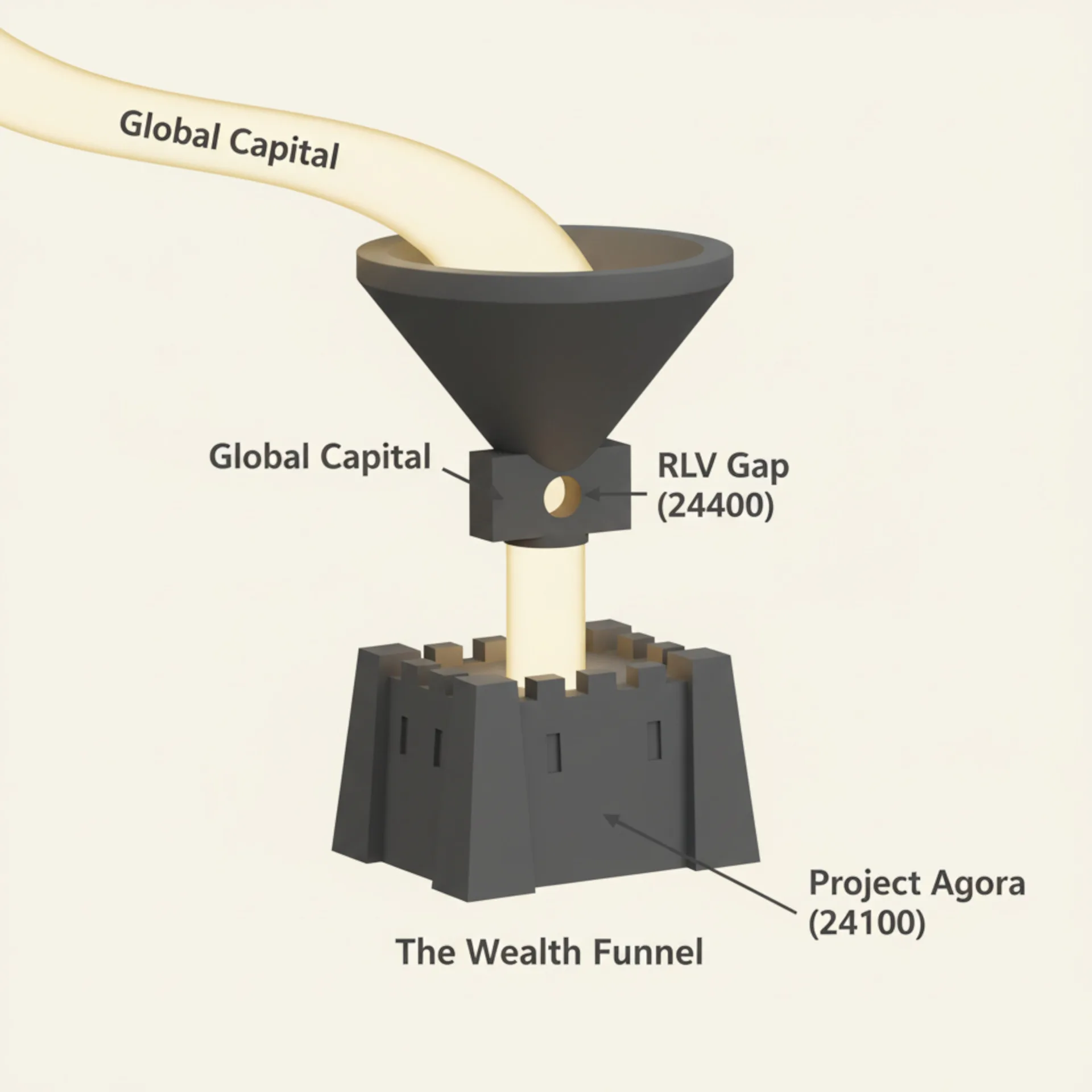
The Initiating Event (APN Agora™): The brief designates the resumption of liquidity as the ‘APN Agora™’ event (24140). While the index typically measures amenity and access, its application here signifies the reopening of the ‘marketplace’ itself. The 20% valuation reset was the catalyst that re-established market confidence and connectivity, allowing capital to be allocated into the prime asset ecosystem, effectively reactivating the market’s central transaction environment.
The Confidence Realignment (APN Professional Sentiment Index™): The market’s transition from risk aversion to capital allocation is a quantifiable shift tracked by the APN Professional Sentiment Index™ (24300). The initial 18-month transactional stasis reflected a contraction in professional confidence as the bid-ask spread became material. The realignment by bellwether REITs acted as a material sentiment reset, providing the certainty required for capital to move from observation into active allocation, as evidenced by Charter Hall’s upgraded earnings guidance.
The Bifurcation Mechanism: The two-speed market condition illustrates a structural capital asymmetry. Well-capitalised offshore institutions and domestic REITs are able to absorb the 20% writedown and leverage the new ‘fair value’ environment. Simultaneously, smaller or over-leveraged owners of secondary assets, lacking the balance sheet strength to recapitalise or fund upgrades, are compelled into distressed sales, resulting in a transfer of assets to more highly capitalised entities able to navigate the market adjustment.
Deconstruction of the Source Event
This deconstruction is based on APN’s analysis of Q3/Q4 2025 financial reporting, transactional data, and market outlooks from major agencies. The key facts are:
- The Institutional Writedown: Dexus, Australia’s largest office landlord, saw its Net Tangible Assets (NTA) contract by a cumulative 19.0% from its FY22 peak to its FY25 trough ($10.88 to $8.81), codifying the valuation reset required to close the bid-ask spread.
- The Sentiment Pivot: Charter Hall upgraded its FY26 Operating Earnings Per Security (OEPS) guidance by 5.5%, citing an ‘inflection year’ in FY25 and an ‘acceleration in transaction volumes’ post-June 2025, confirming the return of market velocity.
- The Volume Recovery: CBRE forecasts a 15% increase in commercial property investment volumes in 2025 to $36 billion, with office investment projected to grow by 25%, driven by assets trading at a significant discount to replacement cost.
- The Elevated Inflow of Foreign Capital: Offshore investors accounted for 45% of total transaction activity in H1 2025. This was highlighted by the GIC and Brookfield consortium’s $2.6 billion bid to privatise National Storage REIT, a transaction that represents the largest real estate privatisation recorded in Australia.
- The Yield Bifurcation: A material divergence has occurred between asset grades. In Q3 2025, Sydney Prime office yields stabilised around 6.0-6.7%, while transactional evidence for B-grade assets (e.g., 100 Pacific Highway) revealed clearing yields of 8.8%, a spread of nearly 280 basis points.
- Indicators of Market Distress: Compelled sales have emerged as the primary transaction mechanism for secondary assets. Mapletree Investments sold a St Kilda Road office at a 38% discount to its 2017 purchase price, while receivers were appointed to sell multiple assets in corridors like North Sydney.
Critical Analysis & Balanced View
The ‘recovery’ narrative requires rigorous qualification. The market has not uniformly recovered; it has bifurcated. The analytical inconsistency is that this new wave of liquidity is predicated on a 20% reduction of prior book value. This is not a return to previous cyclical valuation highs but an acceptance of a new, lower pricing environment. The primary driver for the prime market’s recovery is the ‘Replacement Cost Gap’, with prime assets trading at up to 30% below the cost of new construction, where a material ‘buy vs. build’ arbitrage has emerged, placing a firm support level under values.
However, this same dynamic creates structurally adverse conditions for the secondary market. For B-grade assets, the capital expenditure required to compete with new stock is economically unviable, especially with incentives exceeding 40%. The latent risk is that this is not a cyclical downturn for secondary assets but a structural obsolescence event. The ‘liquidity’ for these assets comes not from investors but from developers assessing residential conversions or from compelled liquidations. The APN Agora™ event, therefore, does not represent a uniform market uplift, but a targeted capital reallocation toward prime-grade assets, while secondary assets face sustained structural obsolescence and disposal at residual values.
Strategic Implications for Property Professionals
- For Institutional Investors & Fund Managers: A valuation floor for Prime assets has been established. The strategic priority is to allocate capital into this segment to capture the ‘buy vs. build’ arbitrage. The narrative to capital partners must shift from precautionary writedowns to the acquisitive opportunity presented by acquiring high-quality assets below replacement cost in a globally attractive, transparent market.
- For Valuers & Lenders: Risk models require immediate bifurcation. Valuations for secondary assets based on historical data or lagging quotes are no longer reflective of current market evidence. Valuations must reflect transactional evidence, including clearing yields approaching 9% and capital loss rates of 30-40%. Lenders must stress-test covenants on B-grade office portfolios, as the risk of default has structurally increased.
- For Agents & Buyers’ Agents: The client profile has structurally shifted. For Prime assets, the focus is the ‘Elevated Inflow of Foreign Capital’, including offshore institutions from Singapore, Japan, and the US. For Secondary assets, the buyer pool is no longer traditional investors but developers, adaptive reuse specialists, and entities engaged in strategic land acquisition. Marketing campaigns must be restructured to focus on these distinct cohorts.
- For Private Investors & Syndicators: Apply elevated caution in the secondary office market. The structural value impairment is material and sustained. Unless an asset possesses clear, cost-effective potential for adaptive reuse (e.g., residential conversion) or is located in a supply-constrained precinct, it carries an elevated risk of further capital erosion and illiquidity.
APN Index Management
The APN Codex 24000 Series is a proprietary set of indices that translates complex market forces into measurable metrics. This section outlines how the preceding analysis is validated against, and informs the calibration of, these frameworks.
- Validation: This analysis validates the designation of the resumption of liquidity as the APN Agora™ (24140) event, confirming that a valuation reset was the key to reopening the market. It also validates the predictive capacity of the APN Professional Sentiment Index™ (24300), which accurately tracked the shift from risk-aversion to capital allocation.
- Index Calibration: The APN Residual Land Value (RLV) Gap™ (24410) is now calibrated as a primary indicator for B-grade asset distress, where the value for continued office use falls below the asset’s redevelopment or conversion value. The spread between Prime and Secondary yields will be integrated as a core metric within the APN Risk & Compliance Index™ (24200) to quantify market bifurcation.
- Data Capture: This analysis initiates a new data capture mandate for the APN Symbiotic Intelligence Network™ (24310). The mandate is to systematically track and quantify the ‘Incentive Trap’ in secondary markets, specifically monitoring when incentive levels (e.g., >40%) render future capital expenditure economically unviable, signalling a structurally unviable asset.
Disclaimer
The analysis and information contained in this deconstruction are for general informational and strategic purposes only and do not constitute financial, investment, legal, or any other form of professional advice. The Australian Property Network (APN) is a strategic intelligence organisation and is not a licensed financial advisor.
This analysis is based on data and information from third-party sources believed to be reliable; however, APN provides no warranty as to its accuracy, currency, or completeness. Images used in this analysis are for illustrative and conceptual purposes only and may not represent real persons, properties, or events.
All frameworks (Codex 24100-24800) are proprietary to APN.
Property values and market conditions can go up or down. Before making any property or investment decisions, you must conduct your own thorough research and seek independent professional advice tailored to your specific circumstances.