
APN Sovereign Policy Composite Index™ (SPCI, 24800) Validated: State Intervention Establishes a Managed Market Framework for Australian Property
APN ANALYSIS: A-251119-AUS130815
Executive Summary
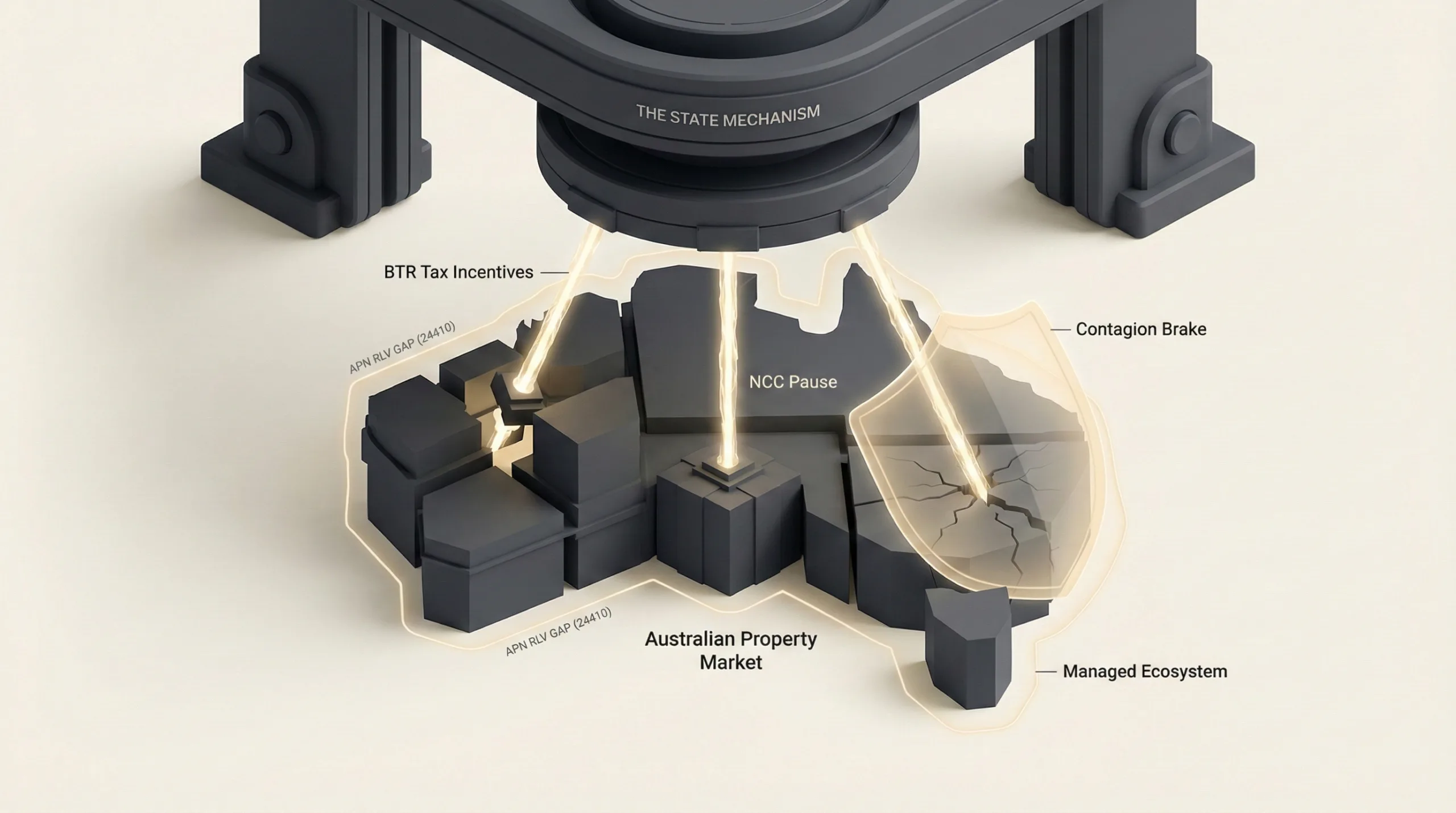
The Australian government has executed a multi-layered intervention, identified by the APN Sovereign Policy Composite Index™ (SPCI, 24800), to structurally influence the stability of the housing market. Through a matrix of Build-to-Rent (BTR) tax incentives, a regulatory pause on construction codes, and a “Contagion Brake” in the banking sector, the state has moved from observer to active architect of the market. This is material because it has prevented a disruptive market correction while fundamentally altering the operating environment, trading long-term climate resilience for short-term supply viability and ring-fencing residential assets from commercial distress.
For property professionals, this signals a transition from a market-led cycle to a state-managed framework. Success now depends on aligning with government-backed supply channels like institutional BTR, understanding the new risk boundaries defined by banking code changes, and navigating a pipeline where state-directed project viability, not just market demand, dictates outcomes.
Background & Strategic Context
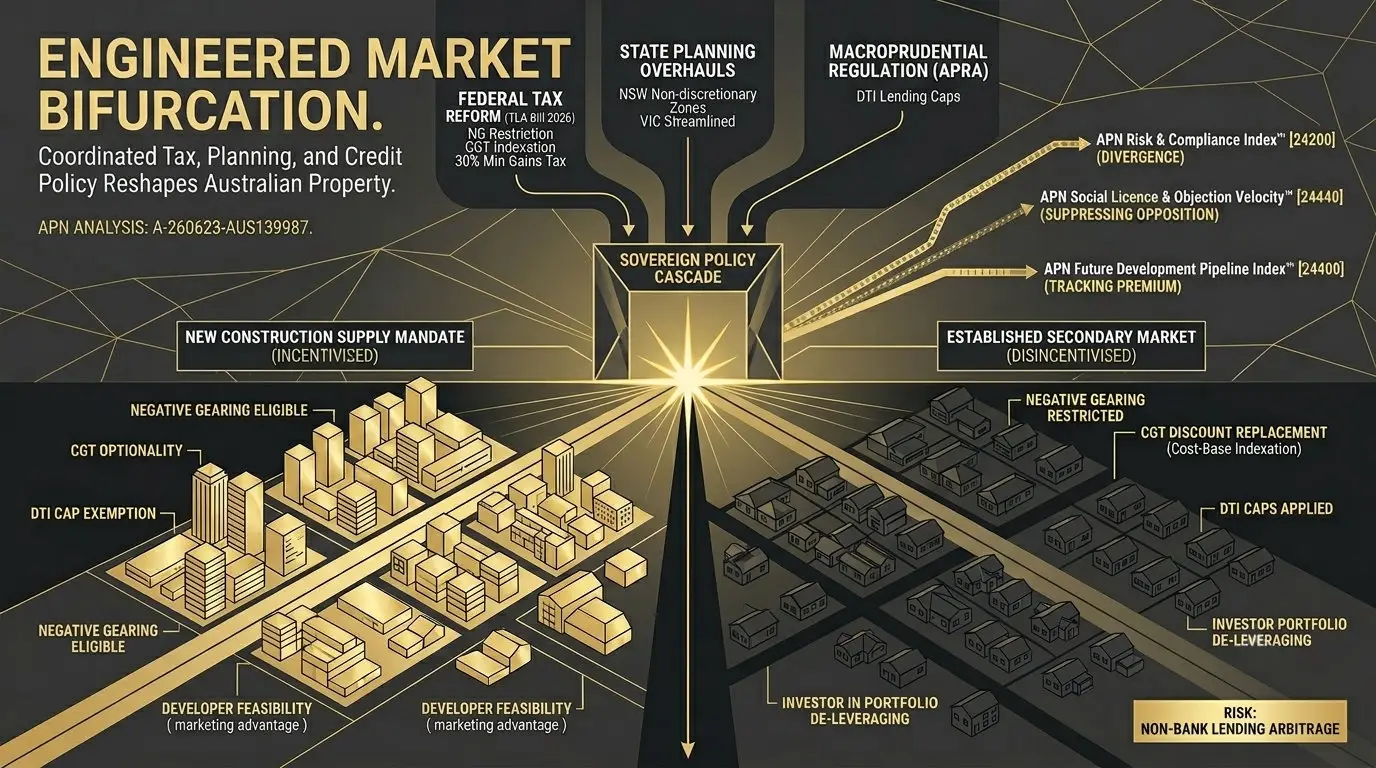
This comprehensive intervention validates and calibrates APN’s core macro-thesis, the APN Sovereign Policy Composite Index™ (SPCI, 24800). The synchronised actions across fiscal, regulatory, and financial domains confirm that state-level actors are the dominant force shaping market boundaries, systematically restructuring the system to prevent systemic contraction and to structurally compel supply.
State Intervention as Market Architecture (SPCI, 24800): The government’s strategy is not a simple stimulus but a substantive restructuring of the market’s operating system. By creating a “social capital” exchange in the BTR sector and imposing a “Contagion Brake” on banks, the state is structurally favouring certain cohorts (patient institutional capital) over others (opportunistic developers, high-risk commercial lenders), directly managing risk and supply.
Quantifying the Viability Chasm (APN Residual Land Value (RLV) Gap™): The entire intervention is designed to address the APN Residual Land Value (RLV) Gap™ (Codex 24410). The BTR incentives and the NCC regulatory pause are direct financial injections and cost reductions aimed at making unviable projects viable, confirming that without state intervention, the private market’s development pipeline is functionally constrained.
The Climate-Cost Trade-Off (APN Climate-Risk Asset Devaluation Index™): The decision to pause NCC updates is a strategic trade-off that prioritises immediate housing supply (Codex 24400) over long-term asset resilience. This action validates the core premise of the APN Climate-Risk Asset Devaluation Index™ (Codex 24500), proving that policy can actively create future “stranded assets” by sustaining lower building standards. This risk will manifest as a quantifiable APN Brown Discount™.
Deconstruction of the Source Event
This deconstruction is based on APN’s “State of the Nation” strategic intelligence audit, which synthesised legislative analysis, regulatory filings, and economic data from Q3/Q4 2025. The key facts are:
- BTR Fiscal Framework Enacted: The Treasury Laws Amendment (Responsible Buy Now Pay Later and Other Measures) Act 2024 is now law, reducing the Managed Investment Trust (MIT) withholding tax to 15% for BTR projects, including Capital Gains, but mandating a 10% affordable housing component.
- NCC Regulatory Pause Confirmed: Building Ministers have formally paused “non-essential” changes to the National Construction Code until mid-2029, freezing standards at 7-star energy efficiency to provide cost relief and “regulatory certainty” for developers.
- Banking “Contagion Brake” Implemented: The 2025 Banking Code of Practice (BCOP), effective February 2025, mandates an enforcement hierarchy, forcing banks to exhaust business assets before seizing a guarantor’s principal place of residence, effectively ring-fencing residential property from SME insolvencies.
- State Planning Powers Centralised: NSW has legislated its Housing Delivery Authority (HDA) with powers to declare projects as State Significant Development and override local zoning, while Victoria has introduced legislation to fast-track approvals and remove third-party appeal rights for certain developments.
- Supply Pipeline Remains Constrained: Despite interventions, the industry is operating at a capacity of approximately 160,000 starts per year, well below the 240,000 required to meet the National Housing Accord target, creating a projected shortfall of over 250,000 homes.
Critical Analysis & Balanced View
The policy framework identified by the SPCI (24800) is a pragmatic approach to short-term management of structural pressure points, but it embeds material long-term risk. The central paradox is that in stabilising the market, the state has made it entirely dependent on its intervention. The BTR incentives, while necessary, create a two-tiered development market, concentrating supply power in the hands of a few global institutions capable of absorbing the “social capital” cost of affordable housing mandates. This institutionalisation may deliver volume but reduces market diversity and agility.
Furthermore, the “Contagion Brake” is a notable example of conduct-based regulation that addresses a prudential gap left by APRA. While it successfully protects the principal residences of SME guarantors, it transfers risk back onto bank balance sheets, potentially tightening credit availability for the very SME sector it aims to support. The most material trade-off, however, is the “Regulatory Retreat” on the NCC. This decision structurally creates a future cohort of climate-vulnerable assets. The housing stock built between 2026 and 2029 will become no longer structurally viable at an accelerated rate, creating a future valuation adjustment point and transferring the cost of climate adaptation from today’s developers to tomorrow’s owners and insurers. The state is applying an elevated political discount rate, prioritising immediate housing starts over the long-term financial and physical resilience of the built environment.
Strategic Implications for Property Professionals
- For Developers: The market is now bifurcated. Either align with the institutional “Patient Capital” model by integrating affordable housing to access BTR incentives, or focus on smaller-scale projects that fall outside the new state-mandated planning pathways. The era of speculative, high-leverage BTS development at scale is now structurally constrained without direct state partnership.
- For Investors & Fund Managers: The primary opportunity lies in the government-sanctioned BTR sector. However, underwriting must now factor in the structural cost associated with affordable housing mandates. The “Contagion Brake” de-risks residential assets held by SME owners, creating a potentially under-priced, stable asset class, but exposure to CRE-linked debt is now higher risk.
- For Valuers & Risk Analysts: Asset valuation must now incorporate a policy-risk overlay. Properties built during the “NCC Pause” (2026-2029) must be assessed for a future APN Brown Discount™ (Codex 24520) due to their lack of climate resilience. The indefinite NSW land tax concession for BTR must be factored in as a permanent OPEX reduction, directly impacting capitalisation rates.
- For Agents & Buyers’ Agents: The “Affordability Anchor” remains the dominant force for the existing housing market. Advise clients that borrowing capacity, not wage growth, is the primary price driver. The “Lock-In Effect” from stamp duty is suppressing listings, meaning off-market opportunities and understanding client “right-sizing” motivations are elevated competitive advantages.
APN Index Management
The APN Codex 24000 Series is a proprietary set of indices that translates complex market forces into measurable metrics. This section outlines how the preceding analysis is validated against, and informs the calibration of, these frameworks.
- Validation (Codex 24400): This analysis validates the core premise of the APN Future Development Pipeline Index™. The government’s direct fiscal and regulatory interventions to address the APN Residual Land Value (RLV) Gap™ (24410) confirm that without state action, the pipeline is unviable.
- Index Calibration (Codex 24500): The APN Climate-Risk Asset Devaluation Index™ is calibrated to reflect the “NCC Pause.” The index will now assign a higher forward-looking APN Financial Climate Sensitivity™ (24510) to all residential stock approved between late 2025 and mid-2029, quantifying the embedded “Brown Discount” risk.
- Data Capture (Codex 24200): The enactment of the 2025 BCOP initiates a new data capture mandate for the APN Risk & Compliance Index™. The framework will now track bank enforcement actions against SME guarantors to measure the empirical effectiveness and economic friction of the “Contagion Brake” mechanism.
Disclaimer
The analysis and information contained in this deconstruction are for general informational and strategic purposes only and do not constitute financial, investment, legal, or any other form of professional advice. The Australian Property Network (APN) is a strategic intelligence organisation and is not a licensed financial advisor.
This analysis is based on data and information from third-party sources believed to be reliable; however, APN provides no warranty as to its accuracy, currency, or completeness. Images used in this analysis are for illustrative and conceptual purposes only and may not represent real persons, properties, or events.
All frameworks (Codex 24100-24800) are proprietary to APN.
Property values and market conditions can go up or down. Before making any property or investment decisions, you must conduct your own thorough research and seek independent professional advice tailored to your specific circumstances.