
Market Data Confirms ‘Viability Gap’ is Materially Restricting National Housing Accord, Rendering Zoning Reforms Ineffective
APN ANALYSIS: A-251117-AUS130606
Executive Summary
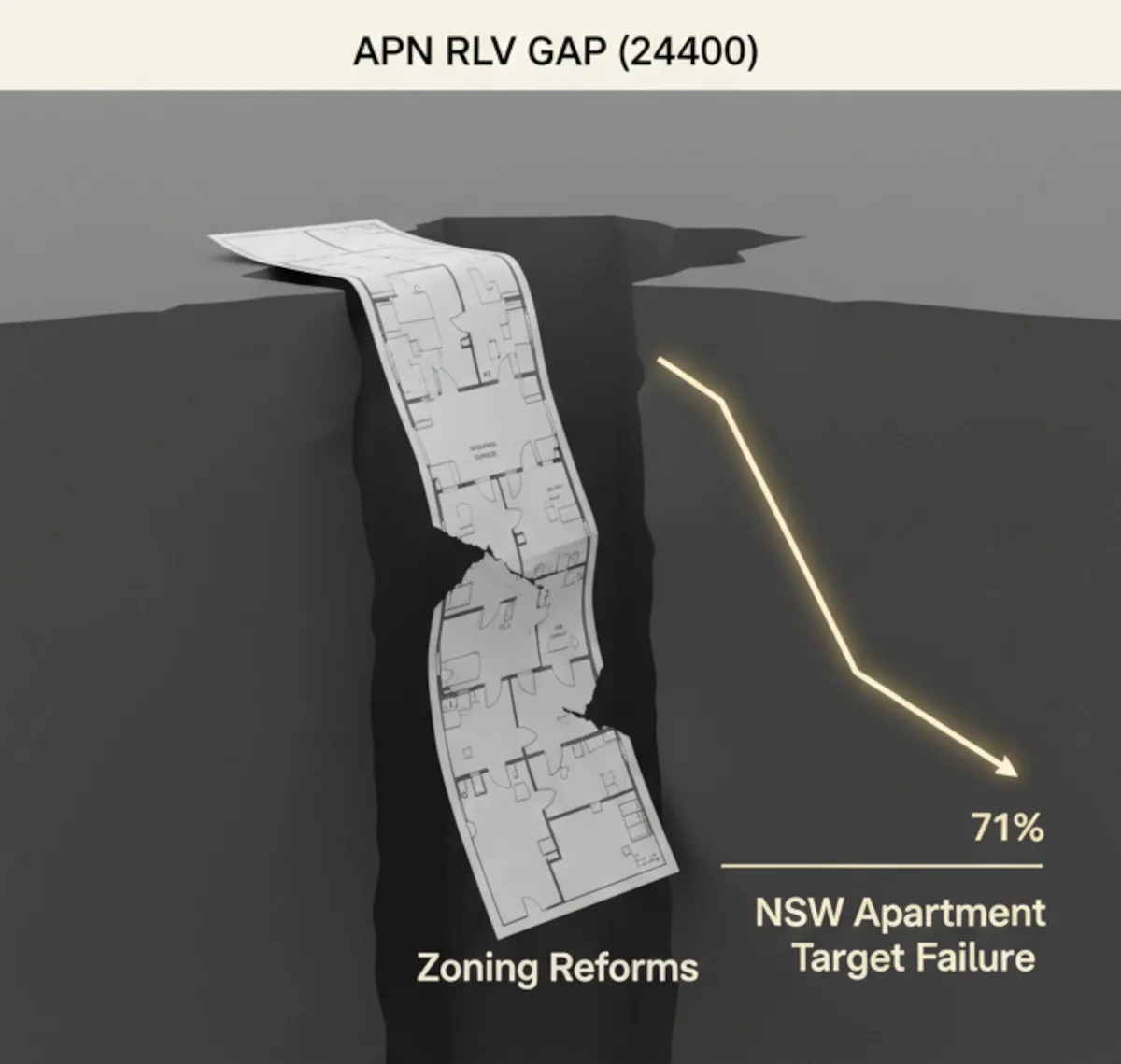
Analysis of the National Housing Accord’s first-year performance confirms its stated housing targets are not being met, a result of fundamental market economics rather than a lack of zoning reform. Despite state-led initiatives to increase density in transport corridors, peak body analysis from late 2025 reveals a structurally significant shortfall in the delivery of new apartments, with NSW falling 71% short of its high-density target. This provides large-scale, real-world validation of APN’s Residual Land Value (RLV) Gap thesis: the disparity between the sustained escalation in delivery costs and the commercial feasibility of projects is the dominant constraint on new supply, rendering paper-based zoning changes ineffective.
For property professionals, this analysis indicates the necessity of moving beyond generalized ‘rezoning’ opportunities. The market has demonstrated that a change in planning controls does not automatically create a viable project. Success now depends on the granular, project-level application of feasibility modelling to quantify the Residual Land Value (RLV) Gap. The divergence between state policies, such as NSW’s 400-metre transit corridor versus Victoria’s 800-metre radius, creates distinct risk and opportunity profiles that demand detailed analysis, not broad-stroke assumptions about supply.
Background & Strategic Context
This market performance provides a real-world calibration for APN’s core macro-theses. It demonstrates how state-led interventions can falter when they fail to account for fundamental market economics, validating the core tenets of the APN Sovereign Policy Composite Index™ (SPCI, 24800) and serving as a test case for the APN Future Development Pipeline Index™.
An Incomplete Intervention (APN Sovereign Policy Composite Index™ (SPCI, 24800)): The National Housing Accord is a characteristic intervention tracked by the APN Sovereign Policy Composite Index™ (SPCI, 24800), where federal incentives are used to drive state-level planning reform. However, the analysis reveals a structural flaw in its design: the intervention focused on zoning (the ‘what’) without adequately addressing delivery costs and feasibility (the ‘how’), leading to a predictable market failure that neutralised the policy’s intent.
A Clear Demonstration (APN Future Development Pipeline Index™): The 71% contraction in NSW apartment completions is a clear demonstration of the Residual Land Value (RLV) Gap. The new Transport Oriented Development (TOD) zoning created ‘Paper Rezonings’ on a large scale, which the APN Future Development Pipeline Index™ is specifically designed to identify and filter from the genuine, economically viable supply pipeline.
A Necessary Recalibration (Infrastructure Uplift Multiplier): The misattribution of the $2 billion ‘Social Housing Accelerator’ and the correct identification of the $1.5 billion ‘Housing Support Program’ highlights the importance of the Infrastructure Uplift Multiplier (IUM). The IUM is designed to measure the impact of *enabling infrastructure* funding, not vertical construction, making the $1.5 billion program the correct and only valid input for calibrating this metric.
Deconstruction of the Source Event
This deconstruction is based on an internal APN intelligence briefing that analysed primary policy documents and peak body analysis surrounding the National Housing Accord’s first-year performance. The key facts are:
- Policy Timeline Correction: The National Housing Accord is not a new November 2025 policy. It is an existing framework from 2023-24. The November 2025 date marks a period of *ex-post analysis* by bodies like the Grattan Institute and UDIA, which highlighted the Accord’s performance shortfalls.
- Zoning Mandate is State-Led: The transit corridor zoning reforms are not a uniform federal mandate. They are state-level responses to the Accord, creating a comparative test case: New South Wales implemented a 400-metre radius for its TOD program, while Victoria adopted a wider 800-metre radius for its activity centres.
- Infrastructure Funding Corrected: The $2 billion fund referenced in initial hypotheses is the ‘Social Housing Accelerator,’ designated for vertical construction. The correct fund for measuring infrastructure impact is the $1.5 billion ‘Housing Support Program,’ which is explicitly tasked with funding ‘enabling infrastructure such as roads, water and power.’
- Market Performance Confirmed: Industry analysis confirms the Accord’s targets are being missed significantly. Data for the first year in NSW shows a 44% overall shortfall against its target, with a structurally significant 71% under-delivery of apartments, the very typology the new zoning was meant to encourage.
Structural Analysis & Balanced View
The core paradox of the National Housing Accord is that a policy designed to increase housing supply has, in the high-density segment, exacerbated the conditions that prevent it. By up-zoning land without addressing the materially restrictive cost of delivery, the policy likely triggered speculative land acquisition, as noted by the NSW Productivity Commission. This strategic land acquisition front-runs any potential developer margin by inflating the land cost input, widening the Residual Land Value (RLV) Gap and ensuring projects remain unviable.
The policy’s shortfall is not in its intent, but in its assumption that zoning is the primary barrier to supply. The structural constraints—construction costs, labour shortages, financing costs, and state taxes and levies—were left unaddressed, rendering the zoning changes ineffective. This creates a dysfunctional two-tier market: theoretically valuable rezoned land that cannot be developed, and a diminishing pipeline of projects that were already viable, which now face even greater competition for finite resources. The result is a market where planning maps indicate potential for supply, but project balance sheets confirm its commercial unviability.
Strategic Implications for Property Professionals
- For Developers: The validation of the RLV Gap as the primary constraint means that site acquisition strategies based solely on new zoning are high-risk. Focus must shift to granular feasibility analysis. The A/B test between NSW (400m) and VIC (800m) provides a unique opportunity to model the impact of density on overcoming fixed costs and achieving commercial viability.
- For Investors & Fund Managers: The distinction between the $1.5B ‘Housing Support Program’ and other funds is a key consideration. Capital allocation should track the deployment of this $1.5B fund, as this is the capital that will unlock land for development by funding enabling infrastructure. Assets in precincts that secure this funding will have a significant competitive advantage.
- For Valuers & Financiers: The 71% apartment delivery shortfall in NSW must be integrated into valuation models for development sites in these newly rezoned corridors. A significant ‘feasibility discount’ should be applied to raw land values until there is clear evidence of costs abating or revenues rising. The ‘highest and best use’ is purely theoretical if it is not commercially deliverable.
- For Agents & Buyers’ Agents: The narrative of ‘new supply entering the market in elevated volumes’ in these transport corridors is demonstrably inaccurate for the immediate term. This creates a short-to-medium term opportunity for existing stock in these well-located areas, which will face significantly less new competition than the zoning maps suggest. Scarcity will remain the dominant price driver.
APN Index Management
The APN Codex 24000 Series is a proprietary set of indices that translates complex market forces into measurable metrics. This section outlines how the preceding analysis is validated against, and informs the calibration of, these frameworks.
- Validation (APN Future Development Pipeline Index™ – 24400): This analysis provides large-scale, empirical validation of the Residual Land Value (RLV) Gap as the core mechanism of the index. The 71% apartment delivery shortfall in NSW confirms the index’s function in differentiating ‘Paper Rezonings’ from viable projects.
- Index Calibration (Infrastructure Uplift Multiplier – IUM): The IUM is recalibrated to use the $1.5 billion ‘Housing Support Program’ as its primary input variable. The misattributed $2 billion ‘Social Housing Accelerator’ is now excluded to prevent inaccurate inputs and ensure the model accurately tracks the land value impact of *enabling infrastructure* investment.
- Data Capture (APN Future Development Pipeline Index™ – 24400): This analysis triggers a new data capture mandate to create a comparative A/B test within the index. The model will now track and compare development viability and the RLV Gap across two distinct cohorts: sites within NSW’s 400m TOD radius and sites within Victoria’s 800m Activity Centre radius.
Disclaimer
The analysis and information contained in this deconstruction are for general informational and strategic purposes only and do not constitute financial, investment, legal, or any other form of professional advice. The Australian Property Network (APN) is a strategic intelligence organisation and is not a licensed financial advisor.
This analysis is based on data and information from third-party sources believed to be reliable; however, APN provides no warranty as to its accuracy, currency, or completeness. Images used in this analysis are for illustrative and conceptual purposes only and may not represent real persons, properties, or events.
All frameworks (Codex 24100-24800) are proprietary to APN.
Property values and market conditions can go up or down. Before making any property or investment decisions, you must conduct your own thorough research and seek independent professional advice tailored to your specific circumstances.