

The Fiscal Airbag Deploys: AUD Rally Shields Feasibility But Fails to Deliver a Material Cost Reduction
APN ANALYSIS: A-260211-AUS137239
Executive Summary
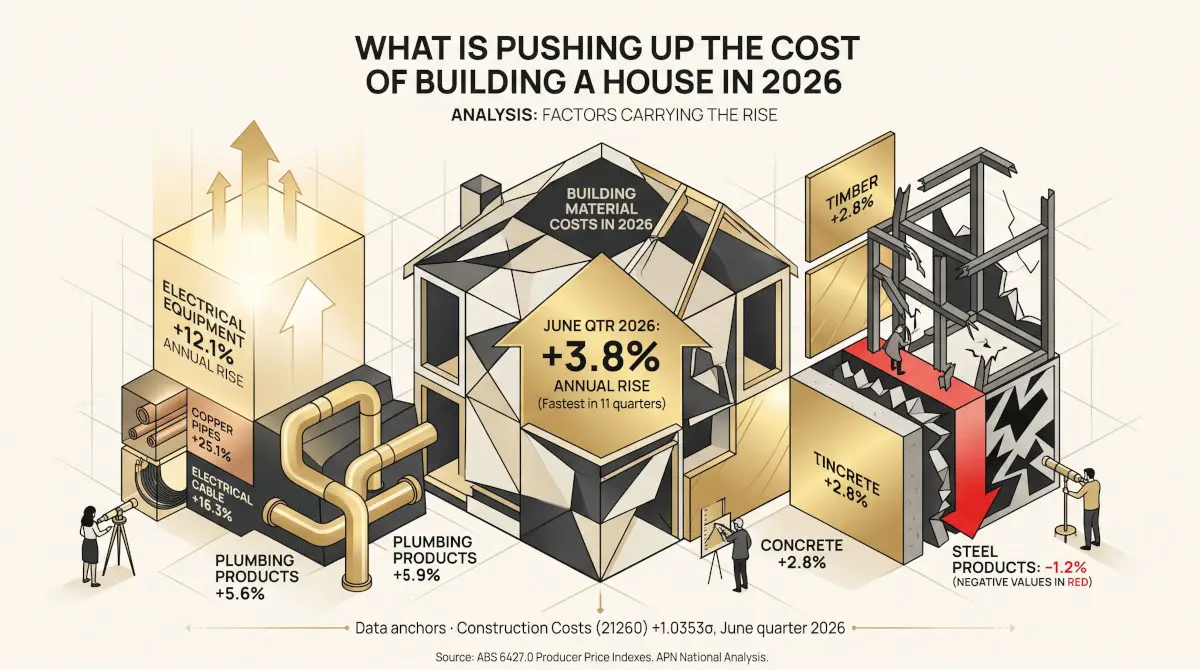
The Australian Dollar’s rally to approximately US$0.71, termed by APN as the “Fiscal Airbag,” is providing a material buffer against sustained escalation in construction costs but is failing to deliver the anticipated material deflation for the property sector. APN analysis confirms the currency’s strength is being almost entirely neutralised by a confluence of sovereign risk and global trade friction. These include new protectionist tariffs on imported steel, the abolition of key tax rebates for Chinese-made solar technology, and persistent embedded energy inflation in global manufacturing, which is eroding gains for high-specification products such as European glazing.
For property professionals, this transforms the market into a “Two-Speed” reality defined by geography and material selection. The strategy is no longer about broad-based cost savings, but about surgical procurement and disciplined capital allocation. Feasibility for the 2026 development pipeline now hinges on actively pivoting designs toward currency-advantaged materials such as European engineered timber, avoiding tariff-impacted categories, and concentrating development activity in the southern states, where labour markets are not distorted by Queensland’s pre-Olympic economic expansion.
Background & Strategic Context
This analysis validates and calibrates APN’s core macro-thesis, the APN Sovereign Policy Composite Index™ (SPCI, 24800), demonstrating how state-level interventions, from RBA monetary policy to targeted tariffs and foreign tax changes, are the primary force shaping the boundaries of development feasibility in Australia. The currency’s movement is not a pure market signal but a direct consequence of these often conflicting, top-down actions.
The State as Primary Actor (APN Sovereign Policy Composite Index™ (SPCI, 24800)): The Reserve Bank of Australia’s contractionary monetary policy is the primary driver of the AUD rally, while the Federal Government’s steel tariff and Beijing’s VAT rebate abolition are direct interventions that structurally adjust the import parity mechanism. This confirms that state policy, not abstract market forces, is dictating cost outcomes for developers.
The Viability Filter (APN Residual Land Value (RLV) Gap™): The intersection of currency gains and cost pressures directly impacts the RLV Gap (24410). In sectors like steel and solar, where the net benefit is zero, the viability gap for new projects remains wide or widens further. Conversely, in the engineered timber sector, the currency advantage helps close the gap, shifting potential projects from unviable “Paper Rezonings” toward genuine, deliverable opportunities.
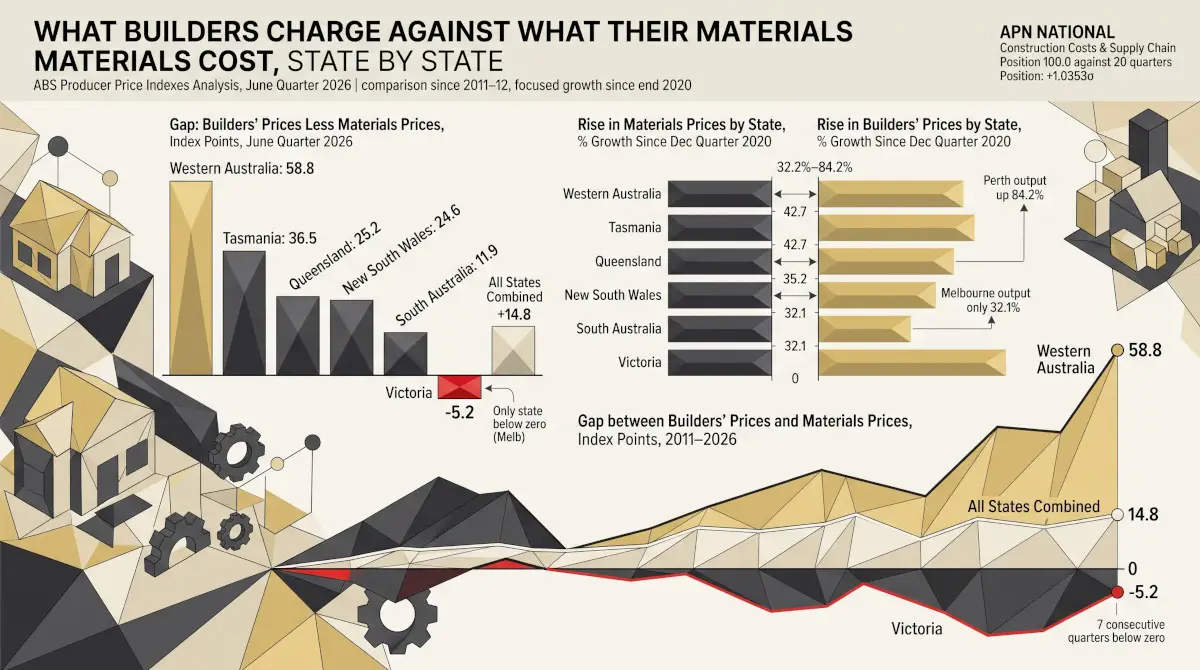
The Two-Speed Economy (APN Regional Green Premium Uplift™ / Brown Discount™): The analysis highlights a clear geographic bifurcation. Queensland’s Olympic-driven inflation creates a localized area of cost escalation, effectively imposing a regional “Brown Discount” (24520) on feasibility for projects not linked to the games. In contrast, the more stable cost environment in NSW and Victoria creates a relative value proposition, validating the index’s focus on regional economic divergence.
Deconstruction of the Source Event
This deconstruction is based on an internal APN intelligence briefing synthesising market data, government announcements, and supply chain analysis as of February 2026. The key facts are:
- Currency Rally Validated: The AUD is trading at ~0.7109 USD, supported by a contractionary RBA cash rate policy of 3.85% and a strong Trade Weighted Index (TWI) of 65.2, indicating broad-based strength against a basket of major trading partners.
- Steel Tariff Imposed: On 9 February 2026, the Australian government imposed a 10% tariff on Chinese-imported steel ceiling frames, citing anti-dumping findings. This action directly neutralises the currency discount for these products.
- Chinese Solar Tax Change: Beijing has abolished the 9% export VAT rebate for solar PV products effective 1 April 2026, forcing manufacturers to raise export prices by a similar margin and erasing the AUD’s purchasing power gain in this category.
- Regional Cost Divergence: Construction cost forecasts for 2026 show a material divergence. WT Partnership projects a 10% escalation for Brisbane, driven by pre-Olympic demand, while Sydney and Melbourne are forecast at a more moderate 4.5-5.0%.
- Material Cost Paradox: Despite a strong AUD against the EUR and JPY, embedded energy inflation is preventing material price reductions in European glazing. Simultaneously, Daikin’s strategic shift to local manufacturing is tempering potential savings on some heat pumps.
Critical Analysis & Balanced View
The “Fiscal Airbag” metaphor is proving accurate. It is not a luxury feature that enables a rapid path to profitability; it is a standard safety device that has been deployed under a structural pressure point. It is successfully preventing a structurally significant material decline in project feasibility across the board, but the industry is still sustaining material adverse effects in the form of margin erosion and cost uncertainty. The currency rally is a tool for survival, not a generator of disproportionate profits.
A central paradox emerges from the analysis: the very domestic inflation the RBA is addressing with higher rates (which strengthens the AUD) is the same force (specifically labour and service cost escalation) that consumes the currency’s benefit on project sites. This creates a zero-sum dynamic in markets experiencing accelerated inflation like Brisbane.
The investigation reveals a material deficiency in simplistic procurement strategies. Relying on a headline AUD/USD rate is a source of miscalculation for non-specialist analysis. True commercial advantage is now only found by minutely analysing each material category’s unique supply chain, accounting for tariffs, foreign tax policies, and embedded energy costs. The “Green Floor” thesis is shown to be structurally inconsistent; the prospect of discounted green technology is deferred. The strong AUD is merely preventing a material cost escalation in solar, shifting its role from a proactive value-add to a reactive cost-containment function.
Strategic Implications for Property Professionals
- For Developers: Immediately review and pivot 2026 project specifications. Substitute tariff-impacted steel framing with currency-advantaged European CLT/Glulam. This is no longer a ‘green’ choice but a core commercial decision to preserve feasibility. Focus on new project acquisitions in New South Wales and Victoria, where the ‘Fiscal Airbag’ can effectively offset moderate labour inflation.
- For Quantity Surveyors & Cost Planners: Cost models require bifurcation. National average assumptions should be discarded. Apply a +10% labour and services escalation factor for all Queensland projects and a more moderate 4.5-5.0% for southern states. Factor in a 9-13% baseline price increase for all Chinese-sourced solar PV from Q2 2026 onwards.
- For Procurement & Supply Chain Managers: The AUD/USD rate is a headline indicator with limited practical application; the TWI and specific currency pairs (EUR, JPY) are the operational metrics. Engage directly with European timber mills and pure-import Japanese HVAC suppliers to realise currency gains before they are absorbed by local distributors. Advise delaying non-essential solar procurement until Q3 2026 to avoid the current supply constraint driven by accelerated acquisition under elevated market anxiety.
- For Asset & Fund Managers: Stress-test the feasibility of your development pipeline against a ‘Two-Speed’ scenario. Assets in Queensland now carry a materially higher risk of cost overruns. Consider reweighting development portfolios toward NSW and Victorian projects with high proportions of imported materials to maximise the reactive benefit of a strong AUD.
APN Index Management
The APN Codex 24000 Series is a proprietary set of indices that translates complex market forces into measurable metrics. This section outlines how the preceding analysis is validated against, and informs the calibration of, these frameworks.
- Validation: This analysis validates the core tenets of the APN Sovereign Policy Composite Index™ (SPCI, 24800), confirming that state-level policy (tariffs, monetary policy, foreign tax changes) is the primary driver of construction cost outcomes, taking precedence over market-based signals.
- Index Calibration (APN Future Development Pipeline Index™): The APN Residual Land Value (RLV) Gap™ (24410) is being calibrated to incorporate new ‘friction filters’ for tariffs and foreign tax policy. This allows for more accurate differentiation between unviable ‘Paper Rezonings’ and genuinely feasible projects based on their specified material typology.
- Index Calibration (APN Risk & Compliance Index™): The ‘Olympic Distortion’ in Brisbane triggers a recalibration of the regional weighting within the APN framework, flagging the market as having a higher operational risk profile due to elevated labour market pressures driven by a state-level infrastructure program.
- Data Capture: This analysis triggers a new data capture mandate for the APN Symbiotic Intelligence Network™ (24310) to track shifts in procurement strategy among developers, specifically monitoring the substitution rate of steel for engineered timber as a leading indicator of adaptation to the new cost environment.
Disclaimer
The analysis and information contained in this deconstruction are for general informational and strategic purposes only and do not constitute financial, investment, legal, or any other form of professional advice. The Australian Property Network (APN) is a strategic intelligence organisation and is not a licensed financial advisor.
This analysis is based on data and information from third-party sources believed to be reliable; however, APN provides no warranty as to its accuracy, currency, or completeness. Images used in this analysis are for illustrative and conceptual purposes only and may not represent real persons, properties, or events.
All frameworks (Codex 24100-24800) are proprietary to APN.
Property values and market conditions can go up or down. Before making any property or investment decisions, you must conduct your own thorough research and seek independent professional advice tailored to your specific circumstances.