
SA’s ‘Agora Defence’: State Intervention as a Hedge Against Aged Care Market Failure
APN ANALYSIS: A-260211-AUS137215
Executive Summary
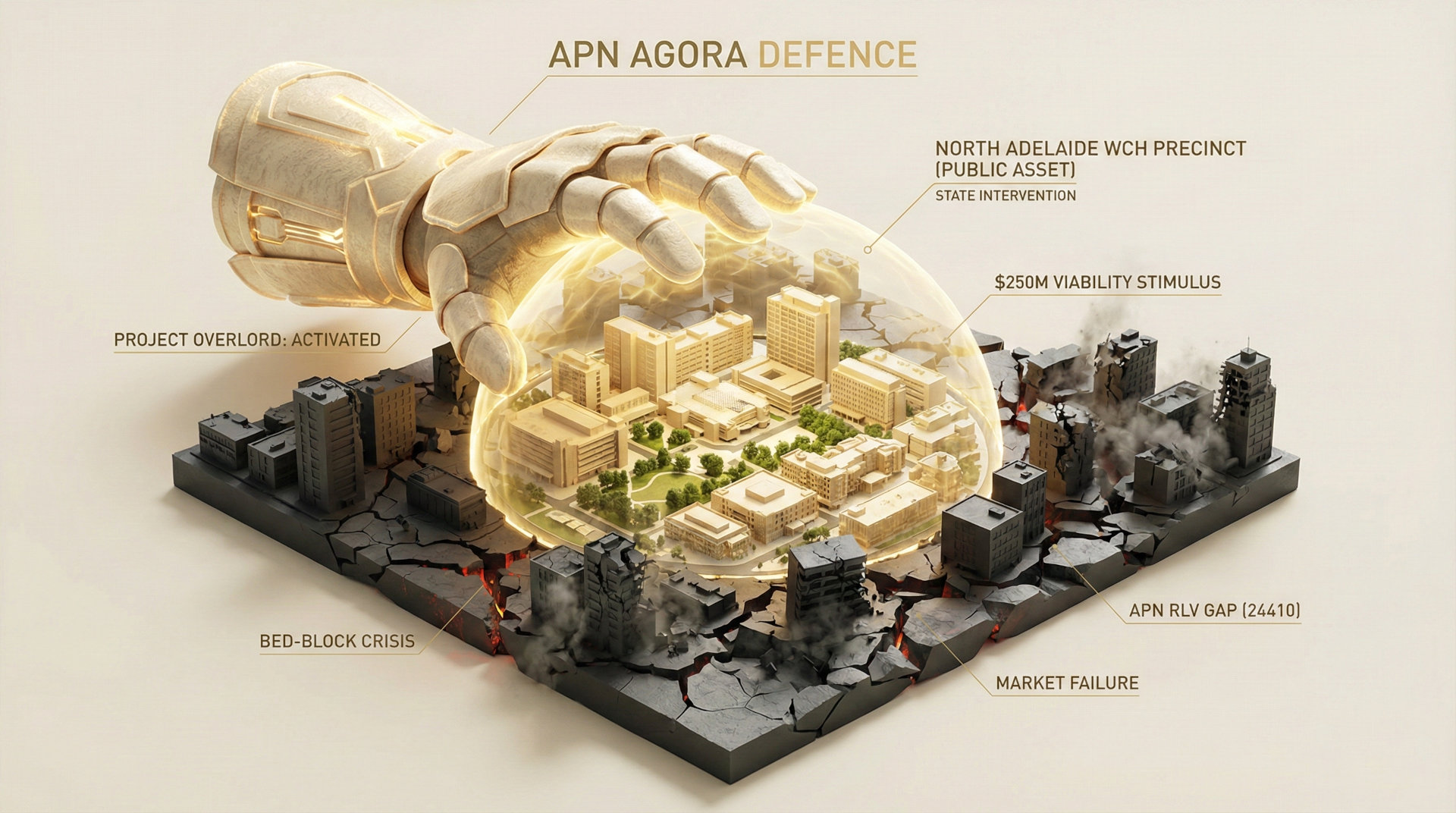
In a landmark strategic pivot, the South Australian Government is intervening directly in the aged care sector to resolve a systemic structural pressure point materially restricting its public hospitals. The ‘Agora Defence’ strategy involves retaining the prime North Adelaide Women’s and Children’s Hospital site for a 600-bed public health precinct and launching a $250 million no-interest loan scheme. This move is a direct response to a market failure: a national contraction in private aged care construction, evidenced by only 800 net new beds built last year, despite demand for 5,000. This failure is the direct cause of 363 medically-fit patients occupying acute care beds due to a lack of available aged care placements, which in turn has contributed to record ambulance ramping.
For property professionals, this event signals a structural shift in the social infrastructure landscape. The era of relying solely on the private market to deliver essential aged care capacity is concluding. The government’s reassertion of control through land retention and capital injection creates a new paradigm. Opportunities will now be concentrated in public-private partnerships and developments aligned with state policy objectives, such as expanding care for low-income individuals. This strategy validates the long-term value of strategic public land assets over short-term fiscal windfalls, fundamentally recalibrating how ‘highest and best use’ should be assessed for critical social infrastructure.
Background & Strategic Context
This event validates and calibrates APN’s core macro-thesis of the APN Sovereign Policy Composite Index™ (SPCI, 24800), which posits that state-level intervention is the primary force shaping property market boundaries. The South Australian Government’s ‘Agora Defence’ is a textbook example of the state reasserting control to correct a structurally significant market failure, creating new rules and opportunities in the process.
State Intervention as Market Arbiter (SPCI, 24800): The decision to retain the WCH site and inject $250 million in capital is a direct intervention that overrides market forces. Instead of divesting the asset for maximum private development value, the state is acting as the ultimate market arbiter, prioritising systemic resilience over short-term revenue and physically redrawing the boundaries of the health and aged care development market.
Private Market Constraint (APN Agora™ 24140): The structural pressure point represents a failure of the ‘Agora’—the private marketplace—to provide essential social infrastructure. The national stagnation in bed supply indicates the private sector is retreating. The state’s intervention to directly commission a 600-bed precinct and stimulate another 650 beds is a ‘State Provisioning’ counter-measure, stepping in where the market has failed to ensure community access to critical services.
Quantifying Constraint (APN RLV Gap™ 24410): The national statistic of only 800 net new beds is a stark manifestation of a widening APN Residual Land Value (RLV) Gap™. Sustained escalation in construction costs and high interest rates have made aged care development unviable for the private sector. The SA Government’s $250 million no-interest loan scheme is a direct fiscal tool designed to artificially close the viability gap for 650 beds, effectively subsidising the project risk that the private market will no longer bear.
Deconstruction of the Source Event
This deconstruction is based on APN’s analysis of the South Australian Government’s February 2026 policy announcements and supporting health system data. The key facts are:
- The Bed Occupancy Structural Pressure Point: As of February 2026, 363 patients medically fit for discharge are occupying acute hospital beds due to a lack of available aged care placements. This represents a circa 600% increase since early 2022 and is the primary driver of record ambulance ramping.
- The ‘Agora Defence’ Policy: The state has formalised a ‘No Sale’ policy for the North Adelaide WCH site, retaining the public land to develop a 600-bed health and aged care precinct. This explicitly rejects the option of selling the site for private luxury residential development.
- The Market Failure Catalyst: National data from the Bolton Clarke report shows a net increase of only 800 aged care beds in FY2024-25, despite an annual demand increase of approximately 5,000 residents, indicating private-sector supply has stalled due to a ‘Viability Gap’.
- The Fiscal Intervention: A $250 million no-interest loan scheme has been launched to stimulate private-sector construction of 650 new aged-care beds. This is designed to bridge the ‘Timeline Lag’ before the new WCH precinct is operational.
- The Timeline Lag: The primary infrastructure solution, the 600-bed North Adelaide precinct, will not be available until post-2031. This creates an elevated five-year gap where the health system’s stability depends on the success of short-term stimulus and reactivation measures.
Critical Analysis & Balanced View
The ‘Agora Defence’ is a strategically coherent and necessary response, yet it contains a significant temporal paradox. The long-term solution, retaining the North Adelaide site to create a 600-bed public capacity floor, is exceptionally sound, hedging against future market volatility and securing a critical state asset. However, this solution provides zero immediate relief for the 363 patients currently constrained in the system. The success of the entire strategy in the short to medium term, therefore, hinges on the effectiveness of a single financial lever: the $250 million loan scheme.
The elevated risk is that this stimulus fails to quickly restart the constrained private development activity. High construction costs, labour shortages, and planning delays could still render the no-interest loans insufficient to close the viability gap for many providers. If the scheme fails to deliver the targeted 650 beds within the next 24-36 months, the bed occupancy structural pressure point will likely persist or worsen, leaving the government facing the 2030 election with the same structural pressure point it faces today. The policy’s hidden strength, however, is its compelling fiscal logic. The estimated annual cost of housing the 363 patients in acute beds (~$265 million) means the $250 million loan scheme effectively pays for itself in less than one year of avoided acute care costs, making it a substantive investment in operational efficiency.
Strategic Implications for Property Professionals
- For Developers: The $250 million no-interest loan scheme is a direct signal to the market. Developers with shovel-ready aged care projects, particularly those targeting the ‘lower means’ cohort, have a unique, state-supported opportunity to de-risk their capital stack and gain first-mover advantage in a capacity-constrained market.
- For Investors & Fund Managers: The ‘Agora Defence’ validates state-backed social infrastructure as a resilient asset class. The future Public-Private Partnership (PPP) model for the 600-bed North Adelaide precinct, likely on a long-term ground lease, will be a landmark opportunity, de-risking the land component for private capital and operational expertise.
- For Valuers & Consultants: Valuation models must now incorporate a ‘State Intervention Premium’. The decision to retain the WCH site over a lucrative luxury sale proves that ‘highest and best use’ analysis must now account for public utility and systemic resilience, not just pure market value. This creates a new advisory requirement for major public land assets.
- For Agents & Buyers’ Agents: Confirmation of the North Adelaide site as a long-term health precinct provides certainty, reducing speculative risk and solidifying the area’s character. This will support stable, long-term value in surrounding residential and commercial assets, insulating it from the volatility of speculative, gentrification-driven development cycles.
APN Index Management
The APN Codex 24000 Series is a proprietary set of indices that translates complex market forces into measurable metrics. This section outlines how the preceding analysis is validated against, and informs the calibration of, these frameworks.
- Validation: This analysis validates the core thesis of the APN Sovereign Policy Composite Index™ (SPCI, 24800), demonstrating the state’s role as the ultimate market arbiter when private mechanisms fail. It also confirms the direct causal link between the APN RLV Gap™ (24410) and a physical lack of new supply.
- Index Calibration (APN Agora™ 24140): The APN Agora™ Index is calibrated to register a significant ‘Market Failure’ event in the South Australian aged care sector. The state’s direct intervention (land retention and capital injection) is recorded as a primary ‘State Provisioning’ countermeasure, increasing the sub-index weight for government involvement in social infrastructure.
- Index Calibration (APN RLV Gap™ 24410): The national statistic of only 800 net new beds provides a new benchmark for the APN Residual Land Value (RLV) Gap™. The SA Government’s $250 million loan scheme is now being treated as a market-correction mechanism, representing a liquidity injection of approximately $384,000 per bed required to close the viability gap.
- Data Capture: This triggers a new data capture mandate for the APN Future Development Pipeline Index™ (24400) to track the uptake, location, and delivery timeline of the 650 beds under the SA loan scheme. This will provide a real-time test of the stimulus’s efficacy.
Disclaimer
The analysis and information contained in this deconstruction are for general informational and strategic purposes only and do not constitute financial, investment, legal, or any other form of professional advice. The Australian Property Network (APN) is a strategic intelligence organisation and is not a licensed financial advisor.
This analysis is based on data and information from third-party sources believed to be reliable; however, APN provides no warranty as to its accuracy, currency, or completeness. Images used in this analysis are for illustrative and conceptual purposes only and may not represent real persons, properties, or events.
All frameworks (Codex 24100-24800) are proprietary to APN.
Property values and market conditions can go up or down. Before making any property or investment decisions, you must conduct your own thorough research and seek independent professional advice tailored to your specific circumstances.