
Van Onselen: A 2027 Recession Risk, and Why Spending Restraint Cuts Both Ways
Regional radio economics segment — an economist sets out the risk of a technical recession in 2027, days before the Reserve Bank’s September board decision
At that meeting, on 29 September 2026, the Reserve Bank raised the cash rate target by 25 basis points to 4.60%
Flat Per Person Since 2022: Van Onselen’s Recession Claims Tested (I-260925-CTID)
NIL RETURN
23000 Series — Scope & Inclusion Criteria
The Australian Property Network’s (APN’s) 23000 Series is the attributed opinion layer of the APN Codex. It presents the recorded perspective of an identified practitioner, academic or subject-matter expert whose observations bear on active node conditions, without constituting APN’s own analytical position. This perspective is drawn from an eight-minute regional radio economics segment, broadcast in September 2026 after the June quarter national accounts. APN carries the whole of the economist’s argument because it names a tension that bears directly on the next Reserve Bank decision: restraint in public spending would ease inflation, and it would also remove one of the supports keeping the economy out of recession. The speaker’s statements are presented as his own attributed analysis, not as verified fact.
Attributed Perspective — Leith van Onselen, Chief Economist, MacroBusiness
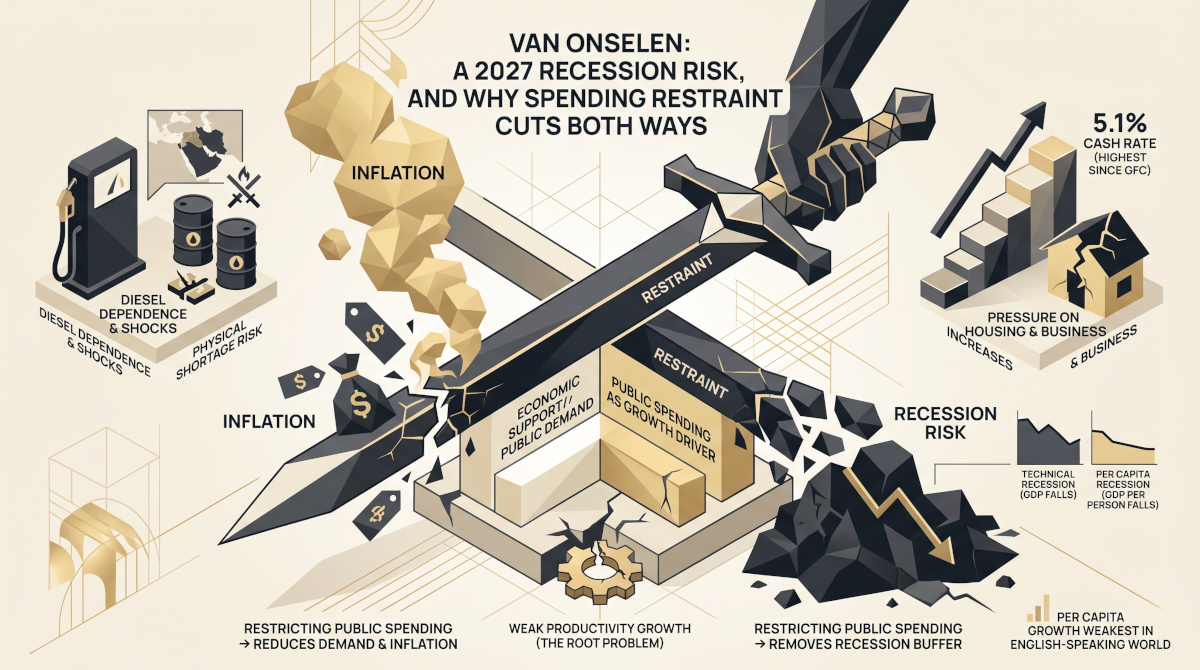
Van Onselen distinguishes two kinds of recession. A technical recession is two consecutive quarters in which gross domestic product falls. A per capita recession, a term he says he coined about a decade ago, is two consecutive quarters in which GDP per person falls. On the second measure, he says, Australia has been at or near recession for four years: as of the June quarter of 2026, real GDP per person was about 0.3% below its level in mid-2022, even though the economy as a whole has grown. He adds that per capita growth over that period has been the weakest in the English-speaking world, and significantly weaker than the euro zone’s.
He sees a decent chance of a technical recession next year, and a deep per capita one with it. With the population growing by about 0.4% a quarter, a fall in GDP of 0.1% in each of two quarters would mean GDP per person falling by about half a per cent a quarter. He gives two reasons for the risk. The first is diesel. Australia’s land mass, its freight task and the weight of agriculture, mining, transport and construction in the economy make it one of the most diesel-dependent economies in the world. Diesel near where he lives costs about $3 a litre, and he says a protracted conflict in the Middle East could push it higher. Physical shortages would bring outright contraction. Higher fuel costs would also pass through to the prices of goods, including in supermarkets, in a second-round inflation shock that reduces what households have left to spend on everything else.
The second is the rate path. He says financial markets expect the cash rate to rise at least twice more in the next year, and possibly a third time, to 5.1%, which would be the highest since the global financial crisis in 2008. He expects that to weigh further on the housing market, raise costs for businesses and households, and add to the risk of recession.
Asked which levers government should reach for, he argues for spending restraint at every level. In his account, governments are spending a record share of GDP. With productivity growth weak, that extra demand outruns supply and feeds inflation, so lower and more efficient spending by federal, state and local governments would take some of the pressure out of the economy.
The host put the difficulty to him: cutting spending would also remove something holding the economy out of recession. Van Onselen agreed.
“Unfortunately, it’s a bit of a double-edged sword because one of the things that has actually fuelled the economy has been this record public spending.”
Leith van Onselen, on the case for spending restraint.
He attributes part of the position to events overseas, including fuel, and part to Australia’s own choices. The underlying problem, in his view, is productivity growth, which over the past decade has been among the weakest in the advanced world.
Source: Leith van Onselen, chief economist, MacroBusiness. Radio interview — ABC Radio Upper Hunter, “The Dismal Science” economics segment, September 2026, about eight minutes. Close paraphrase throughout, with the direct quotation as marked; the broadcast recording is the authoritative record of exact wording. The per capita figure of 0.3% is as the speaker states it in his written commentary of 18 September 2026 (MacroBusiness). Disclosure: in June 2026, van Onselen said publicly that he would be willing to head One Nation’s Victorian Senate ticket at the next federal election (APN, 23 June 2026).
APN Clinical Reframing
The segment carries claims of three kinds. Some are statements about the published record: the per capita GDP figure, population growth, the cash rate arithmetic, the share of public spending in GDP and productivity. The companion National Insight output tests them against ABS and Reserve Bank series. It finds that GDP per person is 0.25% below the June quarter of 2022, as the speaker says, and that it has risen by 1.1% from its low point in September 2024. The claim of four years at or near per capita recession holds for 2023 and 2024 and is less apt for the past year. Public spending, at 28.9% of GDP, is above every quarter before the pandemic, and in the June quarter public demand added 0.1 percentage points to growth. Some are comparisons with other economies, which APN does not test in this output. The third kind is the forecast of a technical recession in 2027, which APN does not test. It is presented as the speaker’s own conditional judgement.
The speaker’s own words set out the tension in his prescription. Public spending restraint is offered as a response to inflation, and public spending is named as one of the things supporting activity. In the short run the two pull in opposite directions: the restraint that would ease price pressure would also subtract from demand at a time when output per person is barely growing. The speaker does not resolve the tension; he names productivity growth as the condition under which it would ease. Characterisations of the housing effect of further rate rises are paraphrased in APN’s register.
This perspective is an exploration candidate for Employment & GDP (21230), Interest Rates (21210) and Inflation (21220). The open question it raises is whether policy can ease inflation driven in part by fuel costs without deepening a slowdown in output per person. No figure or characterisation in this piece may be treated as an APN-certified position for any 21000, 22000 or 24000 Series node.
Disclaimer
The analysis, information, and opinions contained in this article are for general informational and strategic purposes only and do not constitute financial, investment, legal, or any other form of professional advice. The Australian Property Network (APN) is a strategic intelligence organisation and is not a licensed financial advisor.
The views, thoughts, and opinions expressed in this text belong solely to the author and do not necessarily reflect the official policy or position of the Australian Property Network (APN).
This content may be based on data from third-party sources believed to be reliable; however, APN provides no warranty as to its accuracy, currency, or completeness. Images used are for illustrative and conceptual purposes only and may not represent real persons, properties, or events.
Property values and market conditions can go down as well as up. Before making any property or investment decisions, you must conduct your own thorough research and seek independent professional advice tailored to your specific circumstances.