
North: Australia’s Housing Market as a Three-Body Problem
Long-form video interview — an independent analyst of household finances sets out why interest rates and lending policy drive Australian housing, what his household surveys show about financial pressure, and three scenarios for prices
Borrowing, Real Incomes, Rents and Building Costs: Four of Martin North’s Claims Tested (I-260924-151013)
NIL RETURN
23000 Series — Scope & Inclusion Criteria
The Australian Property Network’s (APN’s) 23000 Series is the attributed opinion layer of the APN Codex. It presents the recorded perspective of an identified practitioner, academic or subject-matter expert whose observations bear on active node conditions, without constituting APN’s own analytical position. This perspective is drawn from an interview of about an hour in which Martin North, principal of Digital Finance Analytics and presenter of the Walk The World channel, appears as a guest. APN draws on his account of what is driving the housing market, what his surveys of household finances show, and the social consequences he sees following from it, because the question of how far households can absorb higher interest rates is the one the market now turns on. The host’s own remarks on politics and migration are not reproduced. The speaker’s statements are presented as his own attributed analysis, not as verified fact.
Attributed Perspective — Martin North, Principal, Digital Finance Analytics
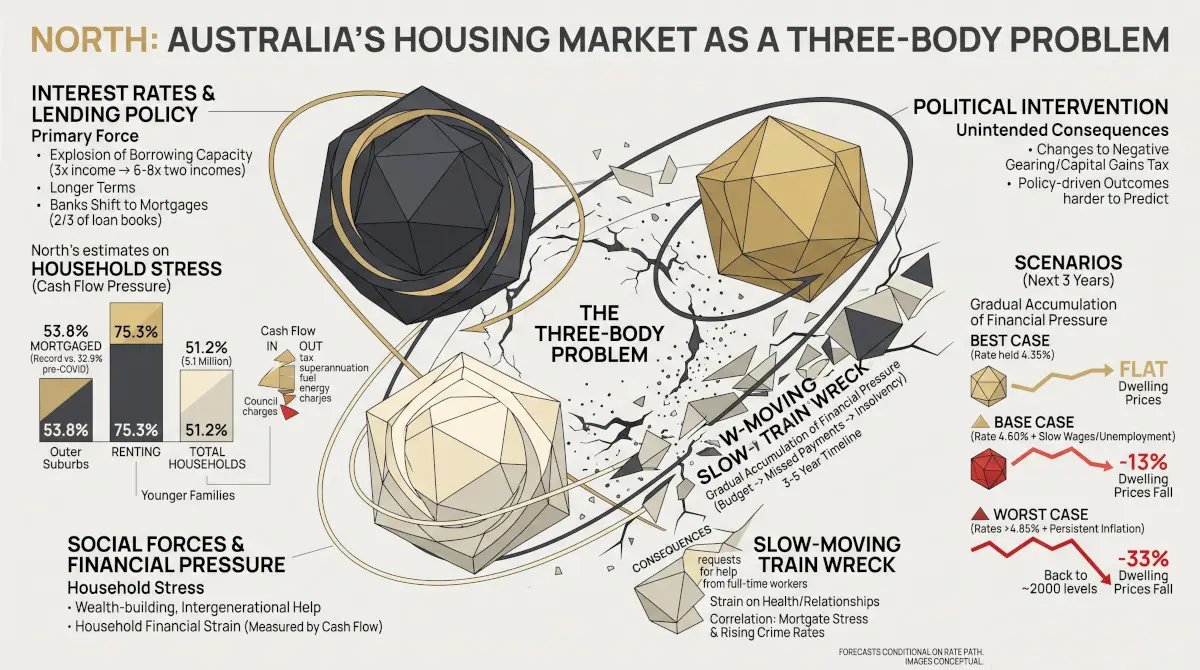
North’s starting point is that there is no single Australian property market. There are many, he says, and aggregate statements that prices are up or down miss the detail that matters. He describes the market as a “three-body problem”: once supply and demand, political intervention, and social forces such as intergenerational help and wealth-building are combined with interest rates and financial pressure, the system becomes hard to predict, and policy changes can have consequences no one intended.
Of all those forces, he puts interest rates and lending policy first. Prices were already falling before the Budget’s changes to negative gearing and capital gains tax, he says, because the Reserve Bank’s expected cutting cycle reversed into rate rises. He traces the long run-up in prices to borrowing capacity: around 2000, a household could borrow roughly three times one full-time income plus a little of a second, where today lending runs to six to eight times two incomes, over terms five to ten years longer. In the same period, he says, the banks’ loan books moved from about two-thirds business lending to about two-thirds mortgages.
He measures household stress by cash flow, not by the share of income spent on the mortgage. His survey of about 52,000 households compares all money coming in with all money going out, including tax, superannuation, fuel, energy and council charges. On that basis he puts 53.8% of mortgaged households under cash-flow pressure, a record in his series against 32.9% before COVID, and 75.3% of renting households. Across the country, he estimates that about 5.1 million households, or 51.2%, are under some financial pressure, with younger families and the outer suburbs of the major cities most affected.
He describes a slow build-up rather than a sudden break. Following the Reserve Bank’s own account of the spectrum of household financial stress, he says households move from tighter budgets to missed payments to insolvency over three to five years. Banks, in his account, are encouraging borrowers to refinance or extend their loan terms, which keeps reported arrears and mortgagee sales low while the underlying pressure persists; some borrowers, he says, are being encouraged to sell before matters become more serious. He adds that new homes are becoming dearer to build even as existing homes fall in price, which he says is squeezing the construction sector.
He argues that the consequences reach beyond household budgets. Debt-counselling services, he says, now report more requests for help from people in full-time work who hold two jobs, and describe the strain that sustained financial pressure places on health and relationships. He also reports a strong correlation, in his own analysis, between rising crime rates and his measure of mortgage stress. In his view, these social and economic consequences receive too little weight in a housing debate framed around helping people into the market.
He closes with three scenarios for national dwelling prices over the next three years. In his best case, with the cash rate held at 4.35%, prices are flat. In his base case, with one further rise to 4.60% and slowing wages and rising unemployment, they fall about 13%. In his worst case, with rates above 4.85% and persistent inflation, they fall about 33%, which he says would take them back towards their level in 2000. His conclusion is that prices need to settle, and that housing lending on this scale has held back productivity growth elsewhere in the economy.
“This is a slow-moving train wreck, right? This isn’t something that happens immediately.”
Martin North, on household financial stress. Quoted in his own register; APN’s reframing follows below.
Source: Martin North, principal, Digital Finance Analytics, and presenter of Walk The World. Video interview — Nucleus Wealth (YouTube), “Where Are Australian House Prices Falling the Most? Featuring Martin North”, hosted by Damian Klassen, September 2026; drawn from segments between about 1:30 and 1:00:40. Retrieved 24 September 2026. Close paraphrase throughout, with short direct quotations as marked; the published recording is the authoritative record of exact wording. Context: North appears as a guest; the household stress figures are from his own firm’s survey and model. Commercial interests not independently verified.
APN Clinical Reframing
North’s account combines three kinds of material, and they carry different weight. The first is a set of claims about the published record: on borrowing, real incomes, rents and building costs. The companion Investment & Finance Claim Test tests four of them: three hold, each with a qualification, and one holds for private rent indices but not for the official measure. The second is his survey. His cash-flow definition of stress is broader than the measures most commonly used, such as mortgage repayments above 30% of income or loans in arrears, so his proportions are not comparable with those measures. They are presented here as his estimates.
The third is forecasting. His three scenarios are his own, conditional on the rate path, and APN does not forecast. In the clinical register, the quoted remark describes a gradual accumulation of household financial pressure that has not yet shown up in arrears or forced sales. That is a testable proposition, and the published arrears data over the next several quarters will show whether it holds. The language of the quoted remark is his own.
The social consequences North describes are the territory of the APN Social Capital Index™ (Composite) (24100), which measures community conditions locality by locality. Its components include APN Sentinel™ (Safety & Sentiment Index) (24120), whose pillars carry violent and property crime risk, and APN Bedrock™ (Socio-Economic Position) (24110). His reported link between rising crime and mortgage stress is his own finding from his own data. A correlation of this kind does not show that one causes the other: both can reflect the same underlying disadvantage. Whether the relationship appears in APN’s locality readings is a question this piece does not test.
This perspective is an exploration candidate for Credit Velocity (21270), Rental Market Analysis (21190) and Construction Costs & Supply Chain (21260), and, for its social dimension, APN Sentinel™ (Safety & Sentiment Index) (24120). The open questions it raises are how much of the pressure his survey records will reach arrears and forced sales, and how quickly, and whether the social consequences he reports are visible in locality-level measures of community conditions. No figure or characterisation in this piece may be treated as an APN-certified position for any 21000, 22000 or 24000 Series node.
Disclaimer
The analysis, information, and opinions contained in this article are for general informational and strategic purposes only and do not constitute financial, investment, legal, or any other form of professional advice. The Australian Property Network (APN) is a strategic intelligence organisation and is not a licensed financial advisor.
The views, thoughts, and opinions expressed in this text belong solely to the author and do not necessarily reflect the official policy or position of the Australian Property Network (APN).
This content may be based on data from third-party sources believed to be reliable; however, APN provides no warranty as to its accuracy, currency, or completeness. Images used are for illustrative and conceptual purposes only and may not represent real persons, properties, or events.
Property values and market conditions can go down as well as up. Before making any property or investment decisions, you must conduct your own thorough research and seek independent professional advice tailored to your specific circumstances.