

NSW Implements SPCI Framework: State Centralises Planning Control to Accelerate Housing Supply and Recalibrate Land Values
APN ANALYSIS: A-251124-AUS131011
Executive Summary
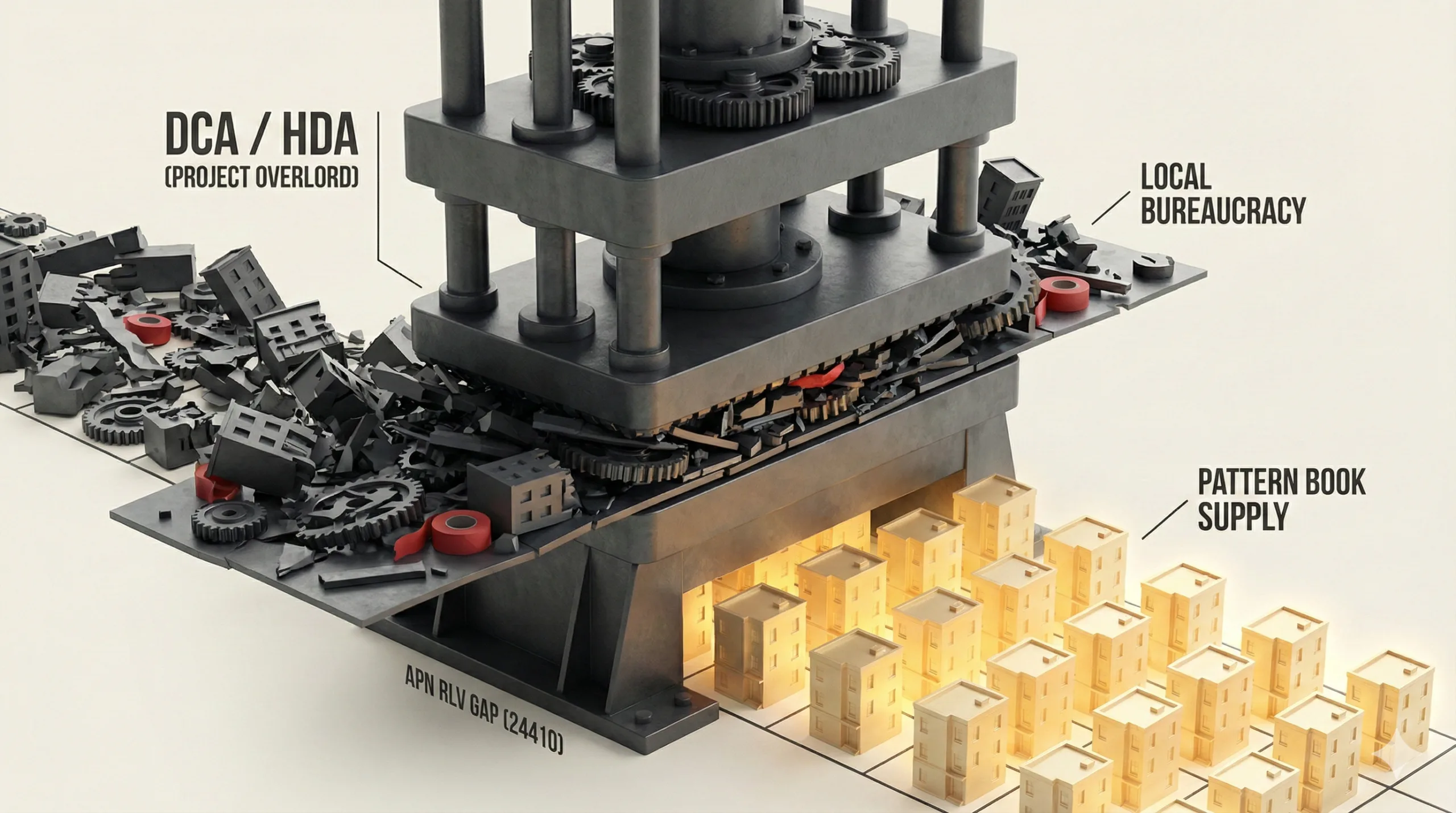
The NSW Government has passed the Environmental Planning and Assessment Amendment (Planning System Reforms) Bill 2025, a structural intervention that centralises planning power into two new bodies: the Development Coordination Authority (DCA) and the Housing Delivery Authority (HDA). This is not an administrative tweak; it is a fundamental re-architecture designed to bypass council and agency vetoes, substantively compress development timeframes, and drive an increase in housing supply. The reforms deploy the planning system as an instrument to prioritise velocity and yield, directly addressing the economic frictions that have stalled development for decades.
For property professionals, this legislative overhaul signals the end of the collaborative planning era and the start of a state-directed delivery model. The changes create immediate, quantifiable uplift in the Residual Land Value (RLV) for specific land classes, particularly R2-zoned sites now eligible for higher-density ‘Pattern Book’ development. The era of speculative strategic land acquisition based on uncertain future rezonings is over; the new market rewards speed, execution, and alignment with state-mandated housing typologies.
Background & Strategic Context
This event validates APN’s core APN Sovereign Policy Composite Index™ (SPCI, 24800) thesis, which posits that state-level intervention is the primary force shaping property market outcomes. The NSW Government’s reforms are a textbook example of a sovereign policy actor applying legislative and administrative power to fundamentally recalibrate market boundaries and value creation mechanisms.
Addressing the Viability Impasse (APN Residual Land Value (RLV) Gap™): The core strategic intent of the reforms is to close the APN Residual Land Value (RLV) Gap™ (24410). By substantively reducing approval timeframes (‘t’) and entitlement risk (‘r’) through the DCA and Pattern Book pathways, the reforms structurally increase the price a developer can viably pay for land, prompting a market recalibration away from speculative vendor expectations.
Deploying Climate Resilience as a Policy Instrument (APN Substrate™): The elevation of ‘climate resilience’ to a primary object of the EP&A Act is a key component of the APN Sovereign Policy Composite Index™ (SPCI, 24800) strategy, validating the APN Substrate™ (24150) framework. It provides the legal justification to mandate density in well-serviced, ‘resilient’ transport corridors while simultaneously empowering the state to block development in high-risk zones, using climate as both an instrument for densification and a mechanism against future liability.
Quantifying the Supply Pipeline (APN Future Development Pipeline Index™): The reforms directly impact the APN Future Development Pipeline Index™ (24400) by converting vast swathes of ‘Paper Rezonings’ into genuine opportunities. The introduction of Manor Houses and Terraces as complying development in R2 zones is a strategic upzoning that bypasses local government approval processes, directly unlocking a new, quantifiable pipeline of ‘missing middle’ housing stock that the index is designed to measure.
Deconstruction of the Source Event
This deconstruction is based on APN’s analysis of the Environmental Planning and Assessment Amendment (Planning System Reforms) Bill 2025 and its associated regulatory instruments. The key facts are:
- Legislative Passage: The Bill passed NSW Parliament in November 2025, representing the most significant overhaul of the EP&A Act 1979 since its inception.
- Creation of Centralised Authorities: The reforms establish two substantive statutory bodies: the Development Coordination Authority (DCA) to act as a “single front door” for agency approvals, and the Housing Delivery Authority (HDA) to manage the housing pipeline and declare State Significant Development (SSD).
- The ‘Pattern Book’ Pathway: A new Complying Development Certificate (CDC) pathway is created for pre-approved ‘Pattern Book’ designs, mandating a 10-day approval timeframe for eligible projects, including Manor Houses and Terraces in R2 Low Density zones.
- Recalibration of Statutory Objects: The objects of the EP&A Act have been amended to prioritise “housing delivery” and “climate resilience” while removing the explicit object of “sharing responsibility” with local government and reducing the emphasis on community participation.
- Dissolution of Regional Panels: Regional Planning Panels have been dissolved, removing a layer of bureaucracy and bifurcating approvals between local councils (for minor works) and the state (for major projects).
- HDA Override Powers: The HDA is empowered to recommend projects for SSD status (>$60m in Sydney) and direct amendments to local environmental plans (LEPs) to facilitate those projects, effectively overriding council zoning controls.
Critical Analysis & Balanced View
The SPCI-aligned strategy is one with material contingent risks. While the centralisation of power within the DCA and HDA is structured for maximum velocity, it creates a significant concentration of power with reduced oversight. The confirmation that ICAC was not consulted on key aspects of the Bill highlights an approach that prioritises delivery speed over other considerations, including traditional probity and checks and balances. This creates a potential long-term governance risk.
Furthermore, the “Pattern Book” model, while effective for accelerating supply, risks homogenising suburban character. The use of “starchitects” is a strategic public relations move to counter claims of poor design, but the commercial reality is that developers will gravitate towards the most cost-effective patterns, potentially leading to a new form of standardised suburbia. The true test will be whether the market embraces this trade-off between design diversity and delivery certainty.
Finally, the removal of community participation as a primary statutory object, while strategically effective in bypassing localised development resistance, creates a “democratic deficit.” This may lead to a loss of social licence for development over the long term, potentially manifesting as political backlash in future electoral cycles. The State has bet that the immediate benefits of increased housing supply will outweigh the political cost of reducing the role of local communities in the planning process.
Strategic Implications for Property Professionals
- For Developers: The strategic environment has fundamentally shifted from managing local government relations to aligning with state directives. Focus acquisition strategies on R2-zoned lots in Sydney, Newcastle, and Wollongong that meet the criteria for ‘Pattern Book’ Manor Houses and Terraces. For larger-scale projects, pivot business models to include a 50% affordable housing component to access the fastest HDA-managed SSD pathways, likely in partnership with Community Housing Providers.
- For Agents & Buyers’ Agents: Your advisory role must now incorporate a deep understanding of the new planning codes. The highest and best use of an R2-zoned property has fundamentally changed materially and immediately. Educate vendors on the new ‘Pattern Book’ potential to justify higher land values, and guide buyers towards assets with unlocked development potential that the broader market has not yet priced in.
- For Planners & Consultants: Your value proposition shifts from negotiation and mediation with councils to technical compliance and process management with the DCA. Expertise in the new ‘Pattern Book’ code and the HDA’s SSD criteria is now paramount. The most valuable consultants will be those who can navigate the state’s “single front door” with maximum efficiency.
- For Valuers & Financiers: Traditional valuation methodologies based on historical sales and existing zoning are now insufficient. Valuations for R2-zoned land must be immediately recalibrated to reflect the new, higher-yield potential under the ‘Pattern Book’ CDC pathway. Lenders should view these projects as lower risk due to the state-guaranteed approval certainty.
APN Index Management
The APN Codex 24000 Series is a proprietary set of indices that translates complex market forces into measurable metrics. This section outlines how the preceding analysis is validated against, and informs the calibration of, these frameworks.
- Validation: This analysis validates the APN Sovereign Policy Composite Index™ (SPCI, 24800) macro-thesis. It also confirms the direct causal link between state intervention and the APN Residual Land Value (RLV) Gap™ (24410), demonstrating how legislative changes can structurally alter development feasibility.
- Index Calibration (APN Future Development Pipeline Index™): The APN Future Development Pipeline Index™ (24400) is recalibrated with immediate effect. A positive multiplier will be applied to all R2 Low Density Residential zoned land within the Greater Sydney, Newcastle, and Wollongong metropolitan areas to reflect the new ‘as-of-right’ development potential for Manor Houses and Terraces via the Pattern Book CDC pathway.
- Index Calibration (APN Substrate™): The APN Substrate™ (24150) is updated to reflect the new statutory weight of ‘climate resilience’. The index will now assign a higher rating to locations within designated Transport Oriented Development (TOD) corridors, reflecting their legal and political favourability for densification under the new planning regime.
- Data Capture: This event triggers a new data capture mandate for the APN Symbiotic Intelligence Network™ (24310). We will now track the approval velocity of Pattern Book CDCs and the rate at which the DCA exercises its ‘override’ power on integrated developments to quantify the real-world impact of the reforms.
Disclaimer
The analysis and information contained in this deconstruction are for general informational and strategic purposes only and do not constitute financial, investment, legal, or any other form of professional advice. The Australian Property Network (APN) is a strategic intelligence organisation and is not a licensed financial advisor.
This analysis is based on data and information from third-party sources believed to be reliable; however, APN provides no warranty as to its accuracy, currency, or completeness. Images used in this analysis are for illustrative and conceptual purposes only and may not represent real persons, properties, or events.
All frameworks (Codex 24100-24800) are proprietary to APN.
Property values and market conditions can go up or down. Before making any property or investment decisions, you must conduct your own thorough research and seek independent professional advice tailored to your specific circumstances.