
The Commuter Delta: How RBA Policy and HGS Caps Are Structuring the Yass Property Market
APN ANALYSIS: A-260205-AUS136749
Executive Summary
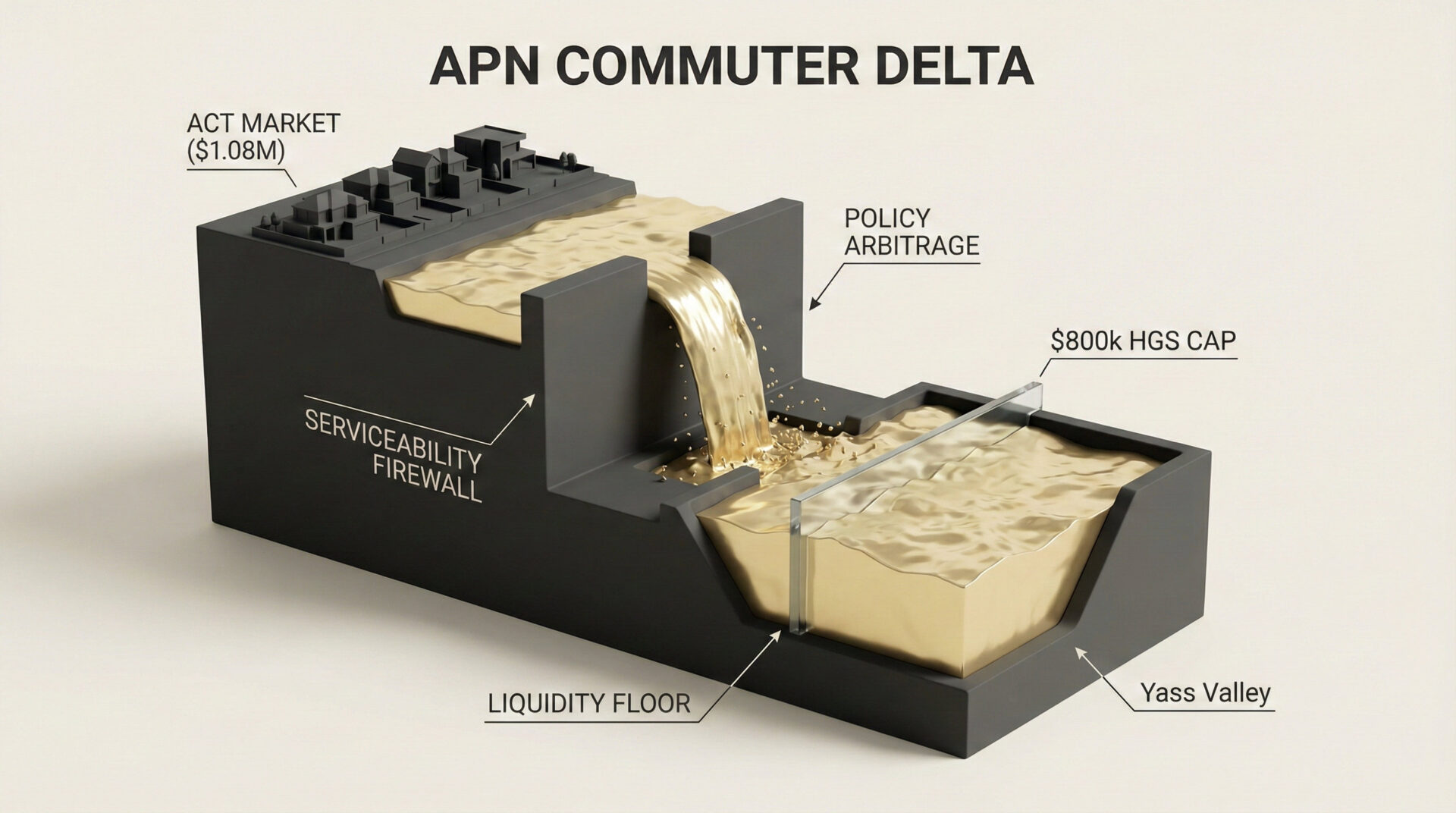
An interaction between restrictive monetary policy and targeted housing support has produced a material market distortion in the NSW-ACT cross-border region, a phenomenon APN terms the ‘Commuter Delta’. The Reserve Bank’s 3.85% cash rate has established a serviceability constraint around Canberra’s $1.01 million median-priced housing market, making it mathematically inaccessible for most first home buyers. Simultaneously, the Federal Government’s Home Guarantee Scheme has established an $800,000 policy-induced liquidity baseline in adjacent regional areas like Yass Valley. This results in a structurally-driven relocation, where households are not choosing to move for lifestyle but are being systematically displaced to the nearest market where their borrowing capacity is validated by government policy.
For property professionals, this analysis reveals a market operating not on organic fundamentals but on the policy-induced boundaries of state intervention. The Yass market’s 9.3% annual growth is a direct result of this policy-driven liquidity, making it highly sensitive to policy adjustments. With only $10,000 of head-room remaining, a mere 1.3% price increase would breach the scheme’s cap, eliminating the primary demand driver for entry-level houses. Conversely, Queanbeyan, which has already breached the cap, offers a case study in the consequences, with its detached housing market experiencing constrained activity. This environment demands a nuanced strategy, focusing on policy risk in Yass and identifying alternative opportunities (such as the rental or unit market) in Queanbeyan.
Background & Strategic Context
This event validates and calibrates APN’s core macro-theses on the primacy of state intervention in shaping market outcomes. The ‘Commuter Delta’ is not a natural market evolution but a direct, structured consequence of interacting policy objectives, demonstrating how top-down decisions produce highly specific, localised and differentiated outcomes for specific cohorts.
State Intervention (APN Sovereign Policy Composite Index™ (SPCI, 24800)): The analysis provides a clear illustration of the SPCI framework, where the actions of two state actors—the RBA (monetary policy) and the Federal Government (fiscal support via Housing Australia)—have interacted to create the market’s primary structural boundaries. The resulting arbitrage opportunity is a direct function of their uncoordinated mandates.
Project Iron Gate: Credit Decoupling: The serviceability constraint is a clear illustration of Project Iron Gate. The combination of a 3.85% cash rate and a 3.0% serviceability buffer structurally decouples households from credit access in the ACT market. The APN Credit Rationing Index™ (24230) tracks this exclusion, quantifying the cohort mathematically channelled into the structurally-driven relocation.
Construction Constraint Confirmed (APN RCG™): The inability for new supply to relieve pressure in Yass validates the APN Replacement Cost Gap™ (24450). With new build costs exceeding $928,000, a significant gap exists relative to the $800,000 policy cap. This construction constraint directs 100% of scheme-backed demand into the finite pool of existing housing stock, structurally increasing its value up to the policy ceiling.
Deconstruction of the Source Event
This deconstruction is based on APN’s analysis of macroeconomic data, federal policy directives, and regional market performance indicators as of February 2026. The key facts are:
- The Policy Interaction: The RBA cash rate stands at 3.85%, requiring banks to assess mortgage serviceability at 9.35%. In parallel, the Housing Australia Home Guarantee Scheme (HGS), effective 1 October 2025, provides a 5% deposit pathway but imposes prescriptive property price caps.
- The Price Cap Dislocation: The HGS cap is $1,000,000 in the ACT but only $800,000 in ‘NSW – Other’ areas, which includes both Queanbeyan and Yass. This legislative distinction creates the core arbitrage channel.
- The Market Price Divergence: Canberra’s median house price ($1.08M) is well above the ACT cap. Queanbeyan’s median ($892,500) has breached the regional NSW cap. Yass’s median ($790,000) sits just below the cap, making it the primary destination for scheme-dependent buyers.
- The Replacement Cost Moat: Analysis shows the all-in cost to build a new standard home in Yass is approximately $928,000. This is well above the $800,000 HGS cap, making new construction unviable for this buyer cohort and constraining demand to existing stock.
- The Infrastructure Delivery Friction Point: As of February 2026, the elevated-priority Stage 2 duplication of the Barton Highway has not commenced construction. The relocation is occurring despite significant transport friction, highlighting the material influence of the financial ‘push’ factors.
Critical Analysis & Balanced View
The key insight from this analysis is that the structurally-driven relocation is driven by access, not affordability. The net financial gain for a household moving from Canberra to Yass is a marginal $313 per month after factoring in commuting costs. The move is not an optimisation of disposable income; it is a binary choice between being approved for a loan in Yass or being rejected for one in Canberra. The ‘Commuter Delta’ is therefore an arbitrage of borrowing capacity itself.
This creates a material policy-dependence. The policy-induced liquidity baseline in Yass is entirely dependent on the median price remaining below the $800,000 HGS cap. With the median at $790,000 and annual growth at 9.3%, the market is under elevated pressure. A marginal price increase, potentially catalysed by speculative investment ahead of the Barton Highway upgrade, could push the median above the cap. This would instantly disqualify the average home from the scheme, eliminating the primary source of demand and risking a material contraction in sales volumes and price stability.
The paradox is that the very infrastructure designed to improve the viability of the commute (the highway duplication) may be the catalyst that undermines Yass’s accessibility for the target demographic. Speculators, attracted by the promise of future connectivity, could front-run the market and push prices through the policy ceiling, structurally excluding the first home buyers the road is meant to serve.
Strategic Implications for Property Professionals
- For Agents & Buyers’ Agents: In Yass, the $800,000 price point is a material financial threshold, not a discretionary negotiation point. Educate clients that a property listed at $801,000 requires over $120,000 more in upfront capital than one at $800,000 for a 5% deposit buyer. In Queanbeyan, pivot focus from first home buyers for detached houses to upgraders, investors, or the HGS-eligible unit market.
- For Developers: Under current conditions, developing new house-and-land packages in Yass for the first home buyer market is economically unviable. The APN Replacement Cost Gap™ (24450) is too wide. Strategy should focus on lobbying for regional cap indexation or designing smaller-footprint products that can land below the $800,000 total cost threshold.
- For Valuers & Lenders: Valuations in the Yass Valley, particularly in the $750k-$800k range, must be assessed with elevated caution. The price is supported by a temporary policy lever, not by underlying replacement cost or organic demand. Note the high ‘policy risk’ in valuation reports and adjust risk models accordingly, as a change to the HGS could precipitate a market correction.
- For Investors: The capital growth in Yass is high-risk and policy-dependent, representing a speculative play on the continuation of the HGS framework. A more durable, lower-risk strategy may be to invest in Queanbeyan’s rental market, which directly captures the displaced population from Canberra who are priced out of buying but still require proximity to the city.
APN Index Management
The APN Codex 24000 Series is a proprietary set of indices that translates complex market forces into measurable metrics. This section outlines how the preceding analysis is validated against, and informs the calibration of, these frameworks.
- Validation: This analysis provides high-confidence validation for the core theses of the APN Sovereign Policy Composite Index™ (SPCI, 24800) (state intervention as the primary market driver) and Project Iron Gate (credit access being rationed by cashflow, not collateral). It also empirically confirms the mechanics of the APN Replacement Cost Gap™ (24450).
- Index Calibration: The APN Credit Rationing Index™ (24230) is calibrated to reflect the specific $200,000+ household income threshold now required to clear the serviceability constraint for a median-priced home in the ACT. The APN Replacement Cost Gap™ (24450) is calibrated to track the 16% negative viability gap ($928k cost vs $800k cap) for new builds in the Yass Valley.
- Data Capture: This analysis triggers a new data capture mandate for the APN Symbiotic Intelligence Network™ (24310). A high-frequency alert will be established to monitor the weekly drift of the Yass median house price toward the $800,000 HGS cap, creating a ‘Breach Risk’ metric for subscribers.
Disclaimer
The analysis and information contained in this deconstruction are for general informational and strategic purposes only and do not constitute financial, investment, legal, or any other form of professional advice. The Australian Property Network (APN) is a strategic intelligence organisation and is not a licensed financial advisor.
This analysis is based on data and information from third-party sources believed to be reliable; however, APN provides no warranty as to its accuracy, currency, or completeness. Images used in this analysis are for illustrative and conceptual purposes only and may not represent real persons, properties, or events.
All frameworks (Codex 24100-24800) are proprietary to APN.
Property values and market conditions can go up or down. Before making any property or investment decisions, you must conduct your own thorough research and seek independent professional advice tailored to your specific circumstances.