
RBA Rate Hike Reinforces Market Bifurcation, Materially Restricts New Supply
APN ANALYSIS: A-260203-AUS136573
Executive Summary
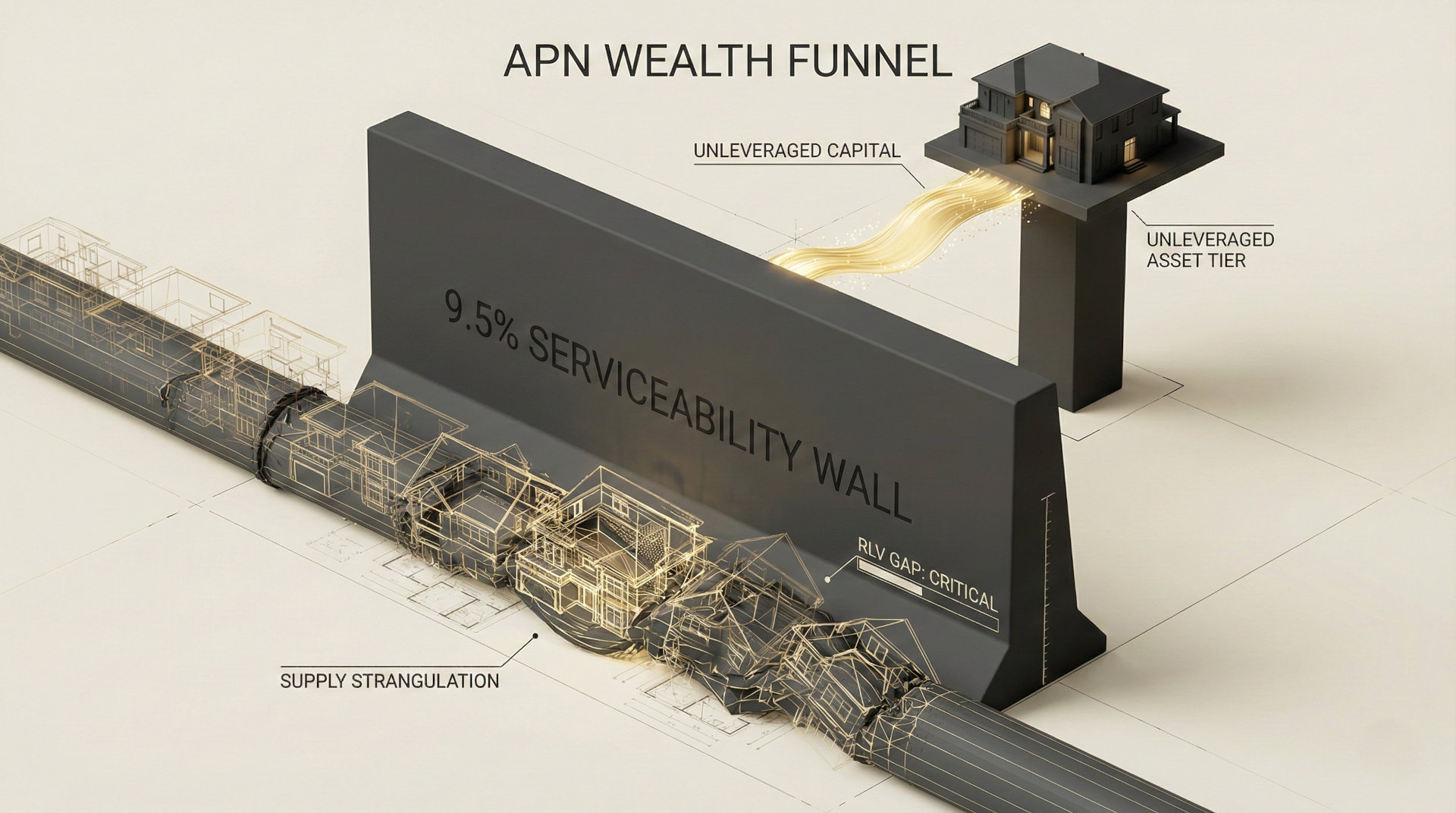
The Reserve Bank of Australia’s decision to lift the Official Cash Rate to 3.85% is not a uniform market cooling mechanism but a structural filter that validates APN’s thesis regarding structural market bifurcation. Citing resilient demand and sticky inflation, the RBA has inadvertently triggered a substantive bifurcation of the property market. The move pushes average bank serviceability assessment rates to a 9.0% threshold, with high-LVR and investor products frequently hitting a 9.5% ‘hard wall’, mathematically excising wage-dependent buyers and debt-reliant developers from participation. This segregates the market into two distinct tiers: capital-rich, unleveraged buyers who are immune to the material rate adjustment and continue to drive prices for existing assets, and the aspiring majority who are now structurally excluded.
For property professionals, this bifurcation is the elevated strategic reality. The policy creates a stagflationary price floor by materially restricting new supply faster than it cools established asset prices. Pricing will now be dictated by unleveraged capital competing for scarce existing stock, while development feasibility contracts under the weight of higher funding costs, materially reducing the future supply pipeline. The primary challenge is no longer finding demand, but navigating a market where access to capital, not income, is the sole determinant of participation.
Background & Strategic Context
This policy pivot by the RBA validates and calibrates APN’s core macro-theses, demonstrating how state-level intervention acts as the primary market-shaping force. The rate hike is not merely a monetary tool but a catalyst for a mechanism creating a substantive structural bifurcation in the market. This event underscores the uneven transmission of monetary policy in an environment of elevated wealth inequality.
APN Sovereign Policy Composite Index™ (SPCI, 24800) (State Intervention): The RBA’s action is a prime example of a state-level actor directly intervening to reshape market dynamics. By prioritising its inflation-control mandate, the Board has accepted the secondary structural consequence of materially restricting the housing supply pipeline, demonstrating the dominance of macro-policy over industry-specific health.
Market Segregation: The resulting 9.5% serviceability wall is the primary filtering mechanism. It functionally separates capital-rich buyers, who can transact without restrictive credit, from wage-dependent participants, thereby concentrating market power and driving price action in the established, premium sector.
APN Residual Land Value (RLV) Gap™ (24410): The hike directly attacks the ‘Cost of Funds’ variable in the development feasibility equation. This policy adjustment widens the APN RLV Gap™, rendering a vast swathe of planned projects unviable and triggering the ‘Supply Restriction’ mechanism that will define the market for the medium term.
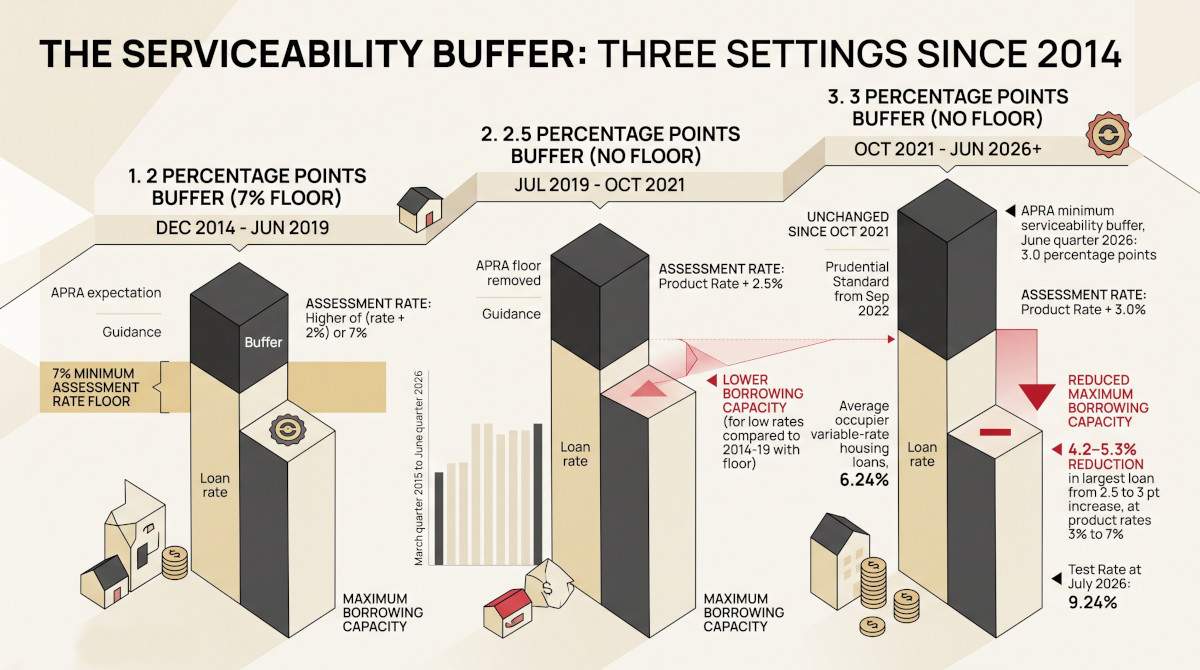
APN Risk & Compliance Index™ (24200) (Regulatory Risk): APRA’s mandated 3.0% serviceability buffer is the regulatory instrument being applied in concert with the RBA’s OCR. This demonstrates how macroprudential policy works in tandem with monetary policy to enforce market discipline, with the material impact falling hardest on new entrants and supply-side creators.
The DTI Filter: The RBA hike is amplified by the APRA Debt-to-Income (DTI) Cap (effective Feb 1, 2026). By restricting banks from issuing more than 20% of new loans to borrowers with a DTI of 6x or higher, the regulator has effectively reinforced the structural market bifurcation. Even if a borrower passes the 9% serviceability test, the DTI cap ensures that high-leverage participants are mathematically excluded from new supply creation.
Deconstruction of the Source Event
This deconstruction is based on APN’s analysis of the RBA’s February 3, 2026, monetary policy decision and its immediate market impact. The key facts are:
- The Rate Decision: The RBA Board lifted the Official Cash Rate (OCR) by 25 basis points to 3.85%, resuming its tightening cycle after a pause.
- The Justification: The primary quantitative trigger was a Quarterly Trimmed Mean CPI figure of 3.4% for the December 2025 quarter, remaining above the 2–3% target band. The qualitative justification cited “greater momentum in demand” that the Board deemed incompatible with its mandate.
- The Serviceability Impact: The hike pushes standard variable mortgage rates towards 6.50%. When combined with APRA’s 3.0% serviceability buffer, this creates a new assessment rate of approximately 9.5%, a level that materially constrains borrowing capacity for new, wage-dependent borrowers.
- The Supply-Side Impact: The 3.85% cash rate translates to an effective developer cost of funds between 8.00% and 10.25%. This escalation in finance costs, combined with persistently high construction costs, materially widens the APN RLV Gap™, making new project commencements unfeasible.
Critical Analysis & Balanced View
The RBA’s strategy contains a central paradox. It is hiking rates to suppress a “resilient” demand signal that is largely an artefact of wealth concentration. The spending of asset-rich cohorts, who are beneficiaries of higher interest on deposits and immune to mortgage pressures, is triggering a policy response that lands squarely on the indebted and productive sectors of the economy. This risks a significant policy mistake, potentially inducing a “two-speed” economic contraction. The wage-earning economy (construction, retail, hospitality) may be driven into a material downturn, while the asset-holding economy remains resilient, meaning the RBA’s inflation fight fails to cool the target demographic but materially constrains the productive sectors of the economy.
Furthermore, the policy is structurally counterproductive to solving long-term inflation in housing. By applying regulatory pressure to the supply side more effectively than the demand side, the RBA is structuring a future housing shortage. The ‘Supply Restriction’ mechanism ensures that even if rates were to fall in 2027, the pipeline of new dwellings will have been materially reduced, leading to a more material price escalation when market entry conditions eventually normalise. The result is a stagflationary environment in property: transaction volumes stagnate as buyers are structurally excluded, but prices for existing stock remain persistently high, supported by scarcity and the purchasing power of the capital-rich.
Strategic Implications for Property Professionals
- For Developers: Feasibility is subject to structural adjustment. The strategic focus must shift from land acquisition to capital preservation and balance sheet repair. Projects without pre-committed funding and fixed-price construction contracts face elevated insolvency risk. The primary opportunity in the next 12-18 months will be acquiring distressed sites and structurally displaced projects from over-leveraged holders.
- For Agents & Buyers’ Agents: The market has bifurcated. Client qualification processes must be substantively recalibrated to prioritise capital liquidity over income serviceability. Your target demographic is now downsizers, cash buyers, and high-equity upgraders. For first home buyers and aspiring investors, the conversation must shift from immediate purchase to strategic rental positioning and long-term financial planning.
- For Investors: The structural market bifurcation makes existing, well-located assets with intrinsic scarcity highly valuable. ‘Replacement cost’ is now a material valuation metric, as building new, comparable stock is economically unfeasible. Strategic acquisitions should focus on assets that appeal to the capital-rich demographic or cater to the growing, structurally excluded rental cohort in supply-constrained markets.
- For Mortgage Brokers & Lenders: Specifically, the structural constraint on refinancing now constrains an estimated 15% of the back-book borrowers who purchased in 2024/25 and now fail the 9% stress test. These structurally constrained borrowers are unable to switch lenders for a better rate, providing incumbent banks with an unearned ‘loyalty tax’ and further validating the structural capture of wage-earner cash flow.
APN Index Management
The APN Codex 24000 Series is a proprietary set of indices that translates complex market forces into measurable metrics. This section outlines how the preceding analysis is validated against, and informs the calibration of, these frameworks.
- Validation: This analysis validates the macro-thesis of structural market bifurcation and the direct causal link between monetary policy intervention (APN Sovereign Policy Composite Index™ (SPCI, 24800)) and the widening of the APN Residual Land Value (RLV) Gap™ (24410).
- Index Calibration: The APN Future Development Pipeline Index™ (24400) is recalibrated to reflect the increased ‘Cost of Funds’ friction. This significantly downgrades the viability score of projects in the pre-construction and planning phases, reducing the forward-looking supply forecast.
- Data Capture: This event triggers a new data capture mandate for the APN Professional Sentiment Index™ (24300). The Symbiotic Intelligence Network™ (24310) will now specifically track professional sentiment around developer insolvency risk and the availability of non-bank construction finance as a leading indicator of supply-side stress.
Disclaimer
The analysis and information contained in this deconstruction are for general informational and strategic purposes only and do not constitute financial, investment, legal, or any other form of professional advice. The Australian Property Network (APN) is a strategic intelligence organisation and is not a licensed financial advisor.
This analysis is based on data and information from third-party sources believed to be reliable; however, APN provides no warranty as to its accuracy, currency, or completeness. Images used in this analysis are for illustrative and conceptual purposes only and may not represent real persons, properties, or events.
All frameworks (Codex 24100-24800) are proprietary to APN.
Property values and market conditions can go up or down. Before making any property or investment decisions, you must conduct your own thorough research and seek independent professional advice tailored to your specific circumstances.