

Vertical Industrial Viability Demonstrated: Stockland-DP World Deal Validates Middle-Ring Density Model
APN ANALYSIS: A-251128-AUS131329
Executive Summary
Stockland securing DP World as the anchor tenant for its 40,000sqm vertical warehouse at Yennora is a material development for the Australian property sector. It validates the commercial viability of large-scale, multi-level industrial assets beyond the inner-city ‘last mile’ and into the middle-ring ‘supply chain core’. The deal demonstrates that for tenants with specific, high-value infrastructure needs, such as the rail connectivity at Yennora, the strategic benefits of location can successfully outweigh the inherent operational friction and significant cost premiums of a vertical design.
For property professionals, this signals a fundamental bifurcation of the industrial asset class. The success of this ‘heavy logistics’ vertical model, which is materially dependent on unique site infrastructure, creates a new, high-barrier-to-entry development category. Valuers must now learn to differentiate between ‘light’ inner-ring and ‘heavy’ middle-ring vertical assets, while developers must secure high-value anchor tenants with specific locational needs to de-risk the substantial construction cost premium and ensure project viability.
Background & Strategic Context
This event validates and calibrates APN’s core thesis on the structural evolution of Australian logistics precincts. The pivot to verticality is a direct consequence of concentrated land scarcity, a market boundary condition largely shaped by decades of state-level planning (APN Sovereign Policy Composite Index™ (SPCI, 24800)), which forces capital into new, more intensive and complex development models to generate acceptable returns.
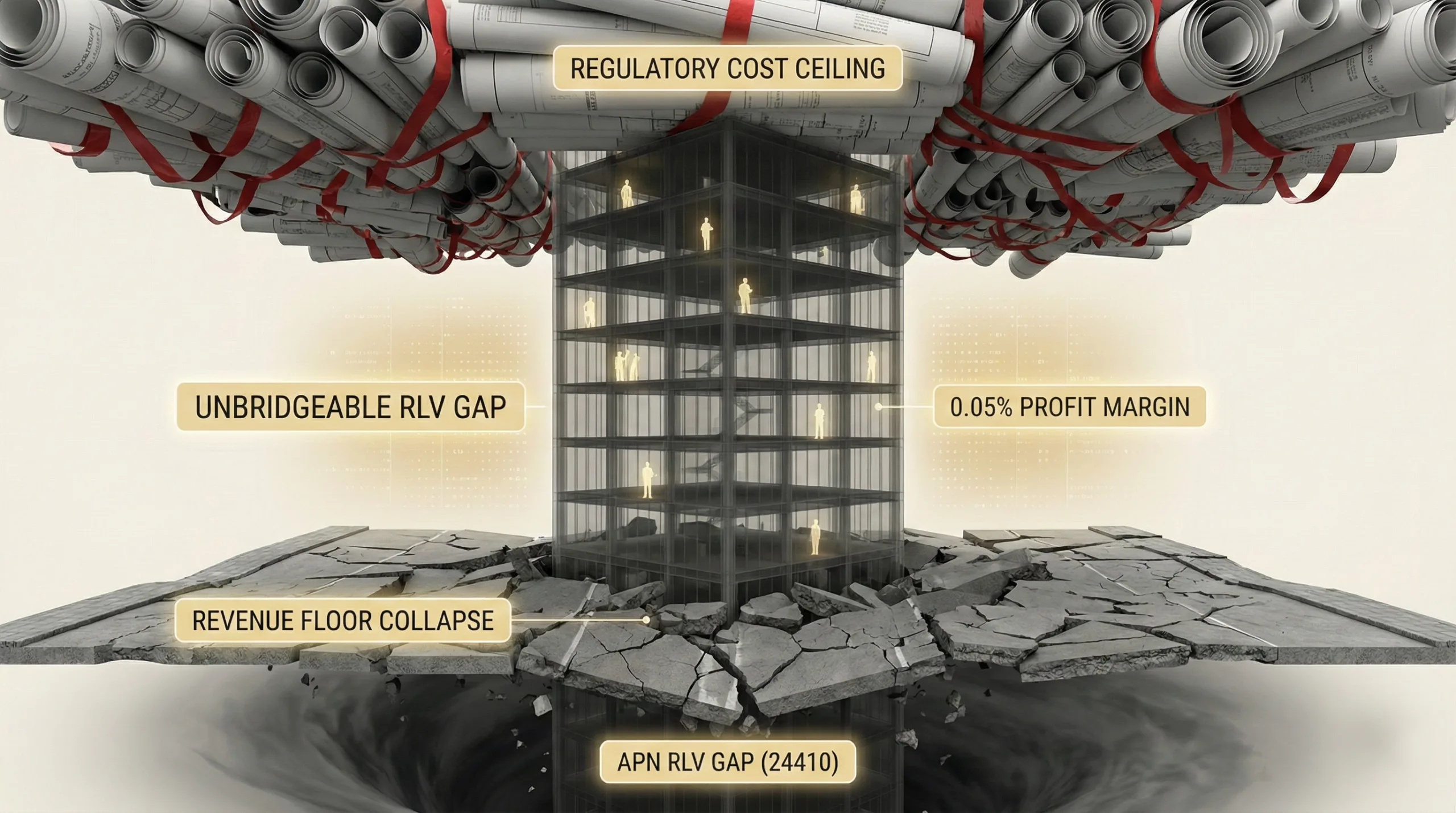
The Density Necessity (APN Future Development Pipeline Index™): The scarcity of contiguous, appropriately zoned industrial land in middle-ring Sydney has created a significant ‘viability gap’ (APN RLV Gap™) for traditional horizontal development. This forces the development pipeline towards vertical solutions as the only method to achieve the Floor Space Ratio required to preserve yield on escalating land values.
The Connectivity Premium (APN Infrastructure Uplift Multiplier™): DP World’s decision quantifies the premium that a major logistics operator will pay for direct intermodal access. This analysis confirms the value of the Yennora site’s rail siding (APN IUM™) is sufficient to offset both the higher construction cost and the operational friction of a vertical facility, a material data point for future infrastructure-led developments.
The Friction Tolerance (APN Agora™): The operational friction of ramp access for heavy vehicles, typically a negative factor in an asset’s connectivity score (APN Agora™), is being tolerated by a top-tier tenant. This demonstrates that for specific users, a single powerful connectivity node (rail) can create a net positive value proposition even when other access metrics, like ease of vehicle movement, are compromised.
Deconstruction of the Source Event
This deconstruction is based on APN’s analysis of Stockland’s media release dated 26 November 2025 and supporting intelligence on the vertical industrial asset class. The key facts are:
- Project: Stockland’s Yennora Distribution Centre, Building 2.
- Scale: A 40,000 square metre multi-level logistics facility, a significant escalation in scale for vertical industrial in Western Sydney.
- Location: The middle-ring industrial precinct of Yennora, a strategic node in the Sydney basin with elevated, direct rail siding connectivity.
- Anchor Tenant: DP World, a global port and logistics operator, has been secured as the primary tenant, validating the facility for heavy logistics use.
- Asset Class Test: This project represents the first major test of a ‘heavy logistics’ vertical model (Class V2) in a middle-ring precinct, contrasting with the established ‘last mile’ model (Class V1) of inner-city projects like Goodman’s Axis Alexandria.
- Delivery Partner: Texco, a specialist in complex industrial builds, has been appointed, signalling a focus on mitigating the heightened structural and execution risks associated with multi-level warehousing.
Critical Analysis & Balanced View
The success of the Yennora project confirms the emergence of a ‘Bifurcation of Verticality’ in the industrial market. ‘Class V1’ assets in the inner-ring (e.g., Alexandria) cater to light, last-mile logistics where speed justifies the rent premium. Yennora pioneers the ‘Class V2’ asset: a heavy, middle-ring facility whose viability hinges not on speed to consumer, but on strategic proximity to core infrastructure like rail. This distinction is material; the business case for Class V2 is far more fragile and tenant-specific.
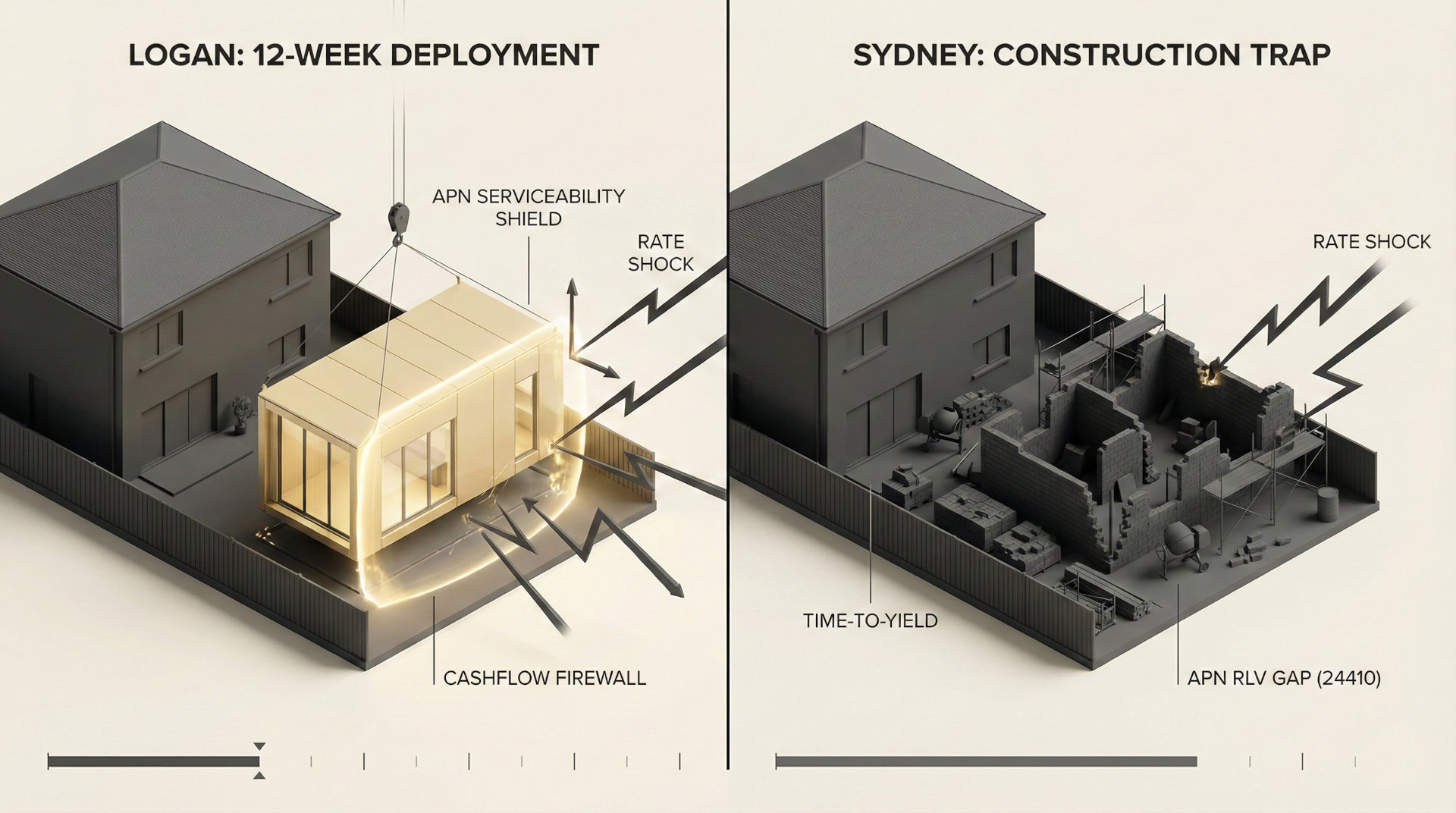
The ‘Construction Cost Trap’ remains the primary counter-narrative. With build costs exceeding 100% of a standard shed, the model carries material financial risk without a commensurate rent premium. Stockland’s success is likely aided by a ‘Land Bank Advantage’, owning the Yennora land for a long period at a low historical cost base provides a crucial financial buffer that a developer acquiring land at today’s prices would not have. This suggests the model is not yet universally replicable.
Finally, two secondary risks emerge: the ‘Hardstand Structural Pressure Point’ and ‘Obsolescence Risk’. Vertical designs create floor space but often reduce the essential hardstand needed for truck manoeuvring. Furthermore, the rigid concrete structure of a ramp-access facility risks functional obsolescence at an accelerated rate relative to a flexible single-level shed if vehicle dimensions or logistics technologies evolve. These factors introduce new, long-term depreciation considerations for valuers and asset managers.
Strategic Implications for Property Professionals
- For Developers: The Yennora precedent confirms the ‘anchor-led’ strategy is a primary requirement for middle-ring vertical projects. The risk profile is elevated for speculative development. Focus must be on identifying sites with unique infrastructure (rail, ports, major interchanges) and securing high-value tenants whose business models can absorb the rent premium.
- For Valuers & Financiers: A new asset sub-class, ‘Heavy Vertical Logistics’, must be established. Valuation models must now incorporate a ‘Friction Coefficient’ for ramp access and a higher ‘Obsolescence Risk’ factor, while also quantifying the premium derived from unique infrastructure like rail access (APN IUM™). The ‘blended rent’ achieved across different floors is now a key valuation metric.
- For Agents & Tenant Representatives: The market is bifurcating. Tenant needs must be qualified not just by space, but by vehicle class and infrastructure dependency. For tenants like DP World, the conversation shifts from ‘cost per square metre’ to ‘total cost of logistics chain’. For general 3PLs, the value proposition remains challenging, and single-level facilities further west will remain the primary competitor.
- For Asset Managers: Existing single-level assets in core middle-ring locations have gained a ‘scarcity premium’. The high cost and complexity of vertical replacement mean these assets face less direct new supply competition. The strategic focus should be on optimising these sites for efficiency, as they represent a distinct and increasingly valuable segment of the market.
APN Index Management
The APN Codex 24000 Series is a proprietary set of indices that translates complex market forces into measurable metrics. This section outlines how the preceding analysis is validated against, and informs the calibration of, these frameworks.
- Validation: This analysis validates the ‘viability gap’ mechanism within the APN Residual Land Value (RLV) Gap™ (24410), demonstrating how concentrated land constraints force development capital into higher-cost, higher-complexity typologies.
- Index Calibration: The APN Infrastructure Uplift Multiplier™ (24420) is calibrated to reflect the significant premium attributable to direct rail-siding access for heavy logistics users, which has now been proven to offset both construction cost premiums and significant operational friction.
- Data Capture: This triggers a new data capture mandate for the APN Agora™ (24140) to track and quantify ‘Operational Friction’ metrics in vertical assets, including ramp gradients, breezeway widths, and vehicle circulation patterns, creating a ‘Friction Coefficient’ for future asset benchmarking.
- Data Capture: A new sub-category, ‘Heavy Vertical Logistics (V2)’, is established within the APN Future Development Pipeline Index™ (24400) to differentiate these assets from ‘Light Vertical (V1)’ and track their specific development pipeline, risk profile, and tenant covenants.
Disclaimer
The analysis and information contained in this deconstruction are for general informational and strategic purposes only and do not constitute financial, investment, legal, or any other form of professional advice. The Australian Property Network (APN) is a strategic intelligence organisation and is not a licensed financial advisor.
This analysis is based on data and information from third-party sources believed to be reliable; however, APN provides no warranty as to its accuracy, currency, or completeness. Images used in this analysis are for illustrative and conceptual purposes only and may not represent real persons, properties, or events.
All frameworks (Codex 24100-24800) are proprietary to APN.
Property values and market conditions can go up or down. Before making any property or investment decisions, you must conduct your own thorough research and seek independent professional advice tailored to your specific circumstances.