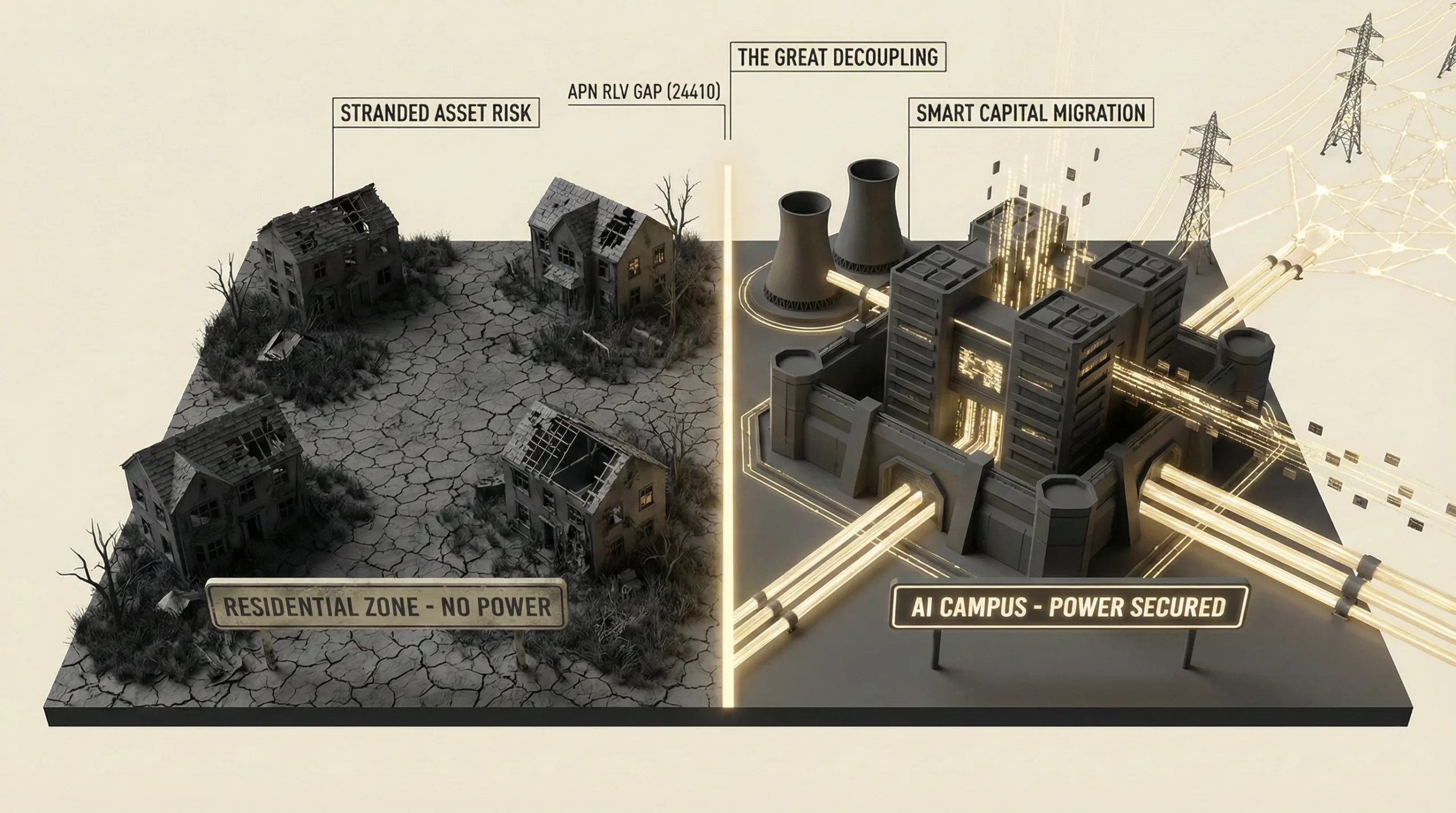

Structural Decoupling: Institutional Capital Reallocates from Residential to AI-Related Assets, Creating a Two-Speed Market and ‘Stranded Asset’ Risk
APN ANALYSIS: A-260120-AUS134925
Executive Summary
A structural reallocation of institutional capital is underway in the Australian property market. This institutional capital migration is seeing material capital reallocate from residential development portfolios, which are constrained by policy factors, and reallocated to high-yield industrial and, specifically, Data Centre (DC) assets. This is not a cyclical trend but a structural decoupling of land value from its traditional residential anchor. The shift is driven by the global AI megatrend, creating a ‘two-speed’ economy where land with secured power access commands a significant premium, evidenced by a valuation gap of over 30% in key contested precincts like Sydney’s Outer West.
For property professionals, this decoupling renders traditional valuation models based on residential potential no longer structurally viable in these key corridors. The ‘highest and best use’ of land is no longer housing; it is compute. Viability is now contingent on understanding and navigating energy infrastructure constraints. The primary risk is the ‘Power Cliff’, a multi-year lag in grid upgrades that presents a risk of creating a new class of ‘stranded assets’: prime development land acquired at a premium but rendered commercially unviable by a lack of connection, representing billions in unproductive capital for the unprepared.
Background & Strategic Context
This event validates and calibrates APN’s core macro-theses on how markets are shaped and value is created. The pivot from residential to digital infrastructure is a textbook example of state-level actions creating new economic realities, which are then utilised by institutional capital, structurally altering the development landscape. The phenomenon is not isolated; it is the physical manifestation of the digital economy’s ascendancy over the traditional built environment.
State Intervention as Market Catalyst (APN Sovereign Policy Composite Index™ (SPCI, 24800)): The NSW Government’s approval of the $3.1 billion CDC hyperscale campus, combined with the acknowledged multi-year delays in grid upgrades by state-owned Transgrid, illustrates how government and quasi-governmental actions create the boundaries within which the market must operate. These actions have effectively designated ‘powered land’ as a new, premium asset class.
Recalibrating Viability (APN Future Development Pipeline Index™ 24400): The institutional capital migration forces a recalibration of our pipeline analysis. The economic friction for residential development (tax, policy) now competes with the elevated yield potential of data centres, altering the ‘Genuine Opportunity’ filter. Land previously earmarked for housing is now being repriced for digital industrial use, rendering prior feasibility studies no longer structurally viable.
Redefining Infrastructure (APN Infrastructure Uplift Multiplier™ 24420): This analysis confirms that the primary infrastructure is no longer roads or rail, but high-voltage power. The ‘uplift’ in land value is now directly correlated to megawatt (MW) capacity. A site’s proximity to a major substation now carries a greater valuation premium than its proximity to a new train station, a structural shift in how infrastructure-led value creation must be measured.
Deconstruction of the Source Event
This deconstruction is based on APN’s analysis of Goodman Group’s FY26 operational updates, CBRE’s Q4 2025 market reports, NSW Government planning approvals for the Marsden Park precinct, and AEMO/Transgrid infrastructure outlooks. The key facts are:
- The Goodman Pivot: Industrial bellwether Goodman Group has structurally shifted its focus, with Data Centres now comprising 68% of its $12.4 billion Work in Progress (WIP). This confirms the institutional capital pivot away from traditional logistics to digital infrastructure.
- The Vacancy Divergence: While Sydney’s headline industrial vacancy rate has softened to ~2.9%, the effective vacancy for ‘AI-Ready’ or Super Prime assets is below 1%. This statistical divergence confirms a ‘two-speed’ market where demand for high-specification facilities is concentrated, while secondary stock experiences lower demand.
- The Marsden Park Premium: The approval of CDC’s 504MW data centre campus in Marsden Park has anchored a new valuation paradigm. Analysis confirms DC developers are paying an estimated $1,600/sqm, a ~33% premium over the underlying raw residential land value of ~$1,200/sqm, confirming that the ‘highest and best use’ of land has been reallocated from housing to compute.
- The ‘Power Cliff’ Risk: Elevated-priority grid upgrades, such as the VNI West interconnector, are delayed until at least 2030. Western Sydney faces a material risk of load shedding from 2026/27, and new high-capacity grid connections face lead times exceeding four years. This creates a material ‘stranded asset’ risk for developers acquiring land without secured power.
Critical Analysis & Balanced View
The central tension of this market is an accelerated growth in speculative land value occurring in the face of a pending physical infrastructure delivery friction point. The 14% land value increase in Sydney’s Outer West is not based on current utility but on the promise of future utility, creating a structurally sensitive, high-risk environment. The market is bifurcating not just into ‘prime’ and ‘secondary’ assets, but into two fundamentally different classes: land with secured power, and land without.
The underlying driver is the globalisation of this asset class. The $9.4 billion partnership between Goodman and the Canada Pension Plan Investment Board (CPP Investments) demonstrates that this is not local speculation but a coordinated, global capital reallocation to gain exposure to the AI megatrend. Institutional operators like Goodman are not merely buying land; they are operationalising a ‘Power Bank’ strategy, monetising secured grid access. This creates a material barrier to entry, structurally excluding not only residential developers but also less sophisticated industrial players. The opportunity lies in identifying the assets that will become stranded as the Power Cliff nears, creating acquisition opportunities for those with the capital and patience to align with the 2028-2030 infrastructure timeline. The risk is for those who misprice the primary element of time, paying a 2026 price for a 2030 connection.
Strategic Implications for Property Professionals
- For Developers: Your primary due diligence must shift from zoning and planning controls to grid capacity and connection timelines. Greenfield sites in corridors like Western Sydney without pre-secured power agreements are no longer opportunities but potential multi-year liabilities. Forging partnerships with energy specialists or acquiring sites with existing, high-capacity connections is now the critical path to de-risking development.
- For Valuers & Financiers: Traditional valuation methodologies based on per-square-metre rates for a given use are now structurally incomplete. A new ‘yield-per-megawatt’ overlay is required to accurately price industrial land in these contested corridors. Assets must be re-rated based on their power access, with material discounts applied to ‘stranded’ land that is years away from a viable connection.
- For Agents & Buyers’ Agents: The sales narrative for industrial land has structurally changed. The ‘highest and best use’ is now a function of power, not just location. You must educate clients on the bifurcation between ‘powered land’ and ‘stranded land’. The grid connection status, available capacity, and proximity to major substations are now primary selling points that must be verified and articulated.
- For Institutional Investors: The Goodman ‘Power Bank’ strategy is the new institutional blueprint. To avoid the unproductive capital constraint of the Power Cliff, capital allocation must prioritise platforms with proven grid access and technical execution capability. Direct acquisitions should target assets with existing, verifiable power rights, as these represent the true scarcity in the market.
APN Index Management
The APN Codex 24000 Series is a proprietary set of indices that translates complex market forces into measurable metrics. This section outlines how the preceding analysis is validated against, and informs the calibration of, these frameworks.
- Validation: This analysis validates the core tenet of the APN Sovereign Policy Composite Index™ (SPCI, 24800), demonstrating how state-level energy policy and planning approvals are the primary forces creating a new, bifurcated market. It also validates the APN Future Development Pipeline Index™ (24400) by confirming a structural shift in land use viability away from residential and toward digital infrastructure in key economic corridors.
- Index Calibration: The APN Infrastructure Uplift Multiplier™ (24420) is recalibrated to weight ‘megawatt access’ as a primary value driver, often exceeding the uplift from traditional transport infrastructure. The APN Residual Land Value (RLV) Gap™ (24410) for residential projects in these zones will be widened to reflect the elevated competition and higher acquisition costs driven by DC demand.
- Data Capture: This analysis triggers a new data capture mandate under the APN Symbiotic Intelligence Network™ (24310). We will now systematically track grid connection queues, substation upgrade timelines (e.g., Kemps Creek BSP), and the declared ‘Power Bank’ capacity of major industrial REITs as a critical leading indicator of future development viability and stranded asset risk.
Disclaimer
The analysis and information contained in this deconstruction are for general informational and strategic purposes only and do not constitute financial, investment, legal, or any other form of professional advice. The Australian Property Network (APN) is a strategic intelligence organisation and is not a licensed financial advisor.
This analysis is based on data and information from third-party sources believed to be reliable; however, APN provides no warranty as to its accuracy, currency, or completeness. Images used in this analysis are for illustrative and conceptual purposes only and may not represent real persons, properties, or events.
All frameworks (Codex 24100-24800) are proprietary to APN.
Property values and market conditions can go up or down. Before making any property or investment decisions, you must conduct your own thorough research and seek independent professional advice tailored to your specific circumstances.