
Federal Environmental Override: Federal Environmental Law Halts Hunter Valley Development, Exposing Sovereign Risk for Property Assets
APN ANALYSIS: A-260122-AUS135053
Executive Summary
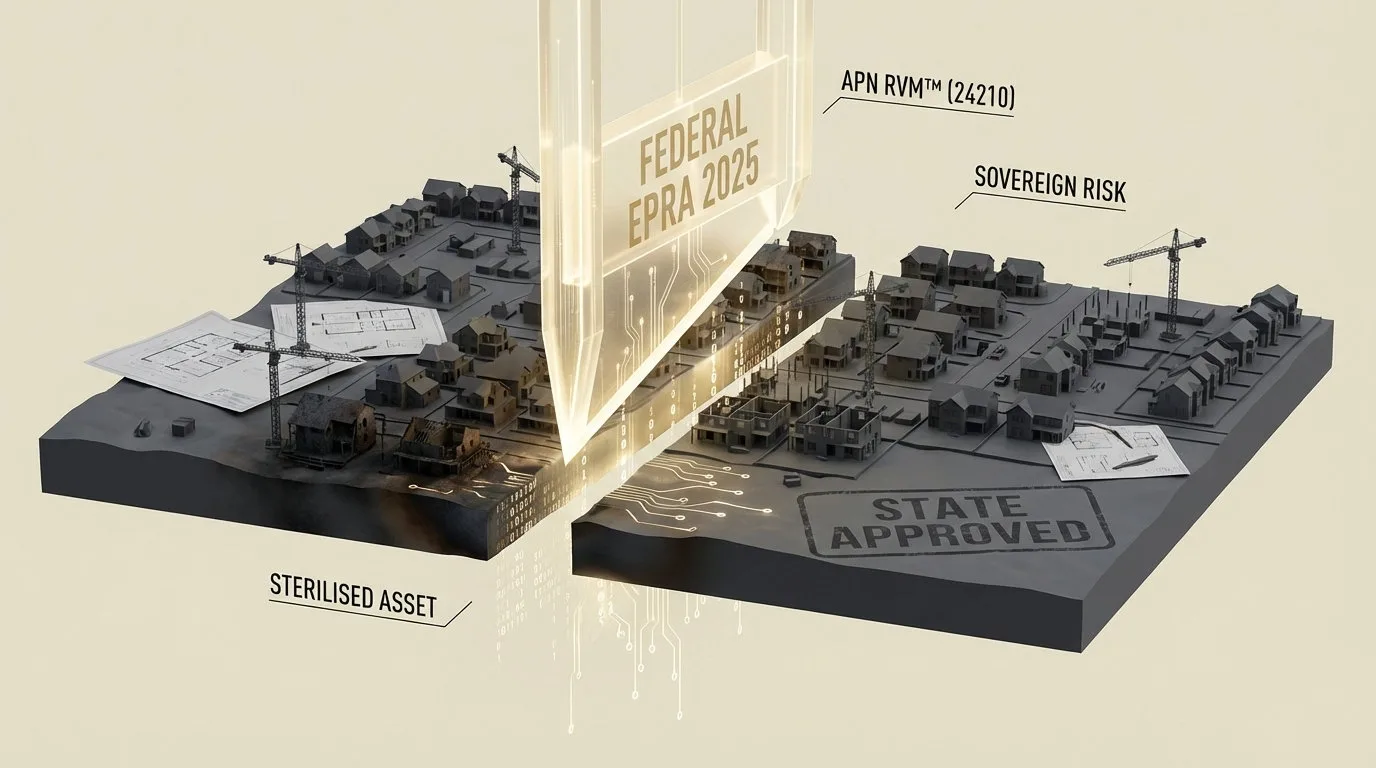
The Federal Government has applied new environmental powers to halt the master-planned Huntlee Stage 2 residential development in the Hunter Valley. Under the Environment Protection Reform Act 2025 (EPRA 2025), the Commonwealth has effectively ‘called-in’ the State-approved project, citing unacceptable cumulative impacts on critically endangered species and ecosystems. This intervention, described as a ‘Federal Environmental Override’, establishes a new precedent where Federal environmental mandates can unilaterally veto State land-use planning, interrupting the development pipeline in one of Australia’s key growth corridors.
For property professionals, this event signals a structural shift in development risk. State-level planning consent is no longer a conclusive approval, creating a new layer of sovereign risk for assets located in or near ecologically sensitive areas. Land holdings acquired for development potential now require re-evaluation against Federal Bioregional Plans. The ‘Federal Environmental Override’ makes navigating Commonwealth environmental law an essential component of due diligence, project financing, and asset valuation, substantively altering the risk calculus for greenfield development across Australia.
Background & Strategic Context
This intervention provides validation of APN’s core APN Sovereign Policy Composite Index™ (SPCI, 24800) thesis, which posits that direct government action is the primary force shaping property market boundaries and value. The activation of the ‘Federal Environmental Override’ is a direct example of a state actor (the Commonwealth) asserting supremacy to override established market frameworks (NSW planning law), thereby recalibrating risk and materially reducing asset value. The event also represents a material escalation in regulatory enforcement, directly informing our APN Risk & Compliance Index™ (24200) risk analysis.
A Structural Shift in Federal Power (SPCI, 24800): The use of EPRA 2025 to halt a State Significant Development marks a departure from cooperative federalism towards a centralised model for land use. The ‘Federal Override’ is no longer a theoretical risk but an operational reality, demonstrating the Commonwealth’s willingness to enforce its policy objective directly against State economic and housing objectives.
The Deployment of Regulation as a Policy Instrument (APN Risk & Compliance Index™, 24200): The ‘Federal Environmental Override’ is the operationalisation of a new, stringent enforcement doctrine. The new ‘Cumulative Impact’ definitions and map-based Bioregional Plans provide the national EPA with substantive, low-friction tools to intervene. This action sets a new benchmark for the APN Regulatory Velocity Multiplier™ (APN RVM™), quantifying the speed at which Federal powers can now be applied to render development projects unviable.
The Creation of ‘Paper Rezonings’ (APN Future Development Pipeline Index™): The Federal intervention transforms thousands of approved residential lots from ‘Genuine Opportunities’ into ‘Paper Rezonings’. Despite holding State consent, the Federal veto creates a material APN Residual Land Value (RLV) Gap™ by prohibiting clearing. This renders the land undevelopable, making the project economically unviable and eliminating its pipeline value.
Deconstruction of the Source Event
This deconstruction is based on APN’s analysis of the regulatory and market activities surrounding the Hunter Growth Corridor in January 2026. The key facts are:
- Legislative Activation: The Environment Protection Reform Act 2025 (EPRA 2025) and its associated ‘Nature Positive Plan’ were activated, granting the Federal Environment Minister and the new national EPA substantive new powers to intervene in projects based on National Environmental Standards.
- The Intervention: On or around 22 January 2026, Federal powers were used to halt the Huntlee Stage 2 development, a major State-approved residential project in the Hunter Valley. This was likely executed via an Environment Protection Order (EPO), a ‘stop-work’ power available to the EPA CEO.
- The Legal Mechanism: The intervention was justified by new ‘Cumulative Impact’ definitions. The EPA determined that further clearing of the Central Hunter Valley Eucalypt Forest, a critically endangered community and habitat for species like the Regent Honeyeater, constituted an ‘Unacceptable Impact’, triggering a mandatory refusal clause in the Act.
- Market Reaction: ASX-listed developers with exposure to the region, notably Stockland, signalled asset ‘redundancy’ and write-downs. This was compounded by a wider ‘capital strike’, evidenced by major partners like Origin Energy withdrawing from related infrastructure projects in the Hunter, citing material project risks.
- Policy Conflict: The action exposes a direct and irreconcilable conflict between two flagship Federal policies: the National Housing Accord 2026 (mandating housing supply) and the Nature Positive Plan (mandating environmental protection). The intervention at Huntlee confirms the environmental mandate currently holds supremacy.
Critical Analysis & Balanced View
The ‘Federal Environmental Override’ exposes a fundamental policy incoherence at the heart of the Federal Government’s policy objectives. The ambition to deliver 1.2 million new homes under the National Housing Accord is in direct conflict with the ‘no new extinctions’ mandate of the Nature Positive Plan. The Huntlee intervention demonstrates that when these two objectives are in conflict in a high-biodiversity growth corridor, environmental protection prevails. This is not a system failure but the logical outcome of two powerful, unaligned legislative frameworks operating in the same space without a clear hierarchy or exemption mechanism.
The deeper driver is a strategic recentralisation of power. The Commonwealth is using environmental law as a lever to reclaim control over land-use planning, a domain traditionally held by the States. While the long-term goal may be to prevent the progressive degradation of Australia’s ecosystems, the immediate consequence is the introduction of de facto sovereign risk for domestic property development. Investors must now price in the risk of a Federal veto on any State-approved project, a factor that will inevitably constrain capital deployment into greenfield projects and exacerbate the structural pressure point in housing supply the government aims to address.
Strategic Implications for Property Professionals
- For Developers & Holders of Strategic Land Acquisitions: An audit of all land holdings against Federal Bioregional Plan maps and the threatened species database is now indicated. A State zoning or development approval is no longer a sufficient guarantee of viability. A ‘Federal Environmental Clearance’ risk assessment is now an essential first step in due diligence for any greenfield acquisition.
- For Investors & Financiers: Recalibrate investment models to include a ‘Sovereign Risk’ premium for projects in growth corridors that overlap with designated ‘Amber’ or ‘Red’ conservation zones. The carrying value of land banks held by developers exposed to these areas requires downward revision to reflect the risk of Federal intervention.
- For Planners & Consultants: Your core value proposition must expand to include navigating the dual State/Federal approval system. Demonstrable expertise in the EPRA 2025, particularly in preparing ‘Cumulative Impact’ assessments and interpreting Bioregional Plans, is now an elevated, high-value skill set to de-risk projects for clients.
- For Agents & Buyers’ Agents: Advise clients that the future supply pipeline in key growth corridors like the Hunter is now subject to elevated uncertainty. This will place material upward price pressure on existing, approved stock and may divert buyer demand to less environmentally constrained regions. The assumption of sustained supply in the urban fringe is no longer tenable.
APN Index Management
The APN Codex 24000 Series is a proprietary set of indices that translates complex market forces into measurable metrics. This section outlines how the preceding analysis is validated against, and informs the calibration of, these frameworks.
- Validation (SPCI, 24800): This analysis provides validation of the APN Sovereign Policy Composite Index™ (SPCI, 24800) thesis, confirming that direct Federal legislative intervention is the primary driver of value reduction and market re-segmentation in the Hunter Valley.
- Index Calibration (APN RVM™ 24210): The APN Regulatory Velocity Multiplier™ is calibrated to register the issuance of an EPO against a State Significant Development as a high-velocity enforcement action, setting a new benchmark for Federal intervention risk in the property sector.
- Index Calibration (APN Future Development Pipeline Index™ 24400): The index is recalibrated to automatically flag any land zoned for development within a Federal ‘Conservation Zone’ as having a near-100% APN Residual Land Value (RLV) Gap™, classifying it as a ‘Paper Rezoning’ until Federal clearance is granted.
- Data Capture (APN Climate-Risk Asset Devaluation Index™ 24500): This event triggers a new data capture mandate to map Federal Bioregional ‘Elevated Risk Localities’ as a primary input for calculating the APN Brown Discount™ on affected land assets, quantifying the financial impact of this new regulatory risk.
Disclaimer
The analysis and information contained in this deconstruction are for general informational and strategic purposes only and do not constitute financial, investment, legal, or any other form of professional advice. The Australian Property Network (APN) is a strategic intelligence organisation and is not a licensed financial advisor.
This analysis is based on data and information from third-party sources believed to be reliable; however, APN provides no warranty as to its accuracy, currency, or completeness. Images used in this analysis are for illustrative and conceptual purposes only and may not represent real persons, properties, or events.
All frameworks (Codex 24100-24800) are proprietary to APN.
Property values and market conditions can go up or down. Before making any property or investment decisions, you must conduct your own thorough research and seek independent professional advice tailored to your specific circumstances.