
Consensus for 2026 Rate Cut Removed: RBA’s ‘Restrictive Permanence’ Establishes a Two-Speed Economy
APN ANALYSIS: A-251209-AUS131829
Executive Summary
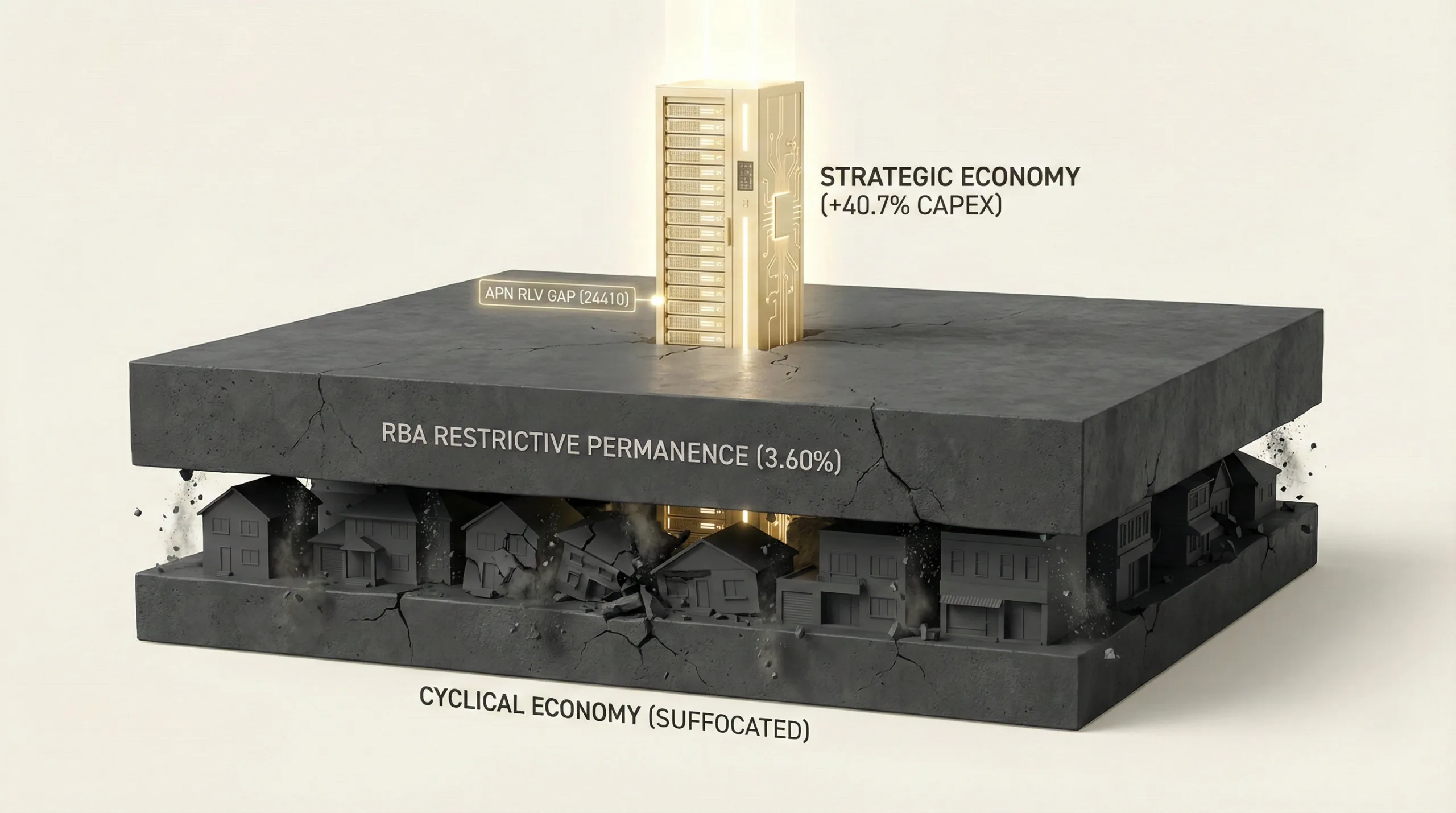
The Reserve Bank of Australia’s decision to hold the cash rate at 3.60% has ended the era of ‘Pivot Volatility’, but has not delivered the expected stability. Instead, it has inaugurated a period of ‘Restrictive Permanence’. Despite a nominally neutral stance, the RBA’s hawkish internal discussions and upwardly revised inflation forecasts for 2026 have materially shifted the consensus against rate cuts next year. This matters because it fundamentally alters corporate planning assumptions, validating a ‘higher for longer’ interest rate environment. The economy has consequently bifurcated into a ‘Strategic Economy’, where tech and infrastructure investment proceeds irrespective of capital costs, and a ‘Cyclical Economy’ of households and domestic businesses materially constrained by the enduring monetary restriction.
For property professionals, this bifurcation is the single most significant strategic consideration for 2026. The ‘Stability Dividend’ is not realised for the broader market; budgeting for high capital costs and suppressed consumer demand must be the new baseline. The divergence creates concentrated sector-specific risks and opportunities: assets exposed to the consumer-facing ‘Cyclical Economy’ face material headwinds, while those servicing the infrastructure and technology-driven ‘Strategic Economy’ are positioned for growth. Navigating this two-speed market requires a strategic pivot in asset selection, capital planning, and risk management.
Background & Strategic Context
This event validates and calibrates APN’s core macro-theses. The RBA’s ‘hawkish hold’ is a clear manifestation of APN Sovereign Policy Composite Index™ (SPCI, 24800), where a state actor’s policy directly reshapes market boundaries and forces a repricing of future risk. The resulting two-speed economy, where capital-intensive, globally-aligned sectors decouple from the domestically-focused economy, is a structural condition where incumbent asset holders in strategic sectors benefit disproportionately.
Calibrating Regulatory Intent (APN Risk & Compliance Index™ (24200)): The RBA’s stance of using hawkish forward guidance to tighten financial conditions without moving the cash rate is a clear example of a regulatory actor shaping market behaviour beyond its primary tool. It demonstrates a strategic intent to manage inflation via the expectations channel, a key input for our risk indices.
Mapping Sentiment Divergence (APN Professional Sentiment Index™ 24300): The divergence between Westpac’s dovish outlier forecast and the hawkish ‘No Cut 2026’ consensus from CBA, NAB, and ANZ represents an elevated divergence of professional sentiment. This divergence, now the dominant market feature, creates significant planning uncertainty and validates the index’s role as a measure of market coherence.
Validating the Pipeline Filter (APN Future Development Pipeline Index™ 24400): The 40.7% increase in data centre investment, proceeding irrespective of high capital costs, demonstrates a development pipeline driven by strategic imperatives, not cyclical economic health. This validates the index’s function of separating economically sensitive projects from those with inelastic, non-financial drivers.
Deconstruction of the Source Event
This deconstruction is based on APN’s analysis of the Reserve Bank of Australia’s December 2025 monetary policy decision and subsequent market and institutional commentary. The key facts are:
- ‘Hawkish Hold’ Confirmed: The RBA held the cash rate at 3.60% on December 9, 2025, but the Board explicitly discussed scenarios for a future rate hike, signalling a fragile and conditional ‘neutral’ stance.
- Inflation Forecasts Revised Upwards: The RBA’s November Statement on Monetary Policy, which informed the December decision, revised the June 2026 forecast for core inflation significantly higher, from 2.6% to 3.2%, pushing the return to the target band into 2027.
- Forecasting Consensus Materially Shifted: Major banks CBA, NAB, and ANZ have shifted their baseline to ‘No Cut in 2026,’ citing sticky inflation and resilient demand. Westpac remains the sole outlier, forecasting substantive cuts.
- Capex-Confidence Decoupling: While business confidence fell to a neutral +1, private capital expenditure increased 6.4%, driven almost entirely by an 11.5% jump in equipment investment and a 40.7% increase in the data centre-led telecommunications sector.
- Fixed Mortgage Rates Resurge: In late 2025, major banks withdrew sub-5% fixed-rate mortgage offers, with rates repricing higher in anticipation of a ‘higher for longer’ cash rate, creating a ‘Refinancing Cliff 2.0’ for borrowers.
Critical Analysis & Balanced View
The central paradox of the Australian economy is now clear: businesses are investing at the fastest rate in years while their confidence in the domestic outlook is flat. This analysis reveals the ‘Stability Dividend’ is not a broad-based economic phenomenon but a highly concentrated ‘Tech Dividend’. The capex boom is a defensive reaction to capacity constraints and a strategic imperative to build digital infrastructure, not a vote of confidence in the RBA’s policy. The ‘neutral’ 3.60% cash rate is, in practice, materially restrictive for the highly indebted household sector, a fact confirmed by the resurgence in fixed mortgage rates above 5%.
A key leading indicator is the drop in forward orders, which suggests the current investment boom is unsustainable. This sets up a self-reinforcing structural condition for 2026: the ‘Refinancing Cliff 2.0’ will erode consumption, which will in turn materially erode business confidence and halt the capex that is currently propping up the economy, challenging the entire ‘managed economic deceleration’ narrative.
Strategic Implications for Property Professionals
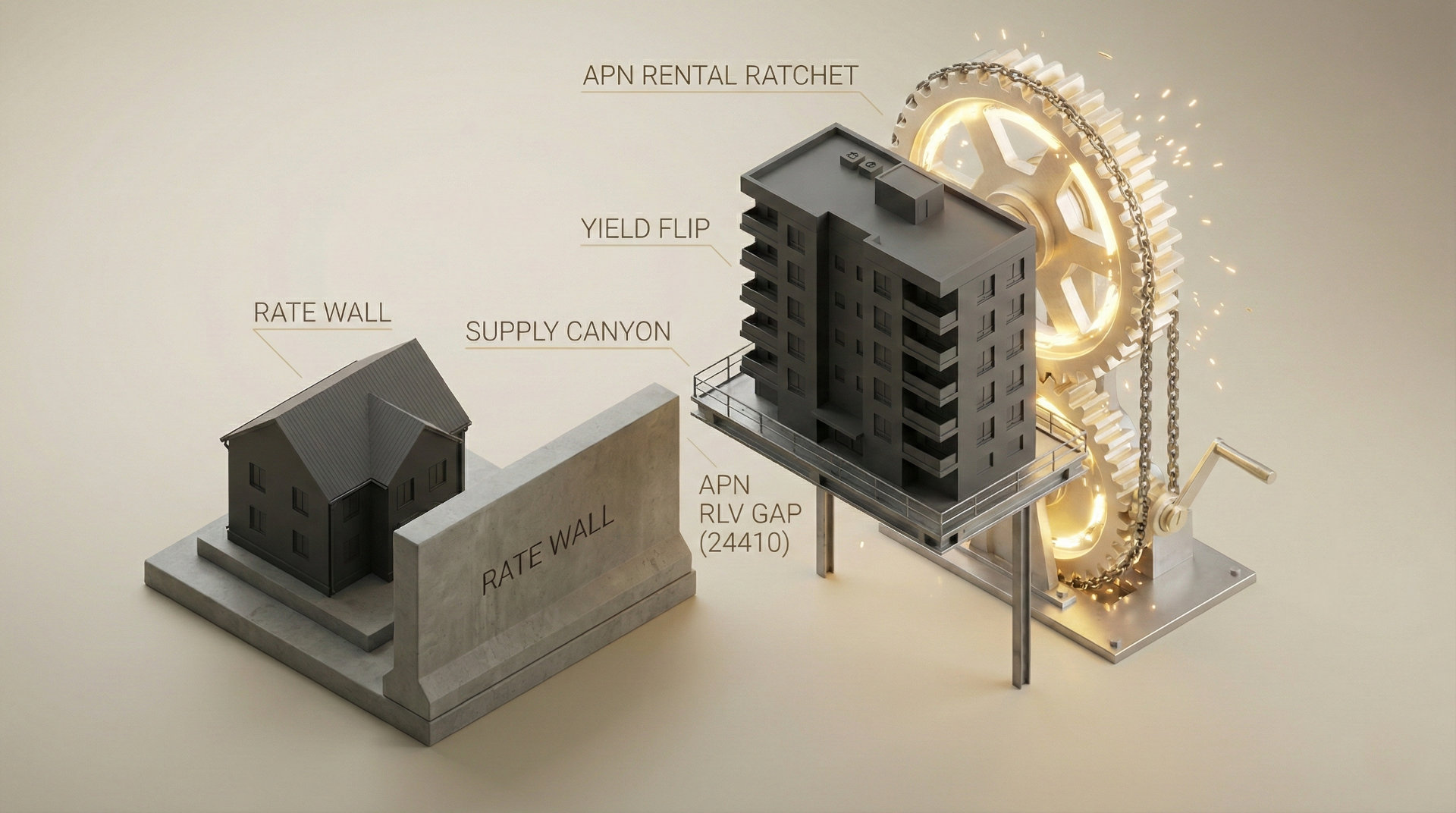
- For Developers & Capital Planners: The base case for all financial modelling must shift to a 3.60% cash rate for the entirety of 2026. Projects dependent on a lower cost of capital or a consumer recovery face an elevated probability of non-viability. The APN Residual Land Value (RLV) Gap™ will widen for most residential and retail projects.
- For Commercial Asset Managers: A strategic pivot is required. Assets exposed to the ‘Cyclical Economy,’ particularly discretionary retail and smaller-scale office space, face sustained headwinds from weak consumption. Conversely, assets servicing the ‘Strategic Economy’, industrial logistics, data centres, and related energy infrastructure, will continue to attract capital, validating the APN Infrastructure Uplift Multiplier™.
- For Agents & Buyers’ Agents: The household sector faces an ‘Attrition Trap.’ The ‘Refinancing Cliff 2.0’ will suppress borrowing capacity and buyer sentiment throughout 2026. Market activity will be constrained, with demand skewed towards non-discretionary buyers and those insulated from domestic credit conditions. Expect transaction volumes to remain subdued.
- For Investors & Fund Managers: The market bifurcation presents a direct asset allocation signal. Overweight exposure to digital and essential infrastructure assets. Underweight or hedge exposure to consumer-facing real estate. The ‘managed economic deceleration’ narrative carries significant downside risk; portfolio construction should account for the 25% probability ‘Policy Mistake’ scenario where a forced rate hike triggers an accelerated economic contraction.
APN Index Management
The APN Codex 24000 Series is a proprietary set of indices that translates complex market forces into measurable metrics. This section outlines how the preceding analysis is validated against, and informs the calibration of, these frameworks.
- Validation: This analysis validates the core tenets of APN Sovereign Policy Composite Index™ (SPCI, 24800), demonstrating how a central bank’s policy stance directly redefines market planning horizons. It also validates the APN Professional Sentiment Index™ (24300) by capturing the elevated divergence in institutional forecasting.
- Index Calibration: The APN Future Development Pipeline Index™ (24400) is calibrated to increase the weighting for projects driven by strategic, non-cyclical demand (e.g., data centres) and apply a higher economic friction filter (via the APN Residual Land Value (RLV) Gap™) to consumer-facing developments.
- Data Capture: This analysis triggers a new data capture mandate for the APN Symbiotic Intelligence Network™ (24310) to track the divergence in fixed-rate mortgage pricing as a leading indicator of household financial stress and future consumption weakness.
Disclaimer
The analysis and information contained in this deconstruction are for general informational and strategic purposes only and do not constitute financial, investment, legal, or any other form of professional advice. The Australian Property Network (APN) is a strategic intelligence organisation and is not a licensed financial advisor.
This analysis is based on data and information from third-party sources believed to be reliable; however, APN provides no warranty as to its accuracy, currency, or completeness. Images used in this analysis are for illustrative and conceptual purposes only and may not represent real persons, properties, or events.
All frameworks (Codex 24100-24800) are proprietary to APN.
Property values and market conditions can go up or down. Before making any property or investment decisions, you must conduct your own thorough research and seek independent professional advice tailored to your specific circumstances.