

CPI Shock: 3.8% Core Inflation Liquidates RBA ‘Hold’ Strategy, Forces February Rate Hike
APN ANALYSIS: A-260128-AUS135683
Executive Summary
The December 2025 Consumer Price Index (CPI) data has shattered the “soft landing” narrative that underpinned market consensus. Headline inflation accelerated to 3.6%, but the critical failure was the 3.8% Trimmed Mean (core) inflation, massively overshooting all forecasts. This confirms that inflationary pressures have become entrenched in the domestic services sector, specifically housing, insurance, and education, and are no longer being driven by volatile goods prices. This development forces the Reserve Bank of Australia (RBA) into a “stagflationary trap,” compelling it to hike interest rates into an already collapsing private sector demand environment to maintain its credibility.
For property professionals, this data is a red alert. The repricing of a February rate hike to near-certainty immediately increases funding costs, pressures asset valuations, and validates the “hard landing” thesis for interest-rate-sensitive sectors like retail and construction. The structural drivers of this inflation, housing supply shortages, climate-related insurance costs, and administered prices, are not easily tamed by rate hikes, signalling a prolonged period of market friction, below-trend growth, and heightened risk for the Australian property sector.
Background & Strategic Context
This CPI shock validates and calibrates APN’s core macro-thesis that state-level interventions and structural market failures, rather than cyclical trends, are the dominant forces shaping market outcomes. The data empirically confirms the bifurcation of the economy, a central tenet of our analysis, where policy successfully crushes one sector (goods/retail) while failing to contain another (services).
The State Intervention Paradox (Project Overlord): The RBA’s monetary policy, a primary state intervention, is now creating a feedback loop. By hiking rates to fight inflation, it has crushed construction viability, exacerbating the rental crisis and embedding a key inflationary driver, a classic example of an Overlord action having severe, unintended second-order consequences.
The Asset Holder Benefit (The Wealth Funnel): The data reveals a stark divergence. While households with high discretionary spending capacity are cutting back, incumbent asset holders (landlords) are benefiting from record-low vacancy rates and rising rents. This demonstrates the Wealth Funnel in action, where tight market conditions transfer wealth from renters to property owners, even amidst broader economic pain.
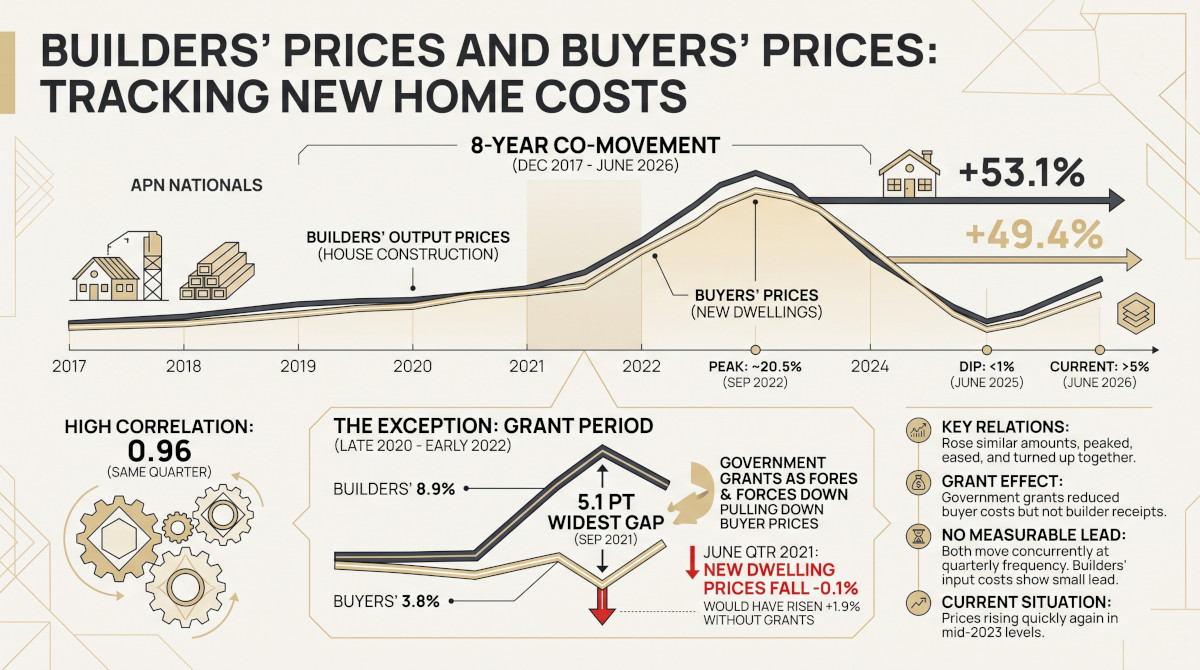
The Supply-Side Failure (APN Future Development Pipeline Index™): The collapse in goods inflation (0.8%) versus the surge in housing costs (+5.8%) is a direct reflection of a broken supply pipeline. The high-rate environment has widened the APN Residual Land Value (RLV) Gap™, making new developments unviable and ensuring the housing supply shortage—and its inflationary impact—will persist.
Deconstruction of the Source Event
This deconstruction is based on APN’s forensic audit of the Australian Bureau of Statistics (ABS) Consumer Price Index, Australia (Cat. No. 6401.0) for the December Quarter 2025. The key facts are:
- Headline CPI “Triple Miss”: The annual Headline CPI accelerated to 3.6%, a 20-basis point miss against the 3.4% consensus. This was the first part of a “Triple Miss” that invalidated the disinflationary narrative.
- Core Inflation Blowout: The Trimmed Mean, the RBA’s preferred measure of underlying inflation, surged to 3.8%. This was a catastrophic 50-basis point miss against consensus (3.3%) and the RBA’s own forecast (3.2%), indicating core inflation is accelerating, not moderating.
- Services vs. Goods Divergence: The data confirmed a structural schism in the economy. Services inflation broke out to 4.2%, while Goods inflation collapsed to just 0.8%. This 340-basis point spread is the widest on record since the GST’s introduction.
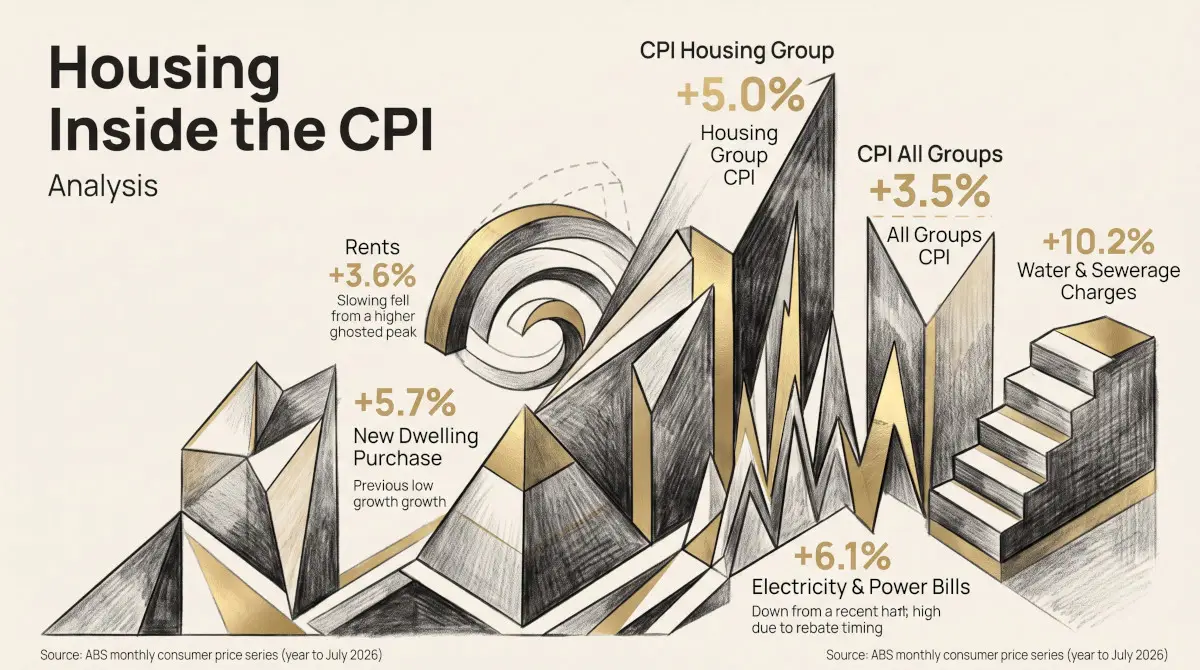
- Structural Drivers Confirmed: The inflation was not driven by volatile items like fuel. The primary drivers were non-discretionary, structural components: Housing (+5.8%), Insurance (+14.0%), and Education (+5.4%).
- Market Repricing: The ASX 30-Day Interbank Cash Rate Futures market reacted violently, repricing the probability of a February 3 rate hike from ~55% to 85% within minutes of the release, making a hike the new base case.
Critical Analysis & Balanced View
The core paradox facing the RBA is that it must now hike rates precisely because its previous hikes have failed to penetrate the services economy, yet have successfully crushed the goods economy. This creates a classic “policy error trap”: hiking now punishes the wrong sectors for the right reasons. The balanced view is that the RBA has no choice; failing to act would risk de-anchoring inflation expectations, a far greater long-term threat to economic stability. The deeper driver is the structural failure on the supply side of the housing market, a problem monetary policy is ill-equipped to solve and may even be worsening. The hidden risk is not just a recession in the retail sector, but a solvency crisis in the construction sector as the cost of finance rises again, further choking future housing supply and locking in rental inflation for years to come.
Strategic Implications for Property Professionals
- For Developers & Financiers: The business case for new residential projects has deteriorated significantly. Expect funding costs to rise immediately and pre-sale hurdles to become more stringent. Projects with a high APN Residual Land Value (RLV) Gap™ are now at extreme risk of failure. Focus must shift to de-risking existing pipelines and exploring alternative funding models.
- For Agents & Buyers’ Agents: The market is bifurcating. Expect demand for discretionary-linked commercial property (e.g., large format retail) to weaken further. In residential, buyer borrowing capacity will be re-assessed downwards, placing a ceiling on price growth. The narrative shifts from “when will rates be cut?” to “how high will they go?”, creating significant buyer hesitancy.
- For Asset & Portfolio Managers: Re-weight portfolios away from interest-rate sensitive assets like REITs (especially retail and office) and consumer discretionary-exposed properties. The “winners” in this environment are assets with non-discretionary demand and inflation-linked leases, such as healthcare facilities, logistics centres servicing essential goods, and high-quality residential blocks in supply-constrained markets.
- For Valuers & Risk Analysts: The “soft landing” assumption underpinning many valuation models is now void. Valuations must incorporate a higher probability of a “hard landing” scenario, with increased cap rates for commercial assets and a more conservative outlook on rental growth forecasts, particularly for sectors exposed to consumer discretionary spending. The structural inflation in insurance and construction costs must be explicitly modelled.
APN Index Management
The APN Codex 24000 Series is a proprietary set of indices that translates complex market forces into measurable metrics. This section outlines how the preceding analysis is validated against, and informs the calibration of, these frameworks.
- Validation: This analysis validates the high-risk reading in the APN Future Development Pipeline Index™ (24400), confirming that monetary policy has widened the APN Residual Land Value (RLV) Gap™ (24410) to critical levels. It also validates the “Exogenous Shock” component within the APN Climate-Risk Asset Devaluation Index™ (24500), as climate-driven insurance costs are now a primary inflationary driver.
- Index Calibration: The APN Meridian™ (Education Value Index) (24130) will be recalibrated to increase the weighting of fee indexation mechanisms (e.g., HECS/private school fees) as a forward-looking inflationary signal. The APN Substrate™ (Climate Resilience Rating) (24150) will now incorporate insurance premium volatility as a direct input metric for assessing a location’s financial resilience.
- Data Capture: This event triggers a new data capture mandate via the APN Symbiotic Intelligence Network™ (24310) to survey developers and financiers on the specific basis point increase in funding costs post-CPI release, providing a real-time input for the APN Future Development Pipeline Index™ (24400).
Disclaimer
The analysis and information contained in this deconstruction are for general informational and strategic purposes only and do not constitute financial, investment, legal, or any other form of professional advice. The Australian Property Network (APN) is a strategic intelligence organisation and is not a licensed financial advisor.
This analysis is based on data and information from third-party sources believed to be reliable; however, APN provides no warranty as to its accuracy, currency, or completeness. Images used in this analysis are for illustrative and conceptual purposes only and may not represent real persons, properties, or events.
All frameworks (Codex 24100-24800) are proprietary to APN.
Property values and market conditions can go up or down. Before making any property or investment decisions, you must conduct your own thorough research and seek independent professional advice tailored to your specific circumstances.