
Analysis: ‘Policy-Derivative’ Speculative Valuation Premium Corrects in Key Industrial Hubs, Projecting 40-60% Land Value Contraction
APN ANALYSIS: A-251204-AUS131547
Executive Summary
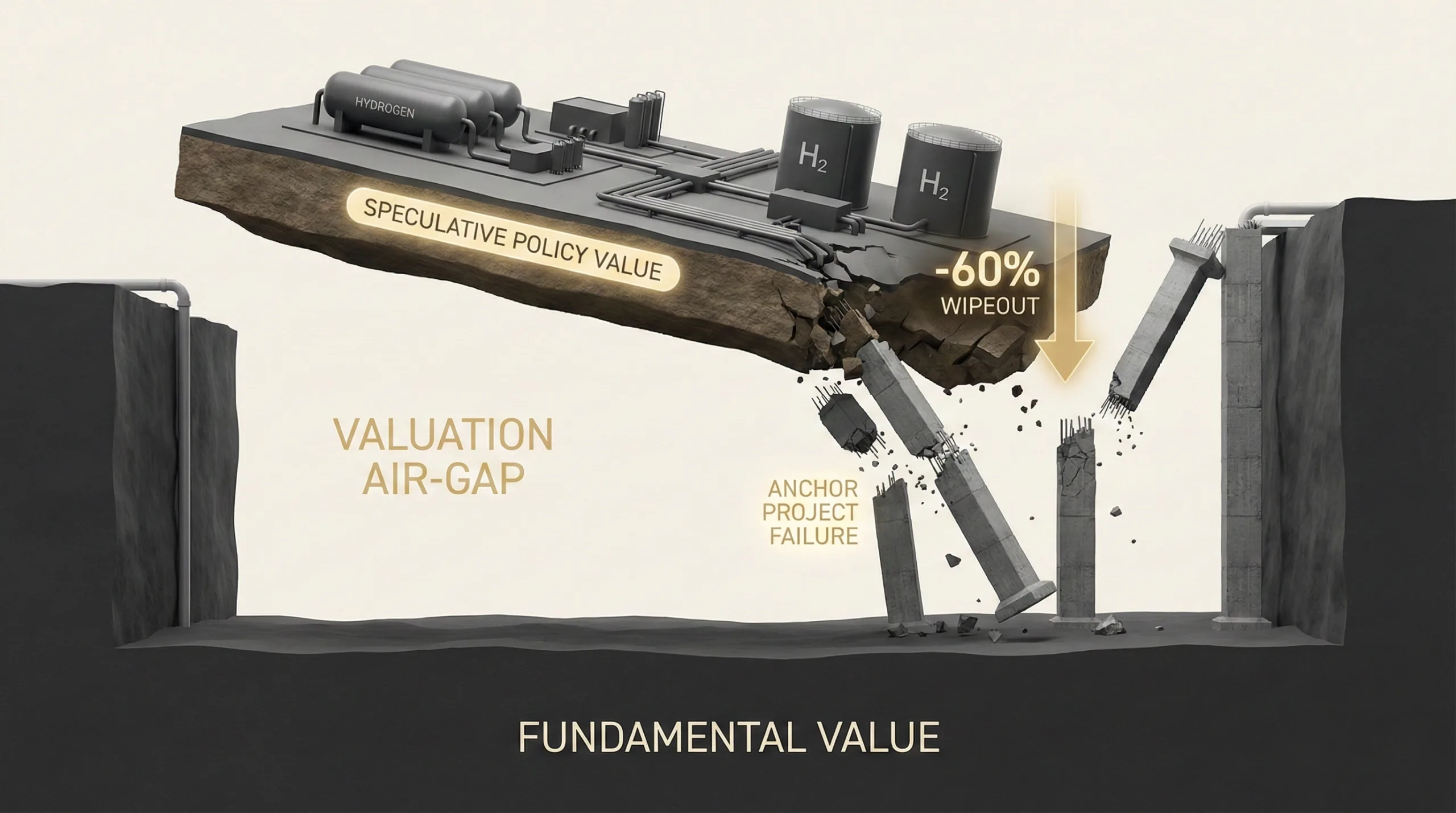
An elevated and widening “valuation air-gap” within Australia’s primary industrial energy precincts has been validated by APN analysis. Industrial land values in Gladstone and the Hunter Valley have fundamentally decoupled from operational fundamentals, with the market pricing assets based on the speculative projection of future government subsidies under the “Future Made in Australia” (FMIA) framework. This “Policy-Derivative” valuation model, which capitalised the potential of a $2/kg hydrogen production subsidy into the current cost of land, has created a significant speculative valuation premium, evidenced by the “sold out” status of estates like Clinton in Gladstone.
The significance is that the anchor projects underpinning this speculative activity are now being discontinued. The cancellation of the Stanwell CQ-H2 project in Gladstone and the discontinuation of Fortescue’s Gibson Island facility have demonstrated that the “Grant-to-Land” transmission mechanism is reversible. The demand drivers for the entire support system are materially reducing, creating a valuation floor unsupported by market fundamentals. For property professionals, this signals the start of a sequence of cancellations that is projected to erode up to 40-60% of the speculative land value premium accumulated since 2023. Assets in these hubs must now be reclassified as high-risk, with a material, near-term correction in both industrial and linked residential property values expected throughout 2026.
Background & Strategic Context
This event validates and calibrates APN’s core macro-thesis that state-level intervention is the primary force shaping property market boundaries and value. The creation and subsequent correction of the hydrogen land speculative valuation premium is a direct case study in the dual-edged nature of government industrial policy, demonstrating how quickly perceived value can be created and then eroded when it is not tethered to commercial reality.
APN Sovereign Policy Composite Index™ (SPCI, 24800) in Application: The FMIA Act served as a material market signal, creating a “policy-derivative” asset class where land tenure became a proxy for subsidy eligibility. This intervention structurally influenced the market. However, the subsequent withdrawal of State Government support for the CQ-H2 project demonstrates the material counter-observation: state-level policy support can be withdrawn. The contraction in value is a direct consequence of this SPCI-level policy reversal, demonstrating that policy risk is the primary variable.
The Grant-to-Land Transmission Failure (APN Infrastructure Uplift Multiplier™): The market incorrectly applied the APN Infrastructure Uplift Multiplier™ by capitalising a future, conditional production subsidy (the HPTI) into an upfront land value premium. The framework is designed to measure value from committed infrastructure, not speculative revenue. The project cancellations have triggered a material reversal of the multiplier, initiating a devaluation sequence as the subsidy’s value is materially reduced before it was ever realised.
The Perception of Viability (APN Residual Land Value (RLV) Gap™): The hydrogen mega-projects lacked economic viability, even with the proposed subsidies. The APN Residual Land Value (RLV) Gap™ was consistently negative, meaning total project costs materially exceeded achievable end values. The market, driven by policy-driven market sentiment, did not account for this fundamental gap. The project cancellations represent the RLV Gap™ asserting its influence over policy projections, confirming that a subsidy does not correct a structurally unviable business case.
Deconstruction of the Source Event
This deconstruction is based on an internal APN intelligence briefing analysing the failure of the “Policy Capitalisation” hypothesis in Australia’s key energy precincts. The key facts are:
- Policy Driver: The $22.7 billion “Future Made in Australia” (FMIA) Act, specifically the Hydrogen Production Tax Incentive (HPTI), created an accelerated acquisition of land by allowing proponents to use the projection of future subsidies to secure finance for upfront land acquisition.
- Market Signal: The “Sold Out” status of all 41 lots in the Clinton Industrial Estate (Stage 2) in Gladstone in mid-2025. This 100% absorption rate, driven by supply chain companies, indicated peak market sentiment, with inferred land values breaching $200/sqm, double the historical baseline.
- Anchor Project Discontinuation: In late 2025, the $12.5 billion Stanwell CQ-H2 project in Gladstone was discontinued after the Queensland State Government rejected a $1 billion funding request, leading to the discontinuation of Stanwell’s involvement. This removed the primary demand anchor for the entire Gladstone region.
- Precedent Discontinuation: The earlier discontinuation of Fortescue’s Gibson Island project, once considered Australia’s most advanced, demonstrated that the FMIA incentives were insufficient to guarantee project viability, leading to a wider market reassessment.
- The “Valuation Air-Gap”: APN analysis identifies a 40-60% speculative premium in land values within these hubs. This “air-gap” between the policy-driven price and the fundamental industrial value is now set to close materially as the primary demand drivers are materially reduced.
Critical Analysis & Balanced View
The core structural inconsistency of the FMIA policy is that in its attempt to de-risk the operational expenditure (opex) of green hydrogen production, it inadvertently created a material and unstable capital expenditure (capex) speculative valuation premium in the land market. The policy’s own requirement for projects to be in “strategic locations” with “comparative advantage” created a concentrated pressure effect in Gladstone and the Hunter Valley, concentrating risk and driving land prices to levels that structurally eroded the advantage the policy sought to leverage.
This was compounded by a widespread perception of liquidity. The market appeared to have high demand and deep capital commitment, but this was an unsupported perception created by a system of “Option Agreements” and conditional contracts. Proponents controlled significant tracts of land without deploying significant capital, creating a perception of scarcity. When the anchor projects failed, these options were not exercised, revealing the limited extent of committed capital and triggering a supply-side adjustment.
The market priced in a full-realisation scenario, assuming 100% subsidy realisation and a near-zero project failure rate, against an empirical reality in which over 80% of announced hydrogen projects fail to reach a Final Investment Decision (FID). The discontinuation of the Stanwell and Fortescue projects was not an anomalous event; it was the predictable collision of policy-driven sentiment with commercial fundamentals.
Strategic Implications for Property Professionals
- For Developers & Strategic Land Acquirers: Immediately re-evaluate any holdings in Gladstone and the Hunter Valley. The “Hub Premium” now represents a liability, not an asset. The strategic play shifts from holding for speculative purposes to preparing for distressed asset opportunities in 2026 as over-leveraged participants and support industries are structurally compelled to divest at a material loss.
- For Valuers & Financiers: Valuations based on a “hydrogen expansion” scenario are no longer tenable and must be revised downwards. A reversion to the baseline industrial land value (~$100-$150/sqm) is the only analytically sound approach. Loan-to-value ratios on existing finance in these precincts must be stress-tested against a 40-60% collateral value decline.
- For Agents & Buyers’ Agents: The market narrative has materially shifted. The “Hydrogen expansion” narrative is concluded, replaced by a narrative of elevated risk and correction. Advise clients accordingly. The residential crossover effect means suburbs like Clinton and New Auckland are also exposed to a material correction as the anticipated workforce influx fails to materialise.
- For Industrial Tenants & Owner-Occupiers: The projected market correction presents a material strategic opportunity. Companies that were affordability-constrained in these primary hubs will find favourable entry points in 2026-2027. The indicated strategy is to defer long-term lease or purchase commitments and await a market reset to its fundamental value.
APN Index Management
The APN Codex 24000 Series is a proprietary set of indices that translates complex market forces into measurable metrics. This section outlines how the preceding analysis is validated against, and informs the calibration of, these frameworks.
- Validation: This analysis provides validation for the core APN Sovereign Policy Composite Index™ (SPCI, 24800) thesis, demonstrating how state intervention (FMIA) and its subsequent withdrawal directly create and destroy asset value. It also validates the APN Infrastructure Uplift Multiplier™ (24420) in a reverse application, where the removal of a perceived future subsidy triggers a devaluation sequence.
- Index Calibration: The APN Residual Land Value (RLV) Gap™ (24410) is calibrated to reflect the structurally significant failure of policy incentives to close the viability gap for mega-projects. The model will now assign a higher risk weighting to projects dependent on future, unrealised production credits versus direct capital grants.
- Data Capture: This event triggers a new data capture mandate for the APN Future Development Pipeline Index™ (24400) to differentiate between land held under firm contract and land held under “Option Agreements” or conditional tenure, flagging the latter as “Phantom Demand” with a high failure probability.
Disclaimer
The analysis and information contained in this deconstruction are for general informational and strategic purposes only and do not constitute financial, investment, legal, or any other form of professional advice. The Australian Property Network (APN) is a strategic intelligence organisation and is not a licensed financial advisor.
This analysis is based on data and information from third-party sources believed to be reliable; however, APN provides no warranty as to its accuracy, currency, or completeness. Images used in this analysis are for illustrative and conceptual purposes only and may not represent real persons, properties, or events.
All frameworks (Codex 24100-24800) are proprietary to APN.
Property values and market conditions can go up or down. Before making any property or investment decisions, you must conduct your own thorough research and seek independent professional advice tailored to your specific circumstances.