
The Fixed-Price Structural Adjustment: How Commodity Volatility and Bank Rigidity Have Constrained Residential Construction
APN ANALYSIS: A-260206-AUS136846
Executive Summary
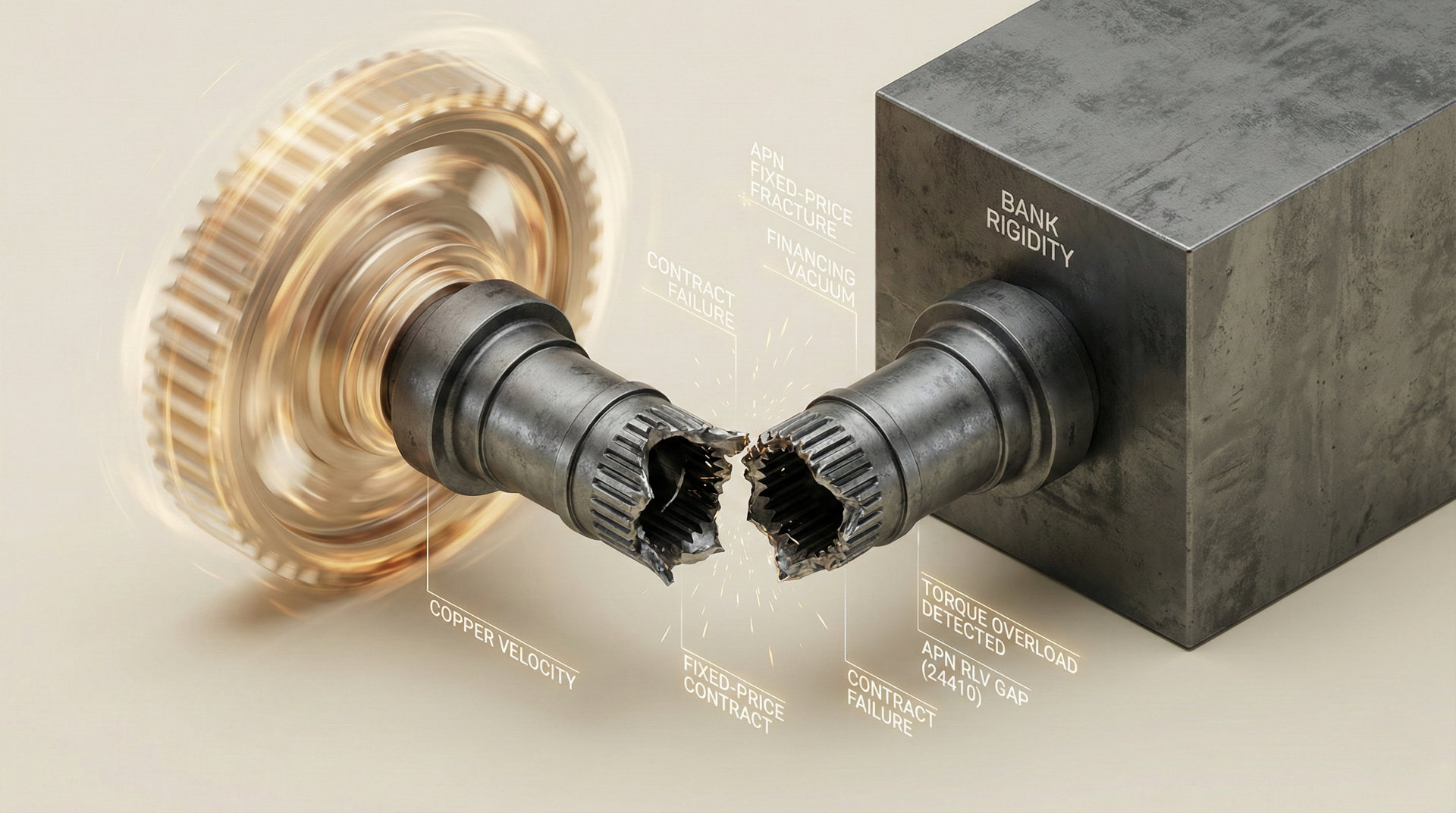
The Australian residential construction sector is confronting a structural dislocation, identified by APN as the ‘Fixed-Price Fracture.’ An accelerated growth in global copper prices—peaking at $14,527.50/tonne on January 29, 2026—has rendered the industry-standard fixed-price contract financially unviable for sub-contractors. The velocity of this input cost escalation, which saw copper prices materially escalate over 20% in 45 days, exceeds the entire profit margin of trades, leading them to refuse work under fixed-price terms. This has created a “Material Financing Constraint,” as Australia’s Tier 1 banks have not adapted their credit risk policies and continue to reject the only commercially viable alternative: “Cost Plus” or “Rise and Fall” contracts. The result is a material misalignment between global commodity markets, supply chain solvency, and domestic financial architecture, resulting in a material constraint on new housing commencements.
For property professionals, this is not a cyclical downturn but a structural dislocation in the supply pipeline. The inability to execute on approved projects will create a growing backlog of “structurally stalled projects,” distorting supply forecasts and leading to a material, non-linear contraction in housing completions in mid-to-late 2026. This is projected to place a material premium on existing and recently completed housing stock, widening the APN Replacement Cost Gap™ and further exacerbating the national housing affordability structural pressure point. The constraint on the market is no longer land or labour, but the inability to write a bankable contract.
Background & Strategic Context
This event validates and calibrates several core APN macro-theses, demonstrating an intersection between global market forces and structurally inflexible domestic policy frameworks. The structural pressure point is not the result of a single point of failure, but a sustained systemic friction created by the interaction of regulatory intervention, financial conservatism, and elevated commodity volatility. The key contextual drivers are:
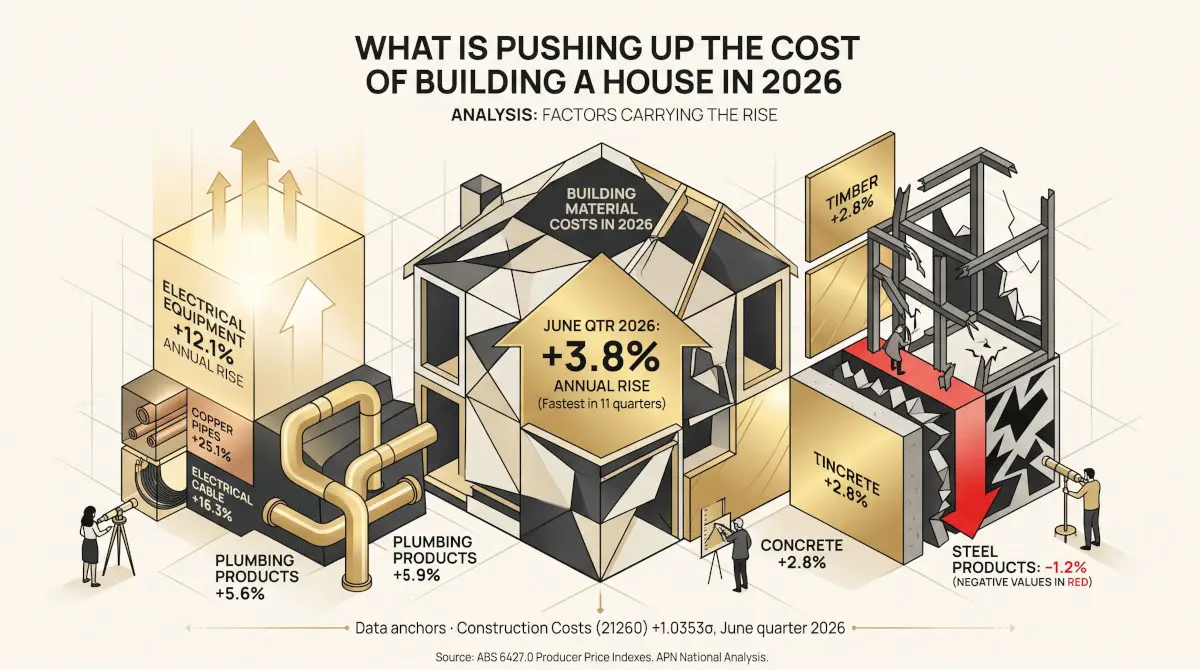
State Intervention as a Price Floor: The Federal Government’s protectionist policy, manifested through the Anti-Dumping Commission’s actions on Chinese steel, is a material factor. This regulatory intervention, a condition tracked by the APN Sovereign Policy Composite Index™ (SPCI, 24800), prevents builders from offsetting the elevated cost escalation in copper with deflationary pressure in other materials. By maintaining a price floor on steel, this policy action removes any financial buffer within the project budget, amplifying the impact of the copper price escalation.
The Inflexibility of Credit Rationing (Project Iron Gate): The refusal of Tier 1 lenders to widely facilitate ‘Cost Plus’ contracts is a manifestation of the Iron Gate thesis. This discretionary exclusion acts as an impassable gate; by materially reducing LVRs to 70% for non-fixed-price contracts, banks create an Equity Chasm that decouples willing borrowers from capital. This is not rationing based on serviceability but rather on contractual risk-pricing.
The Widening Viability Chasm (APN Replacement Cost Gap™ 24450): The accelerated growth in commodities has materially increased the cost of new construction, materially widening the gap between the replacement cost of a new dwelling and the market value of an equivalent existing property. This framework explains why development activity is becoming constrained; it is now fundamentally uneconomical to build a standard residential home under the current financing structure, structurally insulating the value of established housing stock.
Deconstruction of the Source Event
This deconstruction is based on APN’s analysis of London Metal Exchange (LME) data, lender credit policies, and trade body advisories from Q4 2025 to Q1 2026. The key facts are:
- The Copper Price Escalation: Global copper prices experienced a material repricing, escalating from a baseline under $12,000/tonne in mid-December 2025 to a peak of $14,527.50/tonne on January 29, 2026. This structural shift was driven by inelastic demand from the AI and data centre sectors, which are absorbing supply at price points residential builders cannot absorb.
- The Commercial Veto: Sub-contractors, particularly in the electrical and plumbing trades, have not engaged in formal industrial action. Instead, they have exercised a “Commercial Risk-Veto” by refusing to sign fixed-price contracts. Guided by “Protective Advisories” from bodies like MPAQ, they now universally demand “Rise and Fall” clauses to mitigate insolvency risk, effectively withdrawing the financial instrument the banks require.
- The Lending Deadlock: Analysis confirms a functional unbankability of ‘Cost Plus’ loans for retail builds. The banks’ inability to calculate a certain LVR on a floating-cost asset, combined with a requirement for significantly higher deposits, renders the only contract type trades will accept structurally unviable for mass-market financing.
- The Neutralisation of Deflationary Levers: The potential for cost relief has been neutralised by Anti-Dumping Announcement 2026/013 (Jan 23, 2026). This protectionist policy ensures no relief from other materials, forcing the entire budget to absorb the copper price escalation.
Critical Analysis & Balanced View
The “Fixed-Price Fracture” represents a new phase of elevated risk for the Australian property market. The core of the structural pressure point is a paradox: the physical capacity to build (titled land, available trades) is present, but the financial mechanism to connect capital with execution has become structurally disconnected. This creates a state of sustained execution constraint. The point of structural dislocation occurs where the velocity of commodity price changes (daily) far exceeds the processing time of bank loan variations (weeks). This means the financial target is moving faster than the lender can approve funds, creating the Equity Chasm that defines a structurally stalled project: a development with approval and intent, but whose funding model is mathematically incapable of catching up to its cost base. This is not a structural pressure point of demand, supply, or labour in the traditional sense, but a structural pressure point of financial instrumentation.
The immediate consequence is the rapid accumulation of “structurally stalled projects”, developments with council approval and in-principle finance that cannot proceed because the fixed-price quotes on which their funding was based have expired. The new, higher quotes render the original loan facility insufficient, and the banks’ refusal to fund a flexible contract creates a self-reinforcing cycle of non-viability. The point of structural dislocation occurs where the velocity of commodity price changes (daily) far exceeds the processing time of bank loan variations (weeks), meaning the financial target is always moving faster than the lender can approve funds for.
This sustained systemic friction reveals a material structural vulnerability in the Australian economy. The entire housing supply chain has been built on the assumption of price stability, an assumption that ceased to be valid in late 2025. Without a rapid evolution in lending products, such as commodity-hedged loans or the acceptance of Cost Plus contracts with higher equity buffers, the constraint in residential commencements will deepen, with materially adverse consequences for housing supply and affordability.
Strategic Implications for Property Professionals
- For Developers: Project viability assessments must now model elevated input cost volatility as a primary risk. Projects reliant on standard fixed-price funding models from Tier 1 banks face a material viability risk. Securing finance will require exploring second-tier lenders, private credit, or innovative contract structures that share risk between the client and builder.
- For Agents & Buyers’ Agents: The projected constraint in new housing supply will place a material and sustained premium on established and recently completed housing stock. Be prepared to educate clients on the “Replacement Cost Gap,” as the price differential between building new and buying existing is set to widen materially.
- For Investors & Valuers: The concept of “highest and best use” for vacant residential land is now structurally challenged. The value of development sites is structurally impaired by this execution constraint. Valuations must be materially discounted to reflect the elevated financing risk and the unbankable nature of the current contract environment.
- For Mortgage Brokers: The inability to place standard construction loans will become a material business risk. Professionals who develop expertise in second-tier lenders, specialist finance, and alternative funding solutions that can accommodate Cost Plus contracts will hold a significant competitive advantage and become material to facilitating any new projects.
APN Index Management
The APN Codex 24000 Series is a proprietary set of indices that translates complex market forces into measurable metrics. This section outlines how the preceding analysis is validated against, and informs the calibration of, these frameworks.
- Validation: This analysis provides material validation for the APN Replacement Cost Gap™ (24450), demonstrating how a commodity price escalation can trigger a concentrated construction constraint. It also validates the APN Credit Rationing Index™ (24230) by identifying a new, non-serviceability-based rationing mechanism: the systemic exclusion of an entire contract class (Cost Plus) by major lenders.
- Index Calibration: The APN Future Development Pipeline Index™ (24400) will be recalibrated to more heavily weight the “Financing Viability” filter. Projects in the pipeline without a confirmed, flexible funding structure will be downgraded from “Genuine Opportunity” to reflect the high probability of becoming “structurally stalled projects.”
- Data Capture: This analysis triggers a new data capture mandate for the APN Symbiotic Intelligence Network™ (24310). The network will now actively track the prevalence of “Rise and Fall” clauses in sub-contractor quotes and monitor the rejection rates of “Cost Plus” loan applications by Tier 1 and Tier 2 lenders as a leading indicator of supply chain constraint.
Disclaimer
The analysis and information contained in this deconstruction are for general informational and strategic purposes only and do not constitute financial, investment, legal, or any other form of professional advice. The Australian Property Network (APN) is a strategic intelligence organisation and is not a licensed financial advisor.
This analysis is based on data and information from third-party sources believed to be reliable; however, APN provides no warranty as to its accuracy, currency, or completeness. Images used in this analysis are for illustrative and conceptual purposes only and may not represent real persons, properties, or events.
All frameworks (Codex 24100-24800) are proprietary to APN.
Property values and market conditions can go up or down. Before making any property or investment decisions, you must conduct your own thorough research and seek independent professional advice tailored to your specific circumstances.