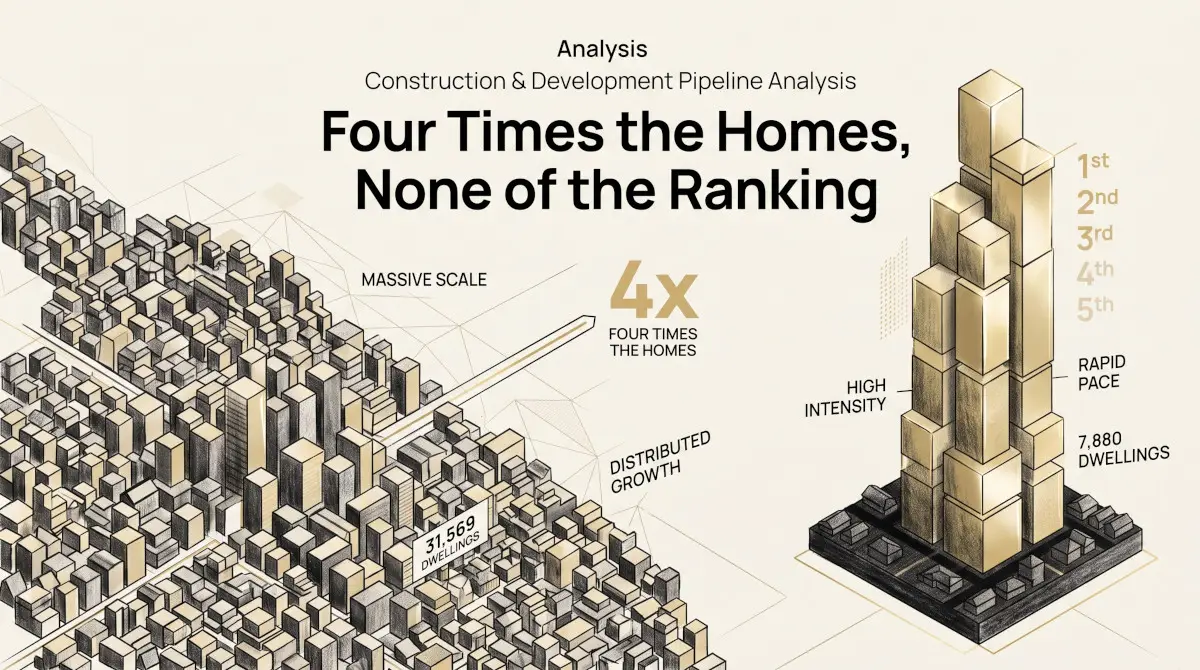

Analysis of ‘Paper Tower’ Site Divestment Characterising the Australian Development Sector
APN ANALYSIS: A-260125-AUS135156
Executive Summary
The Australian property development sector is undergoing a structural liquidation event, characterised by the large-scale divestment of unviable development sites. APN analysis confirms the thesis of large-scale DA site divestment, where accelerated growth in construction costs and structurally constraining finance rates have created a class of ‘Zombie Assets’, projects with valid Development Approvals (DAs) that are economically unviable to build. This ‘Feasibility Trap’ has resulted in a contraction of residual land values, forcing developers, receivers, and funds to divest sites at a loss to stem capital erosion. The phenomenon is not a cyclical downturn but a structural dislocation of the supply pipeline, rendering a significant portion of forecast housing supply as ‘Phantom’ stock and undermining the feasibility of government housing targets.
For property professionals, this marks an elevated inflection point. The market is bifurcating between viable, funded projects and a growing inventory of distressed ‘Paper Towers’. This presents both a material risk of value write-downs for incumbent holders and a significant acquisition opportunity for well-capitalised investors prepared to acquire discounted land assets. Navigating this environment requires a granular understanding of project-level feasibility and the ability to differentiate between genuine opportunities and structurally adverse assets with high capital risk.
Background & Strategic Context
This liquidation event validates and calibrates APN’s core macro-theses on the primacy of economic friction in shaping market outcomes. The emergence of ‘Zombie Assets’ is a direct manifestation of market forces overriding administrative planning intentions, a core dynamic tracked by our proprietary indices.
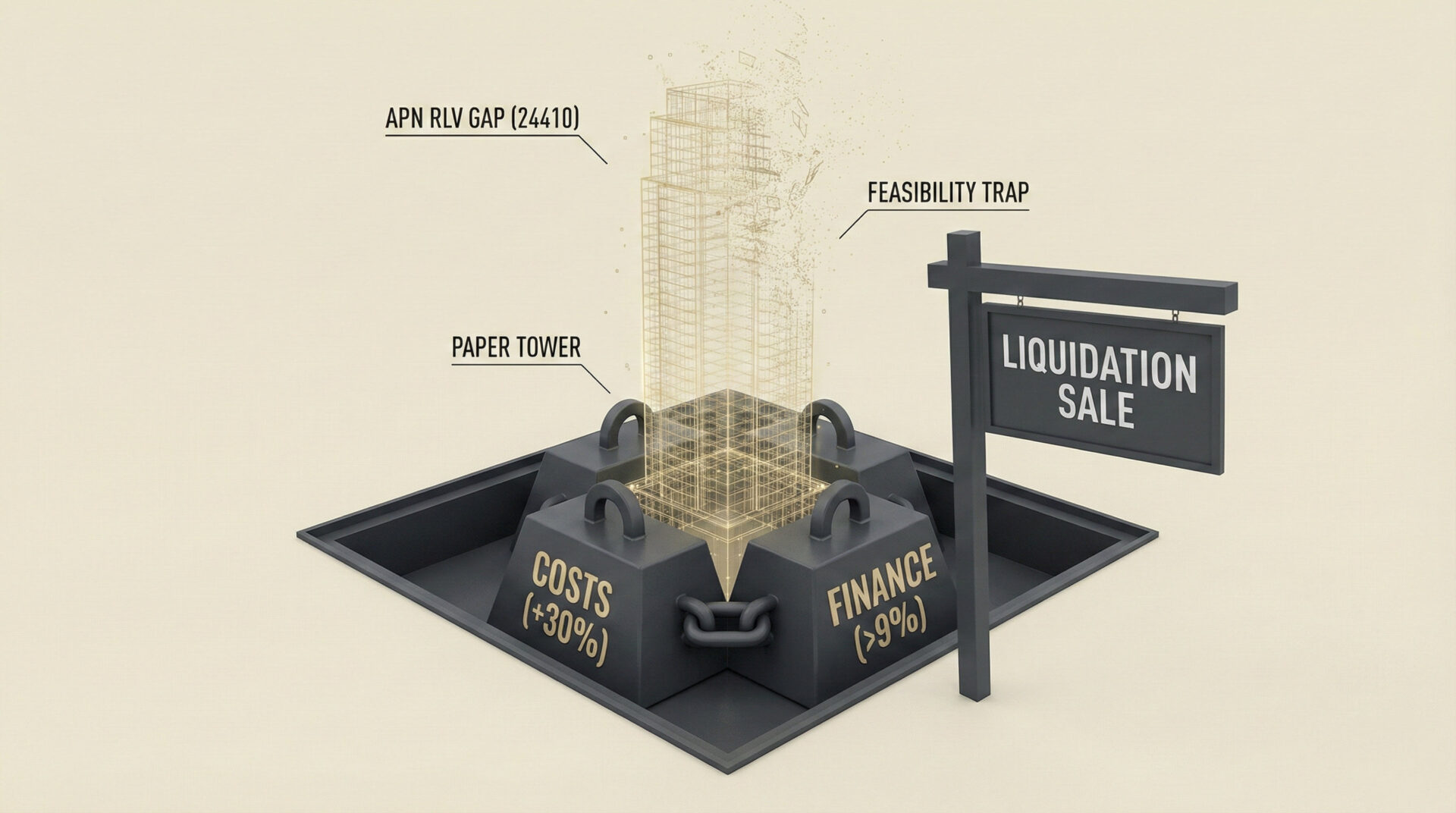
The Development Viability Gap (APN Future Development Pipeline Index™): The ‘Paper Tower’ phenomenon is the physical manifestation of the APN Residual Land Value (RLV) Gap™ (24410). When the cumulative impact of cost inflation (+30.8%) and higher finance rates (>9%) exceeds the growth in end-market sales prices, the RLV experiences a contraction. This gap between the cost to build and the market’s capacity to pay is the primary driver of the liquidation, turning DA-approved sites from assets into liabilities.
The State-Intervention Paradox (APN Sovereign Policy Composite Index™ (SPCI, 24800)): This structural pressure point highlights a core paradox of state intervention. While state planning authorities have approved a pipeline of housing supply on paper, their actions are rendered ineffective by economic reality. The DA, once the primary value-creation event, is now merely the entry ticket to a ‘Feasibility Trap’ from which many projects cannot escape, demonstrating that market fundamentals ultimately govern the built environment outcome.
The Capitulation Signal (APN Professional Sentiment Index™): The shift from a ‘land banking’ to a ‘land divestment’ mentality is an elevated leading indicator of market distress. This behavioural change, driven by escalating holding costs that now outweigh the option value of the land, is a core input for the APN Professional Sentiment Index™ (24300). The observed use of the term ‘dump’ by market participants signifies a capitulation phase, where arresting further losses becomes the primary strategic driver.
Deconstruction of the Source Event
This deconstruction is based on APN’s analysis of market data, insolvency filings, and industry reports under Reference Brief AUS043. The key facts are:
- Construction Cost Escalation: A cumulative rise of 30.8% in construction costs since the start of the COVID-19 pandemic has fundamentally undermined project feasibilities conceived in a lower-cost paradigm. High-rise apartment costs in Sydney now range from $4,500 to over $6,200 per square metre.
- Structurally Constraining Finance Costs: Development finance has stabilised at a new, higher baseline, with senior debt rates quoted from 8.99% plus margins. The cost of mezzanine debt, often required to bridge equity gaps, has increased sharply to between 12% and 20%, making many projects unprofitable.
- Insolvency as a Catalyst: The construction sector leads the nation in corporate insolvencies, with approximately 3,000 companies entering administration in FY24. This acts as a direct mechanism, forcing unattached development sites onto the market via receivership sales.
- Pipeline Attrition Contraction: The DA-to-commencement conversion rate is in a state of sustained contraction. While historical attrition was 20-25%, current conditions suggest a rate indicative of a structural pressure point approaching 60-80%. Data shows one in six approved apartments were not started after two years, a lagging indicator for the current, more challenging environment.
- The ‘Economic Rent’ Gap: Analysis from Knight Frank quantifies the feasibility gap, finding the rent required to justify new construction is 56% higher than market rent in Melbourne and 26% higher in Sydney. This gap acts as a material barrier to new supply.
Critical Analysis & Balanced View
This large-scale divestment of DA sites is more than a collection of distressed sales; it is a structural re-pricing of development risk in Australia. The central paradox is that this supply-side contraction is occurring amidst a widely publicised housing and rental structural pressure point. This disconnect reveals that demand alone is insufficient to trigger supply when the fundamental economics of construction are unviable. The market is not responding to the social need for housing but to the financial unviability of delivering it profitably.
Furthermore, the counter-narratives of pivoting to Build-to-Rent (BTR) or Industrial are a partial and bifurcated solution. While institutional capital with a lower cost of funds can execute this pivot, it is not a viable exit for the majority of private developers holding ‘Zombie’ residential sites. The BTR sector itself faces its own feasibility threshold, with over 20,000 approved units currently stalled. This capital reallocation into ‘premium’ asset classes like industrial and data centres is exacerbating the problem, leaving a residual inventory of unviable residential sites in its wake and creating a ‘two-speed’ development market.
The resulting conclusion is that a significant write-down in high-density residential land values is necessary to restore equilibrium. Until the book value of these sites is reset to a level where a 20% developer margin is achievable on current costs, they will remain ‘Paper Towers’, illiquid, un-financeable, and a drag on the market.
Strategic Implications for Property Professionals
- For Developers: Immediately stress-test all pipeline projects against current construction and finance costs ($4,500/sqm and 9%+). Any project not fully funded is at elevated risk. Prepare for asset value write-downs and consider strategic divestment of non-core or unviable sites to preserve capital, even at a loss.
- For Lenders & Valuers: Historical valuation metrics, particularly ‘per approved unit’, no longer adequately reflect underlying structural conditions. RLV models must be recalibrated with current, granular cost inputs. Increase scrutiny on developer equity contributions and the viability of securing a fixed-price construction contract before funding.
- For Agents & Buyers’ Agents: The market for development sites is now bifurcated. Your advisory value lies in differentiating between genuinely deliverable projects and ‘Paper Towers’. Conduct enhanced due diligence on the funding status and feasibility of any site before presenting it to clients, as the risk of acquiring a stalled asset is concentrated.
- For Investors & Fund Managers: A significant distressed asset cycle is underway. The optimal strategy is to prepare capital for deployment in 2026 to acquire fundamentally well-located ‘Zombie’ sites from distressed sellers at discounts of 30-40% to 2021 book values. The thesis is not to build immediately, but to hold for the next cycle when rental and sales price growth closes the feasibility gap.
APN Index Management
The APN Codex 24000 Series is a proprietary set of indices that translates complex market forces into measurable metrics. This section outlines how the preceding analysis is validated against, and informs the calibration of, these frameworks.
- Validation: This analysis provides validation for the APN Residual Land Value (RLV) Gap™ (24410) as the primary causal mechanism creating ‘Zombie Assets’. It confirms the core function of the APN Future Development Pipeline Index™ (24400) in filtering unviable ‘Paper Towers’ from the genuine supply pipeline.
- Index Calibration: The APN RLV Gap™ (24410) is recalibrated to reflect the new feasibility floor: a construction cost baseline of $4,500/sqm for mid-rise and a senior debt rate of 9%. The APN Professional Sentiment Index™ (24300) is adjusted to weigh the ‘developer capitulation’ factor more heavily as a leading indicator of distressed transaction volume.
- Data Capture: This analysis triggers a new data capture mandate for the APN Symbiotic Intelligence Network™ (24310). The mandate is to track and quantify the ‘Zombie Discount’: the percentage difference between the transaction price of distressed DA sites and their last recorded book value or valuation.
Disclaimer
The analysis and information contained in this deconstruction are for general informational and strategic purposes only and do not constitute financial, investment, legal, or any other form of professional advice. The Australian Property Network (APN) is a strategic intelligence organisation and is not a licensed financial advisor.
This analysis is based on data and information from third-party sources believed to be reliable; however, APN provides no warranty as to its accuracy, currency, or completeness. Images used in this analysis are for illustrative and conceptual purposes only and may not represent real persons, properties, or events.
All frameworks (Codex 24100-24800) are proprietary to APN.
Property values and market conditions can go up or down. Before making any property or investment decisions, you must conduct your own thorough research and seek independent professional advice tailored to your specific circumstances.