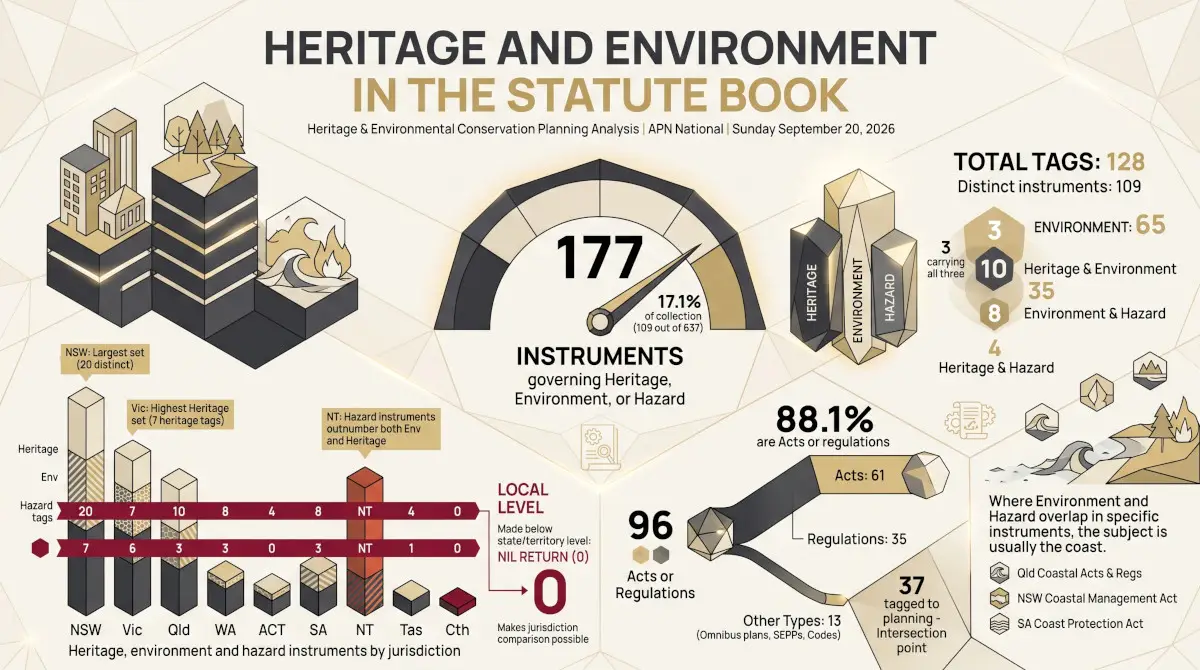
Heritage listing in Australia happens at three levels, and each keeps its own list. New South Wales has 1,825 items on its State Heritage Register, and its councils’ plans schedule another 36,724. Victoria has 2,428 places and objects on its register and 25,048 mapped areas under the heritage overlay in its planning schemes. The Commonwealth lists 126 places of national significance. The registers count different things, overlap with one another, and only a few say when each place was listed, so they cannot be added up. A national count of heritage-listed places does not exist: NIL RETURN.
Node reading for Planning Regulations & Zoning Policy (21320): NIL RETURN. This article rests on the source data alone.
Three levels of listing
A heritage listing marks a place, building or object as culturally significant and brings it under the controls of the law that keeps the list. Changes to a listed place generally need approval. How much approval, and from whom, depends on the level.
State and territory registers hold places of significance to the state as a whole, under each jurisdiction’s heritage Act. Local listings sit in councils’ planning schemes, as heritage schedules or heritage overlays, and cover places of local significance; they are usually far more numerous. Commonwealth lists hold places of national significance, and places the Commonwealth owns or controls, under the Environment Protection and Biodiversity Conservation Act 1999. A single building can appear at more than one level. The Acts themselves are mapped in Heritage and Environment in the Statute Book.
What each register holds
| Register | Level | What it holds | Unit counted | Listing dates published |
|---|---|---|---|---|
| NSW State Heritage Register | State | 1,825 | Items | Yes |
| NSW local environmental plans, heritage schedules | Local | 36,724 (34,959 of local significance), across 129 council areas | Scheduled items | No; plan dates only |
| Victorian Heritage Register | State | 2,428 | Register numbers | No |
| Victoria, Heritage Overlay in planning schemes | Local | 25,048, across 82 planning scheme areas | Mapped areas | Gazettal date for most mapped areas (21,227 of 25,048) |
| Western Australia, State Register of Heritage Places | State | 1,404, plus 910 places within them | Places | No |
| ACT Heritage Register | Territory | 187 registered, 3 provisionally registered, 22 nominated | Places or objects | No |
| National Heritage List | Commonwealth | 126 | Listed places | Yes |
| Commonwealth Heritage List | Commonwealth | 372 | Listed places | Yes |
Counts read from each register’s published map service on 29 September 2026; Victorian Heritage Register on 26 September 2026. Mapped areas are polygons: one listed place can span several. Sources: Heritage NSW (State Heritage Register); NSW Planning Portal (local environmental plan heritage layer); Heritage Victoria; Victorian Department of Transport and Planning (Vicmap Planning); WA Department of Planning, Lands and Heritage; ACT Government; Australian Government Department of Climate Change, Energy, the Environment and Water.
Queensland, South Australia and Tasmania also publish their registers, South Australia with state and local places in one data set; they are not counted here, and the Northern Territory’s register is not included.
The units in the table are not the same. New South Wales counts items, which can be a single house or a group. Victoria counts register numbers, and its overlay counts mapped areas, several of which can belong to one listing. The ACT’s 187 registered places are mapped as 4,509 areas. Western Australia lists 910 places within larger registered places separately from the 1,404 places themselves.
Local listing is where the numbers are
In New South Wales and Victoria, which publish their local listings statewide, local listing far outnumbers state listing. New South Wales councils’ plans schedule about 20 times as many heritage items as the State Heritage Register holds, across 129 council areas and 148 local environmental plans. Victoria’s Heritage Overlay covers 82 planning scheme areas with 25,048 mapped areas, against 2,428 entries on the state register. The local lists also include places of state significance: in New South Wales, 1,763 items in local plans (2,076 mapped areas) are marked as of state significance.
When places were listed: New South Wales
The NSW State Heritage Register carries the date each item was entered. 1,053 items carry the same date, 2 April 1999, the earliest in the register, and 1,115 are dated 1999 in all. The chart starts in 2000 so that the register’s first year does not dwarf the years after it.
Items entered on the NSW State Heritage Register, by year
Number of items by the year of their listing date, 2000 to 2025. 1999, the register’s first year, has 1,115 items; 2026 to August has 2. Source: NSW State Heritage Register map service, read 29 September 2026.
After 150 entries in 2002, additions have run at between 5 and 39 a year: 22 in 2025. At that pace the state register grows by around 1% a year.
When places were listed: the Commonwealth
Places added to the National Heritage List, by year
Number of listed places by the date first entered, 2004 to 2026 (2026 to September). Source: Australian Government, National Heritage List map service, read 29 September 2026.
The National Heritage List began in 2004. 75 of its 126 places were entered in its first four years, 36 of them in 2007, and 51 since. It holds 70 historic, 36 natural and 20 Indigenous places. The Commonwealth Heritage List entered 291 of its 372 places in 2004, its first year, and 43 in 2011; 14 have been added since 2013.
Why there is no national count
A national count would need one unit, one level and one rule for places listed more than once. The registers count items, places, register numbers and mapped areas; the same place can be on a Commonwealth list, a state register and a council schedule at once; and of the registers counted here, only New South Wales and the Commonwealth publish a listing date for every entry, so even the rate of listing cannot be compared across states. A national count of heritage-listed places cannot be built from what is published: NIL RETURN.
What this does not show
A count of listings is not a measure of how much land or housing heritage controls affect. A listed item can be a whole precinct or a single tree, and the registers do not say how many dwellings they cover. Nor is a count a measure of how strict the controls are, which depends on each state’s Act and each council’s scheme. Nothing here ranks the states.
Findings are presented on the basis of data and evidence alone.