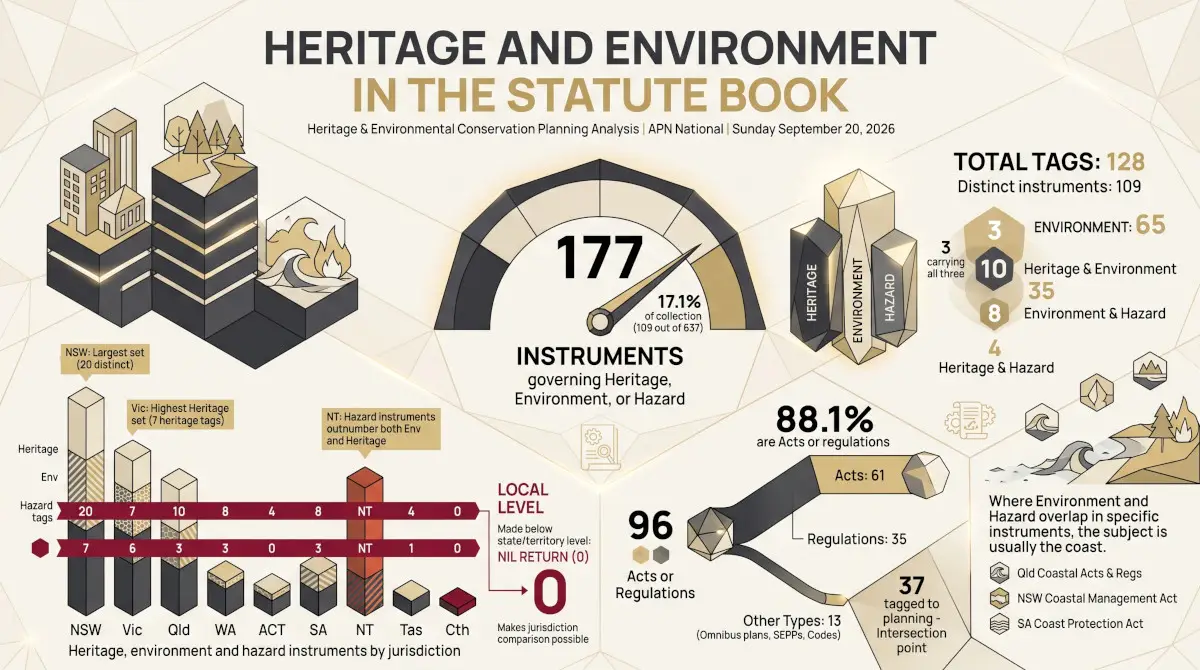

One hundred and nine of the 637 instruments in the APN Regulatory Instrument Library govern heritage, the environment or natural hazards — 17.1 per cent of the collection. Every one of them is made by a state, a territory or the Commonwealth; not one sits at local level, which removes the main obstacle to comparing jurisdictions here. 96 of the 109 are Acts or regulations. And where environment and hazard meet in an instrument written for one subject, that subject is usually the coast.
The node behind this category is Planning Regulations & Zoning Policy (21320), whose reading measures the share of new dwellings approved that are not detached houses — the permissiveness of planning output, not the size of the statute book. No APN node reading measures the instrument set counted here, so this piece is anchored on the library’s own counts rather than on an index value. Subject tags are the library’s classification and are not mutually exclusive: the three subjects account for 128 tags across 109 instruments. The library is curated and grows; counts are reported as at a date for that reason.
Three subjects, and how they sit across the jurisdictions
The three subjects are not mutually exclusive. An instrument may be tagged to more than one, and 16 of them are: 10 carry both heritage and environment, eight both environment and hazard, four both heritage and hazard, and three carry all three. That is why the 128 subject tags resolve to 109 instruments.
The chart below stacks the tags and marks each jurisdiction’s distinct instrument count separately, so the gap between the two is the overlap. South Australia has the most of it, at six tags, carried by four instruments of which two hold all three subjects; four jurisdictions — NT, Tas, Vic, WA — have none at all, each instrument doing one job.
Heritage, environment and hazard instruments by jurisdiction
Bars stack the library’s subject tags; the horizontal marker is the number of distinct instruments, which is lower wherever an instrument carries more than one of the three subjects. Source: APN Regulatory Instrument Library, in force at 19 September 2026.
New South Wales carries the largest set at 20 instruments and Victoria the next at 17. The composition differs more than the totals do. New South Wales carries 16 environmental instruments against Victoria’s seven, while Victoria carries seven heritage instruments, more than any other jurisdiction. Two of those seven are its Aboriginal heritage Act and the regulations under it, the only instruments of that kind the library holds for anywhere, so the lead measures what the register contains rather than a larger heritage statute book: on the instruments held for every jurisdiction, New South Wales, South Australia, Victoria and Western Australia each carry five. In the library’s holdings the Northern Territory is the only jurisdiction where hazard instruments outnumber both other subjects, on a base of eight.
Legislation, not planning documents
96 of the 109 instruments — 88.1 per cent — are Acts or regulations. The remaining 13 are spread across eight further types, and most of those are omnibus planning documents that happen to carry one of these subjects among several: the Australian Capital Territory’s Territory Plan, South Australia’s Planning and Design Code, a handful of state environmental planning policies.
The six largest instrument types
Instruments carrying heritage, environment or hazard, by type. Four further types account for one instrument each. Source: APN Regulatory Instrument Library, in force at 19 September 2026.
This is a different shape from the planning rule set, which runs to hundreds of instruments and is made mostly at council level. Heritage, environmental and hazard controls on development are written in primary and subordinate legislation, and 37 of the 109 are tagged to planning as well — the points at which the two bodies of rules meet.
The absence of a local layer is what makes the jurisdiction comparison above worth drawing at all. A count of all instruments by jurisdiction cannot be compared like for like, because local coverage in the library is uneven, and within these three subjects there is no local layer to be uneven. That removes one distortion rather than every distortion. What each jurisdiction has lodged at state level is itself uneven — the heritage counts above are the clearest case — so the comparison is between what the library holds, not between the statute books themselves.
Where environment and hazard meet, the subject is usually the coast
Eight instruments carry both environment and hazard. Three of them are not about a subject at all but are a form: omnibus planning instruments — the Australian Capital Territory’s Territory Plan, South Australia’s Planning and Design Code and its state planning policies — that carry environment and hazard alongside planning, building and heritage in a single document. Where a jurisdiction has consolidated its planning rules into one instrument, that instrument collects every subject it touches.
That leaves five written for a particular subject, and four of the five are named for the coast: coastal management in New South Wales, coastal protection and management in Queensland in both an Act and a regulation, and coast protection in South Australia. The fifth is New South Wales’ resilience and hazards planning policy, which is not coastal by name.
| Jurisdiction | Instrument | Version in force from |
|---|---|---|
| NSW | State Environmental Planning Policy (Resilience and Hazards) 2021 | 2023-08-04 |
| NSW | Coastal Management Act 2016 | 2024-08-09 |
| Qld | Coastal Protection and Management Act 1995 | 2024-04-26 |
| Qld | Coastal Protection and Management Regulation 2017 | 2026-07-01 |
| SA | Coast Protection Act 1972 | 2021-01-01 |
| SA | Planning and Design Code | 2026-09-10 |
| SA | State Planning Policies for South Australia | 2025-08-14 |
| ACT | Territory Plan 2023 | 2026-08-07 |
Source: APN Regulatory Instrument Library, in force at 19 September 2026.
The coast is where an environmental value and a physical hazard are the same fact about the same piece of land, and an instrument addressing one addresses the other. Elsewhere the two subjects are largely handled apart.
The dates mark publishing, not law-making
105 of the 109 instruments carry a date for the version now in force. 75 of those 105 — 71.4 per cent — fall in 2025 or 2026, and 52 in 2026 alone, which is 49.5 per cent of the dated set.
The year the version now in force took effect
Instruments carrying heritage, environment or hazard. The date is the commencement of the current consolidated version, not of the instrument. Source: APN Regulatory Instrument Library, in force at 19 September 2026.
That is not a body of law written in the last two years. It is what a register of current versions looks like. Australian legislation is republished in consolidated form whenever an amendment commences, and the date attached to the version in force is the date of that republication. The titles make the point:
| Jurisdiction | Instrument | Version in force from |
|---|---|---|
| NSW | Heritage Act 1977 | 10 June 2026 |
| NSW | Environmental Planning and Assessment Act 1979 | 1 September 2026 |
| Vic | Planning and Environment Act 1987 | 3 August 2026 |
| Qld | Queensland Heritage Act 1992 | 22 July 2024 |
| SA | Heritage Places Act 1993 | 30 July 2026 |
| Tas | Historic Cultural Heritage Act 1995 | 1 January 2025 |
| Cth | Environment Protection and Biodiversity Conservation Act 1999 | 24 August 2026 |
Source: APN Regulatory Instrument Library, in force at 19 September 2026.
New South Wales’ Heritage Act carries 1977 in its title and a version in force from June 2026, 49 years apart. The recorded date tells you when the Act was last amended, not when heritage protection began in that state. A reader asking how recent these rules are cannot answer the question from this field, and neither can this piece: what the field supports is a statement about amendment activity, which is what is reported above.
What these counts do not show
A count of protective instruments is not a measure of how much protection exists, how tightly it binds, or how costly it is to comply with. One well-drafted Act may do more than a dozen narrow regulations, and nothing here distinguishes them. No conclusion about which jurisdiction protects heritage or the environment more, or better, can be drawn from these numbers, and none is drawn.
Coverage is partial and the gaps are not random. The library records dedicated Aboriginal cultural heritage instruments for one jurisdiction only — Victoria’s Aboriginal Heritage Act 2006 and the regulations under it. Other jurisdictions legislate in this area, and this piece does not describe how; the point is only that the library does not hold those instruments yet. The counts above should be read as what the library holds, not as what exists, and that caution applies with particular force to a subject where the regimes differ materially between states and where an absent row is a gap in the register rather than a gap in the law.
Nor do the counts say anything about how these instruments operate together. 37 of the 109 are tagged to planning as well, but which control prevails where two apply to the same site is a question about the instruments’ text, not their number. Applicability to particular council areas is mapped only partially, and amendment history is not captured at all.
Findings are presented on the basis of data and evidence alone.