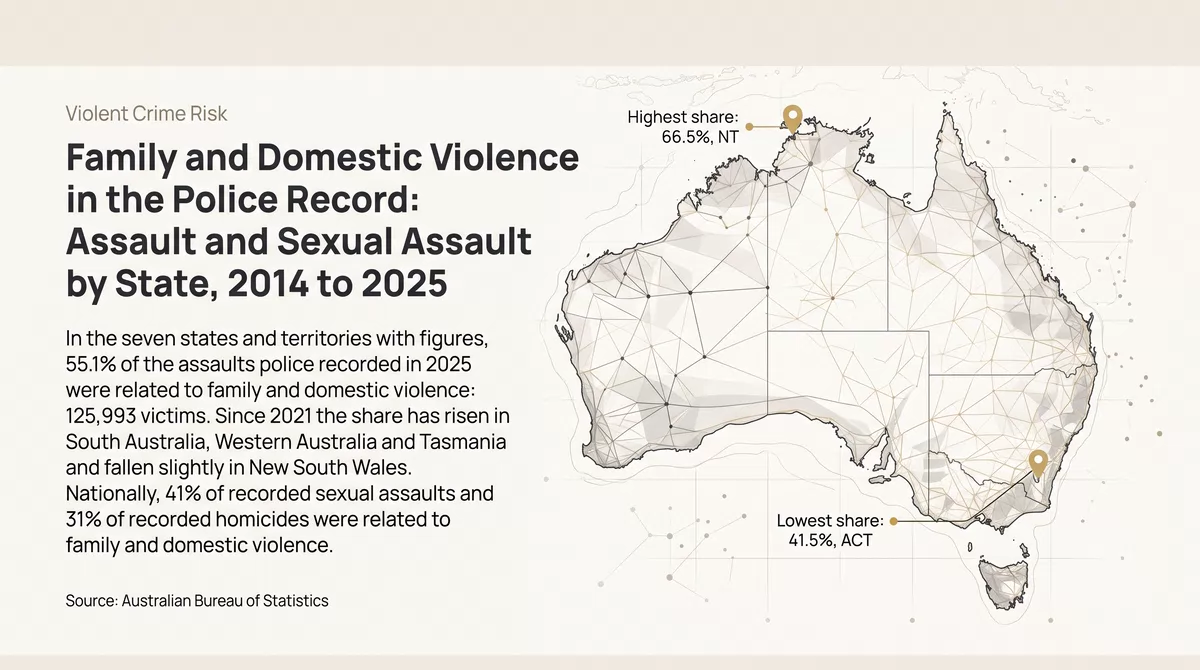

More than half of the assaults that police recorded in 2025, in the seven states and territories with figures, were related to family and domestic violence: 125,993 victims of 228,544. The share ran from 42% in the Australian Capital Territory to 67% in the Northern Territory, and since 2021 it has risen in South Australia, Western Australia and Tasmania, fallen slightly in New South Wales and held steady in the Australian Capital Territory. Nationally, 41% of recorded sexual assaults and 31% of recorded homicides were related to family and domestic violence. These are counts of what reached police records, and they move with reporting and with how police record it as well as with the violence itself.
Victims of offences recorded by police in 2025, from the ABS Recorded Crime – Victims collection.
What is counted
The figures come from the Australian Bureau of Statistics collection Recorded Crime – Victims for 2025. It counts victims of offences recorded by police in a calendar year and identifies those related to family and domestic violence, meaning that police recorded the offender as a partner, former partner or other family member of the victim, or otherwise identified the offence as family and domestic violence. The ABS publishes these figures for homicide, sexual assault and kidnapping nationally and for assault by state and territory. It publishes no assault figures for Victoria, so there is no national figure for assault.
Two cautions apply throughout. First, much family and domestic violence is not reported to police, so these figures measure what was reported and recorded and not how much violence there was. Second, whether an offence is identified as related to family and domestic violence depends on each police force’s practice, which differs between jurisdictions and has changed over time. A rising count can mean more violence, more reporting, more complete recording, or all three, and this collection cannot separate them.
Assault: the share related to family and domestic violence
Family and domestic violence related assault as a share of all recorded assault, 2025
APN calculation based on Australian Bureau of Statistics data: Recorded Crime – Victims, 2025, Tables 9 and 30. Victims of family and domestic violence related assault as a share of all assault victims recorded by police, 2025, with the two counts in brackets. The ABS publishes no assault data for Victoria. Family and domestic violence related victims are those the ABS classifies as such from police records.
Across the seven jurisdictions, 125,993 of the 228,544 assault victims recorded in 2025 were victims of family and domestic violence, which is 55.1%. The share was above 40% everywhere and close to two-thirds in the Northern Territory (66.5%) and Western Australia (66.1%). Women and girls were 69% of these victims (86,446).
How the count has changed since 2021
The ABS notes several breaks in these figures: New South Wales figures from 2021 may not be comparable with earlier years, Western Australian figures from 2016 and Northern Territory figures from 2024 are not comparable with earlier years, and Queensland has figures from 2023 only. This section therefore compares 2025 with 2021, for the five jurisdictions whose figures run across those years without a break the ABS names. It does not compare with 2014.
Change in victims of family and domestic violence related assault recorded by police, 2021 to 2025
APN calculation based on Australian Bureau of Statistics data: Recorded Crime – Victims, 2025, Tables 9 and 30. Change in the number of victims of family and domestic violence related assault recorded by police, 2021 to 2025, with the change in all other recorded assault in brackets. Queensland has figures from 2023 only, and the ABS advises that Northern Territory figures from 2024 are not comparable with earlier years.
All five recorded more victims of family and domestic violence related assault in 2025 than in 2021, but the pattern against other assault was mixed. In Western Australia the count rose by 43.3%, from 22,880 to 32,793, while other assault rose by 26.6%; in South Australia it rose by 35.1% against 23.5%, and in Tasmania by 22.1% against 16.1%. In those three the share of recorded assault related to family and domestic violence rose: from 63.2% to 66.1% in Western Australia, 48.4% to 50.6% in South Australia and 45.2% to 46.5% in Tasmania.
In New South Wales other assault rose faster (23.6% against 19.9%), and the share fell from 50.2% to 49.4%. In the Australian Capital Territory both rose by about 5% and the share was little changed, at 41.8% in 2021 and 41.5% in 2025. In Queensland, where figures begin in 2023, the share was 60.7% in that year and 54.4% in 2025.
These changes should be read with the second caution above in mind. A change in how police identify and record family and domestic violence, or in how readily it is reported, moves the count without any change in the violence itself. The figures show what police recorded. They do not show how much of any change is a change in violence.
Rates for women and for men
Female victims of family and domestic violence related assault per 100,000 females, 2025
APN chart based on Australian Bureau of Statistics data: Recorded Crime – Victims, 2025, Table 30. Female victims of family and domestic violence related assault per 100,000 females, 2025, with the male rate per 100,000 males in brackets.
In every jurisdiction the recorded rate for females was well above the rate for males: from 1.8 times in New South Wales to 4.2 times in the Northern Territory. The Northern Territory’s female rate, 4,431 per 100,000, was close to three times the next highest, Western Australia’s 1,573. Differences between jurisdictions reflect police practice and reporting as well as the level of violence, and comparisons between them should be made with care.
Sexual assault
Victims of family and domestic violence related sexual assault per 100,000 persons of the same sex, Australia, 2014 to 2025
APN chart based on Australian Bureau of Statistics data: Recorded Crime – Victims, 2025, Table 29. Victims of family and domestic violence related sexual assault recorded by police, per 100,000 persons of the same sex, Australia, by the year the offence was reported.
The ABS reports 16,146 victims of family and domestic violence related sexual assault in 2025, about two in five (41%) of all recorded sexual assaults, and 88% of them female. The number of female victims recorded rose in each of the eleven years from 2015 to 2025, from 5,811 in 2014 to 14,201, and the rate for females roughly doubled, from 49.2 to 102.2 per 100,000. The number of male victims rose from 1,138 to 1,738. In 2025 the recorded rate for females was about eight times the rate for males.
| State or territory | 2014 | 2019 | 2025 | Share of all recorded sexual assault, 2025 |
|---|---|---|---|---|
| New South Wales | 3,044 | 3,533 | 6,452 | 38.8% |
| Victoria | 1,325 | 2,140 | 2,972 | 44.2% |
| Queensland | 1,214 | 1,671 | 4,115 | 44.9% |
| South Australia | 591 | 585 | 789 | 38.9% |
| Western Australia | 544 | 757 | 1,263 | 34.8% |
| Tasmania | 84 | 101 | 269 | 46.0% |
| Northern Territory | 111 | 79 | 136 | 25.4% |
| Australian Capital Territory | 50 | 115 | 149 | 35.1% |
Source: Australian Bureau of Statistics, Recorded Crime – Victims, 2025, Tables 9 and 30. Victims of family and domestic violence related sexual assault recorded by police, and their share of all recorded sexual assault victims in 2025, as published. The ABS notes that Western Australian figures are understated before 2017 and that Victorian figures may be understated before 2022.
Every state and territory recorded more victims in 2025 than in 2014. The number more than tripled in Queensland and Tasmania and rose least in the Northern Territory and South Australia. The ABS notes that Western Australian figures are understated before 2017 and that Victorian figures may be understated before 2022, so part of the recorded rise in those two states may reflect a change in recording. As a companion article on recorded violence since 1993 sets out, up to a third of the sexual assaults recorded in 2025 were reported a year or more after the offence, so these counts follow reporting as well as offending.
Homicide
The ABS reports 133 victims of family and domestic violence related homicide in 2025, 31% of all recorded homicides. Of those victims, 73 (55%) were female, and 115 (87%) of the offences occurred at a residential location. Homicide here includes murder, attempted murder and manslaughter. Because most homicides come to the attention of police, this is the figure in the collection least affected by changes in reporting.
What this does not show
Police records understate family and domestic violence, because much of it is not reported, and they do so to a degree that differs between places and changes over time. The collection counts victims of particular offences in a year; it does not count people who experience violence that is not recorded as one of those offences, and a person victimised more than once may be counted more than once. It says nothing about any suburb or town, and nothing here is a measure of how safe a place is. Surveys that ask people directly, such as the ABS Personal Safety Survey, are the source for how common this violence is.
- Australian Bureau of Statistics (Reference period: 2025) Recorded Crime – Victims [https://www.abs.gov.au/statistics/people/crime-and-justice/recorded-crime-victims/latest-release], ABS Website, accessed 13 October 2026.
ABS material is used under a Creative Commons Attribution 4.0 International licence. Calculations, standardisations and index readings are APN’s and are not attributable to the ABS.
Disclaimer
The analysis and information contained in this publication are for general informational and strategic purposes only and do not constitute financial, investment, legal, or any other form of professional advice. Australian Property Network is not a licensed financial advisor. Property values and market conditions can go up or down. Before making any property or investment decisions, you must conduct your own thorough research and seek independent professional advice tailored to your specific circumstances. Images are for illustrative purposes only. E.&O.E.
Findings are presented on the basis of data and evidence alone.