
State Overrides Accelerate, But Feasibility Trap Constrains Housing Accord Target Attainment
APN ANALYSIS: A-260219-AUS137530
Executive Summary
State governments in New South Wales and Victoria are executing a substantive centralisation of planning power, systematically overriding local councils to expedite high-density housing approvals. This ‘State Override’ is a direct response to the material failure to meet National Housing Accord targets, underscored by a structurally significant ~30% contraction in multi-unit approvals in late 2025, and the substantive macroeconomic pressure from the Reserve Bank of Australia to resolve the supply-side drivers of inflation. By applying legislative instruments like State Significant Development declarations and forced rezonings of transport corridors, state executives are successfully materially constraining local ‘Objection Velocity’ to create a theoretical pipeline of tens of thousands of new homes.
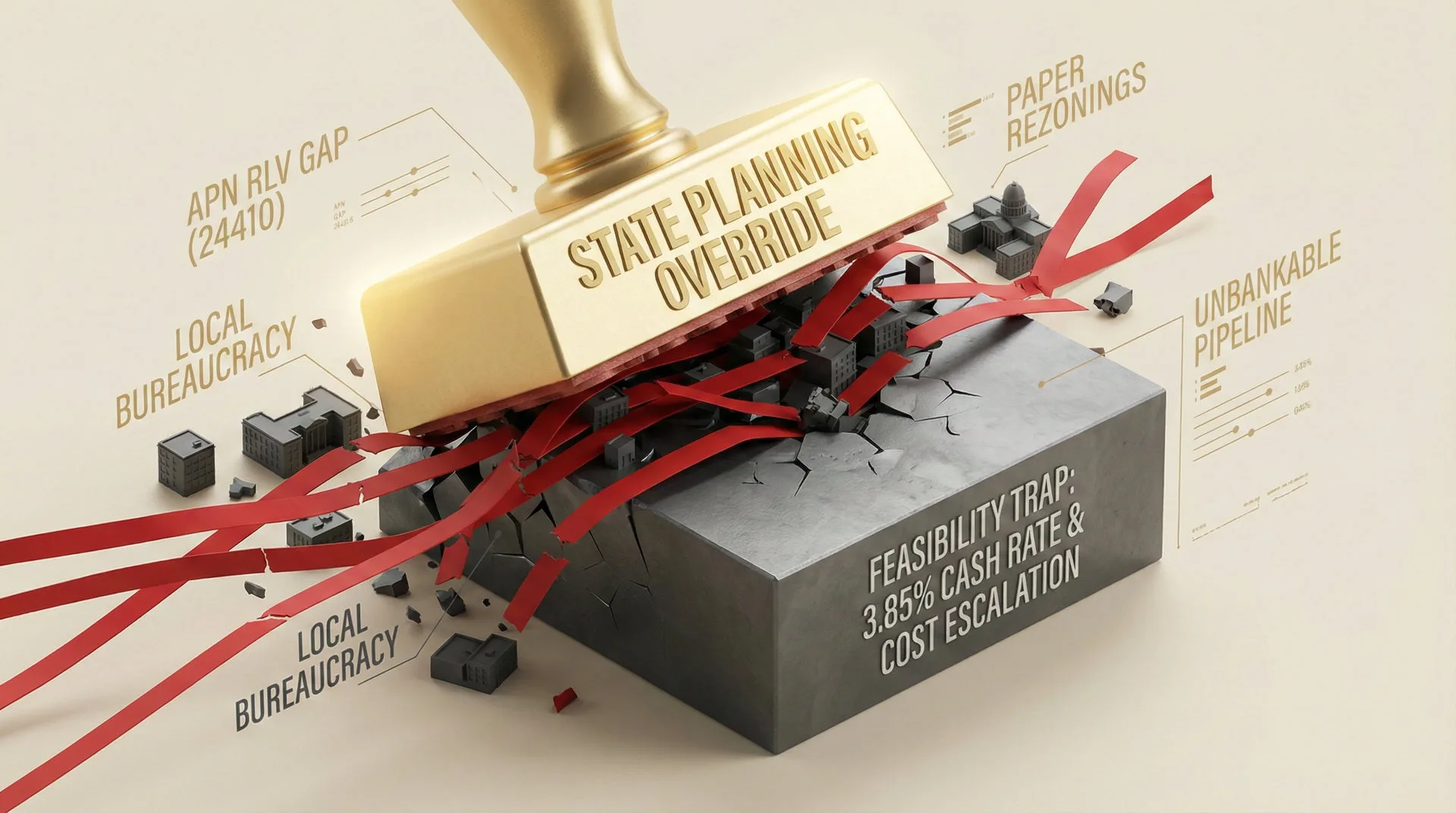
For property professionals, this marks a fundamental shift in the development landscape. The primary constraint on housing supply is no longer local council bureaucracy, but a deep and structural ‘Feasibility Trap’. APN analysis confirms that while the state can mandate zoning, it cannot mandate profitability. A combination of a restrictive 3.85% cash rate, escalating construction costs, and an elevated rate of builder insolvencies has materially undermined project viability. The state has cleared the planning pipeline only to reveal a more material structural constraint: a substantive, and growing, cohort of approved-but-uncommenced projects that are financially unbankable in the current economic climate.
Background & Strategic Context
This series of events validates and calibrates APN’s core macro-thesis that state-level intervention is the dominant force shaping property market outcomes. The substantive deployment of executive power by the NSW and Victorian governments is a clear illustration of the dynamics measured by the APN Sovereign Policy Composite Index™ (SPCI, 24800), where state actors suspend established local planning frameworks to pursue a national macroeconomic objective, in this case, attempting to address an inflation-related structural pressure point by forcing a housing supply response.
State-Level Policy Intervention (SPCI, 24800): The use of the Housing Delivery Authority in NSW and section 151 powers in Victoria to bypass local councils and neutralise community objection is a clear demonstration of the state acting as the ultimate arbiter of land use. This centralisation of power redefines development risk, shifting it away from local political negotiation and towards state-level strategic alignment.
The Feasibility Trap Manifested (APN RLV Gap™): The core counter-narrative is a direct expression of the APN Residual Land Value (RLV) Gap™ (24410). Despite the state granting massive density uplifts in transport-oriented precincts, the equation for developers is broken. The combination of suppressed end-values (due to borrowing capacity limits) and soaring construction and capital costs means the RLV is often negative, rendering state-approved projects unbankable and creating a pipeline of ‘paper rezonings’.
Deploying Regulation (APN Risk & Compliance Index™ (24200)): The legislative reforms, such as reducing public exhibition periods and expanding consent modification powers, represent a state strategy to reduce the effectiveness of legal challenges. This is an attempt to lower the APN Risk & Compliance Index™ (24200) risk profile for developers by systematically reducing the procedural tools used by objectors, prioritising speed over social licence and due process.
Deconstruction of the Source Event
This deconstruction is based on an internal APN intelligence briefing analysing the intersection between state planning overrides and construction sector viability in Q1 2026. The key facts are:
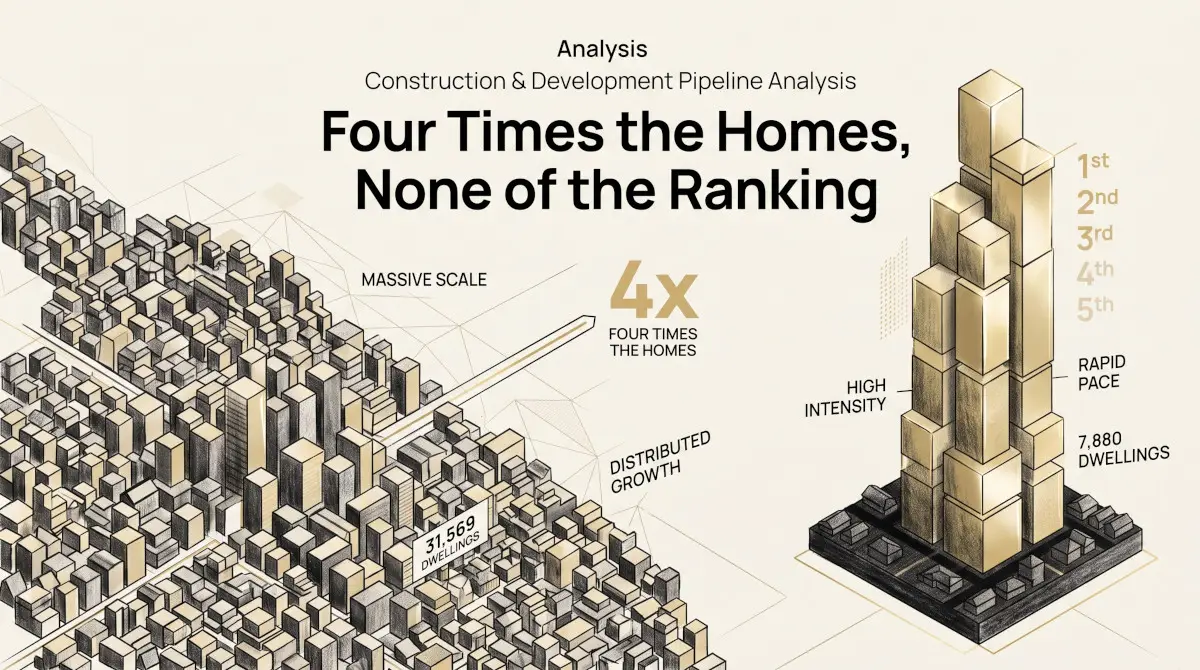
- The Accord Deficit: The National Housing Accord’s target of 20,000 homes per month was not met in December 2025, with approvals of only 15,542 dwellings nationally representing a material shortfall. This was driven by a 29.8% contraction in approvals for multi-unit dwellings, the exact typology the Accord relies on.
- The NSW Override Mechanism: The NSW Government has finalised rezoning for 7 of 8 Transport Oriented Development (TOD) Accelerated Precincts and is using the Housing Delivery Authority (HDA) to declare large projects as State Significant Development (SSD), completely bypassing local councils. Over 2,200 homes were declared SSD in February 2026 alone.
- The Victorian Override Mechanism: Victoria is mirroring the strategy with its Train and Tram Zone Activity Centres program. In a notable policy adjustment, the Planning Minister invoked section 151 powers to discontinue an independent planning panel for the Macaulay precinct, replacing it with a state-controlled committee to ensure density targets are met.
- The Construction Sector Contraction: The construction industry is the single largest contributor to corporate insolvencies in Australia. ASIC data shows nearly 1,800 firms entered administration in the second half of 2025, materially eroding the physical capacity of the market to build any newly approved projects.
- The Macroeconomic Paradox: The RBA’s restrictive 3.85% cash rate, maintained to manage inflation, is a primary contributing factor to the ‘Feasibility Trap’. It suppresses consumer borrowing capacity and makes project finance prohibitively expensive, directly undermining the government’s ability to stimulate housing supply.
Critical Analysis & Balanced View
The analysis reveals a paradox at the heart of Australia’s housing strategy. State governments are demonstrating efficiency in executing their side of the bargain, reducing local planning blockades. The legislative and executive manoeuvres in NSW and Victoria are not theoretical; they are successfully creating a significant pipeline of development permits in high-density corridors. In the structural contest against localised development resistance and ‘Objection Velocity’, the state is effectively overriding these constraints.
However, this represents a constrained outcome. The state override strategy is predicated on a diagnosis that does not account for the current primary constraint. While planning constraints were the historical bottleneck, the primary failure point has migrated from the council planning department to the developer’s balance sheet and the builder’s solvency. The null hypothesis is validated: the ‘Feasibility Trap’ is real and binding.
The combination of a 3.85% cash rate, double-digit construction cost inflation, and the systemic contraction of the SME building sector has created a material APN RLV Gap™. A state-sanctioned permit for a 20-storey tower is financially unviable if no solvent builder can be contracted to construct it at a viable price. The state has cleared one structural constraint only to accelerate the entire development industry into the far larger, more structural barrier of economic unviability. The growing ledger of ‘approved but uncommenced’ dwellings is the primary metric demonstrating the limitations of this strategy.
Strategic Implications for Property Professionals
- For Developers: The core competency has shifted from navigating council politics to mastering financial engineering and supply chain de-risking. Success now hinges on securing solvent construction partners and viable finance, not just a state-level planning permit. The real opportunity lies in projects with unconventional funding structures or those that can achieve pre-construction cost certainty.
- For Investors & Capital Allocators: The ‘approved but uncommenced’ pipeline is a critical risk indicator. Scrutinise developer balance sheets and their nominated builders with a high degree of diligence. The most attractive assets may now be distressed, permit-approved sites that can be acquired at a significant discount to their theoretical ‘as if complete’ value, or strategic investments into the recapitalisation of distressed construction firms.
- For Agents & Buyers’ Agents: The anticipated density in newly rezoned TOD and Activity Centre precincts will not materialise in the short to medium term. This creates a window of opportunity to acquire existing stock before the construction feasibility equation is eventually solved. Advise clients that the projected imagery of a vibrant, dense hub is likely years, if not a decade, from becoming reality, creating value in the scarcity of current, established housing.
- For Planners & Consultants: Your value proposition must evolve immediately. Expertise in local Environmental Plans is being rapidly devalued in strategic corridors. The new, high-value skillset is a deep, technical understanding of State Significant Development pathways, state-level infrastructure contribution frameworks, and the ability to build a robust financial case that can withstand the scrutiny of lenders and quantity surveyors.
APN Index Management
The APN Codex 24000 Series is a proprietary set of indices that translates complex market forces into measurable metrics. This section outlines how the preceding analysis is validated against, and informs the calibration of, these frameworks.
- Validation: This analysis provides validation of the APN Sovereign Policy Composite Index™ (SPCI, 24800) as the primary driver of market boundaries and a primary case study for the APN Residual Land Value (RLV) Gap™ (24410), demonstrating how state-led upzoning can fail when it collides with macroeconomic reality.
- Index Calibration: The APN Future Development Pipeline Index™ (24400) will be recalibrated. The weighting of ‘approved but uncommenced’ dwellings and construction sector insolvency rates will be significantly increased as primary negative friction filters, more accurately distinguishing viable projects from ‘paper rezonings’.
- Data Capture: This analysis initiates a new data capture mandate for the APN Symbiotic Intelligence Network™ (24310). A targeted survey will be deployed to Tier 1-3 construction firms and developers to quantify the precise RLV Gap and risk premium being applied to projects within the new state-designated priority zones.
Disclaimer
The analysis and information contained in this deconstruction are for general informational and strategic purposes only and do not constitute financial, investment, legal, or any other form of professional advice. The Australian Property Network (APN) is a strategic intelligence organisation and is not a licensed financial advisor.
This analysis is based on data and information from third-party sources believed to be reliable; however, APN provides no warranty as to its accuracy, currency, or completeness. Images used in this analysis are for illustrative and conceptual purposes only and may not represent real persons, properties, or events.
All frameworks (Codex 24100-24800) are proprietary to APN.
Property values and market conditions can go up or down. Before making any property or investment decisions, you must conduct your own thorough research and seek independent professional advice tailored to your specific circumstances.