

APN Sovereign Policy Composite Index™ (SPCI, 24800): State Policy Facilitates Systemic Capital Reallocation from Retail Investors to Institutional Landlords
APN ANALYSIS: A-260224-AUS137619
Executive Summary
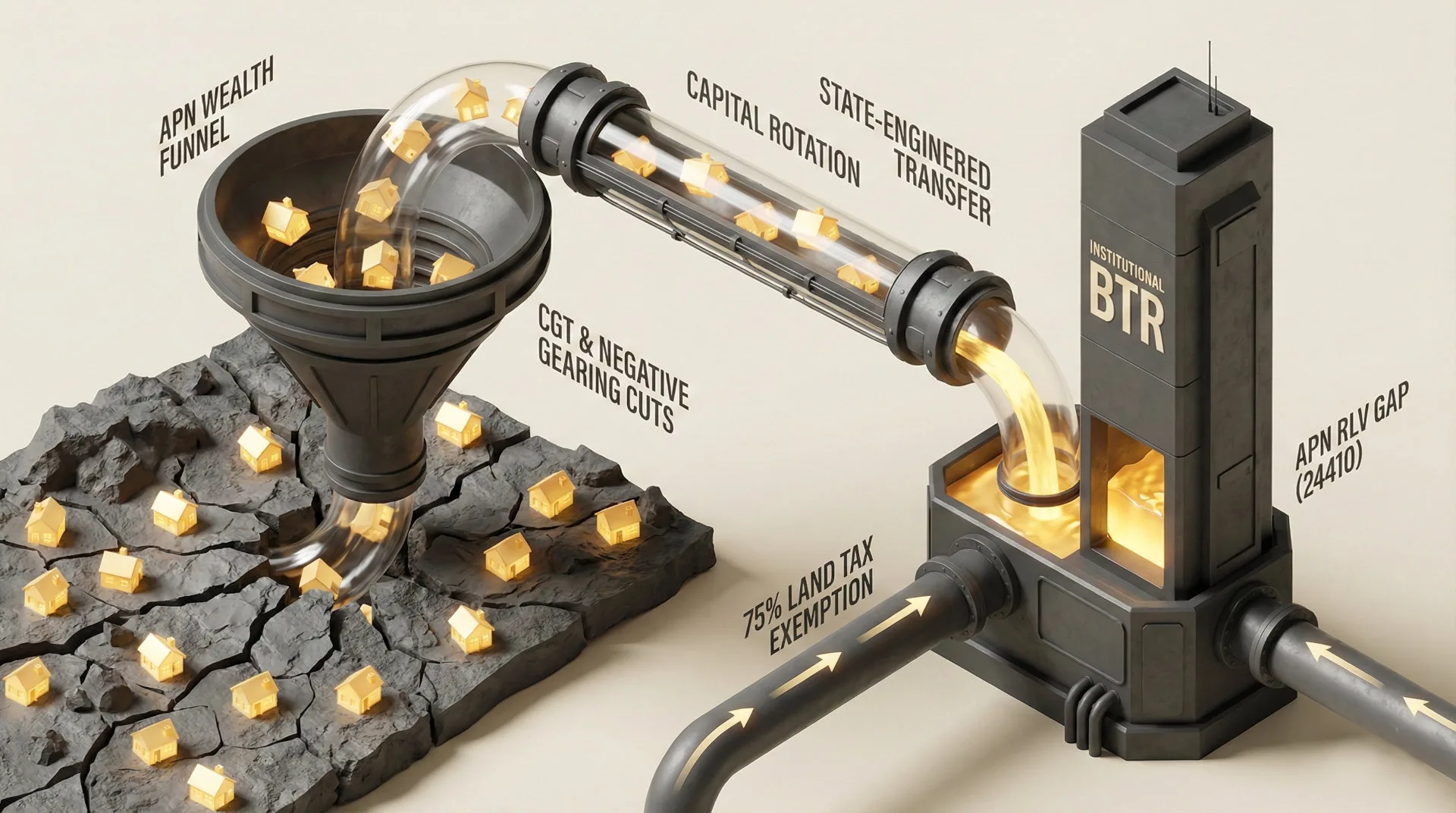
A coordinated set of state-level policy adjustments is fundamentally restructuring the Australian residential property market. In early 2026, federal bodies moved to restructure the tax architecture supporting retail property investors, proposing to reduce the Capital Gains Tax discount and limit negative gearing, while the Western Australian government simultaneously legislated land tax exemptions to subsidise and accelerate institutional-grade Build-to-Rent (BTR) developments. This represents a policy pivot, designated by APN as the APN Sovereign Policy Composite Index™ (SPCI, 24800), which applies concentrated legislative ‘Friction’ to incentivise an exit of retail investor capital, while providing ‘Velocity’ to institutional capital, thereby creating differential structural advantages in the housing market.
For property professionals, this structural shift is not a cyclical market adjustment but a permanent change in the rules of engagement. The viability of traditional retail investment strategies is now under direct legislative pressure, creating significant risk for clients holding leveraged portfolios. Concurrently, the state-backed underwriting of the BTR sector creates a new, dominant asset class. Understanding the mechanics of this state-induced capital rotation is now of elevated importance for advising clients on risk, identifying new opportunities within the institutional framework, and navigating a market where physical construction bottlenecks may ultimately override legislative intent.
Background & Strategic Context
This confluence of federal regulatory intervention and state-level subsidy validates and calibrates APN’s core macro-thesis that government intervention is the primary driver of market outcomes. The events of February 2026 are not coincidental but the synchronised application of a long-term policy objective to corporatise the provision of rental housing in Australia.
Calibrating the Core Thesis (APN Sovereign Policy Composite Index™ (SPCI, 24800)): The diametrically opposed policy actions, applying structurally constraining Friction to retail investors via federal tax reform proposals while funnelling subsidies to institutional players via state legislation, provide clear empirical validation for the APN Sovereign Policy Composite Index™ (SPCI, 24800) framework. It demonstrates the state’s willingness to actively override market forces to achieve a desired structural outcome.
Mapping the Cohort System (The Glass House / APN Net State Position™): This policy pivot materially stratifies the market, solidifying the APN five-tier cohort system. The ‘Tier 3 Protected’ (retail investors) are subject to a systematic reduction of their tax advantages, while institutional ‘Tier 1 Architects’ are provided with a state-supported yield. The ‘Tier 4 Host’ (PAYG workers) are left to fund the subsidies while being mathematically structurally excluded from ownership by the very asset inflation these policies create, as measured by the APN Asset-Wage Decoupling Index™ (24610).
Exposing the Delivery Fallacy (The Supply Illusion): While the state provides legislative ‘Velocity’ for BTR, it ignores the material physical constraints of the construction sector. The assumption that institutional capital can seamlessly replace the rental stock divested from the retail market is a structurally flawed assumption. Systemic builder insolvencies and material cost escalations create a physical bottleneck that policy alone cannot solve, validating ‘The Supply Illusion’ thesis.
Deconstruction of the Source Event
This deconstruction is based on APN’s analysis of the ACTU’s submission to the Senate Select Committee on the Capital Gains Tax Discount and the Western Australian Government’s Land Tax Assessment Amendment (Build-to-Rent) Bill 2026. The key facts are:
- Federal ‘Friction’ – The ACTU Proposal: In February 2026, the ACTU formally submitted a proposal to a Greens-led Senate committee proposing that the Capital Gains Tax (CGT) discount for investors be reduced from 50% to 25%. The submission also called for negative gearing deductions to be limited to a single investment property, with a five-year grandfathering period for existing portfolios.
- State ‘Velocity’ – The WA BTR Subsidy: On 19 February 2026, the WA Government introduced a bill to increase the land tax exemption for eligible BTR developments from 50% to 75%. This exemption applies for the first 10 years of a project’s life, reverting to 50% for the subsequent 10 years, creating a 20-year state-backed concession.
- The Financial Impact of Velocity: For a BTR project on land with a taxable value of $10 million, the new 75% exemption reduces the annual land tax liability to just $24,630, compared to $180,130 without an exemption. This equates to a state-sponsored capital preservation of over $1.55 million in the first 10 years alone, directly inflating the institutional IRR.
Critical Analysis & Balanced View
The strategic design of the APN Sovereign Policy Composite Index™ (SPCI, 24800) lies in its legislative pincer movement. However, its execution is materially flawed by a failure to account for real-world physical and economic constraints. The core paradox is that while the government can create financial ‘Velocity’ on a spreadsheet, it cannot materialise physical assets in a structurally constrained construction market.
The analysis identifies a systemic construction friction that acts as a powerful counter-narrative. National corporate insolvencies increased by 42.6% in the 2024-25 financial year, with the construction sector being a primary area of the structural pressure point. In WA alone, 168 construction firms entered insolvency in FY25. This is compounded by material cost fluctuations, such as an accelerated growth of 16.5% in copper prices. A 75% land tax exemption is a material incentive for a completed, operational asset, but it provides no material protection for a developer whose builder goes bankrupt mid-project.
This creates a structurally problematic transition gap. The federal ‘Friction’ is designed to trigger a rapid divestment of retail inventory, contracting the private rental pool as investors sell. However, the institutional BTR pipeline, materially restricted by the construction sector’s sustained delivery constraint, cannot be delivered in time to absorb the displaced tenants. The ultimate result is not a smooth transition to a new housing model, but a structural market disruption where rental supply materially contracts, rents escalate, and the housing structural pressure point for the ‘Tier 4 Host’ deepens to a structurally significant degree.
Strategic Implications for Property Professionals
- For Developers: The WA BTR subsidy fundamentally de-risks the long-term operational phase of a project, but materially increases exposure to delivery risk. Due diligence on builder solvency and securing material supply chains is now of more elevated importance than securing favourable tax treatment. The focus must shift from financial modelling to construction and counterparty risk mitigation.
- For Agents & Buyers’ Agents: The viability of promoting negatively geared, multi-property portfolios to PAYG-earning clients has diminished. Advising clients to leverage into a second or third property is now a high-risk strategy. The conversation must pivot to deleveraging, portfolio consolidation, and educating clients on the legislative headwinds that could render their assets unserviceable.
- For Retail Investors: The five-year grandfathering period is not a reprieve; it is a clear signal to exit. The market will immediately price in the future loss of tax concessions, eroding asset values now. A strategic review of portfolio viability is non-negotiable. Holding on in the hope of a policy reversal is a high-risk strategy against a clear, state-directed trend.
- For Institutional Capital & Fund Managers: Western Australia is now the premier destination for BTR deployment in the nation, with a state-guaranteed IRR uplift. However, capital allocation must be paired with a robust construction risk framework. Partnering with only the most solvent Tier 1 builders or vertically integrating construction capability will be the key differentiator between a successful project and a stalled asset.
APN Index Management
The APN Codex 24000 Series is a proprietary set of indices that translates complex market forces into measurable metrics. This section outlines how the preceding analysis is validated against, and informs the calibration of, these frameworks.
- Validation: This analysis provides validation for the ‘APN Sovereign Policy Composite Index™ (SPCI, 24800)’ macro-thesis and the ‘The Glass House’ framework. The legislative pincer movement and its distributional impact on different societal tiers are captured by these models.
- Index Calibration (APN Asset-Wage Decoupling Index™ – 24610): The index is calibrated to the specific structural adjustment observed in Western Australia. The delta between WA’s 4.0% annual wage growth and the 4.9% quarterly dwelling value growth (annualised ~19.6%) establishes a new benchmark for state-induced asset-wage decoupling.
- Data Capture (The Supply Illusion): This analysis triggers a new data capture mandate to quantify ‘The Supply Illusion’. APN will now formally track the ratio of state-level BTR announcements (legislative velocity) against ASIC construction insolvency data and key material price indices (physical friction). This will create a forward-looking indicator of pipeline delivery risk.
Disclaimer
The analysis and information contained in this deconstruction are for general informational and strategic purposes only and do not constitute financial, investment, legal, or any other form of professional advice. The Australian Property Network (APN) is a strategic intelligence organisation and is not a licensed financial advisor.
This analysis is based on data and information from third-party sources believed to be reliable; however, APN provides no warranty as to its accuracy, currency, or completeness. Images used in this analysis are for illustrative and conceptual purposes only and may not represent real persons, properties, or events.
All frameworks (Codex 24100-24800) are proprietary to APN.
Property values and market conditions can go up or down. Before making any property or investment decisions, you must conduct your own thorough research and seek independent professional advice tailored to your specific circumstances.


