

Chalmers and Gallagher: A Smaller Deficit, and an Inflation Challenge Made Worse Abroad
Release of the Final Budget Outcome for 2025–26 — a joint press conference by the Treasurer and the Minister for Finance, the day before a Reserve Bank decision
The Final Budget Outcome Claims Tested: Demand, Unemployment, Productivity and Migration (I-260928-151293)
NIL RETURN
23000 Series — Scope & Inclusion Criteria
The Australian Property Network’s (APN’s) 23000 Series is the attributed opinion layer of the APN Codex. It presents the recorded perspective of an identified practitioner, office-holder or subject-matter expert whose statements bear on active node conditions, without constituting APN’s own analytical position. This perspective is drawn from the press conference of 28 September 2026 at which the Treasurer and the Minister for Finance released the Final Budget Outcome for 2025–26. APN carries the budget result and the ministers’ account of inflation, demand and productivity, because they set out the government’s case on the fiscal side of the inflation question one day before the Reserve Bank’s decision. Exchanges on other subjects, and remarks directed at political opponents, are not reproduced. The ministers’ statements are presented as their own attributed account, not as verified fact.
Attributed Perspective — Jim Chalmers, Treasurer, and Katy Gallagher, Minister for Finance
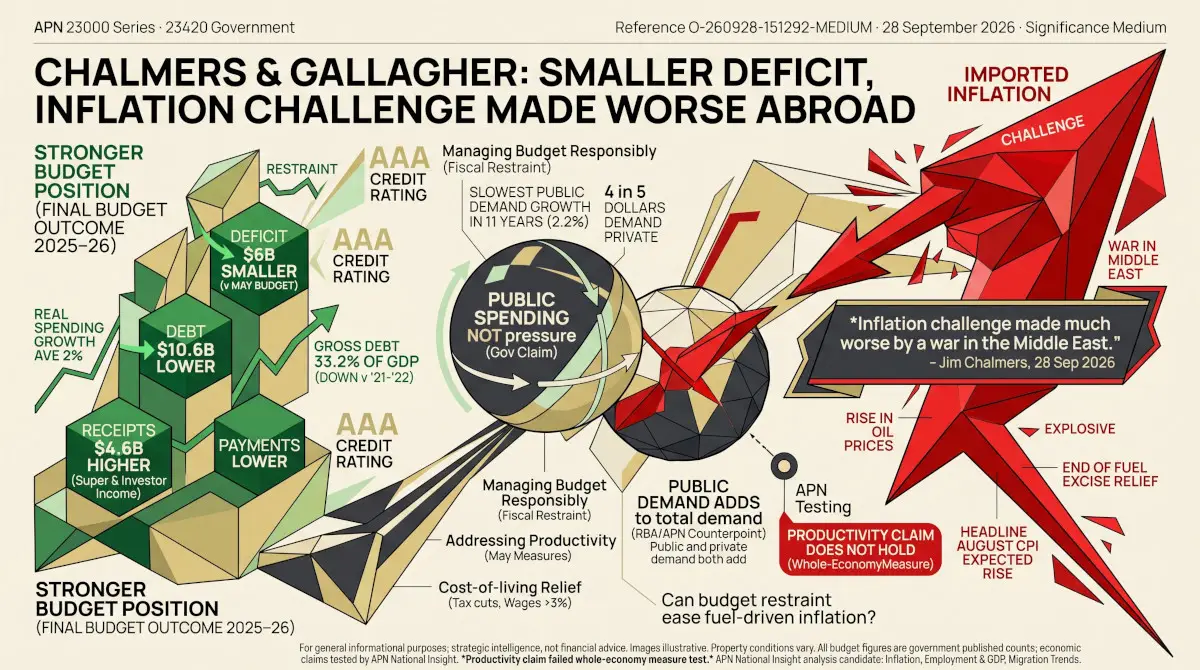
The Treasurer opened with the result. The deficit for 2025–26 came in $6 billion better than expected at the May Budget, and debt was $10.6 billion lower at the end of the financial year. Payments were $1.4 billion lower and receipts $4.6 billion higher than forecast. He was emphatic about the source of the extra receipts: not commodities, where mining profits came in below forecast, and not wage earners, but higher-than-expected superannuation and investor income. He said the result leaves the budget in one of the strongest positions in the G20, and pointed to the AAA credit rating.
The Minister for Finance set out the restraint behind it. Real spending growth has averaged 2% a year over the government’s four years, she said, half the 4.1% of its predecessors; the Treasurer later added that the predecessors’ average was 2.6% with the pandemic years excluded. The government has made about $178 billion in savings and reprioritisations since 2022, including $23.8 billion in 2025–26, and returned about three-quarters of tax receipt upgrades to the bottom line. Gross debt was 33.2% of GDP in 2025–26, down from 38.3% in 2021–22, and $197.6 billion lower than estimated when the government took office, which she said has avoided about $70 billion in interest costs over the 11 years to 2031–32.
On demand and inflation, the Treasurer argued that public spending is not the source of the current pressure. Public final demand grew 2.2% in 2025–26, he said, the slowest in 11 years and half a percentage point below the May forecast, and four in every five dollars of demand over the year was private. Asked directly whether government spending contributes to inflation, he answered by pointing to the fall in public demand and to the Middle East, saying the headline increase expected in the August CPI reflects the end of fuel excise relief, the renewed rise in oil prices and the timing of energy bill relief.
“We have an inflation challenge in our economy made much worse by a war in the Middle East.”
Jim Chalmers, Treasurer, press conference, 28 September 2026.
He described the inflation challenge as partly domestic, and said the government is responding in three ways: managing the budget responsibly, providing cost-of-living relief through tax cuts, bulk billing and wages growth above 3%, and addressing productivity, which he called a two-decade problem. He described the productivity measures in the May Budget, about 15 of them, as the broadest of any recent government, while acknowledging that their benefits will come over years rather than weeks.
On the Reserve Bank, he declined to anticipate the decision, while noting the near-universal expectation of higher rates across advanced economies. Asked about the Governor’s recent remarks on the unemployment rate needed to ease inflation, he said the country has shown that inflation can moderate while unemployment stays low, that he was reluctant to blame workers for inflation, and that the government and the Bank share the same objectives with different responsibilities. On borrowing costs, he pointed to rising bond yields, competition for capital from large technology investors, and the pressure that will place on the budget.
Source: Jim Chalmers, Treasurer, and Senator Katy Gallagher, Minister for Finance. Press conference — ABC News (Australia), “IN FULL: Jim Chalmers and Katy Gallagher discuss Final Budget Outcome”, 28 September 2026. Close paraphrase throughout, with the direct quotation as marked; the broadcast recording is the authoritative record of exact wording. Figures are as stated by the ministers; the Final Budget Outcome 2025–26 is published by the Treasury. Context: the ministers speak for the government; exchanges on the working holiday visa changes, a government cyber incident and public service contracting are not reproduced.
APN Clinical Reframing
The ministers’ account contains claims of three kinds. The budget figures are the government’s own, published in the Final Budget Outcome. The economic claims — the slowest growth in public demand in 11 years, four in five dollars of demand being private, the lowest average unemployment of any government in 50 years, the weakest decade of productivity under the previous government, and a fall of almost half in net overseas migration — can be tested, and the companion National Insight output tests them. It finds that most hold as stated, that the demand share holds as a share of growth rather than of the level of demand, and that the productivity claim does not hold on either the whole-economy or the market-sector measure.
On inflation, the Treasurer’s account and the Reserve Bank’s overlap on the sources of pressure and differ on the labour market. He describes a challenge that is partly domestic and made much worse by the oil shock, and says it exists not because unemployment is too low. The Governor has said that inflation was too high before the conflict began, and has told a parliamentary committee that public demand adds to total demand as any demand does. On 22 September she said the labour market remains tight enough to add to inflation pressure, and that unemployment of between 4.5% and 5% would probably ease it. The data can show which parts of demand grew; they cannot by themselves apportion the inflation that followed between domestic and imported sources. Remarks directed at political opponents are not reproduced.
This perspective is an exploration candidate for Inflation (21220), Employment & GDP (21230) and Migration Trends (21250). The open question it raises is how far budget restraint can ease inflation that is being driven in part by fuel prices, at a time when public demand is already growing more slowly than private demand. No figure or characterisation in this piece may be treated as an APN-certified position for any 21000, 22000 or 24000 Series node.
Disclaimer
The analysis, information, and opinions contained in this article are for general informational and strategic purposes only and do not constitute financial, investment, legal, or any other form of professional advice. The Australian Property Network (APN) is a strategic intelligence organisation and is not a licensed financial advisor.
The views, thoughts, and opinions expressed in this text belong solely to the author and do not necessarily reflect the official policy or position of the Australian Property Network (APN).
This content may be based on data from third-party sources believed to be reliable; however, APN provides no warranty as to its accuracy, currency, or completeness. Images used are for illustrative and conceptual purposes only and may not represent real persons, properties, or events.
Property values and market conditions can go down as well as up. Before making any property or investment decisions, you must conduct your own thorough research and seek independent professional advice tailored to your specific circumstances.

