
Hanan: Taxes and Levies, Not Planning, Now Hold Back New Housing
Bank economics programme — the chief executive of a national developer discusses the housing slowdown, supply, renters and commercial property with a bank’s chief economist
Still Near the Peak: Construction Insolvencies and Mirvac’s Market Claims Tested (I-260926-CTID)
NIL RETURN
23000 Series — Scope & Inclusion Criteria
The Australian Property Network’s (APN’s) 23000 Series is the attributed opinion layer of the APN Codex. It presents the recorded perspective of an identified practitioner, academic or subject-matter expert whose observations bear on active node conditions, without constituting APN’s own analytical position. This perspective is drawn from a 31-minute conversation recorded in September 2026. APN carries the residential argument in full and the commercial property discussion in brief, because the speaker locates the constraint on new housing in construction costs, taxes and levies rather than in planning, and describes a rental market in which private supply is shrinking. The speaker’s statements are presented as his own attributed analysis, not as verified fact.
Attributed Perspective — Campbell Hanan, Group Chief Executive and Managing Director, Mirvac
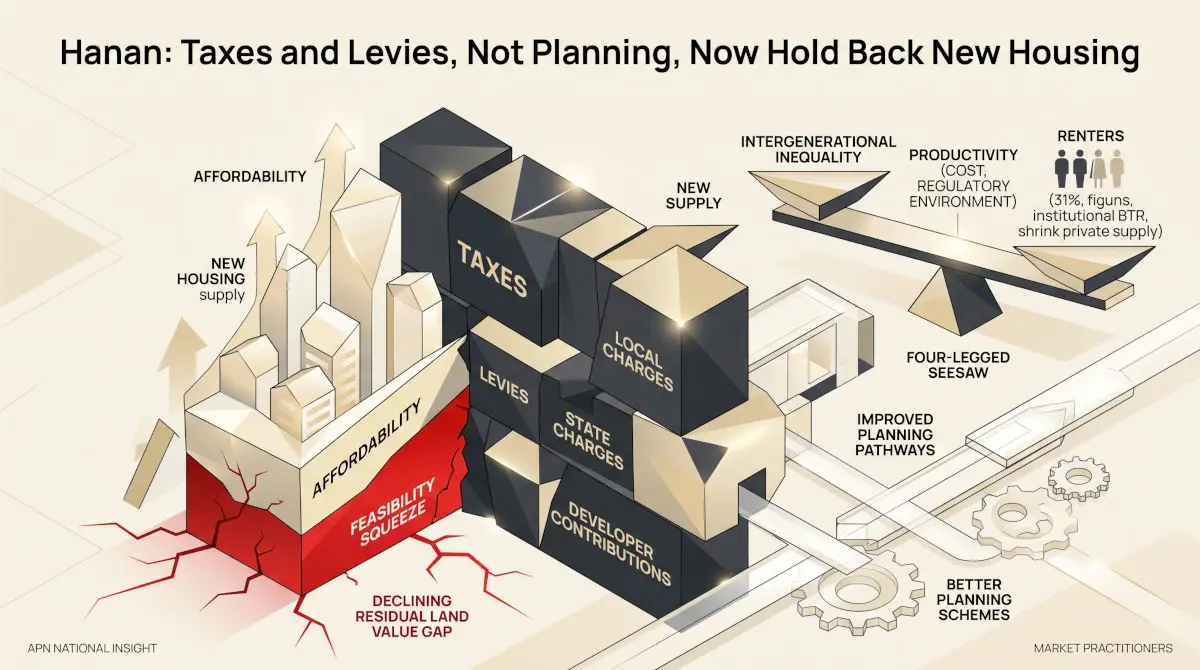
Hanan describes the housing market as a four-legged seesaw. The first leg is intergenerational inequality: when house prices grow faster than salaries for a long period, inequality follows, and he accepts that. The second is new supply for a population that is still growing quickly. The third is productivity, meaning the cost to build and the regulatory environment developers work in. The fourth is the renter; he notes that 31% of Australians now rent. In his view, the federal government has addressed the first leg through its tax changes, and has supported the second by keeping the previous tax treatment for newly built dwellings. The legs he sees as the challenge now are productivity and renters.
On productivity, his central figure is the share of taxes and charges. About 35% of the cost of a new apartment building, wherever it is located, is tied up in local or state taxes, charges and levies, he says, rising to 40 to 45% on the urban fringe. He credits every state government with improving planning, and New South Wales in particular: the planning regime is much better than it was five years ago. The obstacle now is cost. With existing house prices falling and the cost of building new ones rising, the economics of a new project become harder to make work. Taxes and levies are where he would like state, local and federal governments to look, because he sees them as the most direct route to more affordable housing.
Mirvac’s own sales show the slowdown. Volumes are down about 40% on a year earlier, and investors, who historically made up about 30% of Mirvac’s sales, are now about 22%. He cannot yet separate the effect of interest rates from that of the tax changes, and thinks both are at work. Enquiry remains strong, in his account; buyers are waiting to see where the bottom of the market is. He expects the tax changes to make little structural difference, because investors buying new dwellings keep the previous treatment of negative gearing and capital gains. By state, he sees demand still strong in Western Australia and Queensland, where price growth has slowed but continues, and New South Wales and Victoria flatter, with more incentives being offered to buyers.
On renters, his argument is that private rental supply will shrink. When an investor sells an existing property, the buyer is most likely an owner-occupier, and the tenant is likely to be displaced. He expects institutional build-to-rent to become more important as a result, and reports that rents in the residential build-to-rent sector have been growing at about double the rate of inflation for the past two years. He also expects supply to tighten further than many expect, partly because of pressure on developers from the private credit market.
He regards the sector’s financial health as sound. Mirvac, itself a large builder, has not seen an insolvency event for 15 months. After COVID, he says, there were about 7,000 insolvency events, which put heavy pressure on builders and developers; that period is now largely behind the sector, and subcontractors are in reasonable shape. The limit now is skilled labour, with infrastructure spending tailing off, data centre construction rising and electrical and plumbing trades in short supply. He expects construction costs to rise by 4 to 4.5% a year, with Queensland higher because of Olympics-related construction, and sees more subcontractors looking for work in Victoria.
In commercial property, he sees location and quality mattering more than at any time in 20 years. Rent growth is strongest in premium office space in the traditional corporate precincts, from Martin Place to Circular Quay in Sydney and the east end of Collins Street in Melbourne, and in retail in dense inner-urban locations. Large corporate occupiers that once had ten staff sharing seven desks now have eleven sharing five, and he expects them to need more space as office attendance rises. With the cost to build about 40% higher than five years ago, he considers a large new office supply response unlikely for at least ten years, and sees suburban offices facing more difficulty, with conversion to housing the most likely change of use for older buildings. Industrial demand is following government infrastructure, including around the new Western Sydney airport. Mirvac is not investing in data centres, which he sees as dependent on a few very large tenants and exposed to obsolescence.
“If we really want to tackle affordability, we just got to build things cheaper and faster.”
Campbell Hanan, on modular construction, which he says needs uniform rules across the states before it can be adopted at scale.
Source: Campbell Hanan, group chief executive and managing director, Mirvac. Podcast and video — CommBank View, Economics and Markets, “What’s next for Australia’s property market?”, September 2026, in conversation with Luke Yeaman, chief economist, Commonwealth Bank; segment from about 0:38 to 31:20. Close paraphrase throughout, with the direct quotation as marked; the published recording is the authoritative record of exact wording. Context: Mirvac develops and owns residential, office, retail and industrial property, and operates build-to-rent and land lease communities. Its case on development taxes and levies and on build-to-rent aligns with those commercial interests. The figures on Mirvac’s own sales, rents and insolvency record are company data and have not been independently verified.
APN Clinical Reframing
The conversation contains three kinds of claim. Mirvac’s own figures — a 40% fall in sales volumes, investors down from 30% to 22% of sales, no insolvency event in 15 months — are company data, presented as his. His figure of build-to-rent rents growing at about double inflation is for the sector, as reported in Mirvac’s results. Statements about the wider market can be tested, and the companion Construction & Development output tests them. It finds that construction costs have risen by about 40% over five years and that prices are still rising in Western Australia and Queensland while New South Wales and Victoria are flatter, as he says; both fell in the June quarter. It finds that construction insolvencies are not behind the sector as a whole: they ran at about 870 a quarter through the year to June 2026, close to their peak. His account of Mirvac’s own record is a different, narrower claim, and the sector figures do not bear on it. The share of taxes and levies in the cost of new housing, and the forecasts, are his own.
The core of his argument is a feasibility problem, and it is consistent with APN’s own reading. When the price of existing dwellings falls while the cost of building new ones rises, the margin left to pay for land and to justify a new project narrows. APN Residual Land Value (RLV) Gap™ (24410) measures that margin, and in the June quarter of 2026 it reached the lowest of its 60 quarters. Where the speaker and the data diverge is on the cause: the data show the squeeze, and cannot by themselves apportion it between taxes and levies, materials and labour, and prices.
This perspective is an exploration candidate for Construction Insolvency (21281), APN Residual Land Value (RLV) Gap™ (24410) and Rental Market Analysis (21190). The open question it raises is whether reducing taxes and levies on new housing would restore feasibility while prices are falling, or whether the gap would close only as prices recover. No figure or characterisation in this piece may be treated as an APN-certified position for any 21000, 22000 or 24000 Series node.
Disclaimer
The analysis, information, and opinions contained in this article are for general informational and strategic purposes only and do not constitute financial, investment, legal, or any other form of professional advice. The Australian Property Network (APN) is a strategic intelligence organisation and is not a licensed financial advisor.
The views, thoughts, and opinions expressed in this text belong solely to the author and do not necessarily reflect the official policy or position of the Australian Property Network (APN).
This content may be based on data from third-party sources believed to be reliable; however, APN provides no warranty as to its accuracy, currency, or completeness. Images used are for illustrative and conceptual purposes only and may not represent real persons, properties, or events.
Property values and market conditions can go down as well as up. Before making any property or investment decisions, you must conduct your own thorough research and seek independent professional advice tailored to your specific circumstances.