
APN 22000 Series Insight: Structural Gridlock and the Myth of Market Easing in 2026
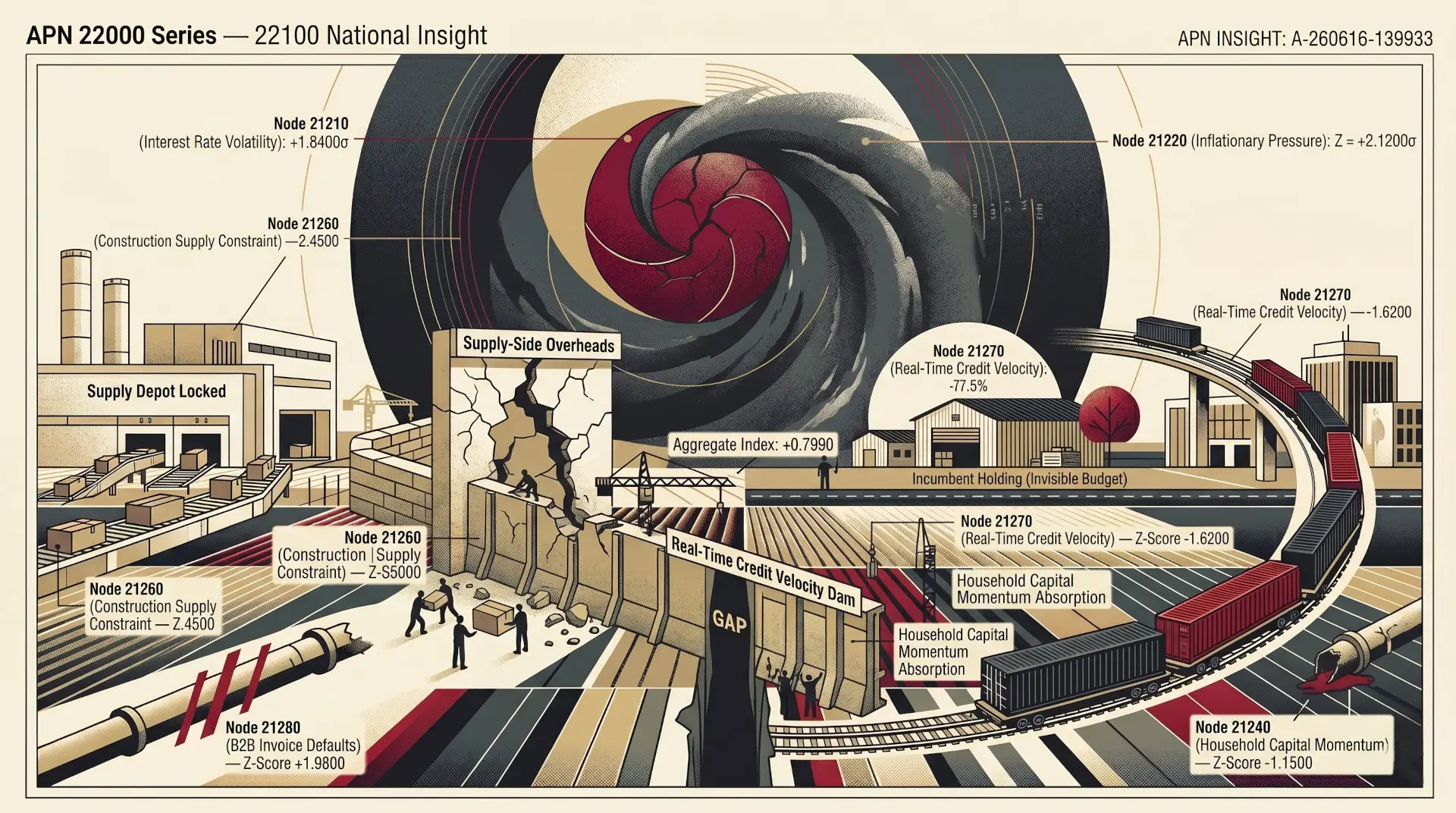
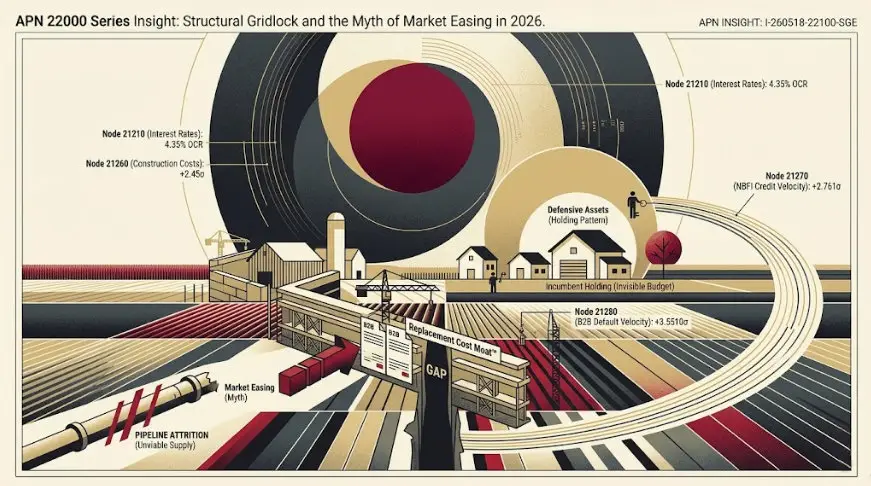
Interest Rates (21210) +1.0049σ Q1 2026
Construction Costs & Supply Chain (21260) +1.3708σ Q1 2026
Real-Time Credit Velocity (21270) +0.7701σ Q4 2025
B2B Invoice Default Velocity (21280) +1.3804σ FY2024-25
Market Psychology & Herd Behaviour (21620) +0.7018σ Q4 2025
Measured Consumer & Business Sentiment (21640) −0.0445σ Q4 2025
Introduction: Reassessing the 2026 Easing Question
Within mainstream macroeconomic commentary, there is a prevailing assumption that the Reserve Bank of Australia’s restrictive monetary policy (Node 21210 operating at 4.35%) will inevitably force a systemic easing of the Australian residential property market. The conventional thesis suggests that elevated holding costs will precipitate vendor capitulation, thereby increasing available supply and inducing a downward variance in established asset pricing.
The certified node data available as at this update does not support either the strong easing thesis or an equally strong “gridlock” counter-thesis. Rate, construction-cost, credit and default-risk readings are all elevated but moderate — none reads beyond ±2.0σ from baseline — and consumer sentiment (21640) sits essentially at its historical norm, not at the acute distress level a forced-immobility mechanism would require. The evidence is consistent with continued firmness in the market, not with either a clear easing trajectory or a confirmed structural floor.
I. Elevated but Moderate Construction Cost Pressure
Construction Costs & Supply Chain (21260) currently certifies at +1.3708σ, Q1 2026 (recertified on a repaired insolvency input, a measurement change rather than a change in conditions) — a material deviation above its historical baseline. This interacts with Node 21280 (B2B Invoice Default Velocity), certified at +1.3804σ, though that reading is on an FY2024-25 annual reference and is materially more lagged than the other declared nodes; it is treated here as directional context, not a current signal.
Together these two nodes are consistent with sustained, moderate pressure on the cost side of new housing supply, without evidence in the certified data of the acute pipeline distress that would be needed to argue for a hard supply ceiling. Node 24450 (APN Replacement Cost Gap™) is the framework most directly relevant to this dynamic, but carries no certified reading as at this update; whether the gap between replacement cost and market valuation is structurally widening cannot currently be stated as a certified finding.
II. No Certified Evidence of Acute Household Distress
A forced-immobility mechanism — households defending an asset rather than divesting because the psychological cost of holding is lower than the cost of displacement — requires evidence of acute household-level distress. Node 21640 (Measured Consumer & Business Sentiment) certifies at −0.0445σ, Q4 2025 — the equal-weighted composite of its consumer and business sentiment sub-scores: essentially at its historical baseline, not at a level of material distress. Node 21620 (Market Psychology) certifies at +0.7018σ, also Q4 2025, a positive but moderate reading on price and transactional momentum.
Read together, these two nodes describe a household sector under mild, not acute, pressure, with price and transactional momentum positive but unremarkable. The certified data does not currently support a strong “defend rather than divest” behavioural story; it is equally consistent with a market that is simply steady.
III. Credit Remains Available, Not Displaced
The intersection of the 4.35% OCR and the APRA serviceability buffer (Node 21350, certified at −1.4085σ, Q4 2025) raises the effective assessment rate lenders apply above the contract rate itself. Node 21270 (Real-Time Credit Velocity) certifies at +0.7701σ, Q4 2025 — elevated, indicating credit flows, including through the Non-Bank Financial Intermediation sector, remain above their historical norm rather than contracting.
This is consistent with credit demand continuing to find a path to market rather than being extinguished by the regulatory ceiling, though the certified reading does not, on its own, distinguish between ADI and NBFI channels.
Forward-Looking Inference
The weight of node evidence available as at this update is consistent with a market under moderate, sustained cost and credit-side pressure, without a certified signal of the acute household distress or elevated supply-chain pressure needed to argue for a hard structural floor. This synthesis speaks only to the structural conditions the cited nodes can independently support; it does not constitute a view on future price direction, and no such view is expressed or implied. Node 24450’s Replacement Cost Gap framework remains a relevant lens for the supply-cost dynamic but cannot be cited as a certified finding until it carries its own node reading.
Disclaimer
The analysis, information, and opinions contained in this article are for general informational and strategic purposes only and do not constitute financial, investment, legal, or any other form of professional advice. The Australian Property Network (APN) is a strategic intelligence organisation and is not a licensed financial advisor.
The views, thoughts, and opinions expressed in this text belong solely to the author and do not necessarily reflect the official policy or position of the Australian Property Network (APN).
This content may be based on data from third-party sources believed to be reliable; however, APN provides no warranty as to its accuracy, currency, or completeness. Images used are for illustrative and conceptual purposes only and may not represent real persons, properties, or events.
Note, September 2026: Banking & Lending Regulation (21350) now records APRA’s lending rules as a register and no longer publishes a standardised reading. The −1.4085σ above was its certified reading at the date of publication.
Property values and market conditions can go down as well as up. Before making any property or investment decisions, you must conduct your own thorough research and seek independent professional advice tailored to your specific circumstances.