

Budget Housing Tax Reforms: Specialist Media Reverses Mainstream Omissions, Exposing Information Market Failure
APN ANALYSIS: A-260522-AUS139315
This analysis extends APN’s inaugural Node 21680 strategic briefing, Media Amplification Asymmetry Skews Perception of 2026-27 Federal Budget Housing Measures, published 14 May 2026. It is produced by Australian Property Network, an independent property intelligence platform now in its tenth year of development, with no commercial affiliations, no advertiser relationships, and no industry body funding. Findings are derived from nine independent research streams across eighteen outlet categories, anchored to a combined factual baseline of twenty-five confirmed budget measures and assessed against certified APN Codex node telemetry. The full research brief for this analysis is published at APN Research
Executive Summary
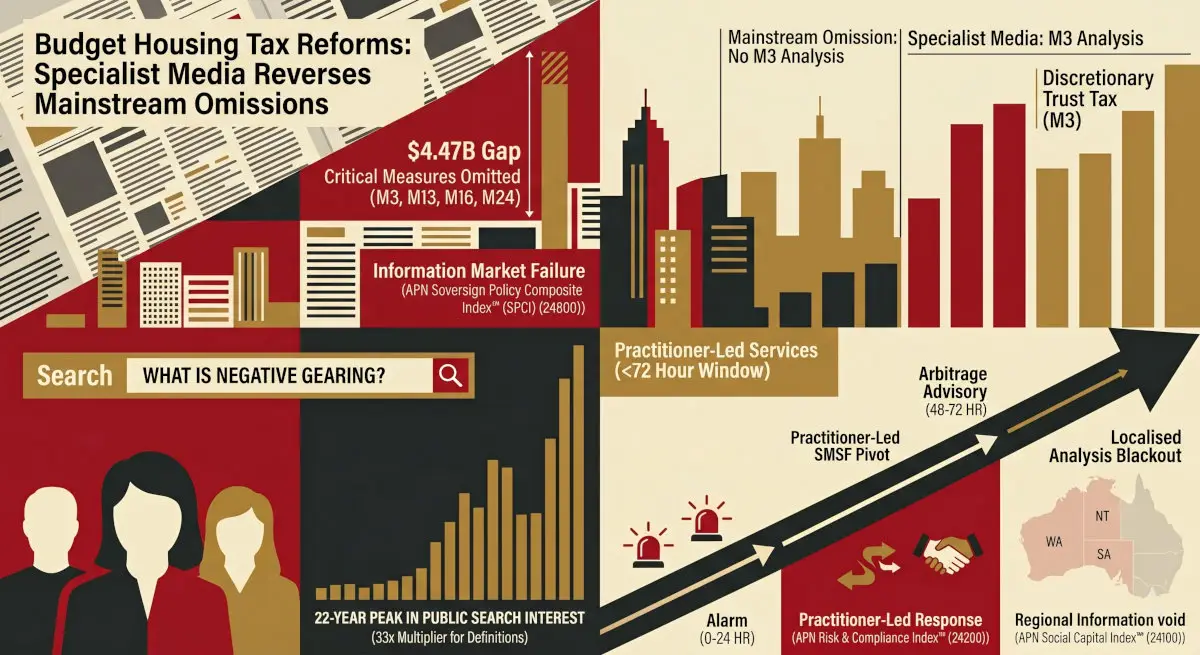
The 2026-27 Federal Budget introduced the most significant property tax changes since 1999, reforming negative gearing (M1) and capital gains tax (M2). APN analysis of the media response across 18 categories reveals a structural divergence: mainstream outlets largely omitted the critical $4.47 billion discretionary trust tax (M3), while specialist podcast and digital video ecosystems provided detailed analysis. This created a measurable information market failure, evidenced by a 22-year peak in public search for “what is negative gearing”, indicating the media amplified policy alarm without supplying necessary explanatory context.
For property professionals, this fragmented media landscape creates both risk and opportunity. The 72-hour alarm-to-arbitrage advisory pivot in the industry-aligned podcast cluster, shifting from alarm to arbitrage advisory, signals an acceleration of transactional activity into the grandfathering window. The simultaneous emergence of a practitioner-led SMSF capital-flight narrative, corroborated by professional services inquiry data, indicates a sophisticated restructuring response is already underway. Professionals must now navigate an environment where mainstream sentiment is decoupled from the specific, technically driven capital movements occurring within specialist practitioner networks.
Background & Strategic Context
This analysis validates and calibrates APN’s core thesis on media-driven information asymmetry. The divergent coverage of the 2026-27 Federal Budget’s housing measures across mainstream and specialist media provides a live case study of how policy signals are selectively filtered, amplified, and omitted, creating distinct information environments for different market participants. The event is analytically significant as it allows for the first empirical measurement of the gap between mass-market sentiment and the technically-driven responses of sophisticated practitioners, a central concern of the APN Sovereign Policy Composite Index™ (SPCI).
The Information Market Failure (APN Sovereign Policy Composite Index™ (SPCI) (24800)): The 22-year peak in Google search interest for “negative gearing” and “what is negative gearing” provides a direct, quantifiable measure of an information market failure. The media ecosystem amplified the policy alarm without adequately supplying the explanatory information the public required, a core risk tracked by the SPCI.
The Practitioner-Led Response (APN Risk & Compliance Index™ (24200)): The rapid pivot to SMSF restructuring advisory within the specialist podcast ecosystem, corroborated by professional services inquiry data, demonstrates how sophisticated capital responds to regulatory change. This behavioural signal, occurring within 48 hours, is a key input for the Risk & Compliance Index, which measures the velocity of market adaptation to new policy frameworks.
The Regional Information Void (APN Social Capital Index™ (24100)): The documented “blackout” of localised analysis of federal housing measures in regional WA, SA, and on commercial television networks represents a material reduction in civic communication capacity. This erosion of shared information infrastructure is a negative indicator for the APN Bedrock™ (24110) sub-index, which measures the strength of local institutions and civic engagement.
Deconstruction of the Source Event
This deconstruction is based on APN’s analysis of 95 media entities across 18 categories in the ten-day period following the 12 May 2026 Federal Budget. The key facts are:
- Core Policy Intervention: The budget introduced three anchor housing measures: reform of negative gearing to new builds only (M1), replacement of the 50% CGT discount with CPI indexation (M2), and a 30% minimum tax on discretionary trust distributions (M3).
- Mainstream Media Omission: The $4.47 billion discretionary trust tax (M3) was classified as a critical omission across mainstream media in the initial 72-hour cycle. Three other measures benefiting renters and social housing tenants (M13, M16, M24) were universally omitted.
- Specialist Media Reversal: The specialist podcast and YouTube ecosystem reversed the M3 omission, with 43% of its inventory providing detailed analysis. This ecosystem also generated an “alarm-to-pivot” narrative, shifting from alarm to arbitrage advisory within 72 hours.
- Quantified Information Demand: Public search interest for “negative gearing” reached its highest level in 22 years, 4.5 times the previous peak. Definitional searches (“what is negative gearing”) saw a 33-times multiplier, indicating a public information gap.
- Regional Coverage Blackout: No dedicated, granular broadcast-level analysis of federal First Nations remote housing policy (M6) was produced by public broadcasters in the Northern Territory or remote Western Australia during the analytical window.
- Misinformation Campaign Confirmed: A social media campaign misrepresenting M2’s impact on small businesses was confirmed in search data, with misinformation-specific terms peaking in the second week of the window, prompting a multi-source corrective response from government and academia.
Critical Analysis & Balanced View
The analysis reveals a two-speed information market operating in parallel. The mass-audience layer, dominated by metropolitan media, amplified the political framing of the M1 and M2 reforms, creating broad-based alarm but little technical understanding. Simultaneously, a specialist audio and video layer provided a niche audience of practitioners and sophisticated investors with detailed, actionable analysis on arbitrage and restructuring opportunities, particularly around M3 and SMSF exemptions. The critical insight is that these two information ecosystems are not in dialogue; the mainstream omission of M3 was not corrected by its coverage in the specialist layer, but instead allowed two separate realities to form. This structural decoupling means that public sentiment and capital flows are being driven by entirely different information sets.
A significant paradox emerges from the digital video ecosystem analysis. The highest concentration of formally credentialled, authoritative economic voices (the “macro-critical cluster”) occupied the lowest-reach segment of the platform, with audience engagement 10 to 15 times lower than industry-aligned practitioners offering alarm-register content. This credential-to-reach inversion suggests that on platforms governed by algorithmic recommendation, analytical authority and audience reach are not correlated. For property professionals, this means the most visible narratives may not be the most credible, and the most credible analysis may have limited impact on broader market psychology, a key risk for Node 21620 (Market Psychology and Herd Behaviour). The corrective response to the misinformation campaign, while institutionally robust, faces this structural headwind in reaching the audience exposed to the initial campaign.
Strategic Implications for Property Professionals
- For Asset Managers & Financial Advisers: The practitioner-led pivot to SMSF restructuring is a primary behavioural signal. The analysis confirms that the superannuation sector’s exemption from the new tax floors is being actively exploited as a defensive strategy. Client portfolio reviews should now prioritise assessing exposure to M3 (discretionary trusts) and modelling the relative advantage of SMSF structures under the new framework.
- For Developers & Capital Planners: The “lock-in effect” thesis, suggesting investors will hold existing stock rather than sell, has material implications for development pipelines. If this community consensus holds true over the industry-podcast prediction of a sell-off, the expected supply of existing stock for redevelopment will not materialise, placing greater pressure on new-build supply, which is the sole beneficiary of the M1 negative gearing changes.
- For Buyer’s Agents & Mortgage Brokers: The 72-hour “alarm-to-arbitrage advisory pivot” in specialist media has accelerated the transactional timeline for a segment of the market. Expect a cohort of educated investors to act decisively within the grandfathering window before 1 July 2027. Conversely, be prepared for a larger cohort of mainstream investors to be confused or paralysed by the information gap, requiring significant educational effort to navigate the changes.
- For Regional Investors & Planners: The documented information blackouts in WA, SA, and on regional commercial television are a structural risk. Federal policies like the M4 regional infrastructure fund are not being consistently contextualised for local markets. This creates a reliance on a small number of specialised outlets or direct political commentary, increasing the risk of mis-priced assets and missed opportunities in under-reported regions.
APN Index Management
The APN Codex 24000 Series is a proprietary set of indices that translates complex market forces into measurable metrics. This section outlines how the preceding analysis is validated against, and informs the calibration of, these frameworks.
- Validation: This analysis validates the APN Sovereign Policy Composite Index™ (SPCI) (24800) by providing a quantifiable case study of policy-induced information asymmetry and its effect on market behaviour.
- Index Calibration: The Media and Narrative Sentiment Index (21680) inaugural baseline is established by the combined findings of the initial audit and the ten-day follow-up. The index is calibrated to track the divergence between mainstream media omissions and specialist ecosystem coverage as a primary metric of information market fragmentation.
- Data Capture: This triggers a new data capture mandate for the APN Risk & Compliance Index™ (24200) to monitor professional services inquiry volumes (legal, accounting) and specialist media discourse as leading indicators of sophisticated capital response to regulatory announcements, distinct from lagging public sentiment indicators.
Disclaimer
The analysis and information contained in this deconstruction are for general informational and strategic purposes only and do not constitute financial, investment, legal, or any other form of professional advice. The Australian Property Network (APN) is a strategic intelligence organisation and is not a licensed financial advisor.
This analysis is based on data and information from third-party sources believed to be reliable; however, APN provides no warranty as to its accuracy, currency, or completeness. Images used in this analysis are for illustrative and conceptual purposes only and may not represent real persons, properties, or events.
All frameworks (Codex 24100-24800) are proprietary to APN.
Property values and market conditions can go up or down. Before making any property or investment decisions, you must conduct your own thorough research and seek independent professional advice tailored to your specific circumstances.