The Restatement: How ABS Revised Two Quarters in Opposite Directions in One Release
Most readers of a quarterly economic release only ever see the newest number. The Australian Bureau of Statistics’ Total Value of Dwellings series is a modelled stock estimate, not a direct count, and like most modelled series it gets revised as more complete information comes in. This quarter, that revision moved in two different directions on two adjacent quarters — a detail easy to miss unless you compare the new release against what was published before.
What changed
Every other quarter in the published history — back to the series’ start in 2011, fifty-seven quarters in total — reproduced exactly against what was previously recorded. This is a genuine two-quarter restatement, not a systematic re-base of the whole series.
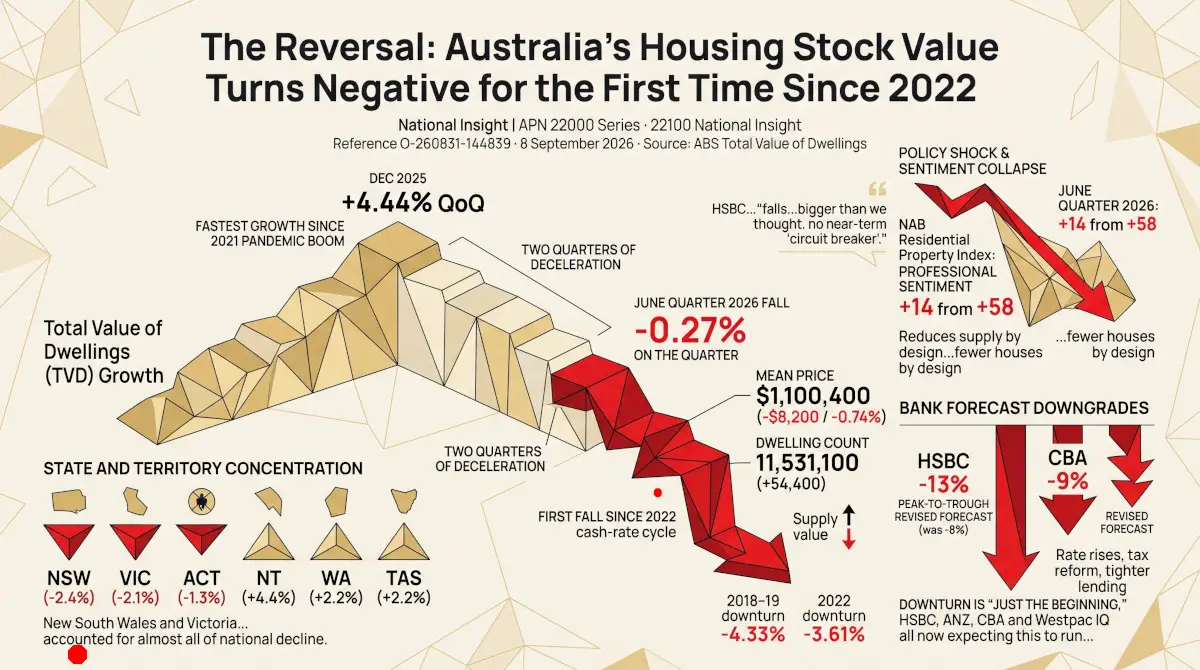
December 2025 and March 2026 — the two quarters this release revised — sit within a fifty-nine-quarter growth history that includes two prior sustained downturns (2018–19 and 2022) and three isolated single-quarter dips (Dec 2011, Sep 2012, and the June 2020 COVID-19 quarter). See The Reversal for the full comparison.
Why this happens
The Total Value of Dwellings is not a live count of every property transaction. It is built from a mean-price estimate and a dwelling-count estimate, both of which draw on building-activity and Census-benchmarked data that itself gets finalised over time. When more complete source data becomes available for a quarter that has already been published, the ABS updates that quarter in the next release. This is standard, disclosed practice for a modelled stock series — not an error, and not unique to this release.
What makes this restatement worth flagging isn’t that a revision happened — it’s that the two adjacent quarters moved in opposite directions. A reader comparing only the two most recently published figures for Dec 2025 and Mar 2026 before and after this release would see a materially different quarter-on-quarter growth story on each side of the revision. The deceleration described in the main piece, The Reversal, is calculated on the corrected figures — using the pre-revision numbers would have understated both how sharply growth peaked in December and how much it had already cooled by March.
What it means for reading this series
- 1
The ABS’s own revision cycle is specific, not just a general caution. Under ABS methodology, revisions to this series apply to the second and third most recent quarters as updated building and sales data arrive; the third most recent quarter is then considered final. On that basis, December 2025 (third most recent as at this release) is now final barring a significant error, March 2026 (second most recent) will get one further revision in the December 2026 release, and June 2026 — the newest print — is the only figure still genuinely open.
- 2
A quarter-on-quarter comparison drawn from two different releases can silently mix vintages. If one quarter has been revised and the other hasn’t, the comparison is between two different bases, not a clean measure of change.
- 3
This is not evidence the series is unreliable. Fifty-seven of fifty-nine published quarters were unchanged in this release. Revision risk is real but narrow — it concentrates in the newest data, exactly where you’d expect for a modelled stock estimate.