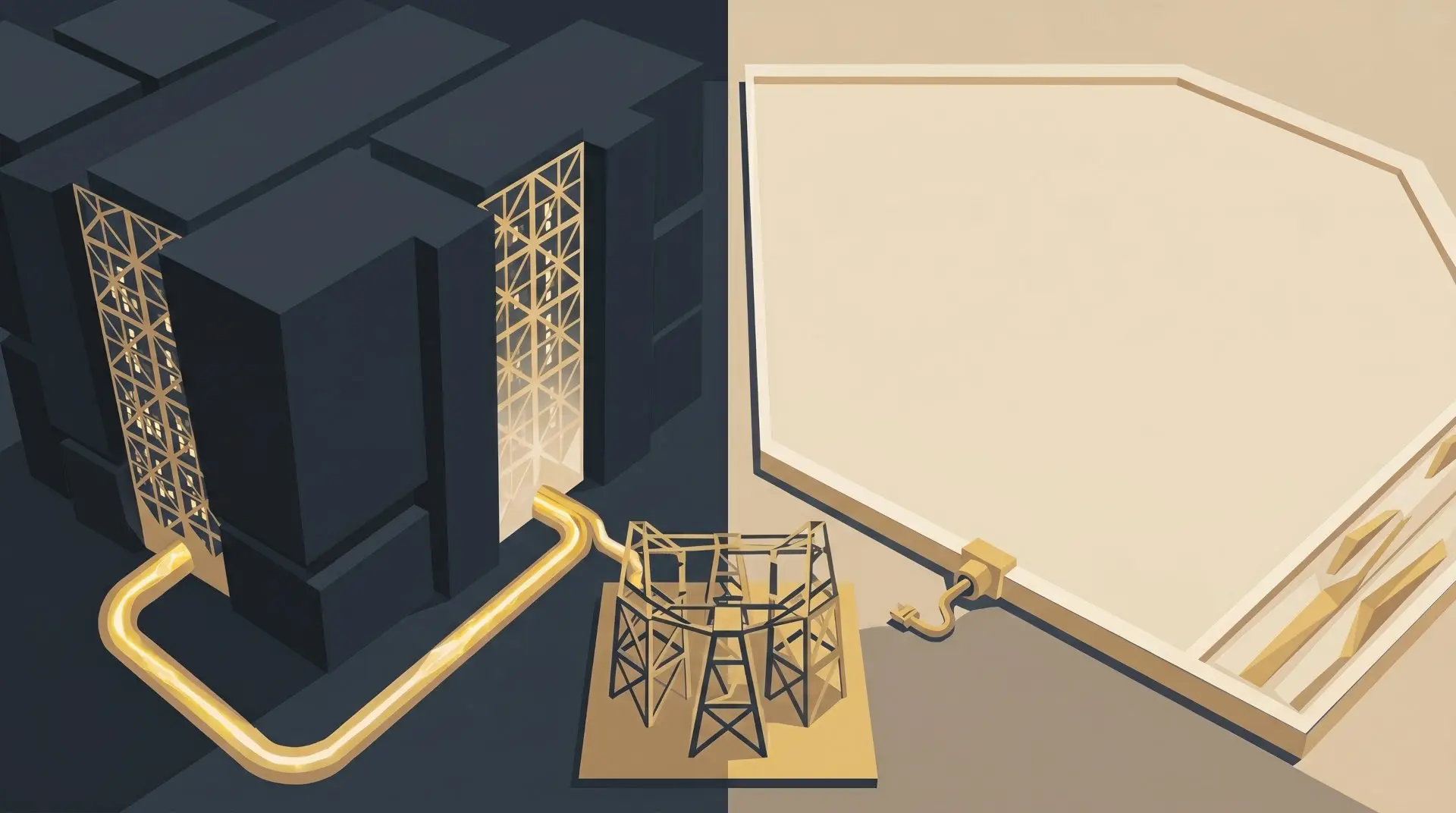


The industrial land in Western Sydney’s data centre corridor is not an isolated case study. It is one visible node in a constraint picture that extends across Australia’s productive property ecosystem, and the pattern it illustrates, serviceable land rendered functionally unavailable not by rezoning or speculation but by the prior allocation of enabling infrastructure, recurs in different forms across every category of physical input that a productive transition requires. The capital appetite for productive assets is demonstrably present and growing, as the preceding pieces in this series have established from multiple independent lines of evidence. What is not present, at the scale and configuration the transition requires, is the physical infrastructure to receive that capital effectively. The productive property that long-duration industrial capital wants to build into does not exist at an adequate scale in Australia. It cannot be built quickly. And its absence is not a market-signal problem that price mechanisms will resolve on a timeline consistent with the transition that the May 2026 Budget proposals have begun to contemplate.
The binding constraint — repeated because it matters — is physical and regulatory, not financial. Capital will not solve this by arriving in greater volume. Understanding where the constraint runs and how deep it is is the precondition for understanding what must be built before the transition can be completed. This piece maps that constraint across four categories: serviced industrial land, grid connection capacity, cold chain and temperature-controlled storage, logistics, freight, and port infrastructure.
Serviced Industrial Land
The most direct measure of the productive property gap is the stock of industrial land that is correctly zoned for manufacturing and industrial use, of adequate parcel size for large-footprint operations, and connected to the enabling services — road access, reticulated water, sewerage, and available grid connection — that make it developable. In Greater Sydney, that figure sits at approximately 7 per cent of the total zoned, undeveloped industrial land base. The remainder is zoned correctly but unserviced: land that exists on the planning map as industrial supply but that cannot be occupied by a productive industrial user on any near-term horizon without substantial infrastructure investment to connect it. This is not a peripheral constraint. It means that of the industrial land that Sydney’s planning framework has designated for productive use, the overwhelming majority is effectively unavailable to the capital seeking to deploy into it.
The servicing gap reflects decades of sequential underinvestment in enabling infrastructure for industrial areas relative to the investment applied to residential land release. State and local governments have historically allocated road, water, and power infrastructure spending toward residential growth corridors, where political and economic pressures have been more immediate, and industrial precincts have received augmentation on a reactive rather than anticipatory basis. The consequence is that industrial precincts in Western Sydney, Melbourne’s outer west, Brisbane’s southwest growth corridor, and Perth’s northern industrial corridor all carry significant backlogs of unserviced but correctly-zoned land that the productive transition is attempting to absorb from a standing start. New precincts — the Western Sydney Aerotropolis industrial zones, Victoria’s proposed industrial land strategies, Queensland’s industrial land supply framework — are in development, but the planning, infrastructure provision, and development timelines involved typically run to five to ten years from designation to occupancy-ready land. Capital seeking a productive industrial destination in the near term is competing for a pool of serviceable land that is both scarce and being consumed by the fastest-moving uses, as the preceding piece documented.
There is a further dimension that planning maps do not capture: the ongoing pressure to rezone residual industrial land in established corridors for residential or mixed-use purposes. The mechanism examined in earlier pieces — the architecture that makes residential the highest-return use for well-located land — creates continuous rezoning pressure on inner and middle-ring industrial precincts in major cities. Land lost to residential conversion is not recoverable on any realistic horizon; once the capital improvements of residential development are in place, the economics of reversion to industrial use become prohibitive. Several Australian states have introduced industrial land protection policies to counteract this pressure, but their application has been inconsistent and their enforcement has at times yielded to specific development proposals where local political economy favoured the residential outcome. The serviced land base is not just inadequate; it is subject to ongoing attrition.
Grid Connection Capacity
The grid constraint compounds the land constraint directly and is, in several important respects, more binding in the near term because it cannot be addressed through planning reform alone. New grid infrastructure — substation augmentation, transmission line capacity, distribution network upgrades — requires capital investment, engineering lead time, regulatory approvals, and physical construction that routinely runs to multi-year timelines. The connection queue for large industrial loads — the scale required by advanced manufacturing operations, green hydrogen production, critical minerals processing, and similar users — is currently running to twenty-four to thirty-six months in constrained metropolitan and peri-urban corridors. This figure is not a bottleneck created by administrative inefficiency; it reflects genuine capacity constraints in the transmission and distribution infrastructure serving established industrial zones, combined with a surge in connection applications from both data centres and large renewable energy-related facilities.
The particular challenge for manufacturing and processing industries is that they require large, continuous, high-voltage connections that are not well-served by the incremental augmentation that network operators typically apply to manage growing residential and commercial loads. A distribution network designed for residential load profiles — peaks in the morning and evening, extended periods of low draw overnight — is not straightforwardly adaptable to the continuous, large-load profile of an industrial processing facility. Where the available connection headroom on an established substation has been consumed by data centres or other continuous-load users, the option for an incoming industrial tenant may be to wait for network augmentation that is not yet planned, funded, or approved. The energy transition itself compounds this: the connection queue that industrial users are joining in 2026 includes a large volume of renewable energy generation projects seeking grid connection, and the network investment required to service that queue is itself subject to planning, approvals, and capital allocation constraints within the regulated network businesses.
Cold Chain and Temperature-Controlled Storage
Australia’s cold chain infrastructure gap is less visible in the public discourse than the land and grid constraints, but it is a binding limitation on a specific and important category of productive complexity: the industries that process, store, and export temperature-sensitive goods, and the advanced manufacturing and life sciences sectors whose supply chains depend on reliable cold chain logistics. By per capita benchmarks, Australia’s total cold storage provision sits at approximately one-third of the United States equivalent — a gap that reflects both the historical orientation of the domestic economy away from high-value perishable exports and the underinvestment in the logistics infrastructure that would support them.
This matters for complexity uplift because several of the sectors identified in this series’ research as viable candidates for Australian productive development are cold-chain-dependent. Premium agricultural processing — the transformation of raw commodities into high-value food products — requires controlled temperature environments at multiple stages of processing and distribution. Vaccine and pharmaceutical manufacturing, and the broader life sciences sector, is cold-chain-intensive by nature. Biotechnology product development and storage requires laboratory-grade temperature control that extends into the logistics chain. The absence of adequate cold storage infrastructure is not merely a cost imposition on these industries; it is a practical barrier to their establishment at commercial scale, because the supply chain reliability that sophisticated offtake agreements and export contracts require cannot be assured without the physical infrastructure to maintain product integrity across the full chain. Investment in cold storage is occurring — the institutional industrial REIT sector has identified it as a high-conviction growth category — but from a base so low relative to the benchmark that the gap cannot be closed on any short horizon through market-led development alone.
Logistics, Freight, and Port Infrastructure
The productive complexity that this transition is intended to build is, by definition, an export-oriented complexity — the advanced manufactured goods, processed commodities, and knowledge-intensive products that lift Australia’s position on the economic complexity index must find markets beyond the domestic economy to justify the capital and industrial scale required to produce them. That means the logistical pathway from production site to export market must be reliable, cost-competitive, and capable of handling the volumes and product types that a more complex industrial base would generate. The current infrastructure base for that pathway is under strain in several critical dimensions.
Major container terminals — Port Botany in Sydney, the Port of Melbourne — are operating at utilisation rates that leave limited headroom for the volume growth that a manufacturing expansion would require, and the road and rail freight corridors serving those terminals face congestion that imposes cost and unreliability on supply chains dependent on them. The intermodal terminal network — the inland freight hubs that allow containers to move efficiently between production sites and ports by rail rather than truck — is underdeveloped relative to the freight task that an expanded manufacturing sector would generate. Infrastructure Australia’s priority assessment has identified several freight corridor investments as nationally significant, but the pipeline between identification and delivered infrastructure spans years of planning, environmental assessment, and capital programming. The productive transition is being asked to accelerate into a freight and logistics system that has not been built for the throughput it would generate.
What these four constraints share is the characteristic that distinguishes them from problems that market mechanisms can solve. They are not price signal failures — the market is already signalling demand for serviced industrial land, grid connection, cold storage, and freight infrastructure through the capital allocation behaviour documented in the preceding pieces. They are infrastructure provision failures that require deliberate capital allocation decisions with long lead times, regulatory coordination across multiple agencies and jurisdictions, and a planning horizon that extends well beyond the return window of most private capital. The entities with both the mandate and the balance sheet to address them are governments and their public or regulated infrastructure intermediaries, and the policy frameworks that would direct them to prioritise productive infrastructure above other spending claims have not been fully established.
I believe this is the most consequential finding in the research behind this series, and I want to state it without enlargement: the transition from speculative property momentum to productive complexity is not waiting on capital. The capital is there. What it is waiting on is the physical and regulatory environment capable of receiving it productively — the serviced land, the grid connection, the cold chain, the freight pathway. Building that environment is not a private sector task, nor is it a market task. It is a deliberate policy task with a specific, sequenced set of requirements. What those requirements are, and what the evidence says about how comparable economies have approached them, is what the final piece of this series examines.