
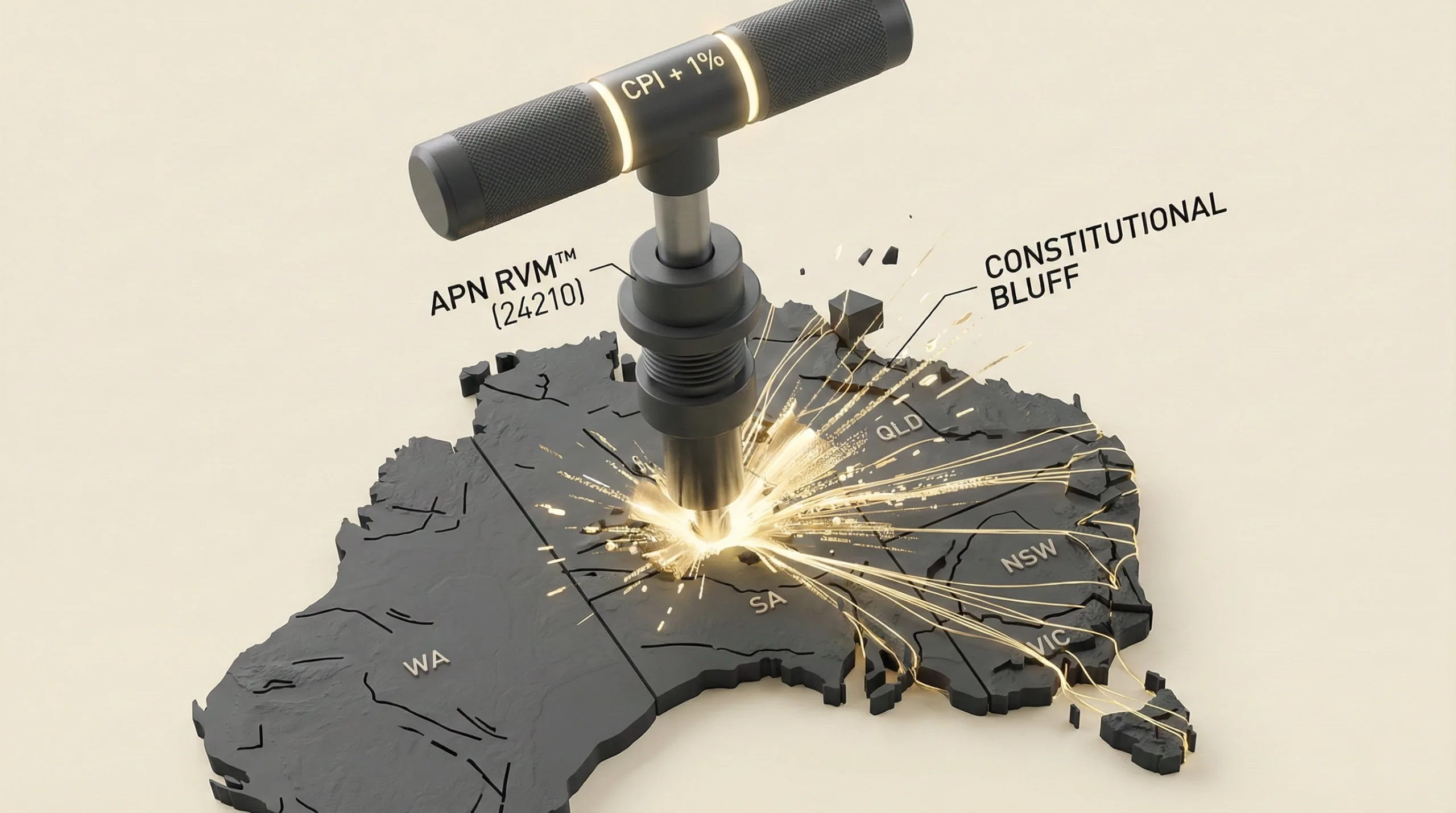

Federal Government’s ‘CPI + 1%’ Rent Cap Proposal: A Constitutional Strategy to Influence State-Level Regulation
APN ANALYSIS: A-260112-AUS134231
Executive Summary
Information from a leaked document from January 2026 confirms the Federal Government is actively modelling a “CPI + 1%” national rent cap for inclusion in the May 2026 Budget. This is not a direct policy proposal but a strategic political and constitutional measure. Faced with a structurally significant shortfall against its National Housing Accord supply targets and escalating electoral pressure from the Australian Greens, the government has pivoted from long-term supply-side economics to a demand-side intervention framed for broad public appeal. The leak is a managed release of information designed to test market sentiment and State government resolve, using the prospect of a rent cap to influence the States into regulatory harmonisation via the Federal Grants Power.
For property professionals, the immediate and elevated risk is not the cap itself, but the market’s reaction to the information leak. Pre-emptive rent adjustments by landlords and investors are already underway, creating a period of elevated rental inflation and volatility in Q1/Q2 2026. Investors are acting to maximise rents to establish a higher base rate before any potential control date can be enacted. This regulatory risk, rather than market fundamentals, is now the primary driver of rental pricing and investor behaviour, demanding immediate portfolio reviews and strategic adjustments.
Background & Strategic Context
This event validates and calibrates APN’s core macro-thesis that state-level intervention is the primary factor shaping property market outcomes. The Federal Government’s policy pivot from an unsuccessful supply-side strategy to an influential demand-side prospect is a clear illustration of how political imperatives take precedence over market logic, creating material volatility and regulatory risk for asset holders.
A Supply Shortfall (APN Future Development Pipeline Index™): The policy U-turn was necessitated by the confirmed shortfall against the 1.2 million new homes target. This outcome validates the APN Residual Land Value (RLV) Gap™ (24410), which identified that government targets were unachievable without addressing the fundamental economic unviability of many approved but uncommenced projects due to high costs and labour shortages.
A Strategic Intervention (APN Sovereign Policy Composite Index™ (SPCI, 24800)): The shift to a “CPI + 1%” cap is a characteristic SPCI event. It demonstrates how a government, facing policy failure and electoral pressure, will escalate its level of intervention. The move from market-led supply incentives to direct price controls represents a substantive departure from the 2023 consensus and a substantive escalation in state interference.
A Test of the Rule of Law (APN Risk & Compliance Index™ (24200)): The specific “CPI + 1%” formula is a strategic attempt to navigate constitutional barriers, framing rent control as “essential service regulation” to withstand High Court challenges. This represents a material escalation in the strategic intent of Federal intervention, a core metric tracked by the APN Risk & Compliance Index™ (24200), as the government tests the limits of its constitutional powers through fiscal influence.
Deconstruction of the Source Event
This deconstruction is based on an internal APN intelligence briefing analysing the strategic leak of a proposed national rent cap. The key facts are:
- The Leak: Information surfaced on January 11-12, 2026, revealing Federal Treasury was actively modelling a “CPI + 1%” national rent cap for the May 2026 Budget.
- The Trigger: The timing of the information release correlates precisely with the finalisation of internal reports confirming a significant shortfall in the National Housing Accord’s target of delivering 1.2 million new homes, necessitating a political pivot.
- The Mechanism: The “CPI + 1%” formula is a technocratic compromise derived from utility regulation. It is designed to allow for asset value maintenance (CPI) plus a marginal return (+1%), aiming to avoid being classified as an unjust acquisition of property under Section 51(xxxi) of the Constitution.
- The Constitutional Strategy: The Federal Government lacks direct constitutional power for rent control. The strategy relies on indirect influence on the States, primarily through the Grants Power (Section 96), to incentivise them to legislate the cap in return for federal funding.
- The Market Reaction: A “pre-emptive rent adjustment” by landlord representative groups is active. Investor groups are advising members to maximise rental increases immediately to establish a higher base rate before any cap is enacted, creating an inflationary feedback cycle.
Critical Analysis & Balanced View
The central inconsistency of this policy is that the prospect of the rent cap is causing more immediate rental inflation than the cap itself would quell. These pre-emptive rent adjustments by landlords, while a rational response to regulatory risk, create a self-reinforcing dynamic. It exacerbates the rental structural pressure point in the short term, which in turn provides the government with greater political justification to implement the very controls that triggered the behaviour. The market is constrained within a government-induced inflationary cycle.
A critical second-order effect is the constraining effect on the Build-to-Rent (BTR) sector. BTR financial models are predicated on long-term yield certainty. The mere discussion of a national rent cap, even as a strategic measure, materially undermines the investment case for institutional capital, stalling billions in potential new housing supply and directly undermining the government’s own long-term supply objectives. This highlights the structural conflict between short-term political objectives and a sustainable, long-term housing strategy.
Furthermore, the policy serves a dual purpose of macroeconomic structural influence. By structurally suppressing the rental component of the Consumer Price Index (CPI), the government can exert downward pressure on headline inflation. This could be used to exert political pressure on the Reserve Bank of Australia for a pre-election interest rate cut, turning housing policy into an instrument for broader economic policy positioning ahead of an election.
Strategic Implications for Property Professionals
- For Investors & Landlords: The immediate priority is to review all lease agreements and rental rates in Q1 2026. While the national cap is a strategic measure, the prospect is sufficiently credible that some States may adopt it. Securing a market-aligned rental base before the May Budget is an important risk mitigation measure against potential retrospective application or a State-level adoption.
- For Agents & Property Managers: Prepare for an acceleration in activity and an increase in disputes. Expect an increase in “Notices of Rent Increase” and tenant disputes. Your advisory role is now paramount; you must communicate the rationale for rent reviews based on regulatory risk, not just market conditions. Concurrently, anticipate an increase in landlords looking to divest in high-regulation states like Victoria, creating listing opportunities.
- For Developers (especially BTR): All financial models for future BTR projects must now price in a significantly higher regulatory risk premium. The “CPI + 1%” leak has eroded investor confidence. Projects without secured financing are at an elevated risk of being stalled or cancelled. The focus must shift to lobbying State governments to resist Federal influence and provide local certainty.
- For Buyers’ Agents: The market is bifurcating. Advise clients that an increase in ex-rental properties may enter the for-sale market in jurisdictions like Victoria as landlords divest, creating potential buying opportunities for owner-occupiers. Conversely, in States that publicly resist the cap, rental stock may tighten further, increasing investor demand for existing assets and supporting values.
APN Index Management
The APN Codex 24000 Series is a proprietary set of indices that translates complex market forces into measurable metrics. This section outlines how the preceding analysis is validated against, and informs the calibration of, these frameworks.
- Validation: This analysis validates the core thesis of the APN Sovereign Policy Composite Index™ (SPCI, 24800), confirming that state intervention, and the prospect thereof, is the primary factor of market volatility, taking precedence over fundamental supply and demand dynamics in the short-to-medium term.
- Index Calibration: The APN Regulatory Velocity Multiplier™ (APN RVM™) (24210) is calibrated upwards to reflect the Federal Government’s shift towards a federalism model of fiscal influence and the use of strategic policy proposals as a tool to influence State-level regulation.
- Data Capture: This event triggers a new data capture mandate for the APN Symbiotic Intelligence Network™ (24310). The network will now specifically track and quantify the “pre-emptive rent adjustment” phenomenon by measuring the delta between advertised rents and newly executed lease agreements in Q1/Q2 2026 to model the real-time cost of regulatory uncertainty.
Disclaimer
The analysis and information contained in this deconstruction are for general informational and strategic purposes only and do not constitute financial, investment, legal, or any other form of professional advice. The Australian Property Network (APN) is a strategic intelligence organisation and is not a licensed financial advisor.
This analysis is based on data and information from third-party sources believed to be reliable; however, APN provides no warranty as to its accuracy, currency, or completeness. Images used in this analysis are for illustrative and conceptual purposes only and may not represent real persons, properties, or events.
All frameworks (Codex 24100-24800) are proprietary to APN.
Property values and market conditions can go up or down. Before making any property or investment decisions, you must conduct your own thorough research and seek independent professional advice tailored to your specific circumstances.


