

Extreme Sentiment Decoupling Confirms ‘The Wealth Funnel’ and Structurally Constrains Housing Supply
APN ANALYSIS: A-251028-AUS42
Executive Summary
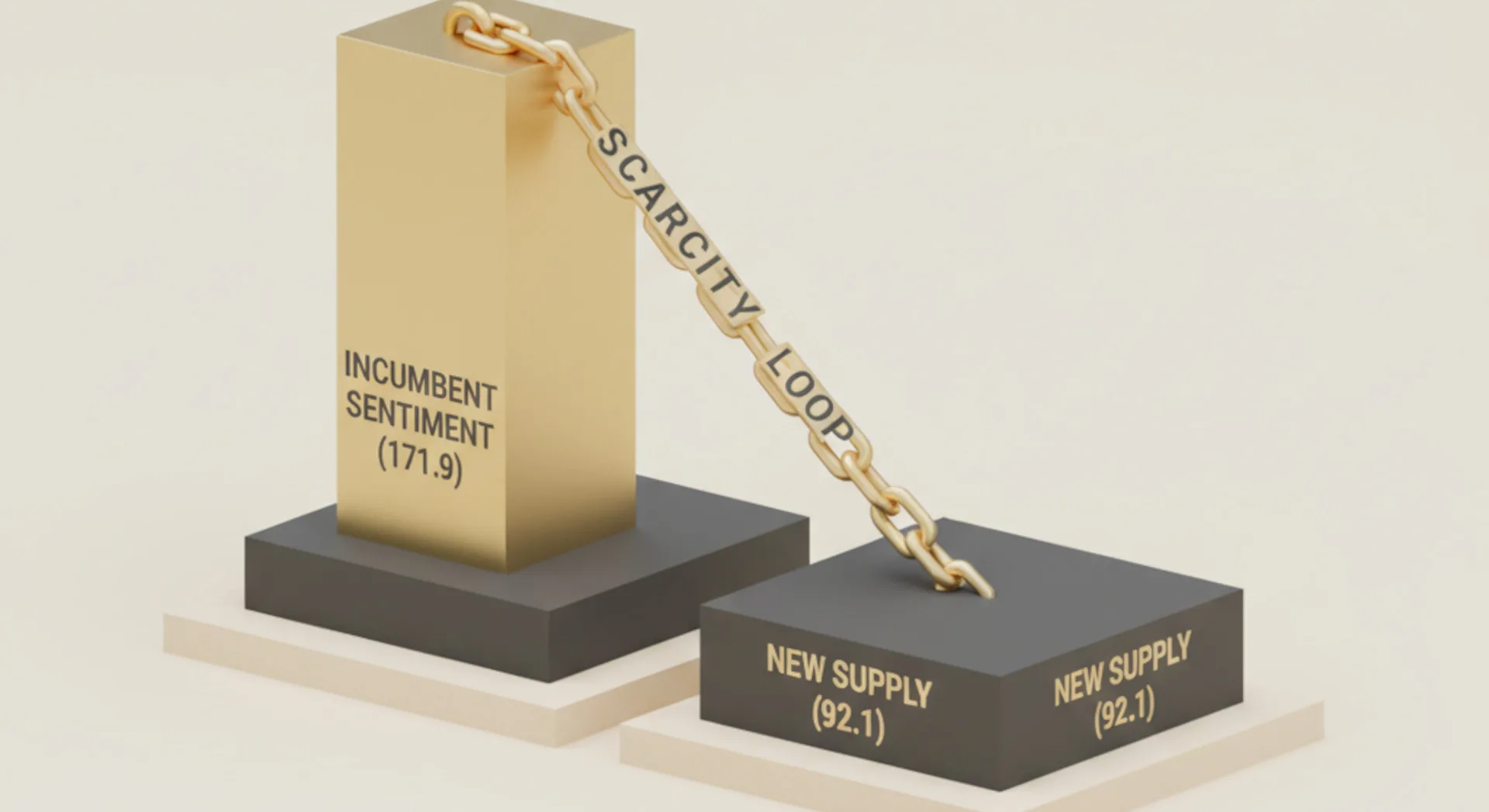
The Australian housing market is in an advanced stage of The Wealth Funnel, confirmed by a structural decoupling of market psychology. House Price Expectations have hit a 15-year high of 171.9, while headline Consumer Sentiment remains “firmly pessimistic” at 92.1.
This psychological divergence is not just a metric; it is a mechanism. It is driving incumbent asset holders to withhold supply (national listings are down 15.6% YoY), creating a “scarcity feedback loop” that accelerates price appreciation for incumbents while simultaneously crippling developer viability for future supply.
Background & Strategic Context
This extreme market divergence is a defining validation of our core theses, and its strategic implications are best understood through our core intelligence frameworks:
Core Thesis Validation (The Wealth Funnel): This is the primary validation. The “structural decoupling”, where extreme asset optimism (171.9) exists alongside deep economic pessimism (92.1), proves that housing is treated as an asset class counter-cyclical to the broader economy. This is the core mechanism of The Wealth Funnel, where incumbents are psychologically insulated from the cost-of-living pain felt by non-asset holders.
Future Supply Collapse (APN Future Development Pipeline Index™ (24400)): This dynamic creates a paradoxical “future supply choke.” The very market force that benefits incumbents (rapid asset price inflation) is the same force that cripples the APN Future Development Pipeline Index™ (24400). This inflation is a primary input cost (land) for developers, destroying margins and widening the RLV Gap, which stalls future projects and embeds scarcity for the medium term.
Sentiment Divergence (APN Professional Sentiment Index™ (24300)): This data provides a critical, dual input for Codex 24300. The 171.9 (incumbent expectation) is the driver of the scarcity. The 92.1 (consumer pessimism) is the result, as the high-price, low-stock environment crushes sentiment for First-Time Buyers and quantifies the accelerating rate of wealth transfer.
Deconstruction of the Source Event
This deconstruction is based on an internal APN intelligence briefing. The key facts are:
- The Westpac–Melbourne Institute Index of House Price Expectations reached a 15-year high of 171.9 in October 2025.
- Headline Consumer Sentiment fell to a “firmly pessimistic” 92.1, driven by a -9.9% plunge in the ‘Family Finances, next 12 months’ sub-index.
- National listing volumes are down 15.6% year-on-year, confirming incumbents are withholding stock to act on their price expectations.
- First-Time Buyers (FHBs) face a high-price, low-stock environment, with reports of “housing despair.”
- Developer viability is crippled as the asset price inflation translates directly into higher land costs, resulting in “razor-thin” margins and stalled projects.
Critical Analysis & Balanced View
The “real” story here is the “scarcity feedback loop.” This is a self-perpetuating cycle. Incumbents act on their 171.9 price expectation by withholding stock; this manufactured scarcity drives prices higher; this price rise validates the initial optimistic expectation, reinforcing the behaviour. This loop makes the market increasingly inaccessible.
- Asset Holder Insulation: Incumbents are psychologically insulated. They are interpreting negative economic news (inflation, rate uncertainty) not as a threat, but as a precursor to future monetary easing (rate cuts), which further fuels their asset optimism and disconnects it from the real economy.
- Future Supply Choking: This is the core paradox. The market dynamic that benefits incumbents (asset price inflation) is simultaneously the primary input cost (land) that cripples developers. This creates a parallel feedback loop that structurally embeds scarcity for the medium term.
Balanced View: On the surface, this is a story of a “hot” property market. However, the analysis reveals it as an advanced stage of The Wealth Funnel, confirmed by a structural decoupling of asset optimism from economic reality. This dynamic is creating a powerful scarcity loop that benefits incumbents while simultaneously choking the future supply pipeline, structurally embedding the crisis.
Strategic Implications for Property Professionals
- For Government & Policy: Any policy intervention aimed at stimulating FHB demand (e.g., small grants) will be ineffective and counterproductive. It will be immediately absorbed by the scarcity loop and capitalised into land values by incumbents.
- For Risk Analysts & Modellers: The APN Professional Sentiment Index™ (24300) must apply a high negative weighting to developer sentiment. Rising land costs are the primary constraint on future supply, which is the only factor that can break this cycle.
- For Investors: This data confirms the investment strategy. Focus must remain on existing, well-located, high-quality assets in high-scarcity markets, as the scarcity loop and 171.9 price expectation index confirm continued capital appreciation.
- For Policy (Solution): The only policy intervention likely to break the scarcity loop is one that directly attacks the cost of land/raw material for development (e.g., significant rezoning, infrastructure levies, land value capture), not one that merely adds more demand to the current supply pool.
Disclaimer
The analysis and information contained in this analysis are for general informational and strategic purposes only and do not constitute financial, investment, legal, or any other form of professional advice. The Australian Property Network (APN) is a strategic intelligence organisation and is not a licensed financial advisor.
This analysis is based on internal APN intelligence, data, and information believed to be reliable; however, APN provides no warranty as to its accuracy, currency, or completeness. Images used in this analysis are for illustrative and conceptual purposes only and may not represent real persons, properties, or events. Property values and market conditions can go down as well as up.
Before making any property or investment decisions, you must conduct your own thorough research and seek independent professional advice tailored to your specific circumstances.
