
$42.2 Billion Flood Devaluation Confirms ‘Brown Discount’ and Structural Housing Wealth Divergence
APN ANALYSIS: A-251027-AUS40
Executive Summary
Primary data from PropTrack and the Climate Council has provided a definitive $42.2 billion quantitative validation of the APN Climate-Risk Asset Devaluation Index™ (24500). This massive devaluation of Australian property is not a future risk but a current, realised “Brown Discount” driven by a structural, persistent 22 percentage point price growth gap for flood-prone assets.
This structural divergence in housing wealth, which is now being algorithmically institutionalised by valuation models, is a primary, active mechanism of The Wealth Funnel. It is accelerating socio-economic inequality by concentrating depreciating, high-risk assets in lower-income areas.
Background & Strategic Context
This $42.2 billion quantification is a landmark event in the pricing of climate risk, and its strategic implications are best understood through our core intelligence frameworks:
Climate Risk Devaluation (APN Climate-Risk Asset Devaluation Index™ (24500)): This data provides the first large-scale, market-wide quantification of Codex 24500. The $42.2 billion devaluation and the median “Brown Discount” of $75,500 confirm that climate risk is no longer a theoretical or future “externality.” It is a realised, capitalised financial penalty that is now being actively priced into assets.
Structural Inequality (The Wealth Funnel): This is a textbook example of The Wealth Funnel in action. The report’s explicit finding that climate risk is “exacerbating intergenerational inequality” confirms the thesis. Lower-income areas, often located on floodplains, are forced to absorb these high-risk, depreciating assets, creating a structural divergence in wealth accumulation and leaving “climate-driven economic ‘sacrifice zones’.”
Data-Driven Risk (Project Substrate): The analysis confirms that the financial risk is, at its core, a data risk. The “Brown Discount” is being algorithmically institutionalised by PropTrack’s AVM, which is driven by a simple, binary “flood: true” flag from Geoscape’s dataset. This provides a critical insight for Project Substrate (The Climate Resilience Rating): the market is pricing the data flag, not the nuanced physical hazard itself.
Deconstruction of the Source Event
This deconstruction is based on an internal APN intelligence briefing. The key facts are:
- The total collective devaluation of Australian residential property from flood risk is quantified at $42.2 billion.
- The median “Brown Discount” (value gap) for a typical flood-prone house is $75,500.
- A 22 percentage point price growth gap has emerged between flood-prone and flood-free properties nationally since 2000.
- Queensland and New South Wales account for over $33 billion of the total value lost.
- The price growth gap in Lismore widened by 21 percentage points after the 2022 floods, confirming a non-linear, event-driven repricing.
- The market (PropTrack) is using Geoscape’s dataset, which abstracts local government “flood overlays” into a commercial, binary data flag.
Critical Analysis & Balanced View
The “real” story is the “Algorithmic Institutionalisation” of the “Brown Discount.” This is not a passive market trend; it is an active, calculated metric generated by Automated Valuation Models (AVMs) that institutionalises the discount and creates a powerful, negative feedback loop.
- Non-Linear Repricing: The Lismore data is a critical signal. It confirms that the “Brown Discount” is a step-function risk. Latent, underpriced risk crystallises into a severe, non-linear financial penalty immediately following a major climate event.
- Insurability is the Causal Antecedent: The primary transmission mechanism converting physical hazard into market devaluation is the insurability crisis. The fact that 80% of uninsurable risk is due to riverine flooding is the core driver that suppresses buyer demand and forces the financial repricing.
- Data Risk is the Ground Truth: The financial risk being priced is a data risk. It is based on a simple, binary ‘flood: true’ flag in a commercial dataset. This means the critical variable for financial risk is not the physical hazard itself, but the application of the abstracted data flag.
Balanced View: On the surface, this is a statistical report quantifying a known risk. However, the analysis reveals it as a fundamental validation of Codex 24500, proving that climate risk is now an algorithmically-driven, non-linear financial penalty. This “Brown Discount” is now a primary, active mechanism of The Wealth Funnel, creating a structural divergence in housing wealth by leaving lower-income areas to absorb climate-driven ‘sacrifice zones’ of depreciating assets.
Strategic Implications for Property Professionals
- For Risk Analysts & Modellers: The APN Climate-Risk Asset Devaluation Index™ (24500) must be recalibrated. The “Brown Discount” should not be modelled as a gradual decline but as a step-function risk tied to the frequency of localised climate events and the availability of insurance.
- For Valuers & Data Analysts: The focus of Project Substrate must be to understand and predict how Geoscape’s “flood overlay” flag is applied. This abstracted data point, not the physical hazard itself, is the critical variable driving the $42.2 billion in financial risk.
- For Lenders & Insurers: You will increasingly use these quantifiable, algorithmic data points to demand larger deposits or outright refuse financing for flagged properties. This will further suppress buyer demand and accelerate the devaluation loop in risk zones.
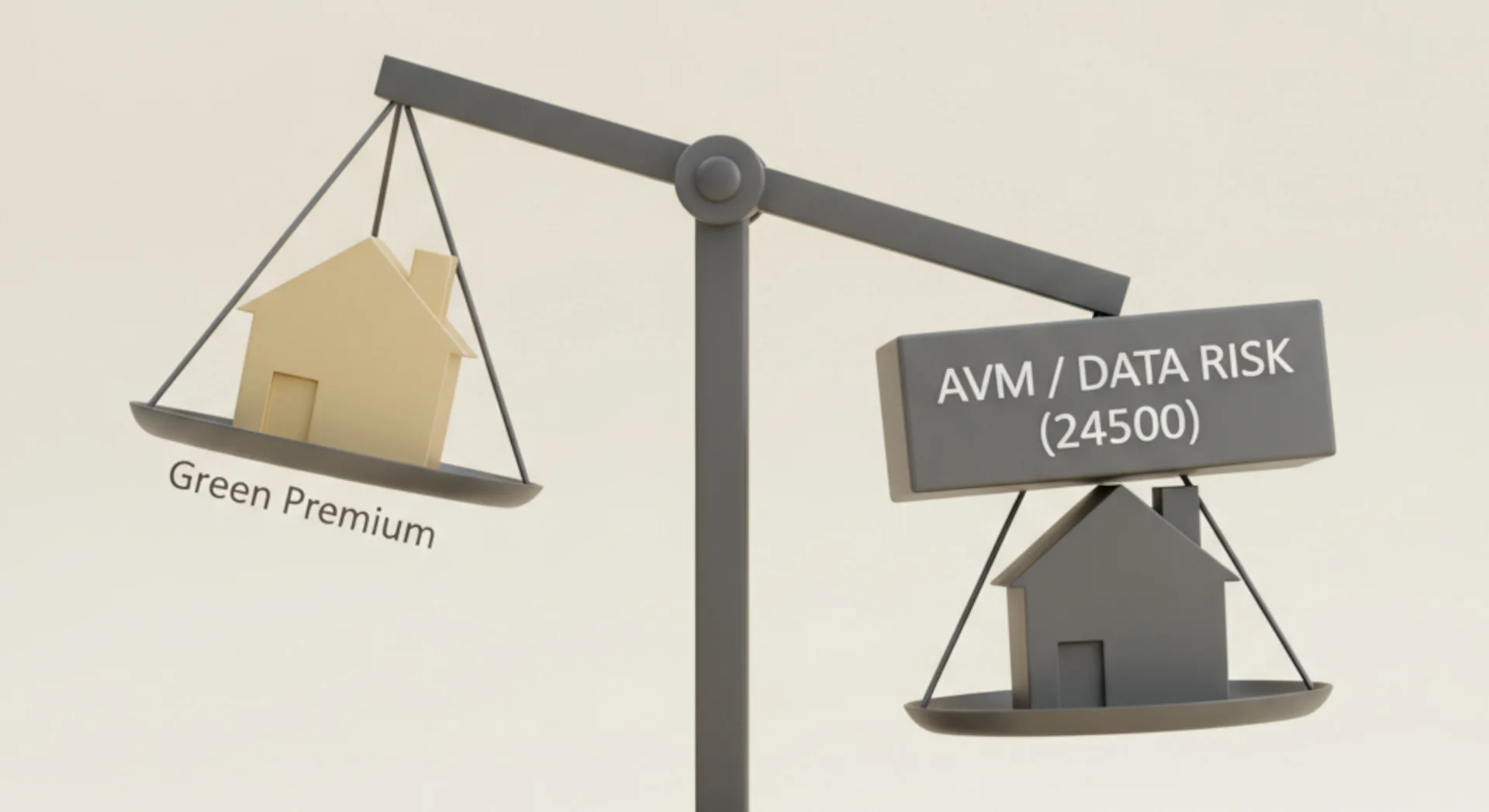
- For Investors & Developers: This confirmed structural divergence will accelerate the migration of capital towards “Green Premium” locations. This will leave behind climate-driven economic ‘sacrifice zones’ where the primary asset class (residential housing) becomes a significant financial liability.
Disclaimer
The analysis and information contained in this analysis are for general informational and strategic purposes only and do not constitute financial, investment, legal, or any other form of professional advice. The Australian Property Network (APN) is a strategic intelligence organisation and is not a licensed financial advisor.
This analysis is based on internal APN intelligence, data, and information believed to be reliable; however, APN provides no warranty as to its accuracy, currency, or completeness. Images used in this analysis are for illustrative and conceptual purposes only and may not represent real persons, properties, or events. Property values and market conditions can go down as in well as up.
Before making any property or investment decisions, you must conduct your own thorough research and seek independent professional advice tailored to your specific circumstances.