

Validated: ‘RiskLock’ Condition Constrains Construction Sector, Rendering a Material Volume of Approved Dwellings Commercially Unfeasible
APN ANALYSIS: A-260114-AUS134309
Executive Summary
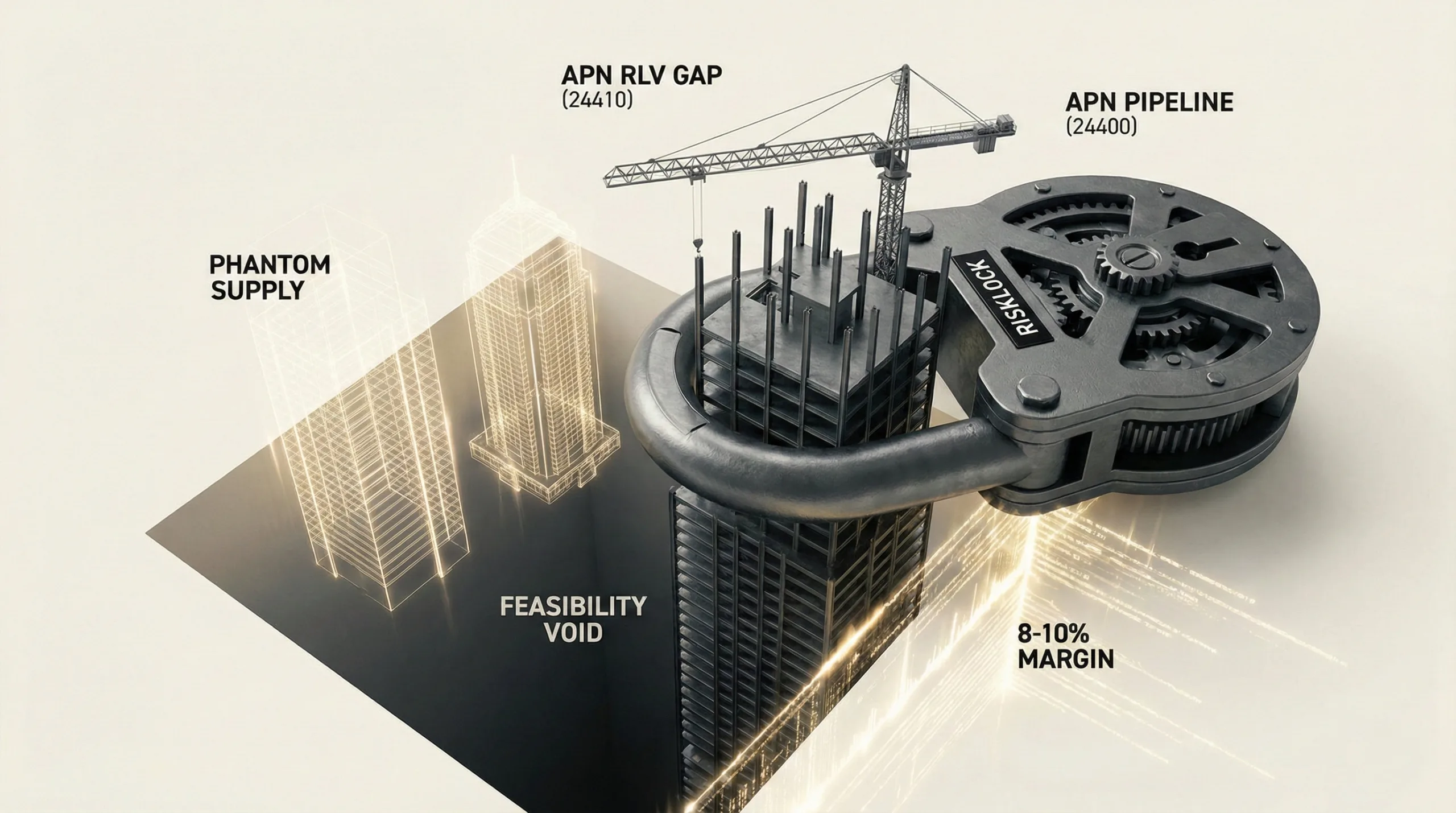
The Australian construction sector is experiencing a period of material structural constraint, a condition APN has classified as “RiskLock.” This is defined by a widening disparity between government housing targets, reflected in high Development Approval volumes, and the commercial reality of a contraction in project commencements. Builders, adversely affected by the “profitless boom” of 2022-2024 and an elevated level of insolvencies, have enacted a “Risk Blockade.” They are now refusing to tender for projects on traditional fixed-price contracts and are demanding net profit margins of 8-10%, a structural shift from the previous 2-4% norm. This has rendered a material portion of the approved development pipeline, termed “Phantom Supply”, commercially unfeasible, rendering tens of thousands of homes in a state of commercial unfeasibility.
For property professionals, this dynamic alters the parameters of traditional feasibility models and invalidates DA volumes as a reliable indicator of future supply. The builder’s margin is no longer a negotiable item but a hard cost floor, and the risk of project incompletion for off-the-plan stock has escalated materially. Success in this new cycle requires a pivot to collaborative contracting models like Early Contractor Involvement (ECI) to de-risk projects from inception and a granular assessment of the true, buildable supply pipeline, distinct from the notional volume of approved “Phantom Supply.”
Background & Strategic Context
This structural constraint in the construction sector validates and calibrates APN’s core macro-thesis, the APN Sovereign Policy Composite Index™ (SPCI, 24800), which posits that state-level intervention is the primary force shaping market boundaries. The resulting “Phantom Supply” phenomenon is a direct, measurable input into the APN Future Development Pipeline Index™ (24400), highlighting the growing disparity between stated government targets and commercial reality.
The Viability Chasm (APN Residual Land Value (RLV) Gap™): The builder “Margin Rebuild” from a 2-4% survival margin to an 8-10% sustainability margin has structurally widened the RLV Gap. This is the primary economic driver of “RiskLock,” pushing total project costs beyond the achievable end value for a significant portion of the approved pipeline, rendering them unbankable and unbuildable.
The Professional Risk Recalibration (APN Professional Sentiment Index™): The “Risk Blockade,” evidenced by a 40-50% functional decline in tender participation, is a quantifiable manifestation of a contraction in risk appetite among builders. This defensive pivot, tracked by the index as a key leading indicator, is the primary driver behind the industry’s widespread rejection of fixed-price contracts.
The Supply-Side Measurement Discrepancy (APN Future Development Pipeline Index™): This analysis confirms the index’s core function: filtering notional supply (“Phantom Supply”) from genuine, commercially viable opportunities. The material divergence between the ABS data for building approvals (volatile/up) and dwelling commencements (down) is the primary empirical indicator that the index is designed to detect and quantify.
State-Level Policy Impact (APN Sovereign Policy Composite Index™ (SPCI, 24800)): The “crowding out” effect, where government-funded “Big Build” infrastructure projects in Brisbane and other capitals absorb finite Tier 1 construction capacity, is a characteristic SPCI intervention. This state action directly inflates costs and reduces labour availability for the private sector, exacerbating the “RiskLock” on residential projects.
Deconstruction of the Source Event
This deconstruction is based on an internal APN intelligence briefing synthesising Q4 2025 and 2026 market data from sources including RLB, KPMG, AS Estimation, and the ABS. The key facts are:
- Builder Margin Expansion: Net profit margins demanded by Tier 1 and stable Tier 2 builders have structurally shifted from a 2-4% “survival” level to a non-negotiable 8-10% “sustainability” target to repair balance sheets and price in risk.
- Tender Coverage Contraction: Bid coverage for major projects has fallen from a historical average of 5-6 compliant bids to just 2-3, representing a functional 40-50% decline in competitive tension, a phenomenon termed the “Risk Blockade.”
- Contractual Model Pivot: The market has substantively pivoted away from Fixed Price Lump Sum (FPLS) contracts, now viewed as structurally adverse by builders. Early Contractor Involvement (ECI) has become the dominant, primary model for de-risking projects and achieving commencement.
- “Phantom Supply” Backlog: An elevated backlog of dwellings (over 37,000 nationally) are approved but have not commenced construction. This “stalled stock” is constrained by a state of commercial unfeasibility by the new cost and risk structure of the market.
- Two-Speed Economy Bifurcation: The construction sector has split. An expanding public and institutional sector (infrastructure, data centres) with collaborative contracts is absorbing resources from a stagnating private residential sector that is materially restricted by feasibility challenges and the “RiskLock.”
Critical Analysis & Balanced View
The builder “Margin Rebuild” should not be characterised as opportunistic pricing; it is a rational and necessary re-capitalisation of an industry of elevated importance that approached a condition of systemic contraction due to the prior “profitless boom.” This represents a permanent, structural repricing of risk, not a cyclical peak that developers can “wait out.” Consequently, the pivot to ECI, while extending pre-construction timelines, is a positive structural adaptation. It enforces financial discipline, aligns stakeholder interests, and ultimately reduces the risk of the structurally significant insolvencies that have affected the sector.
This dynamic creates a structural paradox for policymakers. High approval volumes create a perception of a functioning supply pipeline, potentially leading to a misdiagnosis of the structural housing pressure point as a purely demand-side issue. In reality, the problem is a material supply-side delivery constraint, which is concurrently exacerbated by the government’s own infrastructure spending “crowding out” private housing development. The unaddressed latent factor remains productivity. Even if material costs and margins stabilise, declining labour productivity ensures the total cost to deliver a dwelling will continue to rise, keeping the “RiskLock” in effect for the foreseeable future.
Strategic Implications for Property Professionals
- For Developers: Existing feasibility models are no longer structurally viable. The 8-10% builder’s net margin is the new, non-negotiable cost floor. Project planning and financing require a pivot to Early Contractor Involvement (ECI) models to de-risk delivery and secure a Tier 1 or 2 partner. Projects predicated on securing a traditional Fixed Price Lump Sum contract are now effectively commercially unviable projects.
- For Lenders & Valuers: Development Approval data is now a measure that does not adequately reflect future supply. A “Commencement Probability” discount must be applied to all pipeline analysis, factoring in the builder “Risk Blockade” and the widening RLV Gap. End-project valuations and lending criteria require updating to reflect the new, structurally elevated construction cost base.
- For Agents & Buyers’ Agents: The “Phantom Supply” confirms the projected volume of new apartment stock will not be delivered in the short-to-medium term. This will maintain sustained upward pressure on prices and rents for existing, completed stock. Advise clients that “off-the-plan” purchases now carry a significantly higher completion risk and require elevated due diligence on the developer-builder relationship and contract structure.
- For Construction Contractors & Subcontractors: Commercial leverage is at a cyclical high. This is the cycle to repair balance sheets, not to prioritise revenue growth. Enforce disciplined “Go/No-Go” project selection criteria, refuse to engage on asymmetrically structured fixed-price terms, and explicitly price counterparty risk into all bids to mitigate the risk of developer or head contractor insolvency.
APN Index Management
The APN Codex 24000 Series is a proprietary set of indices that translates complex market forces into measurable metrics. This section outlines how the preceding analysis is validated against, and informs the calibration of, these frameworks.
- Validation: This analysis validates the core thesis of the APN Future Development Pipeline Index™ (24400) by confirming a structural divergence between approvals and commencements. It also validates the APN Professional Sentiment Index™ (24300) by capturing the defensive, risk-averse pivot in builder sentiment and behaviour.
- Index Calibration (APN RLV Gap™): The APN Residual Land Value (RLV) Gap™ (24410) is recalibrated to incorporate the new 8-10% builder net margin as a baseline cost input. This structurally increases the measured viability gap for all private sector projects analysed by the index.
- Index Calibration (APN Sovereign Policy Composite Index™ (SPCI, 24800)): The “crowding out” effect of public infrastructure spending is now weighted more heavily as a negative modulator on private sector commencement velocity within the APN Future Development Pipeline Index™ (24400), particularly in the Brisbane and Perth sub-indices.
- Data Capture (APN Symbiotic Intelligence Network™): This analysis triggers a new data capture mandate via the APN Symbiotic Intelligence Network™ (24310) to specifically track the ratio of ECI-to-FPLS tenders and the average number of compliant bids per major project tender, creating a real-time “Competitive Tension” metric.
Disclaimer
The analysis and information contained in this deconstruction are for general informational and strategic purposes only and do not constitute financial, investment, legal, or any other form of professional advice. The Australian Property Network (APN) is a strategic intelligence organisation and is not a licensed financial advisor.
This analysis is based on data and information from third-party sources believed to be reliable; however, APN provides no warranty as to its accuracy, currency, or completeness. Images used in this analysis are for illustrative and conceptual purposes only and may not represent real persons, properties, or events.
All frameworks (Codex 24100-24800) are proprietary to APN.
Property values and market conditions can go up or down. Before making any property or investment decisions, you must conduct your own thorough research and seek independent professional advice tailored to your specific circumstances.


