
Sustained Infrastructure Friction: The Material Constraint on Private Development from Electricity Grid Connection Delays
APN ANALYSIS: A-260225-AUS137647
Executive Summary
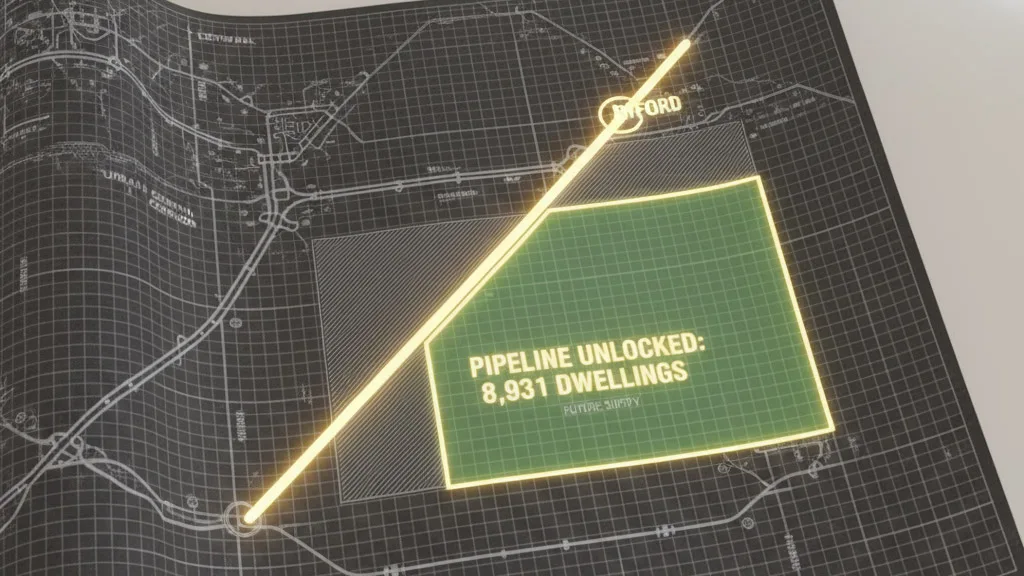
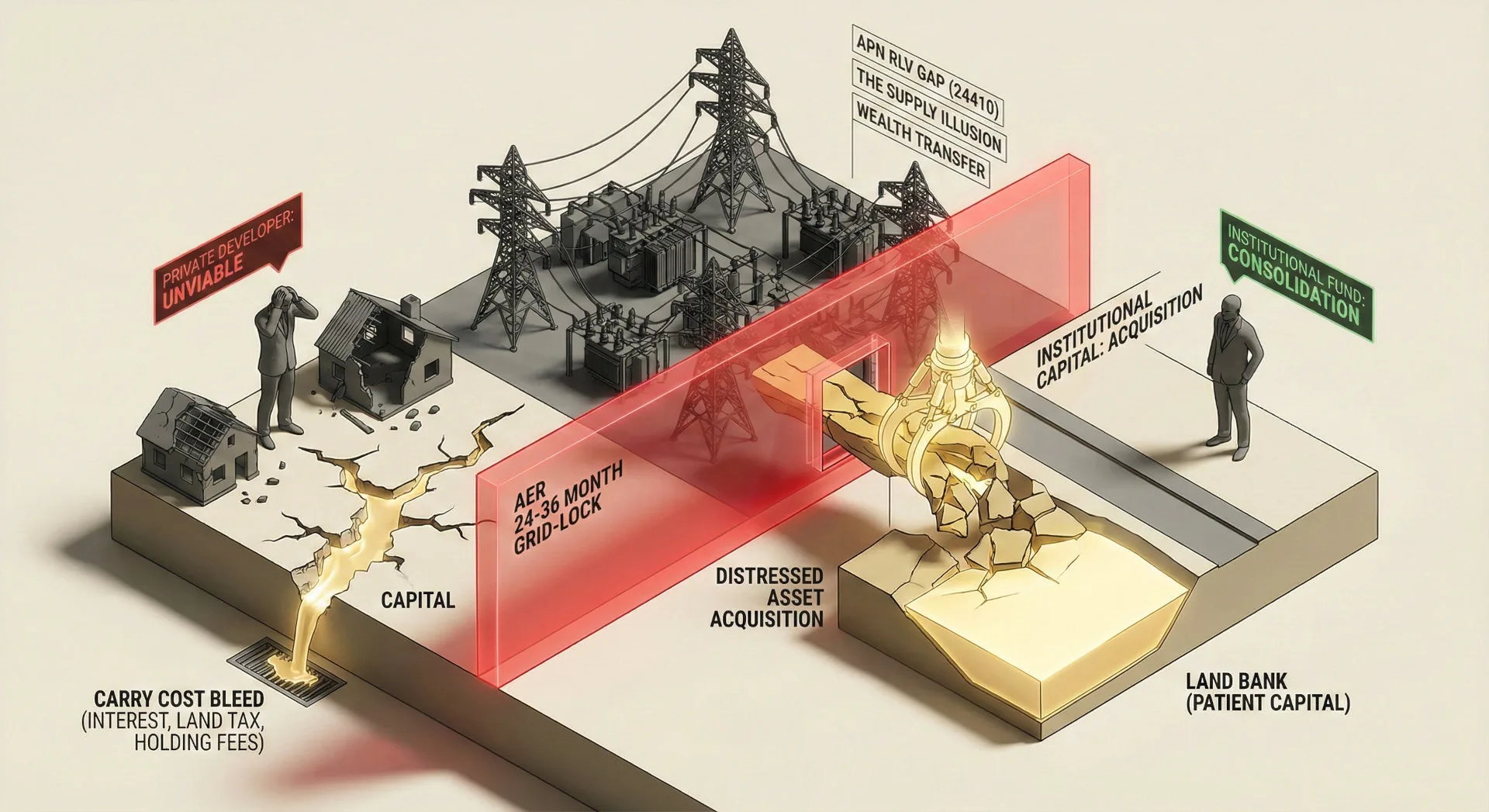
State governments are championing record land releases, colloquially termed “Paper Supply”, creating an inaccurate perception of imminent housing abundance. However, APN analysis reveals a systemic, non-negotiable 24 to 36-month delay in connecting new developments to the national electricity grid. This sustained connection delay, a result of saturated distribution networks and reactionary regulatory frameworks, structurally decouples zoning approvals from dwelling commencements. This enforced delay creates a materially adverse carry cost burden, rendering a significant portion of privately led greenfield projects financially unviable.
For property professionals, this dynamic materially increases the effect of the APN Residual Land Value (RLV) Gap™ (24410), placing moderately capitalised private developers under financial pressure. The sustained connection delay is not a universal negative; it functions as a structural wealth transfer, allowing patient-capital institutional funds to acquire stalled land banks at materially discounted prices. This process systematically consolidates market control, fundamentally reshaping the future housing supply pipeline away from the private sector and towards a concentrated institutional oligopoly.
Background & Strategic Context
This analysis validates and calibrates a core APN macro-thesis, The Supply Illusion, by providing empirical evidence that physical infrastructure constraints, not planning approvals, are the primary determinant of housing supply velocity. The findings are deconstructed through the following APN frameworks:
Decoupling of Intent and Reality (The Supply Illusion): This event provides a case study of the thesis, demonstrating the false equivalence between the bureaucratic act of rezoning land and the physical capacity of the electrical grid to deliver energised dwellings. The analysis quantifies the chasm between policy announcements of supply and the empirical reality of infrastructure delivery.
The Architecture of Constraint (APN Sovereign Policy Composite Index™ (SPCI, 24800)): The dynamic is a direct consequence of conflicting SPCI inputs. Tier 1 “Architects” (state planning bodies) generate the “Paper Supply” narrative through accelerated rezonings, while another SPCI-related actor, the Australian Energy Regulator (AER), enforces a reactionary investment framework (the RIT-D) that prevents Distribution Network Service Providers (DNSPs) from proactively building capacity, thereby creating the sustained connection delay.
The Institutional Pivot: The enforced two-year carry-cost period produces a structural capital transfer. It systematically reduces the capital base of private developers—obliging the sale of assets at discounted prices—and reallocates that land value to institutional investors who possess the patient capital required to absorb the delay and capture the eventual development margin.
The Friction Filter (APN Future Development Pipeline Index™): This analysis demonstrates the elevated function of the index and its core component, the 24410 APN RLV Gap™. It proves that without applying the friction filter of grid connection lead times, any assessment of the future development pipeline is materially inaccurate, mistaking economically sterile “Paper Rezonings” for genuine, market-ready opportunities.
Deconstruction of the Source Event
This deconstruction is based on APN’s analysis of the AEMO 2026 ISP Update, NSW Urban Development Program data, and DNSP Annual Planning Reports. The key facts are:
- Systemic Grid Delay Confirmed: The Australian Energy Market Operator’s (AEMO) own modelling for its 2026 Integrated System Plan confirms that under constrained conditions, “actionable” projects will experience an average delay of 2 years (24 months). This is driven by the recorded scale of required network augmentation and competition for capacity from new, high-demand loads like data centres.
- Widespread Structural Condition of Unserviced “Paper Supply”: Data from the NSW Urban Development Program reveals that between 70% and 81% of recently rezoned land in elevated-growth corridors like Wollongong and the Central Coast is structurally unserviced, primarily lacking the required electrical substation capacity to allow development to commence.
- Regulatory Friction Creates a Structural Impasse: The Australian Energy Regulator’s (AER) framework (the RIT-D) prevents DNSPs from proactively investing in network upgrades for speculative rezonings. The DNSP must wait for committed development applications to justify the capital expenditure, while developers cannot secure finance without a guaranteed power connection, creating a mandatory 24-36 month delay.
- Financial Viability Rendered Unviable by Carry Costs: The enforced 24-month delay imposes a multi-million dollar “Carry Cost Delta” on a standard 100-lot subdivision, comprising compounding debt interest, elevated land taxes, and holding fees. This capital erosion erodes the project’s Residual Land Value (RLV), rendering it unfeasible for a moderately capitalised developer.
- Bypass Solutions are Unviable: Attempting to bypass the DNSP bottleneck with private embedded networks or micro-grids is not a scalable solution for standard greenfield development. These options are subject to elevated regulatory complexity, technical friction, and are considered “boutique” exceptions, not a systemic workaround.
Critical Analysis & Balanced View
The core paradox of the Supply Illusion is that the very policy designed to increase housing supply, fast-tracked land rezoning, is the mechanism that ultimately constricts it and triggers market consolidation. The actions of the “Architects” (planning bodies) and the “Extractors” (institutional funds) are not necessarily the result of overt collusion, but are symbiotically aligned by a structurally deficient and fragmented regulatory structure. The structural failure is not one of malice, but a material lack of chronological integration between political planning and physical infrastructure reality.
The public narrative championing “Paper Supply” serves as a political tool to manage public perception of the housing structural pressure point, but it actively creates adverse conditions for the private development sector tasked with delivery. The risk is that this dynamic becomes a permanent feature of the market, creating a structural oligopoly that will control the price and pace of all future greenfield housing supply. The problem is not a lack of zoned land; it is an elevated deficit of energised, developable land, a distinction the current policy framework does not account for.
Strategic Implications for Property Professionals
- For Developers: Immediately factor a non-negotiable 24-36 month grid connection timeline into all greenfield feasibility studies. The Residual Land Value must be calculated based on this extended carry-cost period, not on optimistic council timelines. Any site without a confirmed, scheduled DNSP upgrade in the public planning reports is a high-risk liability, not an opportunity.
- For Strategic Land Acquirers & Investors: Focus on unserviced, rezoned land held by financially constrained private developers. The sustained connection delay creates a predictable acquisition window for patient capital. The key is to verify the DNSP’s medium-term augmentation plan for the specific sub-transmission line or zone substation to accurately time the acquisition and minimise holding costs.
- For Agents & Buyers’ Agents: Advise clients to apply elevated scrutiny to ‘off-the-plan’ greenfield purchases. Investigate the specific electrical servicing status of the entire estate, not just the individual lot. Extended sunset clauses are now a material indicator for systemic infrastructure delays, not merely isolated builder issues.
- For Commercial Financiers: Recalibrate lending criteria for greenfield development finance. Loan-to-value covenants and feasibility assessments must be stress-tested against a baseline two-year, pre-construction holding period. Developer pro formas that do not explicitly account for the “Carry Cost Delta” from grid delays represent an elevated and unpriced default risk.
APN Index Management
The APN Codex 24000 Series is a proprietary set of indices that translates complex market forces into measurable metrics. This section outlines how the preceding analysis is validated against, and informs the calibration of, these frameworks.
- Validation: This analysis provides validation for The Supply Illusion macro-thesis. It empirically proves the direct causal link between DNSP infrastructure bottlenecks and the material expansion of the 24410 APN Residual Land Value (RLV) Gap™.
- Index Calibration: The 24410 APN RLV Gap™ is calibrated to explicitly model a baseline 24-month ‘sustained connection delay’ carry-cost penalty on all greenfield development feasibilities that lack a contractually committed DNSP energisation date. The model now weights unserviced land as having a higher probability of developer default and financially constrained sale.
- Data Capture: This triggers a new data capture mandate to systematically track and map DNSP Distribution Annual Planning Reports (DAPRs) against state and council Urban Development Programs (UDPs). The objective is to create a forward-looking ‘Servicing Certainty’ overlay for the 24400 APN Future Development Pipeline Index™, allowing for more accurate filtering of viable projects.
Disclaimer
The analysis and information contained in this deconstruction are for general informational and strategic purposes only and do not constitute financial, investment, legal, or any other form of professional advice. The Australian Property Network (APN) is a strategic intelligence organisation and is not a licensed financial advisor.
This analysis is based on data and information from third-party sources believed to be reliable; however, APN provides no warranty as to its accuracy, currency, or completeness. Images used in this analysis are for illustrative and conceptual purposes only and may not represent real persons, properties, or events.
All frameworks (Codex 24100-24800) are proprietary to APN.
Property values and market conditions can go up or down. Before making any property or investment decisions, you must conduct your own thorough research and seek independent professional advice tailored to your specific circumstances.