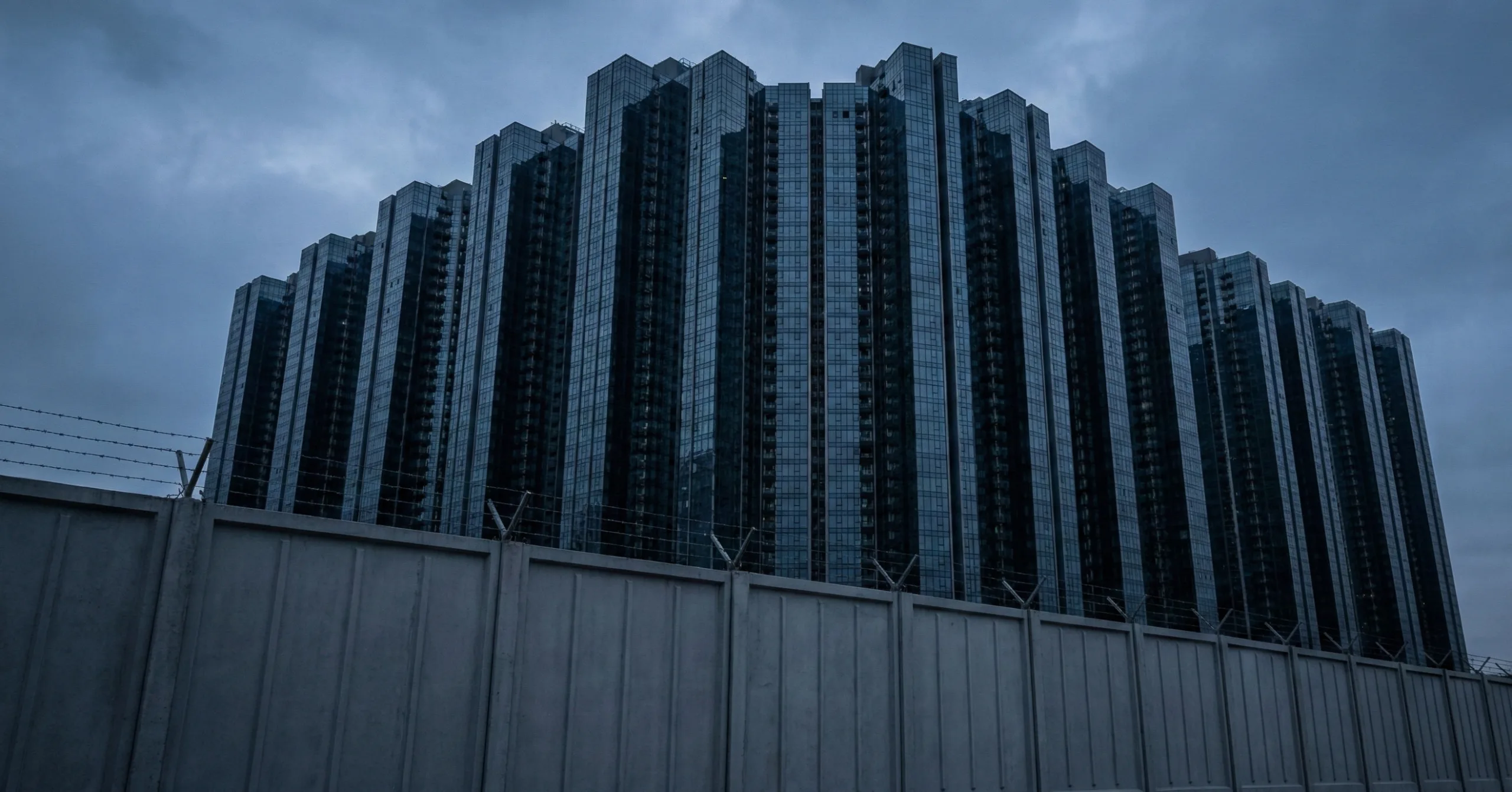

The Asset Wall: A Structural Analysis of Market Dysfunction
In The Shadow City, we introduced the 375,000 Australians currently reliant on informal support networks for housing. We indicated we would explain why they cannot simply “move on”.
The answer lies in a phenomenon we call The Asset Wall.
This is not merely a “tight rental market”. It is the sustained phase of a forty-year experiment in outsourcing housing to private speculation. The result is a material market dysfunction where the cost of shelter has fundamentally decoupled from the value of labour.
The Asset Wall is the point where the market stops functioning as a utility and starts functioning as a structurally exclusionary mechanism.
The 131% Signal: An Indicator of Structural Exclusion
To understand the scale of this dysfunction, we must look at the “Negative Residual”.
For decades, the market operated on a volatile but functional premise: wages and rents tracked loosely together. In 2025, that link has materially diverged.
Our audit reveals that for a single person on JobSeeker or a casualised wage, the median rent for a one-bedroom apartment in a capital city now represents 131% of their total income.
This is the “131% Signal”. It is a mathematical indicator of structural exclusion. The market is effectively offering a product that its customer base cannot legally purchase. This is not “rental stress”; it is structural insolvency.
The Investor Exodus: A Contraction in Rental Supply
Defenders of the status quo argue that the solution is simply “more supply”. But this ignores a structurally adverse new dynamic: the market is experiencing a net reduction in its rental inventory.
Throughout 2025, we witnessed a material Investor Exodus. Driven by interest rate increases and tax policy adjustments, 16.7% of investors sold out.
58% of these properties were purchased by owner-occupiers.
While home ownership is a valid goal, in this ecosystem, it is a zero-sum game. Every time an investor sells to an owner-occupier, a rental property is removed from the rental stock. This removed 213,000 rentals from the market in 12 months.
The market is contracting exactly when the Shadow City is expanding.
The “Class Ceiling”: Supply Constraints at the Entry Level
A material market dysfunction occurs when a system produces high-end assets amidst a structural deficit of entry-level housing.
The “asset accumulation trajectory”, the idea that you start in an entry-level dwelling and work your way up, has been replaced by a “Class Ceiling”. Developers and investors, exhibiting yield-maximising behaviour in a high-cost construction environment, have structurally displaced the bottom end of the market entirely.
- New Builds: Predominantly “luxury” or “boutique” apartments to offset construction costs.
- Old Stock: Boarding houses and low-cost legacy dwellings are being demolished or renovated into premium assets.
The “affordable” rental does not exist because it is not profitable to build. The market has no mechanism to service low-income cohorts, and as a result, supply at this level is structurally constrained.
The Risk Algorithm: Algorithmic Risk Assessment
Finally, the Asset Wall is reinforced by automated risk-assessment systems.
Real estate agents and insurers now rely on automated “Risk Algorithms” to screen tenants. These systems flag anyone with a rent-to-income ratio above 30% or a gap in their rental ledger (common for those who have been residing in informal arrangements).
This automation removes human discretion. It automatically rejects the “working homeless”—the nurse living in her car—because she is a statistical anomaly. The system is structured to prioritise asset-risk mitigation over housing provision.
The Conclusion
The Asset Wall is a structural outcome; it is the structural culmination of a system that treats housing as a financial instrument first and a home second.
A market has been structured that is optimised for the asset holder and has produced structurally significant adverse outcomes for the non-asset-holding citizen.
In The Sentinel State, we examine the consequences of this dysfunction. When the market constrains access, the state does not intervene with support mechanisms. It intervenes with compliance and enforcement measures.
Disclaimer
The analysis, information, and opinions contained in this article are for general informational and strategic purposes only and do not constitute financial, investment, legal, or any other form of professional advice. The Australian Property Network (APN) is a strategic intelligence organisation and is not a licensed financial advisor.
The views, thoughts, and opinions expressed in this text belong solely to the author and do not necessarily reflect the official policy or position of the Australian Property Network (APN).
This content may be based on data from third-party sources believed to be reliable; however, APN provides no warranty as to its accuracy, currency, or completeness. Images used are for illustrative and conceptual purposes only and may not represent real persons, properties, or events.
Property values and market conditions can go down as well as up. Before making any property or investment decisions, you must conduct your own thorough research and seek independent professional advice tailored to your specific circumstances.